
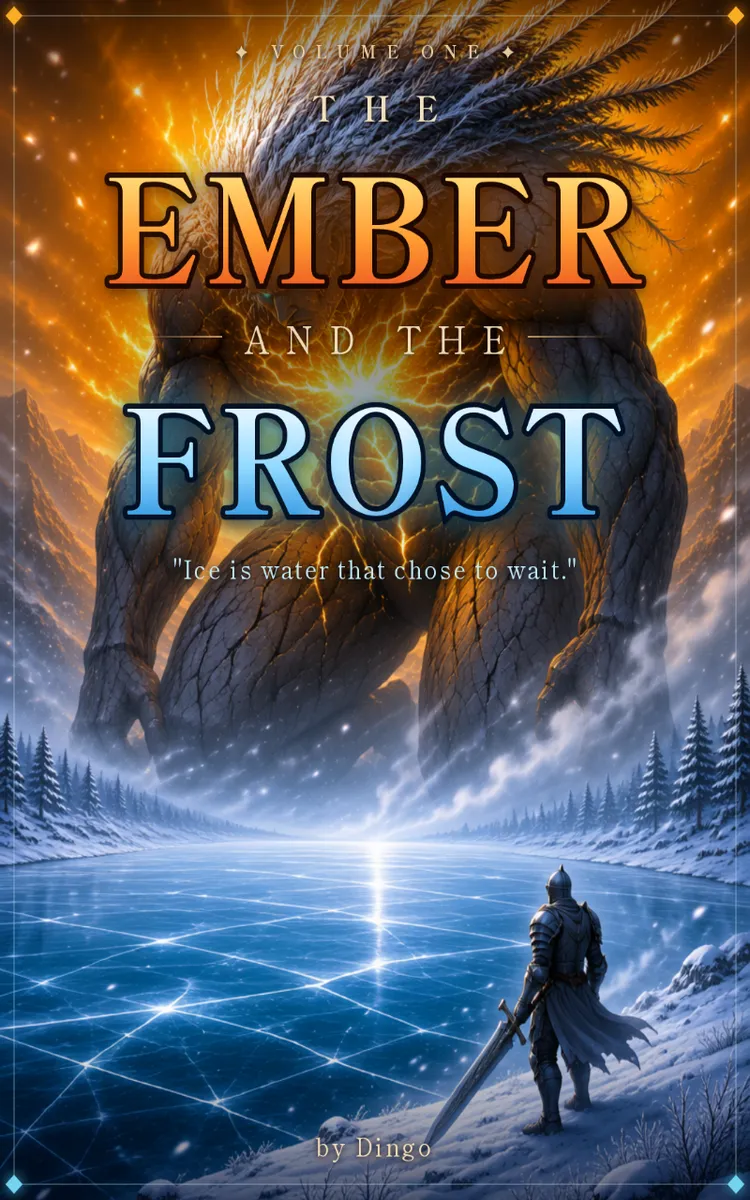
Read the first chapter
The whole of chapter one, free. About 8 min. Turn the pages with the arrows, your keyboard, or a swipe.
Chapter 1
The Spring Beneath the Snow
The town’s gate had been built from doors.
Edran noticed that first: twelve doors laid flat across a timber frame, their hinges still visible beneath a crust of blue ice. A child’s painted sun showed through the frost on one panel. Someone had tried to scrape it away and stopped halfway.
Beyond the gate, the lower quarter crouched in the valley like a heap of wet ashes. Roofs sagged under snow. Smoke crawled from crooked chimneys and vanished against the white. A bell hung above the arch, but its clapper had frozen solid.
Edran stepped toward it.
“Stop there.”
Three figures came out from behind the gatehouse. They wore gray wool, iron badges, and the hard faces of people who had learned to make rules do their cruelty for them. The tallest held a hooked staff across the road.
Edran’s boots sank through the crust. He had walked since dawn with ice in his socks and one cracked buckle at his shoulder. His cloak bore no crest. The silver plates that had made him a knight were gone, taken with his rank and his name.
“I need a roof,” he said. “One night. Then a route through the valley.”
The tall warden looked him over. “No room.”
“There are houses.”
“There are families.”
“I can sleep in a shed.”
“Not in this quarter.”
Edran glanced past him. The road split between leaning walls, one lane climbing toward the upper town, the other dropping toward a district fenced in black stakes. Steam curled faintly beyond that fence, too warm to belong to winter.
“Then point me to an inn.”
The warden gave a short laugh. “You came through the west road. You saw the sign.”
Edran had seen it: NO TRANSIENTS AFTER DARK, painted in red across a plank. Beneath it, someone had added, in smaller letters, THE WINTER IS LONG BECAUSE WE KEEP IT.
He had thought it was a warning. Now he understood it was policy.
“I saw the sign,” Edran said. “I’m asking for a door.”
“You’re asking for what the town has stopped giving.”
The other wardens shifted closer. Their boots scraped ice. Edran’s hand lowered by habit toward the sword at his hip, then stopped. The sword was gone too. Only the empty scabbard remained, a black line at his side.
A woman carrying a basket hurried behind the wardens. She kept her eyes down.
“Please,” Edran called. “I’ll pay.”
The woman did not turn.
The tall warden tapped his staff against the frozen road. “Outsiders don’t enter the spring district. The water is measured. The gate is sealed. You go around.”
“Go around where?”
“Back the way you came.”
Wind pressed snow through the gaps in the doors. It struck Edran’s face like thrown sand. Behind him, the western road disappeared into white bends and black pines. Ahead lay a town that had already decided he was less than a man.
He drew the purse from his belt and held it out. Three coins clinked inside.
The warden did not look at them. “Keep your bribes.”
“They aren’t bribes. They’re payment.”
“For what? The privilege of freezing somewhere else?”
Edran closed his fist around the purse. His knuckles ached. He had been called traitor in three villages, butcher in two, and once, by a boy no older than twelve, a knight-shaped lie. He had endured all of it because each road promised another road beyond it.
But the valley had closed behind him. The mountain pass was buried. The sky had darkened before noon.
He needed shelter before night.
“Let me through,” he said.
The warden’s face hardened. “No.”
The word struck deeper than it should have. Edran had heard it from lords, captains, priests, and the woman who had once shared his hearth. No had become the only gate left open to him.
He stepped forward anyway.
The hook of the staff caught his cloak and yanked him back. The cloth tore. Edran twisted, seized the shaft, and pulled. The warden stumbled into the gatepost.
For one breath, no one moved.
Then the bell above them cracked.
The sound was not loud. It was a thin, painful note, as if the frozen metal had found a voice and regretted using it.
The wardens stared upward.
Edran felt heat under his ribs.
It came and went so quickly he thought it might be dizziness. Then the ice beneath his boot split with a sharp report. A thread of gold light ran through the crack, vanished, and left the snow smoking.
The tall warden looked down.
“What did you do?”
“Nothing.”
The light returned beneath Edran’s foot. It pulsed once, not like fire, but like something waking in a locked room.
The nearest warden raised his staff. “Mark him.”
The third man pulled a red cord from his coat. At its end hung a small iron seal, stamped with the town’s winter mark. He pressed it against the gatepost.
“By order of the ration wardens,” he called, loud enough for the street to hear, “the outsider is barred, detained, and named dangerous to the spring district.”
Doors closed along the road.
Edran released the staff and backed away. The torn edge of his cloak flapped in the wind. His ribs still burned.
He could fight three wardens. He had fought more. But fighting would make their words true. Dangerous. Intruder. Another body for the town to reject.
The gatehouse wall shuddered.
A deep groan moved beneath the street.
The wardens turned as one. Somewhere below them, ice broke with the sound of a tree splitting. A seam opened across the road, running from the gate toward the fenced district.
Steam rose through it.
Not mist. Steam.
It poured between the stones in white ropes, warm enough to soften the snow. The nearest warden cried out and jumped back as his boot sank through the crust.
“Seal the lower quarter!” the tall man shouted.
“Already sealed!”
“Then seal it again!”
They ran toward the fence. Their iron badges flashed dull gray as they pushed through the gathering vapor.
Edran stood alone beneath the door-gate.
The warmth reached his boots. It soaked through the leather and touched his frozen feet. For the first time since entering the valley, his body remembered what comfort felt like.
Then someone screamed beyond the fence.
Edran moved.
The spring district was barred by a chain, but the chain had been wrapped around the gate so many times that the lock sat beneath a mound of ice. He drew the empty scabbard from his belt and drove its metal tip into the lock.
Once.
Twice.
On the third strike, the iron broke.
The gate swung inward.
Steam rolled over him. The snow beneath his feet melted in widening circles. He smelled wet stone, mineral water, and something faintly sweet, like scorched pine.
“Get out!” a warden shouted from within. “You’ll bring the whole gate down!”
Edran saw what they had missed. The district’s black stakes were not a fence. They were supports. Beneath the snow, each one had been driven into the roof of an old stone passage. The ice had sealed the passage for years, but the heat was rising now, lifting the frozen weight inch by inch.
A child crouched beside the nearest stake, trapped by a fallen beam.
Edran crossed the steaming ground.
“Stay still,” he said.
The child’s eyes were wide. “They said no one can go in.”
“They say many things.”
He braced both hands beneath the beam. It was soaked through and heavy as a coffin. His shoulders screamed. His boots slid in the slush.
The heat under his ribs flared.
For an instant, the beam seemed to show him its weakness: a pale line running through the wood, a place where the grain had parted but not yet surrendered. Edran shifted his grip and drove his knee against that line.
The beam snapped.
He dragged the pieces aside and pulled the child free. The boy clung to his coat, shaking.
“Your mother?”
The boy pointed through the steam.
A woman stood at the far end of the district, one hand pressed to the stone arch beneath the gate. Her gray hair streamed around her face, though there was no wind. Behind her, the road ended at a wall of ice.
No. Not a wall.
A door.
It rose from the earth in a curve of black rock, its surface veined with orange light. Snow melted around it. Water ran in bright threads down the stone and disappeared beneath the road.
The woman lifted her head.
She was not old, though something in her stillness made Edran think of mountains. Her skin held the warm brown color of sunlit earth. Her eyes were ember-dark. A simple dress clung to her legs, untouched by snow or steam.
The child tore away from Edran and ran to her.
“Sorbette,” the boy cried.
The woman caught him against her side. She looked over his head at Edran.
The wardens reached the arch.
The tall one pointed his staff. “You. On your knees.”
Edran did not move.
Sorbette’s gaze dropped to the melted rings around his boots. Her expression changed by the smallest measure.
“You woke the gate,” she said.
Her voice was quiet, but it carried through the steam.
“I was looking for shelter.”
“No one looks for shelter here.”
“Then I was looking for a way through.”
“Nothing passes through.”
The warden seized Edran’s arm. His fingers were cold through the torn cloak.
“Enough,” the man said. “You are under arrest.”
Edran looked at Sorbette. The orange veins in the stone behind her brightened, one after another, as if answering something beneath his skin.
“I didn’t break your gate,” he said.
Sorbette’s eyes remained on him. “No. You reminded it how to open.”
The warden pulled his arm behind him and fastened iron around his wrist. The other wardens closed in, their boots sinking into the softened snow.
Edran could have resisted. Heat moved through his blood now, strange and sharp, asking for release. He saw the weak points in the lock. He saw the loose stones beneath the wardens’ feet. He saw, for one impossible instant, a thin gold line inside the tall warden’s chest - not damage, but something buried beneath it.
Then the spring gate opened.
The sound rolled through the valley like a breath drawn after three centuries of silence.
Warm water burst from beneath the black stone and spread across the frozen district. Ice cracked. The wardens stumbled. The child laughed as steam curled around his knees.
Sorbette stepped through the arch.
She came no closer than the edge of the water, yet every flame-colored vein in the stone bent toward her.
“Take him,” she told the wardens. “If you can.”
The iron on Edran’s wrist tightened.
Behind him, the town’s doors began to open.
Ahead, the spring poured into the snow.
End of chapter one. 7 more chapters and about 15,781 words in the full book.
Swipe or use the arrows to turn the page


What's inside: 8 chapters
- 1. The Spring Beneath the Snow
- 2. Yu
- 3. The Temple Heart Walks
- 4. The Breath Across the Lakebed
- 5. The Tear Finally Falls
- 6. The Idol Guards No One
- 7. Rain Beneath the Clear Ice
- 8. Six Around the Dawn Fire
About this book
"The Ember And The Frost" is a fiction book by The Dingo with 8 chapters and approximately 15,781 words. An exiled knight awakens hidden potential and reunites six women born from a fallen god.
This book was created using Inkfluence AI, an AI-powered book generation platform that helps authors write, design, and publish complete books. It was made with the AI Novel Writer.
Frequently Asked Questions
What is "The Ember And The Frost" about?
An exiled knight awakens hidden potential and reunites six women born from a fallen god
How many chapters are in "The Ember And The Frost"?
The book contains 8 chapters and approximately 15,781 words. Topics covered include The Spring Beneath the Snow, Yu, The Temple Heart Walks, The Breath Across the Lakebed, and more.
Who wrote "The Ember And The Frost"?
This book was written by The Dingo and created using Inkfluence AI, an AI book generation platform that helps authors write, design, and publish books.
How can I create a similar fiction book?
You can create your own fiction book using Inkfluence AI. Describe your idea, choose your style, and the AI writes the full book for you. It's free to start.
Write your own fiction book with AI
Describe your idea and Inkfluence writes the whole thing. Free to start.
Start writingCreated with Inkfluence AI


