
Read the first chapter
The whole of chapter one, free. About 6 min. Turn the pages with the arrows, your keyboard, or a swipe.
Chapter 1
Reclaiming Your Creator Identity
Picture This: When “I didn’t ship” feels like “I am nothing” Last Thursday, you stare at your unfinished project file like it’s going to confess what’s wrong. The cursor blinks. The task list sits there, smug. You can’t tell if you’re stuck because the work is hard… or because you’re tired in a way sleep won’t fix.
And then it happens: you start translating output into identity. “I didn’t ship” becomes “I can’t be trusted.” “I missed my deadline” turns into “I’m unreliable.” Even your morning brain sounds like an HR meeting - only the HR person is you, and the verdict is always the same: you’re falling behind, so you’re failing as a person.
If output decides your worth, what happens when burnout steals your output?
The Mindset Shift: The Identity-to-Output Reframe (Before vs After) Old Belief: Your worth is proven by what you produce - clients, posts, invoices, completed pieces, sold work. New Reality: Your worth is the constant; your output is the variable. Burnout changes output, not your value.
This sounds simple, but it’s not “just think positive” simple. When you’re burned out, your nervous system isn’t asking for a pep talk - it’s asking for safety. If you keep tying your safety to performance (“I’m okay only if I deliver”), you’re basically telling your body, stay stressed until further notice. No wonder you feel shaky, foggy, or oddly ashamed.
Take Talia, 34, a freelance illustrator. She’d been taking on new gigs while running on fumes, and the moment she hit a wall, she spiraled fast. She didn’t just miss a client’s revision window - she started believing she’d “lost her talent.” She’d open her tablet, see a blank canvas, and feel this immediate dread like she was walking into a test she’d already failed.
The reframe didn’t magically erase deadlines. What changed was the story she told while her system recovered. Instead of “I’m failing,” she practiced: “My output is paused. My value isn’t.” That tiny shift let her do one honest, low-pressure action - sketching rough shapes for ten minutes - without turning the result into a verdict on her identity. The work didn’t appear overnight, but her confidence stopped bleeding out every time she didn’t produce on schedule.
Because here’s the real trap: when output equals worth, every delay feels personal. And when you feel personal shame, you avoid, freeze, or overwork to “earn” relief. The Identity-to-Output Reframe breaks that loop.
Going Deeper: Why this reframe actually helps your brain function Your mind loves patterns. It takes repeated experiences - deadlines, approval, sales, compliments - and turns them into a rule: “If I perform, I’m safe. If I don’t, I’m in danger.” During burnout, that rule gets louder, because performance becomes harder. So your brain tries to solve the threat by pushing harder… which usually makes burnout worse. (Classic.)
Separating worth from output gives your brain a new pattern to cling to. It doesn’t mean you ignore responsibility. It means you stop using performance as a measure of whether you deserve care, respect, and time. That’s why confidence rebuilds here: not by forcing productivity, but by restoring self-trust.
When you can say, “I’m still me even when I’m producing less,” your system doesn’t have to interpret every unfinished task as humiliation. You can start making smaller choices again - choices that create momentum without demanding you be “fully recovered” first.
Signs this pattern is running your life 1. You feel guilt or panic when your work slows down - even if you’re actively dealing with rest, health, or life stuff. 2. You measure your day by “did I create?” instead of “did I show up with integrity?” 3. You abandon projects the moment they become inconvenient, because difficulty feels like proof you’re not good. 4. You chase intensity (extra hours, extra effort, extra clients) to outrun the shame - then crash anyway.
One-sentence summary: Your value doesn’t rise and fall with output; your output responds to your capacity.
Reflection & Self-Assessment: Where your worth is secretly hooked to performance Let’s get specific. You’re not trying to “be kinder” in some vague way - you’re hunting the exact places your identity gets welded to your results.
Answer these questions honestly. No courtroom speeches. Just clarity.
1. When was the last time you judged your value based on something you produced (or didn’t)? Notice the exact sentence you said in your head. For Talia, it was something like, “If I can’t deliver, I’m not a real illustrator.”
2. What do you fear would happen if you let your output drop without attaching it to shame? You might fear losing income, respect, or opportunities. Naming it turns it from an invisible monster into a manageable concern.
3. What part of your identity feels “at risk” when you’re not producing? Is it your competence? Your professionalism? Your creativity? Your reliability? Pick one, even if it’s messy.
4. How do you usually respond when output drops - avoid, overwork, explain, or numb? For some creators it’s avoidance (can’t open the file). For others it’s overexplaining (sending too many updates). Your pattern will show you where the reframe needs to land.
5. If your worth stayed steady, what would you do differently in the next 24 hours? Look for something practical, not heroic. “I’ll work for 20 minutes without chasing perfection” is a real answer.
As you answer, you’re building a map of how your nervous system has been trained. That matters because the Identity-to-Output Reframe only sticks when it fits your actual triggers - not when it lives in the “should” zone.
Growth Challenge: The 7-Day Worth-Without-Output Practice This is small on purpose. You’re retraining your brain to separate identity from performance, one day at a time. You don’t need a perfect schedule - just consistency.
Worth-Without-Output Reset (7 days) - Day 1: Write one sentence that ties worth to output (your real one, not your “best self” one). Then rewrite it in two parts: “My worth is _. My output is _.” - Days 2-6: Each day, do one “identity action” that doesn’t require shipping anything. Examples: tidy your workspace for 10 minutes, organize brushes/pens, draft a rough thumbnail set, or reply to one client email with a clear next step - even if the full deliverable isn’t happening yet. - Each day, track the truth: After the action, write a single line: “I did ___, and I’m still me.” - Day 7: Review your notes. Circle one moment you felt shame rise - and write the reframe you used (or wish you had used).
Expected difficulty rating: Medium (because your brain will try to “grade” the effort)
You’ll know it’s working when… - You can complete a small action without immediately turning it into a verdict on your talent. - Your inner voice shifts from “I failed” to “I’m in a capacity season.” - Even on low-output days, you feel a little more self-trust - like you didn’t abandon yourself.
Key Takeaway: Confidence comes back when you stop treating output like proof of your humanity Here’s the core truth: burnout doesn’t just slow your hands - it rewrites your self-talk. If that self-talk keeps worshipping output, you’ll keep paying for relief with stress. But when you separate your worth from your output, you stop making rest feel like punishment.
You might still have deadlines. You might still need to earn money. And you can absolutely keep promises. The difference is that you’re no longer using production as a weapon against yourself. You’re using it as a tool - one that shows what you can do when capacity allows.
And once that shift lands, confidence becomes something sturdier than “I produced today.” It becomes: “I can handle reality - and still respect myself while I rebuild.”
• You learned that your worth is constant, while output is capacity-based. - You identified the shame patterns that show up when work slows down. - You practiced an “identity action” approach so your nervous system learns safety without shipping pressure. - You gave yourself a way to return to momentum without waiting to feel perfect.
Next, we’ll use this steadier identity to handle the messy middle - when your motivation is low, your standards feel loud, and you need a plan that doesn’t require you to be “back to normal” before you can move. Your value isn’t on trial every time you produce less.
End of chapter one. 4 more chapters in the full book.
Swipe or use the arrows to turn the page


What's inside: 5 chapters
- 1. Reclaiming Your Creator Identity
- 2. Breaking the Perfectionism Trap
- 3. Building Boundaries Without Guilt
- 4. Designing a Burnout-Proof Weekly Rhythm
- 5. Resilience Through Purpose-Driven Recovery
About this book
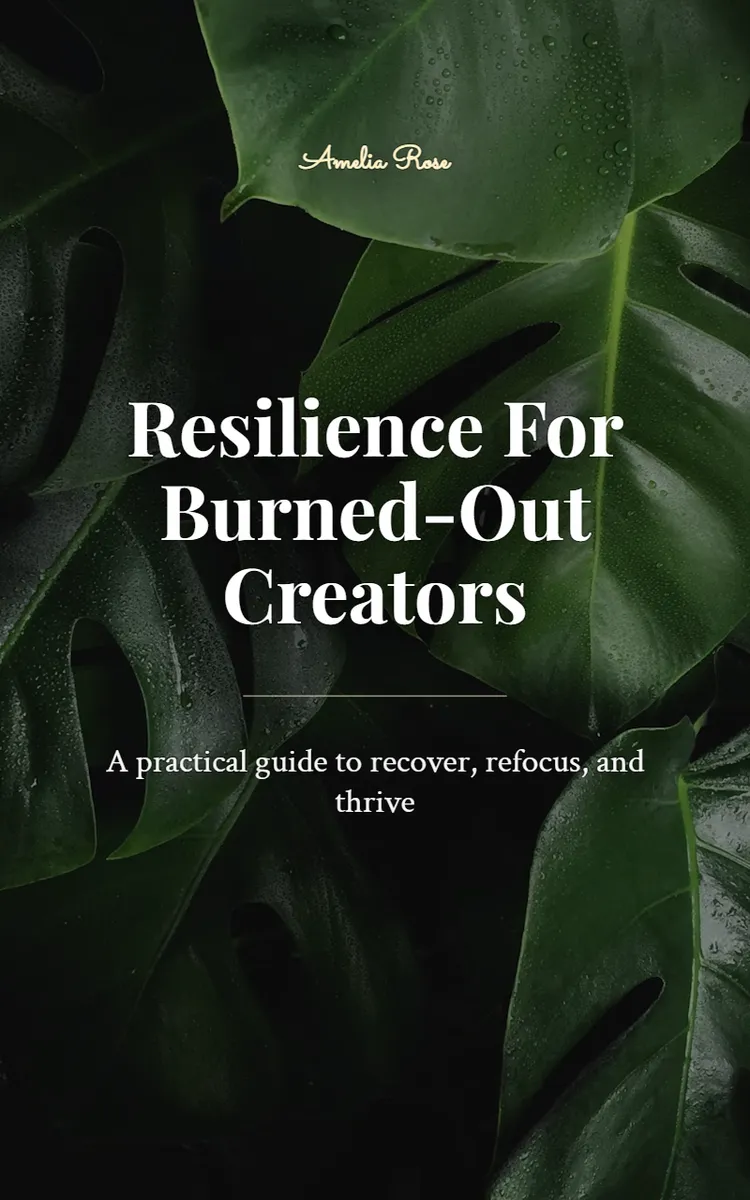
"Resilience For Burned-Out Creators" is a self-help book by Amelia Rose with 5 chapters and approximately 8,314 words. Resilience strategies for creators experiencing burnout.
This book was created using Inkfluence AI, an AI-powered book generation platform that helps authors write, design, and publish complete books. It was made with the AI Self-Help Book Writer.
Frequently Asked Questions
What is "Resilience For Burned-Out Creators" about?
Resilience strategies for creators experiencing burnout
How many chapters are in "Resilience For Burned-Out Creators"?
The book contains 5 chapters and approximately 8,314 words. Topics covered include Reclaiming Your Creator Identity, Breaking the Perfectionism Trap, Building Boundaries Without Guilt, Designing a Burnout-Proof Weekly Rhythm, and more.
Who wrote "Resilience For Burned-Out Creators"?
This book was written by Amelia Rose and created using Inkfluence AI, an AI book generation platform that helps authors write, design, and publish books.
How can I create a similar self-help book?
You can create your own self-help book using Inkfluence AI. Describe your idea, choose your style, and the AI writes the full book for you. It's free to start.
Write your own self-help book with AI
Describe your idea and Inkfluence writes the whole thing. Free to start.
Start writingCreated with Inkfluence AI


