
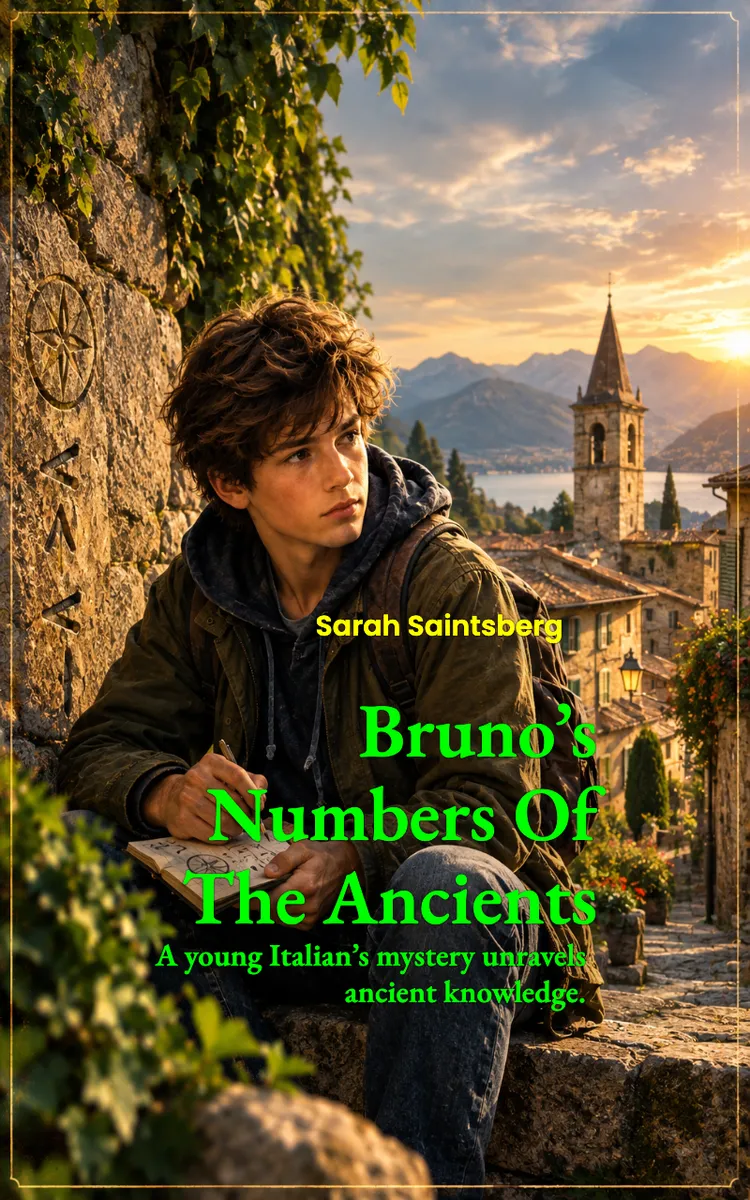

Read the first chapter
The whole of chapter one, free. About 7 min. Turn the pages with the arrows, your keyboard, or a swipe.
Chapter 1
The Numbers Carved in Metal
The metal object lay on Bruno’s kitchen table, cold beneath the yellow cone of a desk lamp. Its surface was no larger than his palm, dark as burned iron, and carved with symbols that seemed to shift whenever he looked away.
Outside, the bells of the small Italian town struck midnight. Their sound traveled through the narrow streets and entered the stone house in trembling waves. Bruno did not move. He had been staring at the object for nearly an hour, afraid that touching it again would make the markings disappear.
He needed to understand the numbers before that happened.
The first row was clear enough: 3, 1, 4, 1, 5. Beneath it ran a line of angular signs, each cut so finely that the grooves caught the light like threads of silver. Bruno had copied them into his notebook, but on paper they looked meaningless. The symbols were not letters. They were not Roman numerals. They belonged to no alphabet he recognized.
He reached for the object.
The instant his fingers closed around it, the lamp flickered.
Bruno jerked back. The metal struck the table with a sharp crack.
For one second, the numbers shone white.
Then they rearranged themselves.
“Not possible,” he whispered.
The sequence now read 5, 1, 4, 1, 3.
He snatched up his notebook and wrote it down. His pencil tore through the paper as he copied the new order. When he looked back, the numbers had changed again.
7, 2, 9, 4, 6.
The room seemed to contract around him. The old walls, built from uneven gray stones, pressed close beneath the wooden beams. A draft slipped through the window frame and stirred the papers scattered across the table. Somewhere in the house, a pipe groaned.
Bruno turned toward the sound.
The hallway beyond the kitchen was black. He had left the lamp burning near the front door, but its light had vanished.
He rose slowly.
“Just the bulb,” he said, though no one was there to hear him.
The stone floor chilled his bare feet as he crossed the kitchen. At the end of the hallway, the lamp stood dark beside the coat rack. Bruno reached for the switch. Nothing happened.
He glanced toward the front door. The bolt was still in place.
A second flicker came from behind him.
Bruno spun around.
The metal object was glowing on the table.
Not brightly. Its light pulsed beneath the carved surface, a dull blue radiance that moved through the grooves and gathered beneath the numbers. The symbols brightened one after another, forming a path from the first mark to the last.
He hurried back.
The moment his hand touched the object, a shock ran up his arm. He saw a flash - not a vision exactly, but an impression of somewhere else. White stone under a hard sun. A broken arch. A line of dark figures standing beside a river.
Then the image vanished.
Bruno staggered against the table.
His notebook slid to the floor.
The metal went cold.
He stared at his hand. A faint black mark had appeared across his palm, shaped like a narrow crescent crossed by three lines. It looked burned into the skin, but when he rubbed it, no pain came.
A knock sounded at the door.
Bruno froze.
Three blows. Evenly spaced.
He looked at the clock above the fireplace. Twelve seventeen.
Nobody visited him at this hour. The town was too small for strangers to pass unnoticed, and the house stood beyond the last row of buildings, where the road narrowed into fields and olive trees. His friends knew he lived alone. They also knew better than to arrive without warning.
Another knock.
“Who is it?” Bruno called.
No answer.
He stepped toward the door, keeping one hand against the wall. The stones were rough beneath his fingers. Through the narrow glass panel beside the entrance, he saw only the courtyard and the crooked shadow of the old well.
“Bruno,” a voice said from outside.
He knew the voice, but the sound was muffled by the wood.
His stomach tightened.
“Who?”
A pause.
Then the voice spoke again, lower this time. “Open the door.”
Bruno did not move. He reached for the iron poker beside the fireplace and gripped it with both hands.
The handle turned.
The bolt held.
For several seconds, neither side moved. Then the pressure vanished. Footsteps crossed the gravel outside, quick and light, fading toward the road.
Bruno waited until the silence returned.
He should have called someone. Sofia, perhaps. She would have answered even at midnight, and she would have told him to leave the house immediately. But the thought of explaining the object, the changing numbers, the mark on his palm - none of it sounded real enough to say aloud.
He unlocked the door by a fraction and looked outside.
The courtyard was empty.
A thin strip of paper lay beneath the gate.
Bruno stepped out, still holding the poker. The night had turned cold. Clouds covered the moon, and the hills beyond the town were only darker shapes against the sky. He bent and picked up the paper.
There was no message on it.
Only a number.
19.
The ink was fresh.
Bruno looked toward the road. Nothing moved between the cypress trees. He returned inside, locked the door, and pushed a chair beneath the handle.
The metal object waited on the table.
He placed the paper beside it. The number 19 seemed to pull the blue light toward itself. The carved symbols brightened, and a thin line appeared along the object’s edge.
Bruno took a knife from the kitchen drawer and worked the blade into the seam.
The object resisted.
He tried again, harder. The metal slipped, and the knife cut across his thumb. Blood fell onto the carved surface.
The reaction was immediate.
The numbers flared.
A sharp tone rang through the room, too pure to be mechanical and too steady to be human. The table vibrated beneath Bruno’s hands. Dust dropped from the ceiling. Along the wall, the stones began to hum.
Then the object opened.
Not like a box. Its upper layer separated from the lower one by less than a finger’s width, revealing a narrow compartment hidden inside the metal. Something pale was folded within it.
Bruno pulled it free.
The paper was brittle and yellow, no larger than a postcard. A fragment of a map covered its surface in faded brown lines. At the center stood a symbol matching the mark on his palm. Around it were four numbers:
19-7 - 3-11.
A route had been drawn from the town, winding south through mountains and ending at a small black triangle beside a river.
Bruno recognized the first stretch. The line passed through the old quarry, then beyond the abandoned monastery on the hill. After that, the map left familiar ground and continued toward the coast.
At the bottom, beneath a torn edge, a word remained visible.
EGYPT.
He stared at it until the letters blurred.
A floorboard creaked behind him.
Bruno turned.
The kitchen doorway was empty.
He listened. The refrigerator clicked off. Water tapped somewhere inside the walls. Beyond those ordinary sounds came another - a faint scrape from the hallway, as if a shoe were being lifted carefully from the stone.
Bruno lowered the map.
The front door was still locked. The chair remained wedged beneath the handle.
He looked toward the window.
It stood open.
Cold air moved the curtains. Bruno had closed that window before sitting down. He remembered the latch catching. He remembered checking it twice.
His gaze dropped to the floor.
There, beneath the window, were muddy footprints.
They crossed the kitchen stones and stopped beside the table.
One footprint pointed toward the metal object.
The other pointed toward Bruno.
He backed away, the map clenched in his fist.
A shape shifted beyond the hallway, just past the reach of the lamp’s weak light.
Bruno raised the iron poker.
“Show yourself.”
The house answered with silence.
Then something struck the wall behind him.
The metal object flew from the table and hit the floor. Its blue light vanished. At the same instant, the map tore in Bruno’s hand, splitting straight through the number 7.
He lunged for the object.
His fingers closed around it as another blow shattered the kitchen window.
Glass exploded across the floor.
Bruno dropped behind the table. A dark figure moved outside, fast and low, disappearing between the olive trees.
He stayed crouched, gripping the metal against his chest. A thin line of blood ran from his thumb to his wrist. The carved numbers were dark again, but the crescent mark on his palm had begun to glow.
On the floor beside him, the torn map fragment showed only three numbers now.
19-3 - 11.
The route beyond his town remained visible.
Behind him, the front-door chair scraped across the stone.
Someone had entered the house.
End of chapter one. 19 more chapters and about 35,626 words in the full book.
Swipe or use the arrows to turn the page

What's inside: 20 chapters
- 1. The Numbers Carved in Metal
- 2. A Partner’s Cipher, A Hidden Key
- 3. The Dead End That Points Forward
- 4. The Egyptian Cartouche That Breaks Rules
- 5. Bruno’s Choice to Share the Truth
- 6. The Clockwork Map in Bruno’s Bag
- 7. Unlocking the Roman Counting Box
- 8. The Greek Letter That Isn’t a Letter
- 9. A Friend Key from Maya’s Laughter
- 10. Bruno’s Wobbly Confidence Test
- 11. The Egyptian Pattern That Bites
- 12. Chasing the Countdown Through Storage
- 13. Maya’s Whispered Clue in the Library
- 14. The Enemy Who Loves Riddles
- 15. Fixing the Stolen Fragment’s Message
- 16. Bruno’s Hero Mistake in the Courtyard
- 17. The Babylonian Riddle Under Pressure
- 18. Rylan’s Number Duel on the Stone Steps
- 19. Learning the Ancients’ Friendly Counting Rule
- 20. Bruno’s Numbers Back Home
About this book
"Bruno’s Numbers Of The Ancients" is a fiction book by Sarah Saintsberg with 20 chapters and approximately 35,626 words. The numbers rearrange themselves the moment you touch them, and Bruno can feel the truth slipping away. In a quiet Italian town, a 23-year-old discovers a palm-sized metal artifact carved with coded symbols that do not behave like anything he has ever seen.
This book was created using Inkfluence AI, an AI-powered book generation platform that helps authors write, design, and publish complete books. It was made with the AI Novel Writer.
Frequently Asked Questions
What is "Bruno’s Numbers Of The Ancients" about?
The numbers rearrange themselves the moment you touch them, and Bruno can feel the truth slipping away. In a quiet Italian town, a 23-year-old discovers a palm-sized metal artifact carved with coded symbols that do not behave like anything he has ever seen. He copies the sequence, only to watch it change again, then again, as if the object is alive and listening. When someone breaks into his home and a partner races in with answers shaped like anger, Bruno realizes the artifact is not a mystery to solve. It is a message to survive. Each new sequence points to another place, another clue, and another danger closing in. If the ancients left a code, Bruno is already too late to do it safely.
How many chapters are in "Bruno’s Numbers Of The Ancients"?
The book contains 20 chapters and approximately 35,626 words. Topics covered include The Numbers Carved in Metal, A Partner’s Cipher, A Hidden Key, The Dead End That Points Forward, The Egyptian Cartouche That Breaks Rules, and more.
Who wrote "Bruno’s Numbers Of The Ancients"?
This book was written by Sarah Saintsberg and created using Inkfluence AI, an AI book generation platform that helps authors write, design, and publish books.
How can I create a similar fiction book?
You can create your own fiction book using Inkfluence AI. Describe your idea, choose your style, and the AI writes the full book for you. It's free to start.
Write your own fiction book with AI
Describe your idea and Inkfluence writes the whole thing. Free to start.
Start writingCreated with Inkfluence AI


