
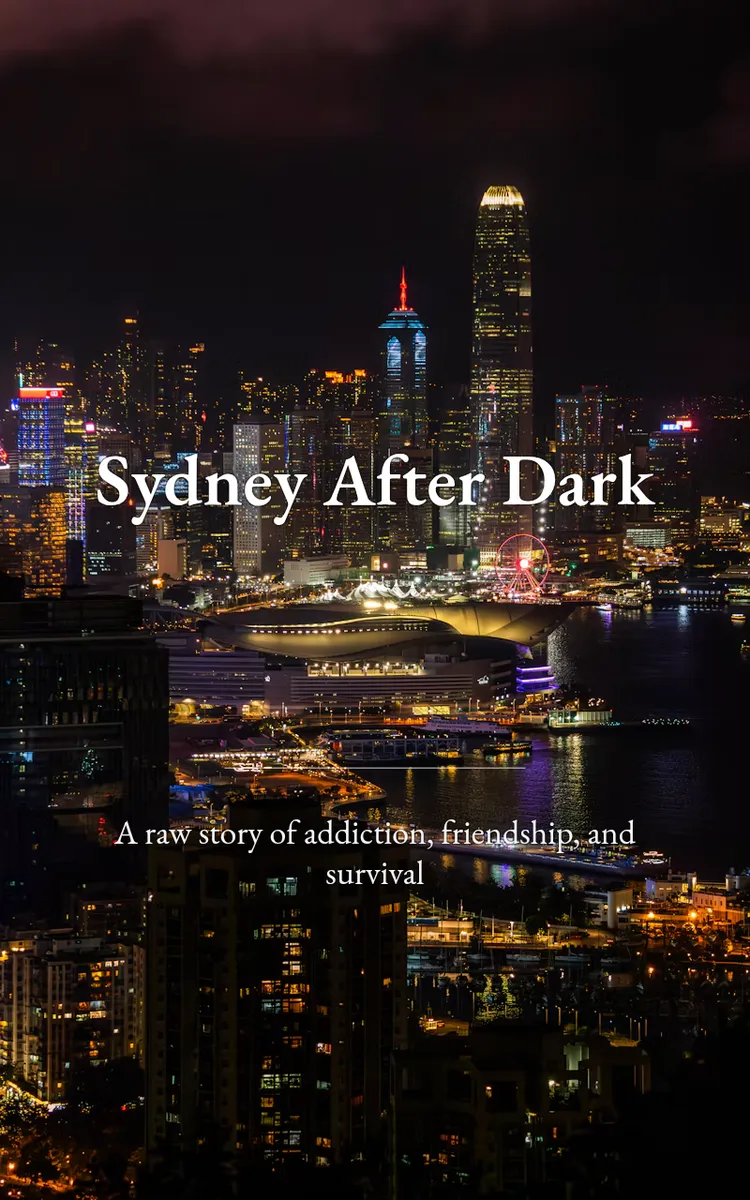
Read the first chapter
The whole of chapter one, free. About 10 min. Turn the pages with the arrows, your keyboard, or a swipe.
Chapter 1
The Rain-Slicked Kings Cross Run
The pay phone outside the Bourbon had swallowed Mick’s last two-dollar coin and kept ringing anyway. Its metal cradle shuddered beneath his knuckles while rain stitched silver lines through the red neon above the footpath.
“Hang up,” said Dazza. “You’re talking to nobody.”
Mick slapped the receiver down. The ringing stopped. Behind him, the Cross carried on making noise - taxis hissing through puddles, a woman laughing too loudly beneath a clear plastic hood, the bass from some basement club thumping through the pavement.
He turned his collar up and checked the envelope inside his jacket. The notes were folded tight against his ribs, warm from his body. Two hundred and forty dollars, pooled between four of them, enough to get them through the night if the promise at the share house held.
“Still there?” Dazza asked.
Mick gave him a look. “Wouldn’t be much of a courier if I lost it.”
“Don’t say courier. Makes it sound respectable.”
“It is respectable. I’m a professional.”
“You stole my lighter three minutes ago.”
“I borrowed it professionally.”
Dazza snorted, and for a moment the rain seemed harmless. Mick liked nights that began with a joke. They made the rest feel arranged, as if the city had agreed to let them pass.
Lena waited under the awning of a closed travel agency, arms folded over her denim jacket. Her mascara had run at one corner, giving her the look of someone who’d been punched by a small, careful ghost. Beside her, Kev was trying to light a cigarette with a match cupped in both hands.
“Move,” Lena said. “If we’re late, Gary’ll sell the room to someone else.”
“He can sell it to the Queen,” Dazza said. “I’m not paying rent for a lounge room.”
“It’s not rent. It’s a contribution.”
“That’s what rent says when it’s ashamed.”
Mick stepped off the curb. A taxi horn barked inches from his knee. He jumped back, and the driver leaned across to shout something lost beneath the rain.
“Professional,” Dazza murmured.
“Shut up and keep up.”
They moved east, four figures squeezed along the slick footpath, passing shuttered shops and doorways bright with cigarette ends. Kings Cross looked different in the rain. The familiar signs bent in puddles. Streets he knew by daylight seemed to slide sideways, their corners erased by water and headlights. Every awning dripped. Every doorway held somebody watching.
Mick kept one hand pressed over the envelope. The paper made a small, reassuring ridge beneath his jacket.
At the corner, Lena grabbed his sleeve.
“Not that way.”
“Why not?”
“Because that’s William Street.”
“So?”
“So it’s William Street.”
Dazza peered through the rain. “She’s got a point. William Street’s where good intentions go to die.”
“Darlinghurst Road,” Lena said. “We cut up past the station.”
Mick glanced at the traffic. Red lights blurred across the wet road like blood diluted in a sink. He had walked this route a hundred times, but tonight the city had rearranged itself. The pub signs were wrong. The pavement tilted. Somewhere nearby, a siren wailed and then cut off sharply.
“Fine,” he said. “Past the station.”
They crossed with the lights, dodging a couple who had stopped in the middle of the road to argue. The woman wore one red shoe and held the other in her hand. A bus rolled past, throwing a sheet of dirty water over Kev’s trousers.
“Lovely,” Kev said.
“You’re lucky,” Lena told him. “That’s the colour you usually wear.”
He laughed, and Mick felt the loose knot in his chest ease. They were nearly there. The gathering would be warm, loud, and badly organised. Gary would have music on the stereo and a saucepan nobody was allowed to ask about. Someone would produce bread, or chips, or a packet of biscuits crushed at the bottom of a bag. The cash would become something shared, and for a few hours the four of them would stop counting what they didn’t have.
A man in a black leather jacket stepped out from a doorway ahead. He was broad through the shoulders and grinning at nobody. Mick shifted closer to Lena. The man watched them pass, his eyes following Mick’s hand at his chest.
“Keep walking,” Lena said quietly.
“I am walking.”
“You’re looking at him.”
“I’m looking in his direction.”
“That’s practically an invitation with you.”
The man called after them. “Hey, mate. Got a light?”
Dazza kept going. Kev did too. Mick felt the man’s attention between his shoulder blades until the four of them turned up a narrow lane beside a hotel.
The lane was worse than the main road. Water poured from a broken gutter and struck the bins with a hollow drumming. Their shoes slipped on grease shining beneath the rain. A delivery van blocked half the passage, forcing them into single file.
“Gary said the back way,” Lena said.
“Gary says lots of things,” Dazza replied. “Last week he said his brother was a surgeon.”
“He is a surgeon.”
“He sells stolen televisions.”
“Surgeons need hobbies.”
Mick smiled, but the envelope had begun to feel heavier. He checked it again without taking it out. The inside pocket was buttoned. His fingers found the button, then the seam, then the hard fold of paper.
At the far end of the lane, a crowd spilled from a club doorway. Umbrellas collided. Someone pushed through carrying a crate of beer. A girl in a silver dress slipped, caught herself on Mick’s shoulder, and shouted an apology that became a laugh when she saw his face.
“Sorry, mate.”
“No worries.”
The crowd surged as the club door opened. Mick’s shoulder struck Dazza’s. Lena vanished behind a pair of men arguing over a taxi. Kev swore. A hand caught Mick’s elbow, another pressed against his back. For three seconds he was carried sideways by bodies and rain, the whole street reduced to wet leather, perfume, beer, and the hot electrical glare of the club sign.
“Lena!” he shouted.
“Here!”
Her voice came from behind him. Mick fought toward it. The envelope shifted under his jacket. He clamped his arm down.
Then the crowd released them.
They stumbled into the mouth of the lane, blinking beneath the hotel’s awning. Dazza was missing his cap. Kev had a tear in his shirt. Lena stood with both hands on her knees, breathing hard.
Mick straightened his jacket.
“Everyone alive?”
“Your standards are beautiful,” Lena said.
Dazza wiped rain from his eyes. “Where’s the money?”
Mick looked at him.
“What?”
“The money. You’ve still got it?”
Mick reached inside his jacket.
His fingers found the button hanging open.
The envelope was gone.
For a moment the rain seemed to stop, though it was still hammering the awning and running in streams along the gutter. Mick searched the pocket again, slower this time. His hand came out empty.
“Don’t,” Dazza said.
“I’ve got it.”
“You haven’t.”
“I’ve got it somewhere.”
Lena pulled him beneath the light. “Empty your pockets.”
Mick did. Cigarettes gone soft at the ends. A bus ticket. The borrowed lighter. Three coins. No envelope.
Kev stared at the little pile in Mick’s palm. “That was all of it.”
“I know what it was.”
“You were carrying it.”
“I know where I was carrying it.”
Dazza looked back toward the club crowd. “Someone lifted it.”
“No one lifted anything.”
“Then the envelope grew legs.”
Mick shoved the coins back into his pocket. The rain had soaked through his sleeves, and cold water ran from his hair down the back of his neck. “We go back.”
“We go back where?” Lena asked. “The lane? The club? The whole bloody Cross?”
“Yes.”
Dazza gave a short laugh. “That’s your plan?”
“It’s better than standing here admiring my pockets.”
They went back into the crowd.
Mick searched the ground first, crouching beneath the club sign while people stepped around him. Cigarette packets, a broken heel, a pink hair clip, bottle caps shining in the gutter. He lifted each pale scrap of paper and dropped it again.
“Maybe it fell in the lane,” Kev said.
“Maybe you dropped it,” Dazza said.
Kev turned. “What’s that meant to mean?”
“It means you’ve got hands like a drunk spider.”
“Both of you, shut up,” Lena said. “Mick, when did you last touch it?”
“The phone.”
“Before or after the phone?”
“After.”
“Then we retrace from the phone.”
The four of them moved back through the streets, now angry enough to ignore the rain. Mick checked every doorway and drain. He asked the woman in the red shoe. He asked the taxi driver, who told him to get out of the road. He asked a bouncer with a shaved head, who looked him over and said, “Mate, if I found two hundred and forty dollars, I wouldn’t be standing here talking to you.”
At the pay phone, Mick opened the metal box beneath the cradle. Empty except for a dead moth and a wad of grey tissue.
Dazza leaned against the wall. “It’s gone.”
Mick stared at the pay phone’s scratched glass. His reflection looked older than it had an hour ago. Water had flattened his hair. His mouth had tightened into a line he didn’t recognise.
“We can still go,” he said.
“With what?” Lena asked.
“Gary might float us.”
“Gary doesn’t float anybody. Gary sinks people and calls it friendship.”
“He’ll understand.”
Dazza pushed away from the wall. “He’ll understand that we’ve turned up empty. Then he’ll understand we can leave.”
Mick felt heat rise beneath his wet clothes. “I said I’d bring it.”
“And you didn’t.”
The words landed cleanly. Dazza looked sorry as soon as he said them, but he didn’t take them back.
Lena touched Mick’s arm. “Come on. We’ve got nowhere else to go.”
They walked the final blocks without talking. The rain softened to a steady hiss. Ahead, the share house appeared above a row of closed shops, its windows glowing yellow behind curtains that never quite met. Music leaked through the walls - an old pop song with a drum machine rattling like loose change.
Mick climbed the stairs first. The carpet smelled of damp wool and somebody’s fried onions. At the landing, he stopped outside the door.
“We tell him straight,” Lena said.
“No,” Mick replied.
Dazza looked at him. “What do you mean, no?”
“We tell him we’ve got a problem.”
“That’s a fancy way of saying the same thing.”
“It’s different.”
“It’s not.”
Mick knocked before either of them could argue again.
The door opened at once. Gary stood there in a dressing gown over a football jersey, holding a plastic cup and wearing one sock.
“You made it,” he said. “I was about to send a search party.”
His eyes moved from Mick’s wet face to the three people behind him.
“Where’s the contribution?”
Nobody spoke.
Music thudded from the lounge room. Someone inside shouted for more ice. A burst of laughter rose and broke against the ceiling.
Gary’s smile faded. “What happened?”
Mick stepped over the threshold. Rainwater dripped from his cuffs onto the cracked tiles.
“We lost it,” he said.
Gary blinked. “Lost what?”
“The money.”
Dazza muttered, “All of it.”
Gary looked at Mick as though waiting for the punch line. When it didn’t come, he set his cup on the windowsill.
“You had two hundred and forty dollars.”
“I had two hundred and forty dollars.”
“And now?”
“Now I’ve got three dollars and a lighter.”
Gary’s gaze dropped to the coins in Mick’s hand. The room behind him seemed to lean closer. Faces appeared in the hallway: a girl with a silver nose ring, a man wearing a towel around his shoulders, someone Mick knew only as Rabbit.
Lena pushed past them into the lounge. “Don’t stand in the doorway.”
Mick followed. The room was crowded and overheated, its windows fogged with bodies. A cassette deck clicked between songs. On the coffee table sat empty glasses, a deck of cards, and a chipped ceramic bowl no one had touched.
Gary shut the door behind them.
“So the night’s finished,” he said.
Mick looked at the faces, at the wet footprints spreading across the carpet, at Dazza’s clenched jaw and Lena’s tired eyes. The money was gone. That part was true. But the room was still warm, the music was still playing, and somewhere in the kitchen a saucepan lid rattled.
He took the three coins from his palm and placed them on the table.
“Not finished,” he said. “Just changed.”
Gary stared at the coins.
“Changed into what?”
Mick didn’t have an answer yet. He could feel the question waiting in every face around him, sharp as the missing envelope.
Outside, a taxi dragged its tyres through the rain. Inside, the cassette clicked, and the room fell quiet enough to hear it.
End of chapter one. 4 more chapters and about 11,511 words in the full book.
Swipe or use the arrows to turn the page
What's inside: 5 chapters
- 1. The Rain-Slicked Kings Cross Run
- 2. Mick Doyle’s Last Clean Shirt
- 3. The Party on the Fire Escape
- 4. Who Took the Blue Envelope?
- 5. The Last Train Is Cancelled
About this book
"Sydney After Dark" is a fiction book by Anonymous with 5 chapters and approximately 11,511 words. Heroin users navigating friendship and life in 1990s Sydney.
This book was created using Inkfluence AI, an AI-powered book generation platform that helps authors write, design, and publish complete books. It was made with the AI Novel Writer.
Frequently Asked Questions
What is "Sydney After Dark" about?
Heroin users navigating friendship and life in 1990s Sydney
How many chapters are in "Sydney After Dark"?
The book contains 5 chapters and approximately 11,511 words. Topics covered include The Rain-Slicked Kings Cross Run, Mick Doyle’s Last Clean Shirt, The Party on the Fire Escape, Who Took the Blue Envelope?, and more.
Who wrote "Sydney After Dark"?
This book was written by Anonymous and created using Inkfluence AI, an AI book generation platform that helps authors write, design, and publish books.
How can I create a similar fiction book?
You can create your own fiction book using Inkfluence AI. Describe your idea, choose your style, and the AI writes the full book for you. It's free to start.
Write your own fiction book with AI
Describe your idea and Inkfluence writes the whole thing. Free to start.
Start writingCreated with Inkfluence AI


