
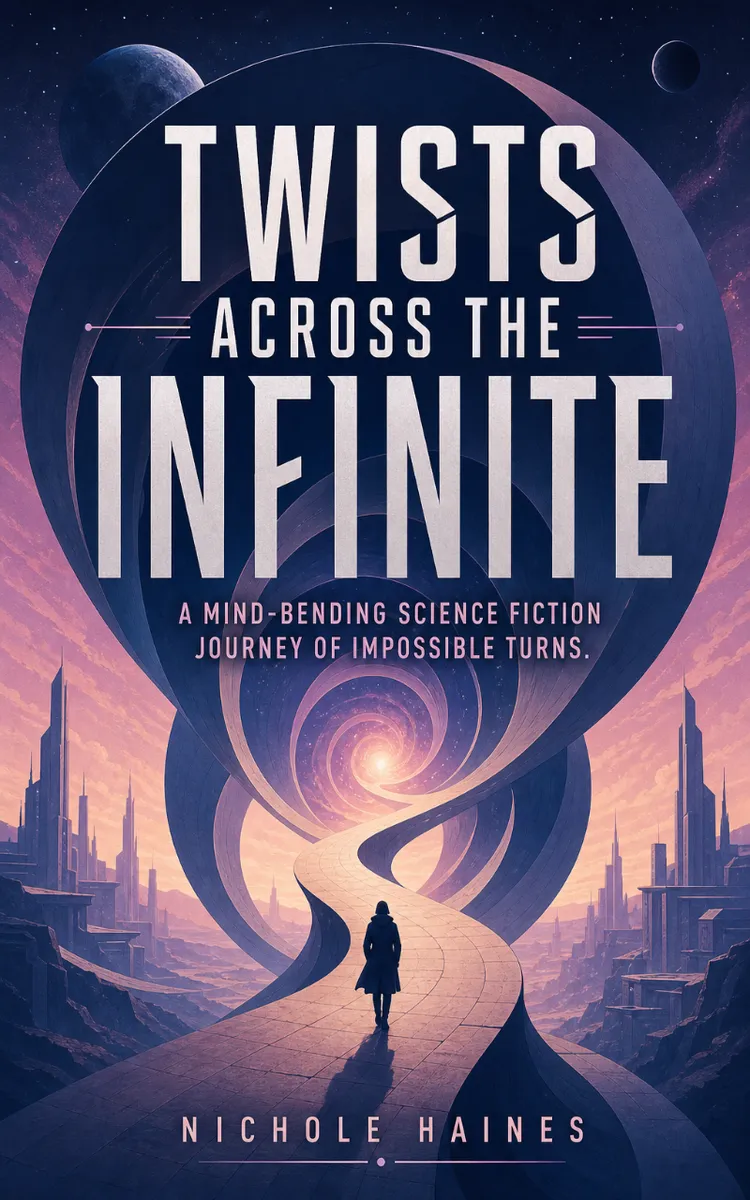
Twists Across The Infinite
Created with Inkfluence AI
A long science fiction novel with twists and plot turns
Table of Contents
- 1. The Door That Opens Wrong
- 2. A Signal That Rewrites Her Name
- 3. The Investigator With the Missing Memory
- 4. Unwritten Corridors Eat the Lights
- 5. Her Fear Becomes a Lock
- 6. The Archive Guards Arrive Too Soon
- 7. Quarantine Logs Contradict Each Other
- 8. A Room That Was Never Built
- 9. Ivo Calder Names the Key
- 10. The Promise Phrase Costs a Year
- 11. The Missing Year Has a Witness
- 12. Evidence Vault Doors Refuse Her Face
- 13. A Suit Profile That Isn’t Hers
- 14. Soren Halden’s Ship Is a Trap
- 15. The Jump Leaves No Arrival
- 16. Soren’s Journal Names a Third Party
- 17. Calyx Concord Uses Her as Proof
- 18. The Broadcast Turns the Archive Hostile
- 19. A Friend Who Isn’t There
- 20. Midpoint: The Infinite Archive Lies
- 21. Ivo Calder Chooses to Forget
- 22. The Concord Burns the Evidence Chain
- 23. The False Core Coordinates Lead Nowhere
- 24. A City Built from Unkept Promises
- 25. Her Missing Year Returns as a Monster
- 26. Concord Agents Hijack Her Body Interface
- 27. Ivo’s Fragment Reveals the Real Door
- 28. The Door Leads to a Mirror Mara
- 29. The Concord Offers a Clean Deal
- 30. She Breaks When the Timeline Snaps
- 31. The Core Reads Her True Intent
- 32. The Core Room Turns Inside Out
- 33. She Trades Memory for Control
- 34. The Generator Spits Out a Choice
- 35. Mara Breaks the Infinite Archive
- 36. Ivo Remembers Her in the New Now
- 37. The City of Promises Stops Fighting
- 38. Her False Memory Finally Fades
- 39. Calyx Concord’s Last Broadcast Fails
- 40. Twists Become a Door for Everyone
- 41. The Threshold of Consent
Preview: The Door That Opens Wrong
A short excerpt from “The Door That Opens Wrong”. The full book contains 41 chapters and 74,280 words.
The door label flickered between 9-17 and 9-71 while Mara Voss held the sealed Archive token against her palm. Beyond the glass roof of the Lattice Transit Hub, rain moved upward in silver threads, pulled toward the city’s weather engines. Every few seconds, the hub shuddered as another transit line folded through its foundations.
“Confirm destination,” said the door.
Mara glanced at the token. Its black surface had no markings, yet the metal warmed beneath her skin in the precise rhythm of a pulse.
“Archive access corridor,” she said. “Coordinates seven-four-nine, delta branch, origin lattice.”
The door remained shut.
A red line appeared across the threshold. ROUTE INVALID.
Mara’s grip tightened around the token. She had crossed three districts and surrendered two years of clearance privileges to get it. The Archive was supposed to contain the original records: birth ledgers, transit histories, identity keys, every version of every event that the Lattice had permitted itself to remember. If her brother’s disappearance had been altered, if someone had scrubbed the last six months from the city’s systems, the Archive would hold the unedited sequence.
She lifted the token toward the reader.
“Try again,” she said.
The door spoke in her own voice.
“Destination accepted.”
The red line vanished.
Mara froze.
The hub roared around her. Trains arrived without moving, their carriages blooming into existence along the platforms. Travelers stepped from one doorway and into another, carrying parcels sealed against alternate atmospheres. Above Door Row 9, the station clock displayed three different times, each one accurate according to a separate civic timeline.
The door unlocked with a soft mechanical click.
Mara should have called Control. She should have waited for the route verification that the Lattice required before any unauthorized transit. Instead, she slid the token into the reader.
It disappeared.
The door opened inward.
Not onto the white corridor of the Infinite Archive, but onto a narrow apartment hallway lit by amber wall strips. A child’s drawing hung crookedly beside the frame. A blue house. Three stick figures. Four, if the dark shape in the corner counted.
Mara smelled hot circuitry and cinnamon.
She stepped across.
The door shut behind her.
For one breath, there was no sound except the tick of a wall clock. Then a woman called from somewhere deeper in the apartment.
“Mara? Is that you?”
Mara’s hand went to the emergency beacon clipped beneath her coat. The beacon was dead weight. The hub’s signal could not pass through a misrouted threshold, and the token was gone.
“I’m here,” she called.
The answer came with footsteps.
A woman entered the hallway carrying a folded blanket. She was tall, narrow-shouldered, and wore Mara’s old gray work jacket. Her hair was cut short on one side, just as Mara had worn it before the accident at South Relay.
Mara knew the woman’s face.
She was looking at herself.
The stranger stopped.
For several seconds neither of them spoke.
Then the other Mara said, “You’re early.”
Mara backed into the door. Its surface was warm beneath her fingers.
“Where is this?”
The other woman’s expression changed - not fear, exactly, but recognition sharpened into annoyance.
“Home.”
“This isn’t my home.”
“You said that last time.”
Mara looked past her. The hallway opened into a living room filled with objects she had never owned and somehow remembered: a ceramic bird on the mantel, a cracked red chair, a framed transit map with Door Row 9 circled in ink. On the wall hung a photograph of two women standing beneath the Lattice’s central spire.
One was the stranger.
The other was Mara.
Except Mara was smiling in the photograph, her arm around the stranger’s waist. Between them stood a boy of about eight, his face blurred by a strip of white interference.
“What is this?” Mara asked.
The stranger lowered the blanket. “You tell me. You’re the one who keeps leaving.”
“I have never been here.”
“That’s not what your clothes say.”
Mara looked down. Her coat was damp from the hub’s rain, but beneath it she wore the same black transit uniform as the woman in the photograph. A silver band circled her left wrist. She had never seen it before.
The stranger noticed her staring.
“You took it off after the fire,” she said. “You said it made you feel watched.”
“What fire?”
The apartment lights flickered.
A voice spoke from the ceiling. “Unregistered duplicate detected.”
The stranger moved fast. She grabbed Mara by the wrist and pulled her into the living room.
“Don’t answer it,” she whispered.
The walls brightened with thin blue veins. A civic monitor unfolded above the fireplace, displaying Mara’s face beside a line of text.
MARA VOSS: DOMESTIC STATUS CONFIRMED.
Mara tore free.
“Shut it down.”
“I can’t.”
“Then get me back to the hub.”
The stranger laughed once, without humor. “The hub is three years gone.”
Mara stared at her.
...
About this book
"Twists Across The Infinite" is a fiction book by Nichole Haines with 41 chapters and approximately 74,280 words. A long science fiction novel with twists and plot turns.
This book was created using Inkfluence AI, an AI-powered book generation platform that helps authors write, design, and publish complete books. It was made with the AI Novel Writer.
Frequently Asked Questions
What is "Twists Across The Infinite" about?
A long science fiction novel with twists and plot turns
How many chapters are in "Twists Across The Infinite"?
The book contains 41 chapters and approximately 74,280 words. Topics covered include The Door That Opens Wrong, A Signal That Rewrites Her Name, The Investigator With the Missing Memory, Unwritten Corridors Eat the Lights, and more.
Who wrote "Twists Across The Infinite"?
This book was written by Nichole Haines and created using Inkfluence AI, an AI book generation platform that helps authors write, design, and publish books.
How can I create a similar fiction book?
You can create your own fiction book using Inkfluence AI. Describe your idea, choose your style, and the AI writes the full book for you. It's free to start.
Write your own fiction book with AI
Describe your idea and Inkfluence writes the whole thing. Free to start.
Start writingCreated with Inkfluence AI


