
Read the first chapter
The whole of chapter one, free. About 8 min. Turn the pages with the arrows, your keyboard, or a swipe.
Chapter 1
Clarify Your Personal Brand North Star
Where do partnerships go to die-your inbox, your website, or the way you talk about what you do?
If you’ve ever pitched a brand partnership and felt the same awkward pause on every call, you already know the real problem: people can’t quickly answer, “Who are you, who do you serve, and why should we care right now?” Without that clarity, partners treat you like a vendor instead of a fit. And when you look like “anyone,” you get “maybe later” instead of “let’s build something.”
This chapter gives you a clear way to define your personal brand North Star so partnerships instantly recognize your value. You’ll leave with a positioning statement you can paste into your website and outreach, a brand promise that turns attention into trust, and a signature point of view that makes the right partners lean in. No fluff. Just clean decisions you can make today.
Why This Matters
Partnerships don’t fail because you lack skill. They fail because your value takes too long to understand. A brand partner needs speed. They need to know who you serve, what you deliver, and how your presence supports their goals-without you explaining your business for twenty minutes.
Most entrepreneurs try to fix this by posting more, networking harder, or “building awareness.” That works for some things, but it doesn’t solve the core issue: confusion. When your message sounds broad, your identity feels unstable. A partner can’t justify a deal when they can’t explain you to their internal team in one breath.
When you clarify your North Star, you remove friction. You help partners categorize you instantly: “This person serves our people. This person stands for the outcome we want. This person sounds like a credible fit for our brand.” That’s how you start getting inbound conversations, better-fit offers, and agreements that feel rooted instead of rushed.
How It Works
You’ll use the North Star Positioning Sprint: a focused, practical exercise that turns your personal brand into a clear, partnership-ready message. You don’t guess. You write. You test your words against real partnership conversations, then you lock the language so it stays consistent across your site, your outreach, and your identity.
Here’s the core model. Complete it in order, and don’t skip the “why” behind each line.
1. Define “Who I am” in one sharp sentence Write a plain statement that describes your role and the way you think or work. Use action language. Example: “I help operational teams automate delivery workflows so they hit deadlines without chaos.” This anchors your identity so partners can place you.
2. Define “Who I serve” as a specific buyer type Name the person or team you serve, and include one concrete context they relate to. Not “small businesses.” Use “service businesses with 5-30 contractors who manage client handoffs across tools.” This makes your message feel built for them, not for everyone.
3. Define “What I deliver” as a measurable outcome Choose one primary result you create. Keep it outcome-based, not task-based. “Reduce time-to-launch” beats “I do automation.” “Increase booked consults from qualified leads” beats “I manage marketing.” Partners want outcomes they can bet on.
4. Define “What I stand for” as a non-negotiable standard Pick one belief you protect. This becomes the filter partners use to decide if your brand matches theirs. Example: “I don’t sell gimmicks; I build systems that stay useful after the hype cycle.” Your standard makes your point of view obvious.
5. Write your Positioning Statement (one paragraph) Combine the pieces into a single clear block: who you are, who you serve, what outcome you deliver, and what standard you won’t compromise. This becomes your website hero section, your partnership pitch opener, and your intro line in emails.
6. Write your Brand Promise (two sentences) The promise tells partners what they can expect when they work with you. It should include a behavior and a result. Example: “I bring clarity fast and execute with clean handoffs. You’ll know what we’re building, why it matters, and how it performs before we scale.”
7. Write your Signature Point of View (three bullets) Your point of view answers, “How do you see the world differently?” Use three bullets that show your approach, not your preferences. Partners love this because it signals what your content and offers will feel like.
That’s the sprint. The reason it works is simple: partners don’t buy your services first-they buy your clarity. When your message holds together, people can see how you’ll represent their brand and how you’ll attract the right audience.
A real example: Talia, 31, AI automation consultant Talia didn’t struggle with doing the work. She struggled with being understood. Her early outreach sounded like: “I automate processes with AI.” Cool-but it didn’t tell a partner which businesses she served, what problem she solved first, or what she stood for when results weren’t instant.
In the North Star Sprint, she clarified: - Who she is: an automation consultant who designs systems, not “set-and-forget hacks.” - Who she serves: service-based operators who juggle client intake, scheduling, and follow-ups across multiple tools. - What she delivers: faster response times and fewer missed leads through reliable workflow design. - What she stands for: “No black-box magic-everything stays explainable and maintainable.”
The difference wasn’t her skills. It was her message. Within a few weeks, partners stopped asking broad questions and started asking implementation questions-because her positioning gave them a clean path to say yes.
Putting It Into Practice
Let’s run the sprint on a realistic setup. Use this even if you feel “not ready.” You’re not trying to sound perfect. You’re trying to sound clear.
Scenario: You want to land partnerships with brands that already serve your ideal customer, but they keep responding with generic interest. Your message currently lists services. You need to communicate outcomes and standards.
Step-by-step sprint (do this in one sitting) 1. Pick one partnership goal for the next 60 days Choose one. For example: “Secure one co-marketing collaboration with a tool brand my buyers already use.” This keeps your positioning sharp and avoids building a message for every possible partner.
2. Write your “Who I am” sentence (10 minutes) Include your role and your method. If you do AI, don’t say “AI.” Say what you automate and what changes for the operator.
3. Write your “Who I serve” buyer type (15 minutes) Fill in this template: “I serve [type of business or team] that struggles with [specific problem] when [specific context].” Example: “I serve service business owners who manage client handoffs across tools and miss follow-up windows when lead volume spikes.”
4. Choose one primary outcome (10 minutes) Write three outcomes you can credibly claim, then pick the one you can deliver consistently. Your North Star outcome should feel like something partners can repeat.
5. Choose your “What I stand for” standard (10 minutes) Answer: “What do I refuse to do even if it sells?” That refusal becomes your standard.
6. Draft your positioning statement (15 minutes) Use this structure: “I help [who you serve] achieve [primary outcome] by [how you do it], without compromising [standard].” Then refine until it reads like you talk in a real meeting.
7. Draft your brand promise (10 minutes) Write two sentences: one about how you work, one about what partners get.
8. Draft your signature point of view (10 minutes) Write three bullets that start with your perspective, not your service list. Example bullet patterns: - “Most teams try [common approach]. I focus on [your approach] because [why].” - “Automation should [standard].” - “The real bottleneck is [your belief about cause].”
Expected outcomes you should see after you publish this message Within two weeks, you should notice higher-quality inbound replies, faster partner qualification, and fewer “Tell me more about what you do” emails that never lead anywhere. Your message should make it easier for someone to decide if you fit their audience and their brand standards.
Quick checklist - Your positioning statement names who you serve and the outcome you drive. - Your brand promise includes a work behavior and a partner-facing result. - Your signature point of view tells partners how you think, not what you sell. - You can read your positioning out loud in 15 seconds without stumbling. - Your website headline, outreach opener, and partnership pitch use the same core language.
What to Watch For
Your message reads like a menu If your positioning lists services (“I do X, Y, and Z”), partners can’t predict your impact. They don’t know what you’re known for, so they treat you like a generic provider.
Do this: Lead with one outcome and one standard. Not this: “I offer automation, marketing, and consulting for growing businesses.”
You serve “everyone,” so partners can’t map your audience If you write “small businesses” or “creators,” you create a category problem. Your buyer becomes too broad, and partners hesitate because they can’t guarantee audience fit.
Do this: Describe your buyer by context and constraints (tools they use, volume they manage, workflows they struggle with). Not this: “I help entrepreneurs increase leads.”
Your “what you stand for” stays invisible If you don’t state your standard, your point of view becomes interchangeable with other professionals. Partners can’t feel your brand vibe or your risk tolerance.
Do this: Write one non-negotiable you protect, then weave it into your positioning and promise. Not this: “I value quality.” (Too common to differentiate.)
When you fix these, your brand becomes easier to partner with. People stop guessing. They start aligning.
Before you move on, lock in your North Star draft today. Open a document and write your positioning statement, brand promise, and three bullets for your signature point of view. Then bring them to your next conversation and watch how fast partners can repeat your value back to you.
Next, we’ll turn that North Star into a brand identity direction that feels premium, consistent, and instantly recognizable-so the right partnerships don’t just understand you; they trust you.
End of chapter one. 8 more chapters and about 15,463 words in the full book.
Swipe or use the arrows to turn the page


What's inside: 9 chapters
- 1. Clarify Your Personal Brand North Star
- 2. Build a Luxury Presence System
- 3. Design Your Partnership Magnet Offer
- 4. Create a Single-Location Income Hub
- 5. Use AI for Visibility Without Virality
- 6. Develop a Lifestyle Brand of Freedom
- 7. Build Multiple Income Streams in One Brand
- 8. Become the CEO of Your Brand Life
- 9. Luna Nomad Studios Finale
About this book
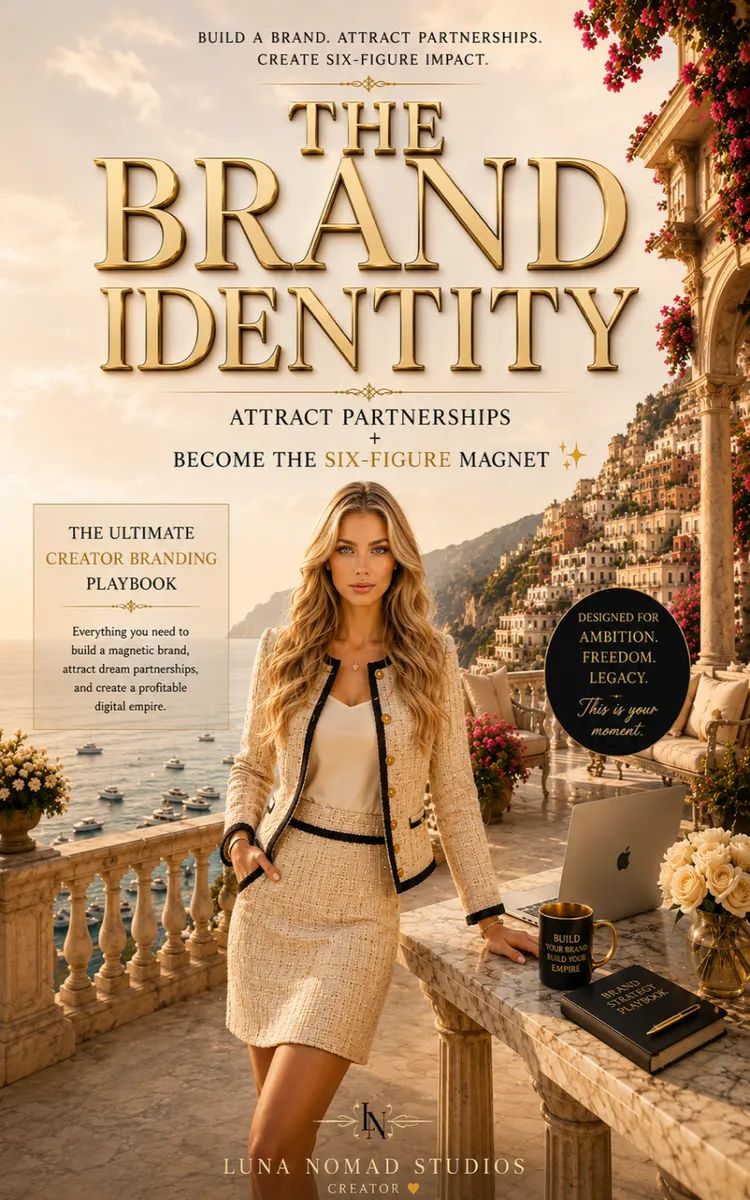
"The Brand Identity -Attract Six Figure Partnerships" is a business book by Luna Nomad Studios with 9 chapters and approximately 15,463 words. Brand positioning and identity strategy to attract partnerships and income.
This book was created using Inkfluence AI, an AI-powered book generation platform that helps authors write, design, and publish complete books. It was made with the AI Business Book Writer.
Frequently Asked Questions
What is "The Brand Identity -Attract Six Figure Partnerships" about?
Brand positioning and identity strategy to attract partnerships and income
How many chapters are in "The Brand Identity -Attract Six Figure Partnerships"?
The book contains 9 chapters and approximately 15,463 words. Topics covered include Clarify Your Personal Brand North Star, Build a Luxury Presence System, Design Your Partnership Magnet Offer, Create a Single-Location Income Hub, and more.
Who wrote "The Brand Identity -Attract Six Figure Partnerships"?
This book was written by Luna Nomad Studios and created using Inkfluence AI, an AI book generation platform that helps authors write, design, and publish books.
How can I create a similar business book?
You can create your own business book using Inkfluence AI. Describe your idea, choose your style, and the AI writes the full book for you. It's free to start.
Write your own business book with AI
Describe your idea and Inkfluence writes the whole thing. Free to start.
Start writingCreated with Inkfluence AI


