
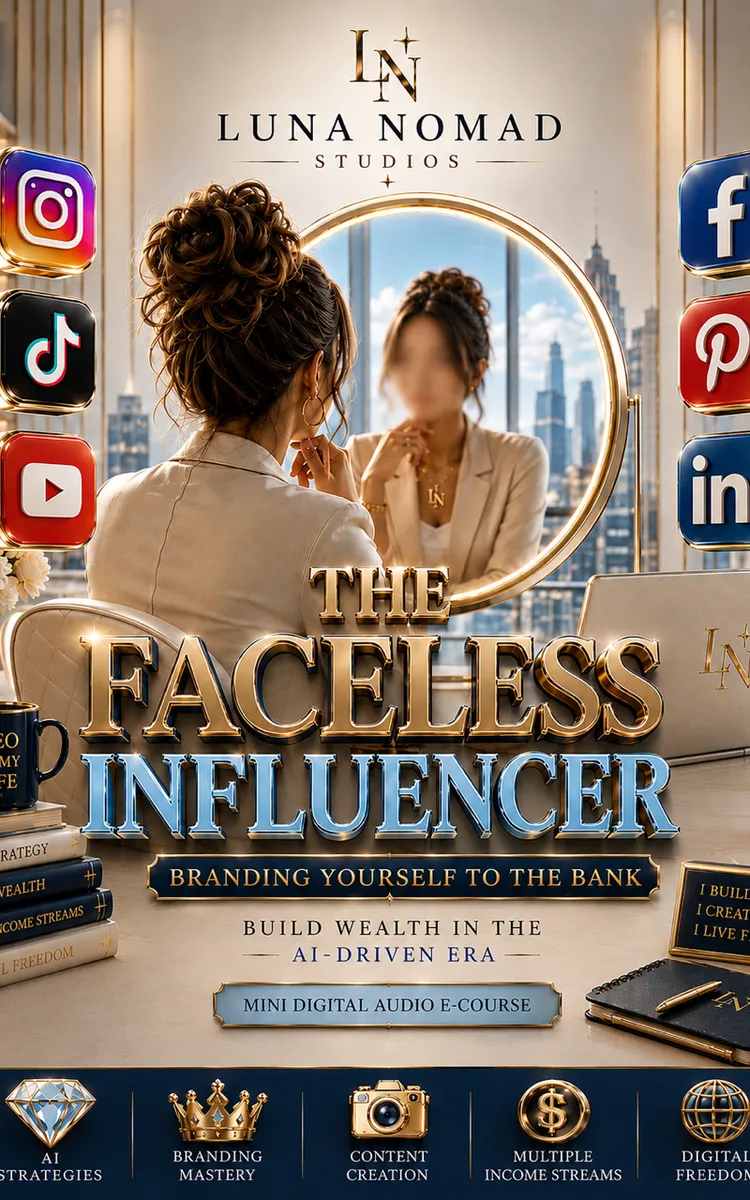
Read the first chapter
The whole of chapter one, free. About 9 min. Turn the pages with the arrows, your keyboard, or a swipe.
Chapter 1
Avatar-First Brand Positioning
What if people could recognize your content before they even see your face, your name, or your logo? In faceless influencer marketing, that “instant recognition” is not a lucky accident. It’s the result of tight brand positioning built around three signals: who you help, what you promise them, and how your content sounds and looks every time.
This chapter is for you if you’re building a faceless brand from anywhere with Wi-Fi and you’re tired of feeling invisible. You might already post consistently, but your content still blends in because your niche is fuzzy, your promise changes with the topic, or your voice shifts depending on what you feel like making that day. You’ll need a clear niche statement, a single audience promise you can repeat, and a brand voice you can enforce without guessing.
The key approaches, ranked by importance, are: first, define a niche you can own (not just “content about X,” but the exact slice of X you serve). Second, write an audience promise that your avatar and captions can deliver in every post. Third, lock a brand voice system so your content looks and reads like the same person, even when you’re using templates, stock footage, or tools. Finally, use the Mirror-to-Market Positioning Map to check whether your positioning matches what your audience actually wants to buy-before you spend weeks making content that doesn’t convert.
The Strategy
Strategy name: The Mirror-to-Market Positioning Map This is a simple positioning check that makes your brand feel instantly recognizable because it forces you to align what you “show” (your content style, topics, and structure) with what the market “hears” (the result your audience expects and the language they use).
Use it when you notice any of these problems: - Your posts get saves but not follows, which usually means people like the content but can’t tell why they should keep you. - You’re posting in multiple directions (tutorials, edits, reviews) and your audience doesn’t know what you’re about. - You keep changing your niche wording because it “doesn’t feel right,” which is a sign you haven’t picked a slice you can own.
To execute successfully, you need three inputs you can write in plain language: - Your niche slice (the exact segment you serve). - Your audience promise (the outcome you help them get, stated like a result). - Your brand voice rules (how your posts sound, what you say often, what you never say, and how you format your messages).
Then you map them using the Mirror-to-Market Positioning Map by answering one question per quadrant: “Does my content mirror what my audience is already trying to solve?”
What makes this map different is that it isn’t just “branding theory.” It’s built for faceless creators where identity comes from patterns: repeated visuals, consistent message structure, and predictable language. If your content doesn’t repeat in a useful way, people can’t recognize you.
Primary case study example: Talia, 24, freelance graphic designer. Talia doesn’t show her face. Her content is screenshots, before-and-after mockups, and quick design breakdowns. Early on, she posted everything she could: logo tips, Instagram templates, flyer ideas, and “design inspiration” posts. The result: her audience enjoyed the visuals, but they didn’t know what she specialized in. Her positioning wasn’t memorable because her promise kept changing. When she narrowed to one niche slice and wrote one audience promise, her content started to “stick” because each post signaled the same outcome.
Here’s what that looks like in practice: instead of “graphic design tips,” Talia chose “branding kits for new coaches who need a clean, modern look that converts.” That one sentence gave her a target, a reason to exist, and a repeatable promise. Then her voice rules became consistent: short captions, one key takeaway per post, and a repeated phrase that anchored her positioning (“Make your offer look as credible as it sounds.”). Even without showing her face, people could feel the same person behind every design.
Execution Steps
1) Write your niche slice in one sentence (10-20 minutes). Checkpoint: you can read it out loud and someone else can repeat it back accurately. Metric to measure: your niche slice should include three parts-who, what they’re trying to do, and the style or outcome you deliver. Example for Talia: “I help new coaches build a simple, modern brand kit that makes their offers look credible and easy to trust.”
Time estimate: 15 minutes to draft, 5 minutes to tighten.
2) Choose one audience promise you can deliver in every post (20-30 minutes). Checkpoint: your promise must be an outcome, not a topic. Topics are “logo design.” Outcomes are “a logo that helps people trust your offer in 5 seconds.” Metric to measure: your promise should fit into one caption sentence and you should be able to attach it to at least 10 post ideas without changing it.
For Talia: “Credible branding assets that help your audience understand your offer instantly.” She stopped making posts that didn’t support instant understanding, like random typography history or general inspiration.
Time estimate: 25 minutes to draft and test against 10 post ideas.
3) Define your brand voice rules using a “repeatable caption template” (45-60 minutes). Checkpoint: you can write a new caption in under 5 minutes using your template without thinking. Metric to measure: time-to-caption. If you can’t consistently produce a caption quickly, your voice rules are too vague.
A practical template you can use: - Hook line: one sentence that reflects the audience’s problem in their language. - Design/lesson line: what you did or what the viewer should notice. - Promise line: tie back to your audience promise in plain words. - Action line: one clear next step (save, comment, or check a link).
Talia’s version: - Hook: “If your coaching page looks ‘nice’ but doesn’t convert, it’s usually clarity.” - Lesson: “Here’s the layout change that makes the offer obvious.” - Promise: “This is how you build credibility fast.” - Action: “Save this for your next brand kit update.”
Time estimate: 60 minutes to create and test 3 captions.
4) Run the Mirror-to-Market Positioning Map (60-90 minutes). Checkpoint: you can fill each box with specific examples from your own content. No blank squares. Metric to measure: alignment score. Rate each quadrant from 1 to 5 based on how clearly your content mirrors your audience’s buying reasons. Your target is an average of 4.0 or higher.
Use these four prompts (write your answers, then pick the best version): - Mirror (What you show): What visuals and topics do you consistently post? List 5 recurring content types. - Market (What they want): What result do they want most right now? Use their words from comments, DMs, or competitor captions. - Bridge (How your content delivers it): What pattern connects your visuals to the result? For Talia, it was “before/after + one clarity change.” - Proof (Why you’re believable): What evidence do you repeat? Examples: portfolio screenshots, client outcomes (even small ones), process steps, or “what I changed” breakdowns.
Talia’s outcome: - Mirror: brand kits, layout changes, mockups, font pairing, “clarity checks.” - Market: coaches who need credibility quickly without learning design software. - Bridge: before/after + one specific improvement tied to trust and clarity. - Proof: consistent portfolio posts and “I changed X to fix Y” captions.
5) Create a “recognition system” that repeats without feeling boring (30-45 minutes). Checkpoint: you can list 3 consistent visual elements and 3 consistent caption behaviors you’ll use for the next 30 days. Metric to measure: recognition consistency. If you can’t describe your recurring patterns, you’ll drift.
Recognition system examples: - Visual elements: same frame style, same color palette range, same screen capture format, same text placement for callouts. - Caption behaviors: one takeaway per post, same promise line, same action line.
Talia: She used a consistent “before/after” split screen and always ended with the promise line. People started to recognize her posts by layout even in a fast scroll.
6) Build a 14-post “positioning runway” that tests your niche and promise (2-3 hours to plan, plus posting time). Checkpoint: each post must clearly support the same audience promise. Metric to measure: post clarity score. After you publish, review each caption and ask: “Would someone know what I do within 3 seconds?” Target: 12 of 14 posts should score “yes” when you test it on a friend or teammate.
Time estimate: 2 hours planning, 10-20 minutes per post to produce if you reuse templates and your recognition system.
Watch Outs
Don’t make your niche “broad” because it feels safer. Broad niches create vague content, and vague content doesn’t become recognizable.
Don’t write an audience promise that sounds motivational because outcomes need proof. If your promise can’t be delivered with a concrete content pattern, you’ll drift.
Don’t mix promises across posts because your audience will follow the strongest one and ignore the rest. If your promise is “credible branding assets,” then a post about “color theory trivia” weakens recognition.
Don’t keep changing your brand voice rules because you’ll train your audience to expect randomness. Pick one caption template and enforce it for at least 14 posts.
Don’t rely on your logo as the main recognition signal. In faceless influencer branding, recognition comes from repeated structure: visuals, caption format, and recurring language.
Don’t start with “viral hooks” that don’t match your promise. If a hook gets attention but the post doesn’t deliver the promised result, your saves and follows will stall.
Don’t skip the Mirror-to-Market map because you “feel like it’s right.” Feelings are not a positioning check. You need specific alignment between what you show and what the market wants.
Don’t measure success with vanity numbers alone. If you chase views but ignore whether people return (follows, comments, shares), you’ll optimize the wrong thing.
Success Metrics
You’re looking for evidence that your brand is becoming recognizable and that your positioning is turning attention into follows and conversations.
1) Recognition signals (check weekly). Target for the next 4 weeks: - Follower conversion: At least 2-5 new follows per 1,000 views on average. (Use your platform analytics to calculate. If you post 4 times a week, you’ll have enough data to see a trend.) - Return intent: Comments that mention the result, not just the aesthetics. Target: at least 10 comments per week that include phrases like “this helped,” “I needed this,” “I’m using this for my…,” or questions about your niche.
Checkpoint rhythm: every Sunday, review the last 7 days and label each post as “clear promise” or “unclear promise” based on whether the caption tied back to your audience promise within the first two lines.
2) Positioning clarity (check per post, not just monthly). Metric: post clarity score (0-3). - 0 = no clear niche cue - 1 = niche is implied but not obvious - 2 = niche is clear, promise is clear - 3 = niche + promise + proof pattern are all obvious
Target: average score of 2.3+ across your first 14-post runway.
3) Content delivery match (check after 2 weeks). Metric: Promise delivery rate. Count how many posts actually deliver a “bridge” action your audience can use immediately (a change, a checklist, a breakdown, a template, or a step). Target: at least 10 out of 14 posts deliver a direct “do this” element tied to your promise.
4) Audience language pull (check bi-weekly). Metric: language match. In your comments and DMs, pick the top 5 repeated words people use for the problem. Then check whether your hooks and caption lines use at least 3 of those words. Target: reach 60%+ language match by week 2.
Talia’s example results (what to look for): After narrowing her niche and locking her promise and voice, she saw her comments shift from “pretty design” to “this is exactly what I needed for my coaching page.” Her follower conversion improved because her posts stopped feeling like random design tips and started feeling like a repeatable solution.
When these metrics move together-views leading to follows, comments referencing the result, and your posts scoring higher on clarity-you’ve built a faceless influencer brand that people can recognize instantly by pattern, not by face. That’s the foundation for growth, and it sets you up to scale content without losing your identity. Next, you’ll turn this positioning into a repeatable content system that keeps your brand consistent even when you’re busy.
End of chapter one. 6 more chapters and about 13,349 words in the full book.
Swipe or use the arrows to turn the page


What's inside: 7 chapters
- 1. Avatar-First Brand Positioning
- 2. Viral Content Pillar System
- 3. AI Avatar Identity Kit
- 4. Quality-Content Production Workflow
- 5. Bank-Ready Growth Funnel
- 6. Multiple Avatars, Global Reach
- 7. Blueprint Niche Alignment
About this book
"The Faceless Influencer" is a marketing book by Luna Nomad Studios with 7 chapters and approximately 13,349 words. Branding and marketing strategy for faceless influencer growth.
This book was created using Inkfluence AI, an AI-powered book generation platform that helps authors write, design, and publish complete books. It was made with the AI Ebook Creator.
Frequently Asked Questions
What is "The Faceless Influencer" about?
Branding and marketing strategy for faceless influencer growth
How many chapters are in "The Faceless Influencer"?
The book contains 7 chapters and approximately 13,349 words. Topics covered include Avatar-First Brand Positioning, Viral Content Pillar System, AI Avatar Identity Kit, Quality-Content Production Workflow, and more.
Who wrote "The Faceless Influencer"?
This book was written by Luna Nomad Studios and created using Inkfluence AI, an AI book generation platform that helps authors write, design, and publish books.
How can I create a similar marketing book?
You can create your own marketing book using Inkfluence AI. Describe your idea, choose your style, and the AI writes the full book for you. It's free to start.
Write your own marketing book with AI
Describe your idea and Inkfluence writes the whole thing. Free to start.
Start writingCreated with Inkfluence AI


