
Read the first chapter
The whole of chapter one, free. About 10 min. Turn the pages with the arrows, your keyboard, or a swipe.
Chapter 1
The Metal Hiding in Your Phone
The Pocket Mineral Trace
The phone in your hand may contain material dug from a hillside in the Democratic Republic of the Congo (DRC), refined in China, assembled in Vietnam, and sold through a shop thousands of miles from any mine. Its smooth glass surface hides a supply chain that crosses geology, war, chemistry, engineering, and ordinary consumer life.
The amounts are small enough to disappear into a pocket, yet important enough to shape international trade. Tantalum, cobalt, and rare earth elements do not all perform the same job, and they are not always mined in the same places. But each becomes part of a device whose finished form gives little hint of its mineral origins.
The useful way to follow them is through what might be called the Pocket Mineral Trace: begin with an object familiar enough to carry every day, then follow its materials backward - from circuit board to refined metal, from refinery to mine, and from mine to the landscapes and communities where extraction begins.
How many distant landscapes are folded into the small rectangle that never leaves your hand?
From a Pocket to a Deposit
A smartphone is not made from one mineral, nor does any single country supply everything inside it. Its screen depends largely on silica-based glass and other materials; its battery uses lithium compounds, graphite, nickel, manganese, cobalt, or combinations of these; its circuitry requires copper, gold, tin, and other metals. Tantalum and rare earth elements appear in more specialized roles, but their importance is out of proportion to their weight.
Tantalum is valued for its ability to form highly stable electrical components. In a phone, tantalum capacitors can help regulate and store electrical charge in a compact space. A capacitor is a small component that manages changes in voltage, much as a valve controls the flow of water. Tantalum’s useful combination of stability, heat resistance, and high capacitance allows engineers to place dependable components in crowded electronic assemblies.
The tantalum-bearing mineral most often associated with electronics is coltan, a trade name commonly used for ores containing columbite and tantalite. The DRC holds major tantalum resources, particularly in its eastern provinces, where mining has taken place amid weak governance, armed conflict, and difficult working conditions. The ore itself is not a finished electronic material. It must be mined, sorted, concentrated, chemically processed, and refined before tantalum can enter a capacitor factory.
That distance between ore and component matters. A dark mineral dug from rocky ground does not resemble the bright, sealed capacitor mounted on a circuit board. By the time tantalum reaches a device manufacturer, its connection to a particular hillside may be difficult to see. Supply-chain reporting and traceability systems attempt to restore that connection, especially where minerals may have passed through areas affected by armed groups.
Cobalt follows a different path. It is a key ingredient in several lithium-ion battery chemistries, where it helps support energy density and structural stability in the battery’s cathode. The DRC has long been the world’s leading source of mined cobalt, with large industrial operations and smaller informal or artisanal workings existing within the same national mining landscape. Cobalt may leave the ground as part of a copper-cobalt ore, then move through processing plants before reaching battery-material producers.
A phone battery is therefore not simply “powered by electricity.” Its performance depends on a chain of chemical decisions made far from the finished product: which minerals are available, how they are separated, which battery chemistry is selected, and how manufacturers balance energy, cost, safety, and supply risk.
Cobalt, Conflict, and the Battery Age
The rise of portable electronics changed the meaning of a battery. Earlier rechargeable batteries had already brought convenience to cameras, laptops, and power tools, but lithium-ion technology made it practical to place substantial energy inside thin, lightweight products. The same basic family of batteries now serves electric vehicles, grid storage, and countless handheld devices.
Cobalt became important because battery designers needed cathode materials that could hold energy while remaining reasonably stable. It is not the only possible ingredient, and manufacturers have worked to reduce the amount used in some battery designs. Yet reducing dependence on cobalt does not erase the existing mining economy. Millions of devices already contain battery materials whose origins lie in a complicated network of mines, traders, processors, and manufacturers.
In eastern and southern DRC, cobalt extraction has included large-scale industrial mines as well as artisanal and small-scale mining. Artisanal miners often work with basic tools and limited protection, while buying and selling can involve layers of intermediaries. Reports of child labor, dangerous tunnels, and hazardous conditions have drawn international attention. At the same time, mining provides income in places where alternatives are scarce, and the industry supports communities as well as exposing them to serious risks. The reality is not captured by either a clean corporate supply chain or a simple story of helpless victims.
A mineral can be legally traded and still be connected to hardship. It can also be extracted under difficult conditions without every person involved being reduced to a symbol of exploitation. Those tensions make cobalt different from an abstract ingredient in a battery specification. Its value is determined in laboratories and commodities markets, but its consequences are felt in neighborhoods near mine sites, processing centers, roads, and export routes.
The phone’s battery is a compact record of this tension. It stores energy through carefully controlled movement of lithium ions between cathode and anode. Yet the social history of its materials is much less orderly. Chemistry can be measured in a laboratory; responsibility becomes harder to assign once ore has passed through many hands.
Rare Earths and the Invisible Machinery
Rare earth elements are often described as a single group, but they are a family of seventeen elements with related chemical properties. Their names sound obscure - neodymium, dysprosium, terbium, lanthanum - but their behavior makes them valuable in technologies that depend on magnetism, light, color, and precise electronic control.
A smartphone may contain rare earth elements in several places. Neodymium can be used in small permanent magnets, including components associated with speakers and vibration systems. Other rare earths help produce colors in display technologies or support specialized electronic and optical functions. The quantities are tiny, but the performance requirements are exacting: a speaker must fit inside a thin frame, a vibration motor must respond quickly, and a display must produce consistent color across millions of pixels.
Unlike cobalt and tantalum, rare earth supply is not centered primarily on the DRC. China has played a dominant role in mining, separation, refining, and processing many rare earth materials, while significant resources also exist in countries including Australia, the United States, Brazil, India, and others. The crucial point is that mining is only the first stage. Rare earth ores often contain several elements mixed together, and separating them requires complex chemical processing. A country may possess rare earth deposits without possessing the industrial capacity to turn them into the high-purity materials needed by manufacturers.
This creates a less visible form of dependence. A deposit can exist on a geological map, yet remain commercially distant if roads, processing plants, skilled labor, environmental controls, and investment are missing. The map of resources is not the same as the map of usable supply.
The environmental burden can also shift along the chain. Mining disturbs land, while separation and refining may produce waste streams that require careful management. In some regions, rare earth processing has been associated with radioactive by-products because certain ores contain thorium or uranium. The finished phone reveals none of this. Its vibration motor gives a brief buzz; its speaker produces a voice; its screen lights up. The industrial landscape behind those functions remains outside the frame.
The Counterintuitive Geography of “Critical” Minerals
The surprising fact is that a mineral can be abundant in the ground and still be scarce in the marketplace. Geological presence does not guarantee a reliable supply of the refined material that factories require.
That distinction changes how mineral security should be understood. The decisive bottleneck may lie not at the mine but at the refinery, chemical separator, specialist component plant, or transport route. Tantalum, cobalt, and rare earths each show a different version of this problem: resources may be concentrated in one region, processing in another, and final manufacturing somewhere else entirely.
A mine produces an ore, not a phone component. Tantalum must be separated and refined into a form suitable for capacitors. Cobalt must become a chemical compound with carefully controlled purity for battery materials. Rare earths must be separated from one another, often through repeated chemical stages, before they can be converted into magnets, phosphors, or other industrial products.
This is why the phrase “where a phone is made” tells only a small part of its story. Assembly location describes the final joining of parts, not the origin of the materials embedded in them. A device assembled in one country may rely on refined substances produced in several others, each with its own energy system, labor conditions, regulations, and political risks.
The DRC illustrates the point sharply. It is central to the world’s cobalt supply and important to tantalum production, yet the country is not the main center where these materials become finished battery chemicals or electronic components. Value can accumulate far from extraction. The people closest to the ore may have the least influence over the price, design, and use of the final product.
The same pattern appears in rare earths. A country may extract mineral-bearing rock, another may perform chemical separation, and a third may manufacture the magnet that eventually enters a speaker or motor. The supply chain is global not because every stage is evenly distributed, but because different places specialize in different forms of control.
A Mine, a Phone, and the People Between Them
In the copper-and-cobalt mining belt of southern DRC, cities such as Kolwezi have expanded alongside industrial mining. Roads carry trucks between mines, processing plants, warehouses, and border routes. The landscape includes open pits, waste rock, power infrastructure, workshops, markets, and neighborhoods whose fortunes are tied to the rhythm of mineral production.
Kolwezi is also a place where industrial and artisanal mining have come into contact. Artisanal miners may seek cobalt-bearing material in areas outside formal industrial operations or in abandoned workings, using hand tools and improvised methods. Industrial companies operate with heavy machinery, formal permits, and processing facilities. Their coexistence has produced disputes over land, access, safety, and who is entitled to benefit from the mineral beneath the surface.
The cobalt leaving this region does not carry a visible label naming the person who dug the original rock. It may be blended with material from other sources, processed into an intermediate product, and sold onward to a chemical manufacturer. Eventually, some of that material may become part of a battery cell, then a phone assembled on another continent.
That chain links Kolwezi to an object used in offices, buses, kitchens, classrooms, and railway stations around the world. The connection is not sentimental; it is industrial. A decision about battery chemistry in a design center can affect demand for a mineral in a mining district. A change in purchasing rules can alter which suppliers are accepted. A new refining plant can shift the balance of power between countries and companies.
Tantalum has its own human geography in eastern DRC and neighboring countries. Small-scale miners and traders work within routes that may be difficult to monitor, especially where state authority is limited and armed groups have operated. International rules concerning conflict minerals have pushed electronics companies to ask more carefully where tantalum, tin, tungsten, and gold originate. Yet paperwork can only reveal what the supply chain records, and records are strongest where institutions are strongest.
The phone therefore connects people who may never meet and may not know one another’s names. The engineer concerned with capacitor reliability, the refinery worker handling chemical solutions, the miner sorting ore, and the consumer charging a device at night occupy different points in one material system. The screen keeps them visually separate while the minerals join them physically.
The Smallest Object, the Widest Map
A smartphone is a lesson in scale. Its components are measured in millimeters, its useful metals in grams or less, yet its materials may originate in mines spread across continents. The object is physically compact because industrial society has learned to concentrate extraordinary complexity into very small spaces.
That concentration can make origins easy to forget. The phone appears finished, clean, and self-contained, while its materials remain part of a larger world of rock, water, labor, chemistry, trade, and political power. Tantalum gives a capacitor dependable control; cobalt helps a battery store energy; rare earths support magnets, color, and motion. Their functions are quiet, but their routes are not simple.
Human beings are remarkably good at shrinking the visible evidence of what they depend on. A mine becomes a refined powder, the powder becomes a component, and the component disappears beneath a casing. Yet every disappearing step leaves a question behind: when a mineral becomes invisible inside a device, has its history vanished - or merely moved somewhere we are less accustomed to looking?
End of chapter one. 39 more chapters and about 68,110 words in the full book.
Swipe or use the arrows to turn the page


What's inside: 40 chapters
- 1. The Metal Hiding in Your Phone
- 2. Lithium Beneath the Salt Flats
- 3. Can Seafloor Nodules Power Cars?
- 4. The Greenland Rare Earth Rush
- 5. Cobalt Beyond the Congo
- 6. The Graphite Inside Every Battery
- 7. Copper’s Buried Second Wind
- 8. Nickel’s Indonesian Transformation
- 9. Uranium Beneath the Athabasca Shield
- 10. Phosphate Rock for Future Harvests
- 11. Potash Under Saskatchewan
- 12. Helium Leaking from the Earth
- 13. The Boron That Strengthens Glass
- 14. Fluorspar’s Hidden Industrial Reach
- 15. Antimony in Fire-Safe Materials
- 16. Tungsten’s Unbreakable Edge
- 17. Manganese Beyond Steel
- 18. Vanadium for Long-Life Storage
- 19. Scandium’s Small but Powerful Promise
- 20. Gallium in the Light of LEDs
- 21. Germanium’s Infrared Advantage
- 22. Indium Behind the Touchscreen
- 23. Tellurium in Tomorrow’s Solar Panels
- 24. Rhenium from the Refinery’s Shadow
- 25. Palladium’s Uneven Global Map
- 26. Platinum Beneath South Africa
- 27. Zirconium for Nuclear Reactors
- 28. Titanium’s Ore-to-Aircraft Journey
- 29. Bauxite’s Untapped Red Earth
- 30. Silica Sand for the Digital Age
- 31. Rare Earths in Mountain Pass
- 32. The Deepest Mineral Frontier
- 33. Mining Asteroids Without Leaving Earth
- 34. Old Mine Waste, New Mineral Wealth
- 35. The Minerals Locked in Brines
- 36. When a Deposit Is Not a Mine
- 37. The Water Cost of Hidden Metals
- 38. Who Owns the Untapped Ground?
- 39. Can Recycling Replace New Mines?
- 40. The Map Beneath Tomorrow’s Choices
About this book
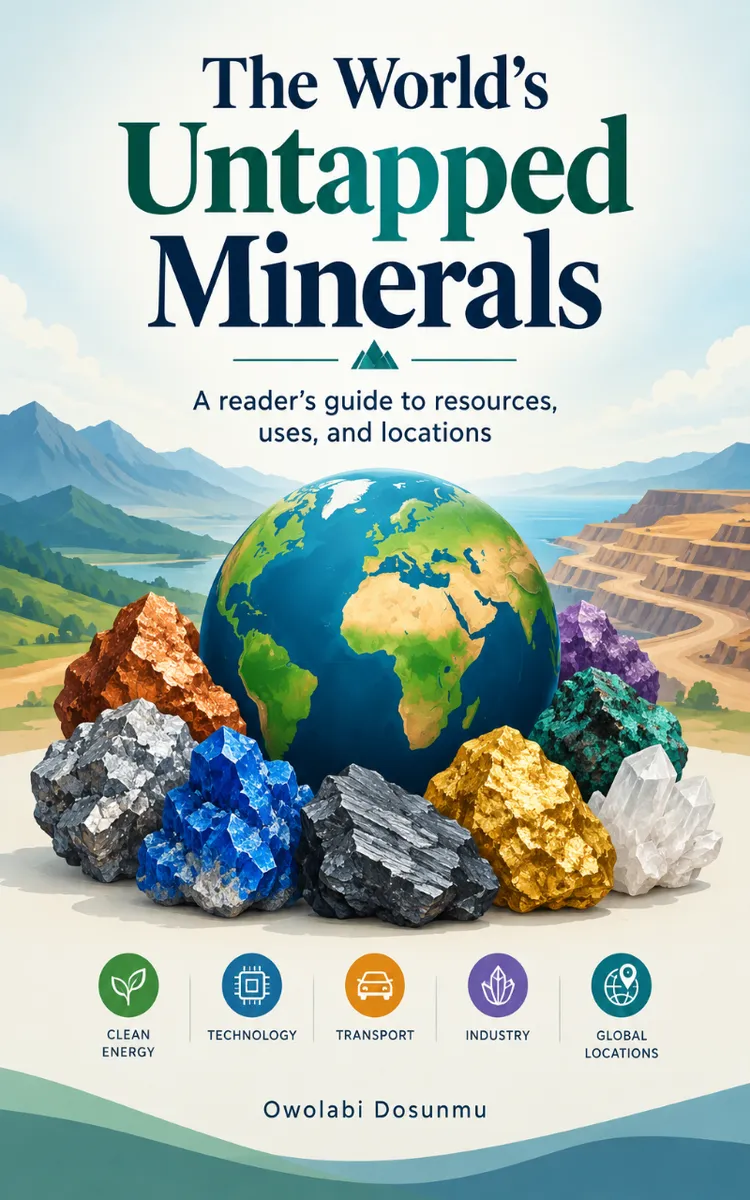
"The World’s Untapped Minerals" is a curiosity book by Owolabi Dosunmu with 40 chapters and approximately 68,110 words. Untapped mineral resources, their major uses, and global locations.
This book was created using Inkfluence AI, an AI-powered book generation platform that helps authors write, design, and publish complete books.
Frequently Asked Questions
What is "The World’s Untapped Minerals" about?
Untapped mineral resources, their major uses, and global locations
How many chapters are in "The World’s Untapped Minerals"?
The book contains 40 chapters and approximately 68,110 words. Topics covered include The Metal Hiding in Your Phone, Lithium Beneath the Salt Flats, Can Seafloor Nodules Power Cars?, The Greenland Rare Earth Rush, and more.
Who wrote "The World’s Untapped Minerals"?
This book was written by Owolabi Dosunmu and created using Inkfluence AI, an AI book generation platform that helps authors write, design, and publish books.
Write your own curiosity book with AI
Describe your idea and Inkfluence writes the whole thing. Free to start.
Start writingCreated with Inkfluence AI


