
Read the first chapter
The whole of chapter one, free. About 9 min. Turn the pages with the arrows, your keyboard, or a swipe.
Chapter 1
A Voyage North Begins
The steamer’s whistle split the gray morning above Seattle, and a flock of gulls rose from the pilings as if the sound had struck the water itself.
Nikola Tesla stood beside his crates on the wet quay, one gloved hand resting on the largest wooden case. Inside it lay a rotary converter, coils of insulated copper wire, a small induction motor, recording instruments, glass cells, and the delicate thermometers upon which his Alaskan measurements would depend. The cases had been lined with felt and packed in sawdust. Every latch had been inspected twice.
“Mr. Tesla,” called a deckhand, “if those are going aboard, they go now.”
Tesla looked toward the steamer. Smoke rolled from its stack and flattened beneath the low clouds. The vessel was not elegant, but it was broad in the beam and built to endure the northern coast. Beyond it waited Alaska, then the interior, where he intended to expose his electrical apparatus to temperatures no laboratory in New York could provide.
“I am coming,” Tesla said.
He signaled to the deckhand and watched the first crate swing from the hoist. It rose, dripping rain, and lurched above the black water.
“Steady!” Tesla called.
The crate struck the rail with a wooden crack. Tesla’s fingers tightened around his cane. The deckhand swore, caught the guide rope, and brought the case safely onto the deck.
“Nothing broken,” the man said.
“Nothing you can see,” Tesla replied.
The deckhand gave him a doubtful glance, but Tesla was already examining the rope burns along the crate’s corner. An instrument might survive a fall and still carry a wound invisible until the first reading.
He had brought most of what he needed because he trusted neither distance nor promises. In Alaska, a missing screw could become a week’s delay. A damaged coil could end an experiment before it began. His plan required current, temperature, and time to be measured together. He would compare the behavior of copper windings, iron cores, insulation, and storage cells as the cold deepened. His alternating-current machines had performed reliably in warm rooms, in factories, and beneath the electric lights of cities. Alaska would offer a harsher judge.
The last case contained the thermometer assembly: a glass tube, a fine mercury column, and a recording mechanism Tesla had altered so that temperature could be marked beside the electrical readings. He had wrapped it separately in wool and placed it in a spring-suspended compartment.
That case he carried aboard himself.
The purser met him near the gangway, a broad man with a brass button shining at his throat. “Your passage is paid, Mr. Tesla. Your freight is another matter.”
“My equipment has been registered.”
“Registered is not the same as cleared.”
Tesla produced a folded document from his coat. “The instruments are for experimental work. They are not commercial goods.”
The purser read the paper, then glanced at the line of crates. “The customs office says otherwise.”
“The customs office may inspect every case.”
“It may. When the officer arrives.”
“And when will that be?”
The purser looked toward the harbor. “After the tide turns, perhaps. We sail on schedule.”
Tesla’s eyes moved to the clock above the pier office. “You cannot delay scientific equipment for a form.”
“I can delay a ship for nothing,” the purser said. “The ship’s owners are less patient.”
A bell clanged from the deck. Men began casting off lines.
Tesla felt the first clean edge of anger. His schedule had been calculated around the coastal passage, the transfer north, and the short season in which the interior roads remained open. Every hour lost in Seattle would be taken from the measurements. He had arranged for transport onward from Alaska, but arrangements were only equations with human beings substituted for numbers. They changed without warning.
“Put the cases aboard,” he said.
“The customs seal - ”
“Put them aboard.”
The purser hesitated.
Tesla stepped closer. “If an officer wishes to examine them, he may do so on the ship. If you leave them here, the expedition ends before it begins.”
Perhaps it was the certainty in his voice, or perhaps the bell had rung again. The purser turned and shouted to the deckhands. The remaining crates went up in a hurried procession.
Tesla followed the thermometer case to the cargo hold. The air below was warm with engine heat and smelled of rope, coal dust, and wet timber. He found a place against the bulkhead, away from the heavier freight, and wedged the case between two beams.
“Do not stack anything on this,” he told the nearest sailor.
The sailor looked at the painted mark on the lid. “Fragile?”
“More than fragile.”
“That is a difficult condition for a box to have.”
Tesla knelt and checked the lashings himself. “It contains an instrument that can be destroyed by a blow too small to be heard.”
The sailor scratched his jaw. “Then it has come to the wrong ship.”
Above them, the engines began to turn. The floor trembled beneath Tesla’s boots. He placed one hand on the case until the vibration became familiar, then climbed to the deck.
Seattle receded behind curtains of rain. The cranes and warehouses blurred into a dark shoreline. Tesla remained at the rail, watching until the last masts vanished.
By afternoon the steamer had entered rougher water. The vessel rose sharply, paused at the crest of each swell, and dropped with a shudder that traveled through the iron plates. Crockery crashed in the dining saloon. Doors slammed open and shut. A child cried somewhere below.
Tesla spent the first hours in the cargo hold, where the motion was worst but the instruments were visible. The larger crates held. The rotary converter shifted only a fraction against its chocks. The copper wire remained dry. The cells had been packed in cork and wrapped against freezing, though he knew the cold would eventually test their chemical balance.
The thermometer case was another concern.
A sailor came down carrying a lantern. “You are wanted above.”
“By whom?”
“The purser. Says the cargo has moved.”
Tesla looked at the case. “This one has not.”
“Then perhaps it is the rest.”
At the hatch, the ship rolled. The lantern flame sprang sideways. A crate slid across the deck and struck the bulkhead with a booming impact.
Tesla seized the handrail. “Stop the hoist. Stop all movement in the hold.”
The sailor stared at him. “The sea will not stop because you ask it.”
“Then secure the cargo before another case is ruined.”
The sailor laughed, but Tesla had already taken a coil of rope from the wall. He worked quickly, fastening the loose crate to a ringbolt. Two sailors joined him, grumbling until the next roll nearly threw one against the mast.
When they finished, Tesla inspected every knot. His cuffs were wet, and a splinter had entered his palm. He pulled it free with his teeth.
The purser appeared at the hatch. “We are losing time.”
“We are preserving your freight.”
“You were told the ship sails on schedule.”
“Your schedule is meaningless if the instruments arrive broken.”
The purser’s expression hardened. “They are boxes.”
“They are measurements not yet made.”
For a moment the only sound was the pounding of water against the hull. Then the purser turned away.
“Secure them as you like,” he said. “But if you delay the crew again, I will have you confined to your cabin.”
Tesla watched him go. The threat did not trouble him. The thought of losing the instruments did.
That night, the storm strengthened. Rain struck the deck in hard bursts, and the wind drove spray through every seam in Tesla’s cabin window. He sat at the narrow desk with his notebook braced beneath one hand. The lamp flame trembled as he wrote the order of his proposed work.
First, he would establish the temperature of the room and the exterior air. Then he would expose the insulated wire and record changes in resistance. The motor would be turned by hand before current was applied, its bearings observed for stiffening. The storage cells would be tested at fixed intervals. He would not trust a single reading. Cold affected materials unevenly, and an error in one instrument could masquerade as a discovery.
A violent roll sent the ink bottle sliding. Tesla caught it before it overturned.
He closed the notebook and went below again.
The hold was dark except for a swinging lamp. Water had entered through a hatch seam and spread across the planks. One of the smaller cases had broken free. It slammed against the bulkhead, then swung back on its rope.
Tesla shouted for help. A sailor descended, followed by another.
“Lift it,” Tesla ordered.
“It weighs a hundred pounds.”
“Then lift it with me.”
They dragged the case clear. The lid had split at one corner, but the instruments inside were wrapped in oilcloth. Tesla opened it with his knife. Brass fittings, wire terminals, and a small galvanometer lay undisturbed.
He turned toward the thermometer case.
Its lashings were tight. The spring suspension had held.
Relief came so sharply that it felt like pain.
The steamer fought north for two days. The storm delayed them, then a fouled intake forced the engines to slow while the crew cleared it. Each delay narrowed Tesla’s margin. He spent the hours between inspections studying charts spread across his bunk. From the Alaskan port he would have to continue inland by riverboat and then by sled, depending on the season and the condition of the trails. He had written to no university, no government office, and no company that could offer him a warm room. His work required the cold itself.
On the third morning, the sea eased.
A pale strip of land appeared through the mist, then mountains, blue and severe, rising beyond the coast. The deckhands pointed toward the shoreline. Tesla came out carrying his notebook.
“Alaska,” one of them said.
Tesla watched the mountains. Their slopes showed no welcome, only distance. Somewhere beyond them waited the interior, the cabin he had been promised, and the winter conditions that would either confirm his calculations or expose them.
The ship entered the harbor under a sky the color of lead. Lines flew. Men shouted. Tesla hurried below before the cargo was unloaded.
Most of the crates came ashore intact. The rotary converter, the coils, the motor, the cells, and the recording apparatus were carried onto the dock and counted beneath the eyes of a customs officer who had arrived at last. Tesla stood over each case while the officer scraped at seals and asked questions.
Then a deckhand brought the thermometer case.
The lid had shifted.
Tesla opened it.
The glass assembly inside had cracked from end to end. The mercury column lay broken into bright beads beneath the wool. The recording frame was bent, though the brass mount remained whole.
For several seconds Tesla said nothing. Behind him, the harbor rang with chains and boots. A riverboat whistled from farther along the quay, announcing its departure inland.
The customs officer peered into the case. “Can it be repaired?”
“Not here.”
“Then you have lost one instrument.”
Tesla lifted the fractured glass between thumb and forefinger. The crack caught the gray daylight.
“One instrument,” he said. “And the time required to replace it.”
The riverboat sounded again.
Tesla closed the case and looked toward the inland channel. His expedition had reached Alaska, but the cold would not wait for a new thermometer, and neither would the river.
End of chapter one. 38 more chapters in the full book.
Swipe or use the arrows to turn the page


What's inside: 39 chapters
- 1. A Voyage North Begins
- 2. Crates Unloaded in Anchorage
- 3. Choosing the Interior Route
- 4. River Steamer to the Trading Post
- 5. Sled Travel Through White Silence
- 6. A Cabin Offered by Tundra Winds
- 7. First Night of Cold Measurements
- 8. Rebuilding the Cracked Thermometer
- 9. The Assistant Learns Tesla’s Rules
- 10. Miners Spot the Stranger Scientist
- 11. A Missing Lead Wire
- 12. Stove Heat vs. True Ambient
- 13. Night Watch for Sabotage
- 14. The Coil That Wouldn’t Hold
- 15. Recording Data by Lantern Light
- 16. River Ice Cuts Off Supplies
- 17. A Storm Breaks the Test Shelter
- 18. Miners Set a Trap for the Assistant
- 19. Negotiating Access Without Losing Control
- 20. Cold Effects on Insulation Clarified
- 21. The Assistant’s Cabin Key Disappears
- 22. A Power Failure Ruins a Full Cycle
- 23. Following Footprints to the Scrap Heap
- 24. The Miners Burn His Spare Notes
- 25. Choosing Fewer Tests, Better Proof
- 26. The New Station Survives the Wind
- 27. Modeling Cold’s Hidden Variables
- 28. A Miner’s Offer of Help
- 29. When the Data Feels Useless
- 30. Packing the Evidence for Home
- 31. Final Calibration Before Leaving
- 32. Sled Return Through the Frozen Trail
- 33. River Passage Back to Anchorage
- 34. A Boat Cabin for Two
- 35. Shipping the Equipment Safely
- 36. Replaying Alaska in the Mind
- 37. The Assistant Becomes a Companion
- 38. Homecoming and the First Unpacking
- 39. Data That Proves the Cold
About this book
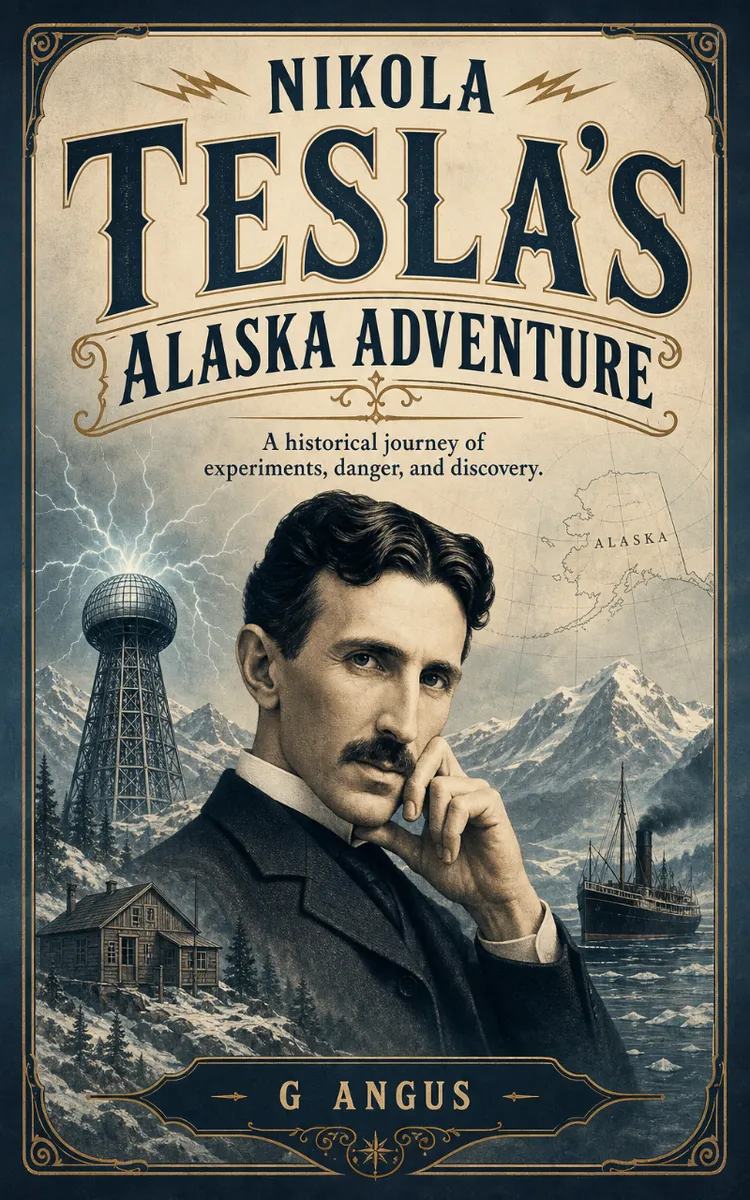
"Nikola Tesla's Alaska Adventure" is a fiction book by G Angus with 39 chapters and approximately 80,621 words. A historically grounded Tesla expedition to Alaska for cold-weather experiments..
This book was created using Inkfluence AI, an AI-powered book generation platform that helps authors write, design, and publish complete books. It was made with the AI Novel Writer.
Frequently Asked Questions
What is "Nikola Tesla's Alaska Adventure" about?
A historically grounded Tesla expedition to Alaska for cold-weather experiments.
How many chapters are in "Nikola Tesla's Alaska Adventure"?
The book contains 39 chapters and approximately 80,621 words. Topics covered include A Voyage North Begins, Crates Unloaded in Anchorage, Choosing the Interior Route, River Steamer to the Trading Post, and more.
Who wrote "Nikola Tesla's Alaska Adventure"?
This book was written by G Angus and created using Inkfluence AI, an AI book generation platform that helps authors write, design, and publish books.
How can I create a similar fiction book?
You can create your own fiction book using Inkfluence AI. Describe your idea, choose your style, and the AI writes the full book for you. It's free to start.
Write your own fiction book with AI
Describe your idea and Inkfluence writes the whole thing. Free to start.
Start writingCreated with Inkfluence AI


