
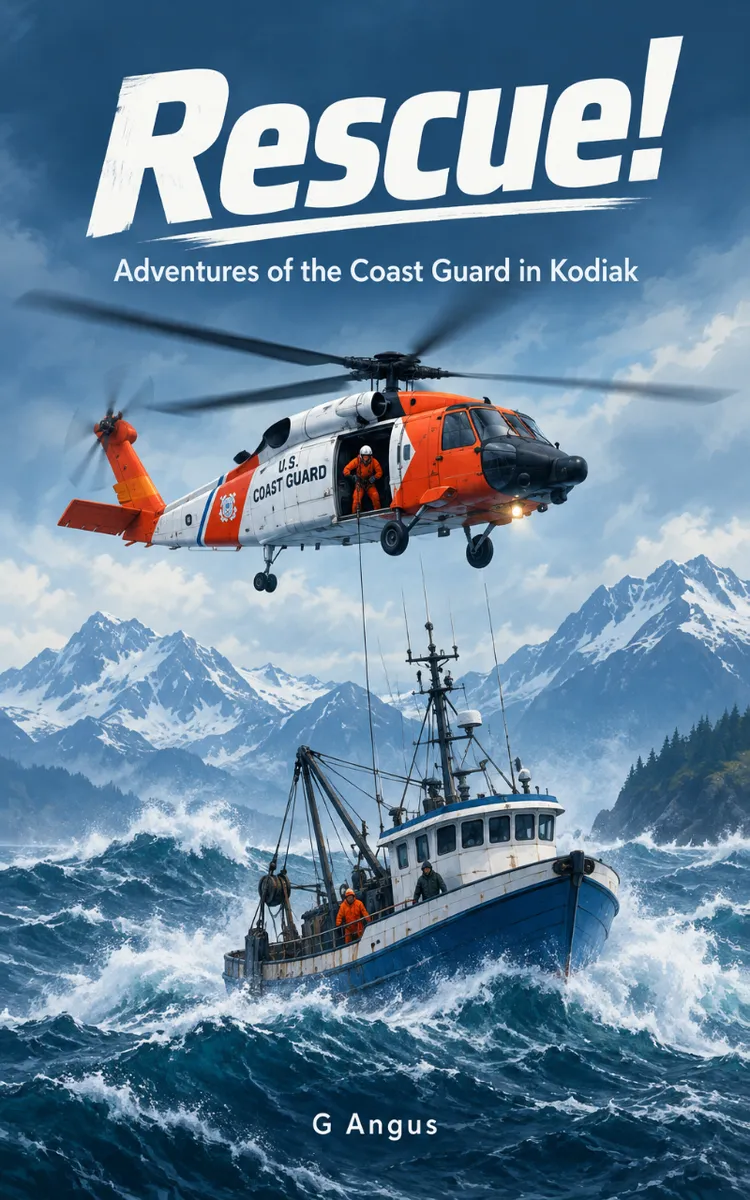

Read the first chapter
The whole of chapter one, free. About 8 min. Turn the pages with the arrows, your keyboard, or a swipe.
Chapter 1
The Kodiak Mayday
The alarm tore through the watch room just as Jim Stanton lifted his coffee.
“Mayday traffic,” the duty watchstander shouted. “Fishing vessel, storm conditions. Position coming through now.”
Jim set the mug down. Coffee sloshed across the chart table as the radio crackled again, buried beneath static and the hard hiss of wind.
“Mayday, mayday, mayday. This is - ” The voice broke apart. “Taking water - crew trapped - Kodiak - ”
Another burst of static swallowed the rest.
Outside, rain lashed the windows of the US Coast Guard Base in Kodiak, Alaska. The harbor lights smeared across the glass, yellow and trembling. Beyond them, the mountains had vanished into a wall of weather.
Jim leaned toward the speaker. “Bring it up.”
The watchstander adjusted the volume. A man’s voice returned, thin with distance and panic.
“ - engine room flooding. We’re in the channel. Repeat, we’re in the channel. Three aboard. One injured.”
Then came a sharp metallic crash, followed by a cry and silence.
Jim was already moving. He pulled his survival gear from the rack, the familiar weight settling across his shoulders. The room smelled of wet wool, coffee, and the rubberized fabric of storm gear.
“How far out?” he asked.
“Position’s incomplete,” the watchstander said. “Last transmission puts them near the north approach, close to the steep water.”
Jim looked toward the operations window. The storm had turned the harbor into a black, shifting sheet.
A cutter could reach them, but not quickly. A rescue boat might struggle through the channel. The helicopter was their best chance if Truman could get it airborne.
Jim grabbed the radio handset. “Get the flight crew moving.”
The reply came from the hangar channel, rough and immediate.
“Already moving,” Dean Truman said.
Truman’s voice carried no alarm. That was what made it convincing. He sounded like a man discussing a broken winch instead of launching into a storm that could fold an aircraft into the sea.
Jim pushed through the door into the rain.
Wind struck him sideways. Water stung his face and ran cold beneath his collar. Across the apron, the helicopter’s rotors began to turn, each blade slicing the darkness with a growing thump. Ground crew hurried beneath the aircraft, heads down, their reflective gear flashing in the floodlights.
Truman stood at the open side door, helmet on, one gloved hand raised.
“Stanton,” he called. “You’re with me.”
Jim climbed aboard and clipped into the cabin. The helicopter shuddered as the engines rose. A crewman secured the rescue litter while Jim checked his harness, mask, and fins by touch.
At the base of the ramp, Harry Edgecomb appeared in a dark foul-weather jacket, rain streaming from the brim of his cap. The cutter captain held a chart case against his chest.
“Boat’s name is North Star,” Edgecomb said. “Fishing vessel, thirty-eight feet. Three reported aboard. Last known position is unreliable.”
“Unreliable how?” Jim asked.
“The transmission broke before they finished giving coordinates.”
Truman glanced back from the cockpit. “Then we find them the old-fashioned way.”
Edgecomb’s eyes stayed on Jim. “The cutter is getting underway. We’ll approach from the south and keep clear of the channel mouth. If the weather closes it, you may be the only asset over them.”
Jim tightened his glove. “We’ll get them out.”
Edgecomb gave a short nod. “Get the living. Worry about the rest afterward.”
The helicopter lifted into the storm.
Kodiak disappeared beneath them almost at once. Rain hammered the windshield and turned the world into streaks of gray. The aircraft climbed over the harbor, then dropped toward the black water beyond the breakwater. Jim felt each gust through the cabin floor. The helicopter lurched hard enough to throw his shoulder against the restraint.
Truman corrected without comment.
Jim watched the sea through the side window. Waves rose in long, dark ridges, their tops torn white by the wind. Somewhere ahead, a fishing boat was taking on water in a channel narrow enough to punish any mistake.
The radio spat fragments.
“ - North Star - can’t hold - ”
“ - one overboard - ”
“ - lights to the east - ”
Jim turned toward the crewman at the radio station. “Did he say lights?”
“Unclear.”
Truman’s voice came through the headset. “I’ve got a contact.”
Jim leaned toward the window. At first he saw only rain and foam. Then a pale light appeared below, vanished behind a wave, and returned farther off.
The North Star emerged from the weather in pieces. Her bow slammed into a swell, rose, and came down crooked. One deck light glowed near the wheelhouse. Another flickered at the stern.
A second vessel rode beyond her, low and dark.
Jim pointed. “That the cutter?”
“No,” Truman said. “Too small.”
The unknown vessel turned slightly. Its running lights remained hidden from view, but a dim white glow moved along its deck.
“Can you identify it?” Jim asked.
“Not in this.”
The North Star rolled heavily. A figure appeared near the stern, waving both arms.
Truman brought the helicopter around. “We’ll make one pass.”
The rescue swimmer clipped his helmet into place. The cabin door opened, and the storm exploded inside. Rain struck like gravel. Jim tasted salt and fuel.
Below, the fishing boat pitched through the channel, boxed in by steep black slopes on either side. The water boiled white where submerged rock constricted the current. The North Star’s stern dropped into a trough, then rose with a deckhand clinging to the rail.
Jim saw the man fall.
“Man overboard!” he shouted.
Truman held the helicopter steady for half a second, then the wind shoved them sideways. The boat slipped beneath the aircraft, and the deckhand vanished into the foam.
“Hold on,” Truman growled.
The helicopter swung wide. Jim kept his eyes on the water, searching for a head, a hand, anything that moved against the breaking sea.
“There!” he yelled. “Two points right!”
Truman adjusted. The unknown vessel had moved closer. Its dark shape rode outside the channel, keeping pace with the North Star.
Jim forced his attention back to the water.
A red jacket surfaced between waves.
“Lower me!”
The cable dropped. Jim hooked into it, checked the connection, and gave the signal. The winch pulled him from the cabin.
Cold struck first, then the force of the wind. He swung beneath the helicopter, spinning over black water. The channel walls rushed past on either side, steep and slick with rain. A wave lifted him toward the sky and dropped him toward the next trough.
“Thirty feet!” the crewman called.
Jim released into the sea.
The impact drove the air from his lungs. Water closed over his helmet, icy enough to burn. He surfaced beneath the roar of the helicopter and saw the red jacket rise ten yards away.
The deckhand was face down.
Jim kicked hard, fighting the current. Each stroke carried him forward, then the channel dragged him back. The deckhand’s arm disappeared beneath a wave.
Jim reached him by the collar and rolled him over. The man’s face was gray, his mouth open, blood washing from a cut above one eye.
“Stay with me,” Jim shouted, though the storm tore the words away.
The man coughed seawater. His fingers closed weakly around Jim’s sleeve.
A wave broke over them. Jim locked one arm beneath the deckhand’s shoulders and raised the other toward the helicopter. The cable descended, whipping in the wind.
He caught it on the second attempt.
The winch began to pull. The deckhand’s weight dragged against Jim’s injured shoulder, and the current swung both men toward the rocks. Jim kicked away from the channel wall as spray burst over the black stone.
“Pull!” he yelled.
The cable tightened. Water streamed from the deckhand’s clothes as they rose. Below them, the North Star slammed bow-first into a wave. For a moment, her stern lifted high enough to expose the propeller.
Then the vessel dropped out of sight behind the swell.
Jim and the deckhand swung toward the helicopter. The unknown vessel was still there, pacing them beyond the channel. A brief flash appeared on its deck, too bright and steady to be a navigation light.
Jim stared at it until the cable hauled him into the cabin.
Hands seized the deckhand and dragged him inside. Jim followed, landing hard on the deck. The cabin door slammed shut against the storm.
The injured man coughed and vomited seawater. Jim rolled him onto his side and checked his breathing.
“Pulse is weak,” he said. “Get oxygen on him.”
The crewman fitted the mask while Jim pressed gauze against the wound. The deckhand’s eyelids fluttered.
“Boat,” he whispered.
“Your crew is still aboard,” Jim said. “We’re going back.”
The helicopter banked toward the North Star. Through the window, Jim saw the fishing boat wallowing near the channel wall. One man stood in the wheelhouse doorway, waving a flashlight. Another figure moved along the deck, struggling with a line.
The unknown vessel had disappeared.
“Where’d it go?” Jim asked.
Truman’s reply was clipped. “Lost in the rain.”
The radio crackled.
“Coast Guard aircraft, this is North Star,” the captain said. His voice shook beneath the static. “We have one crewman aboard. Engine room’s flooded. We’re losing steerage.”
Jim lifted the handset. “North Star, this is rescue swimmer Stanton. We have your injured deckhand. Prepare for extraction of the remaining crew.”
“Negative,” the captain answered. “We can’t hold position for a hoist.”
“Then keep your bow into the waves.”
“We’re trying.”
The helicopter circled as the North Star drifted toward the narrowest part of the channel. The cutter’s voice came through next, steady beneath the interference.
“Aircraft, this is Edgecomb. Cutter is four minutes out. Can you stabilize the fishing vessel?”
“Not from here,” Truman said.
Jim looked down at the boat. “The captain has a line over the stern.”
“That line won’t save them,” Truman said.
The North Star rolled again. The man on deck disappeared behind the wheelhouse. A moment later, the flashlight flashed three times.
Jim grabbed the microphone. “North Star, report.”
For several seconds, there was only static.
Then the captain answered. “We’re not alone out here.”
Jim looked toward the rain-blurred darkness beyond the channel.
“What do you mean?”
“That vessel’s back,” the captain said. “It’s following us.”
A shape moved through the storm, low and silent, just outside the channel mouth.
Truman banked away from the fishing boat to make room for the cutter’s approach. Below, the North Star fought the current with her bow pointed toward the rocks.
Jim kept one hand on the injured deckhand’s shoulder and watched the unidentified vessel pace them through the rain.
The rescue had succeeded, but the storm had left something behind.
End of chapter one. 32 more chapters and about 65,503 words in the full book.
Swipe or use the arrows to turn the page


What's inside: 33 chapters
- 1. The Kodiak Mayday
- 2. Truman Takes the Controls
- 3. A False Fishing Log
- 4. The Strait Closes In
- 5. The Swimmer’s Doubt
- 6. A Cable Snaps
- 7. The Signal in the Spray
- 8. The Deck Goes Under
- 9. The Risk of the Rope
- 10. The Helicopter Turns Back
- 11. Coordinates in the Static
- 12. The Rocks Below
- 13. A Swimmer’s Promise
- 14. The Man Overboard
- 15. The Missing Transponder
- 16. The Inlet’s Blind Corner
- 17. The Smuggler’s Route
- 18. The Cost of the Call
- 19. Edgecomb’s Intercept
- 20. The Package Below
- 21. The Icebound Passage
- 22. The Pilot’s Hard Limit
- 23. The Empty Hold
- 24. The Cut Line
- 25. No One in the Water
- 26. The Shoal’s Last Exit
- 27. Stanton’s Second Wind
- 28. The Hidden Manifest
- 29. The Fleet Under Fire
- 30. The Swimmer Comes Ashore
- 31. The Cutter Comes Home
- 32. Truman’s Quiet Approval
- 33. Another Call at Dawn
About this book
"Rescue!" is a fiction book by G Angus with 33 chapters and approximately 65,503 words. Coast Guard rescue missions and drug-smuggling interdictions off Kodiak, Alaska.
This book was created using Inkfluence AI, an AI-powered book generation platform that helps authors write, design, and publish complete books. It was made with the AI Novel Writer.
Frequently Asked Questions
What is "Rescue!" about?
Coast Guard rescue missions and drug-smuggling interdictions off Kodiak, Alaska
How many chapters are in "Rescue!"?
The book contains 33 chapters and approximately 65,503 words. Topics covered include The Kodiak Mayday, Truman Takes the Controls, A False Fishing Log, The Strait Closes In, and more.
Who wrote "Rescue!"?
This book was written by G Angus and created using Inkfluence AI, an AI book generation platform that helps authors write, design, and publish books.
How can I create a similar fiction book?
You can create your own fiction book using Inkfluence AI. Describe your idea, choose your style, and the AI writes the full book for you. It's free to start.
Write your own fiction book with AI
Describe your idea and Inkfluence writes the whole thing. Free to start.
Start writingCreated with Inkfluence AI


