

Read the first chapter
The whole of chapter one, free. About 7 min. Turn the pages with the arrows, your keyboard, or a swipe.
Chapter 1
Recognizing Your Emotional Triggers
The Moment Before You Snap
At 8:17 on a Tuesday morning, a customer says, “I thought this would be finished yesterday.”
You’re already behind. Your phone has buzzed six times. You skipped breakfast. You read the message as criticism, even though it could have been a simple question. Your shoulders tighten. Your jaw locks. Before you’ve decided what to do, you type, “As I already explained,” and hit send.
Then comes the familiar aftermath. You reread the message and notice the sharpness. Your stomach drops. You tell yourself you shouldn’t have reacted that way. Maybe you send a second message to smooth things over, or maybe you leave it alone and carry the irritation into the next conversation. One small moment has now taken over the morning.
The important part isn’t only the message. It’s the pattern around it: the situation, the body sensation, and the meaning your mind attaches to both. Do you recognise this in yourself?
The Question Beneath the Reaction
What if the first thing upsetting you isn’t the real trigger?
A late payment, a blunt text, a child refusing to get ready, or a coworker changing the plan can start the reaction. But the intensity often comes from what the moment seems to prove. “They don’t respect me.” “I’m being taken for granted.” “I’m going to be stuck fixing this.” The event is real. The conclusion may be a fast guess.
That guess can arrive so quickly that it feels like a fact. Your chest tightens, and your mind supplies a reason. The body sensation makes the assumption feel more convincing. Then the assumption pushes you toward an action: argue, withdraw, over-explain, slam a door, check your phone repeatedly, or say nothing while quietly building a case against someone.
Consider the customer message from the opening. Before noticing the pattern, you might read it, feel heat in your face, and answer defensively. After using the Trigger Map, you pause long enough to name what’s happening: “The situation is a deadline question. My body feels braced. My assumption is that I’m being blamed.” That doesn’t make the message pleasant. It gives you room to reply, “I’m still finishing it. I can send you an update by 3 p.m.”
The shift isn’t from anger to cheerfulness. It’s from automatic reaction to accurate information. You’re not trying to convince yourself that everything is fine. You’re checking what is actually happening before your first interpretation takes the wheel.
How a Trigger Takes Over
Here’s the usual chain:
1. When someone questions your work or changes the plan at the last minute, your brain reads the moment as a threat to control, competence, or respect. 2. You feel heat, tightness, pressure, restlessness, or a sudden drop in your stomach. 3. So you assume the other person is careless, disrespectful, demanding, or trying to make you look bad. 4. Which leads to a sharp reply, avoidance, overworking, shutting down, or replaying the moment for hours.
The alternative chain is slower by only a few seconds:
1. When the same trigger happens, you mark the situation without adding a verdict: “The plan changed,” or “They asked when it will be done.” 2. You feel the body response and name it: “My jaw is tight. I’m bracing.” 3. So you test the assumption: “Do I know they’re blaming me, or do I feel blamed?” 4. Which leads to a deliberate response: ask one clear question, set a time, take a short break, or answer after your body settles.
This is the Trigger Map: situation, sensation, assumption, response. It works because it separates facts from forecasts. The situation tells you what happened. The sensation tells you your nervous system is activated. The assumption tells you the story forming around the event. The response is where you regain a choice.
You don’t need to map every emotion in your life. Start with the reactions that repeat. If the same kind of message ruins your morning three times a week, that’s useful information. Repetition gives you something specific to work with.
Name the trigger before it names your next move.
Rate Your Trigger Awareness
Use the questions below when you’re calm enough to answer honestly. Don’t rate the person you wish you were. Rate what usually happens on a normal difficult day.
1. From 1 to 10, how quickly can you notice a physical sign that you’re getting activated? A 1 may mean you only notice after the argument. An 8, 9, or 10 means you can catch signs such as clenched hands, fast speech, a hot face, or shallow breathing while the reaction is building.
2. Yes or no: Can you name the situation that set you off without describing the other person’s character? “They’re impossible” is a judgment, not a situation. “They changed the delivery time after I arranged the crew” gives you something concrete to examine.
3. From 1 to 10, how strongly do your first assumptions feel like facts? A high score doesn’t mean you’re irrational. It means your mind moves quickly from “They haven’t replied” to “They’re ignoring me.” That’s a useful place to slow down.
4. Yes or no: Have you changed your response after identifying the trigger? If the answer is no, you may be noticing the pattern but not yet creating enough space to act differently. That’s not failure. It shows the next skill to practise.
For a quick interpretation, low awareness usually means you need to focus on body sensations first. Middle scores often mean you can see the trigger afterward but miss it in real time. Higher scores suggest you’re ready to work on the assumption and response. Don’t chase a perfect score. The goal is to catch the pattern earlier than you did last time.
The Ten-Minute Trigger Map Challenge
Track one repeating trigger before it runs the day.
1. Choose one trigger and record it today. Timing: Spend five minutes before bed. Difficulty: Easy. Pick one repeat event, such as unanswered messages, last-minute changes, being interrupted, or feeling corrected. Write four short lines: Situation, Sensation, Assumption, Response. Keep the wording plain. “Client asked for another change” is better than a paragraph about how inconsiderate clients are.
2. Catch the body signal once tomorrow. Timing: Use the first moment you notice activation, ideally before replying or speaking. Difficulty: Medium. Stop for ten seconds. Put both feet on the floor. Name one sensation and take one slower exhale. Then ask, “What do I know, and what am I assuming?” You’re not trying to become calm on command. You’re interrupting the automatic chain.
3. Choose a response that fits the facts. Timing: Take two minutes after the trigger, or before sending the message. Difficulty: Hard. Pick one action: ask for clarification, give a realistic time, say you need a break, or answer only the actual question. Write down what happened afterward. This helps your brain learn that noticing a trigger can lead to a useful outcome, not just more thinking.
You’ll know it’s working when:
• You notice a body signal before your words come out. - You can separate what happened from what you think it means. - Your reply is shorter, clearer, or delayed instead of sharper.
The first few attempts may feel clumsy. You may remember the Trigger Map ten minutes too late. That still counts. Awareness usually arrives after the reaction before it arrives during the reaction. Keep tracking the same trigger for three days. Changing targets every day makes it harder to see the pattern.
Start With What Your Body Already Knows
Your strongest reactions usually leave clues before they become visible.
Look for the early signs: your grip tightening around the steering wheel, rereading a text, speaking faster, feeling suddenly cold, holding your breath, or needing to prove your point immediately. These aren’t random annoyances. They’re signals that your system has decided something important is at risk.
The situation may be small, but the assumption can connect it to an older pressure. A delayed reply becomes “I don’t matter.” A mistake becomes “I’m failing.” A request for help becomes “Everything depends on me.” You don’t have to argue with the assumption or shame yourself for having it. Just label it accurately. A label creates distance without pretending the feeling isn’t real.
Try this today with the next noticeable reaction: write one sentence for each part of the Trigger Map. Keep the sentences separate. “The supplier moved the date.” “My stomach dropped.” “I assumed they didn’t care about the impact on me.” “I called to confirm the new plan instead of sending an angry message.” That small separation is where choice begins.
The point isn’t to become unbothered. Some situations deserve anger, boundaries, and direct action. The point is to know whether your response is aimed at the actual situation or at the story your alarm system added. Once you can spot that difference, you’re ready to look more closely at what happens in the pause between feeling triggered and deciding what to do.
End of chapter one. 7 more chapters and about 12,210 words in the full book.
Swipe or use the arrows to turn the page


What's inside: 8 chapters
- 1. Recognizing Your Emotional Triggers
- 2. Separating Feelings from Identity
- 3. Using the Four-Step Pause
- 4. Cooling Frustration Before It Spreads
- 5. Speaking Clearly During Conflict
- 6. Setting Limits Before Burnout
- 7. Recovering After an Emotional Slip
- 8. Building Regulation Into Real Life
About this book
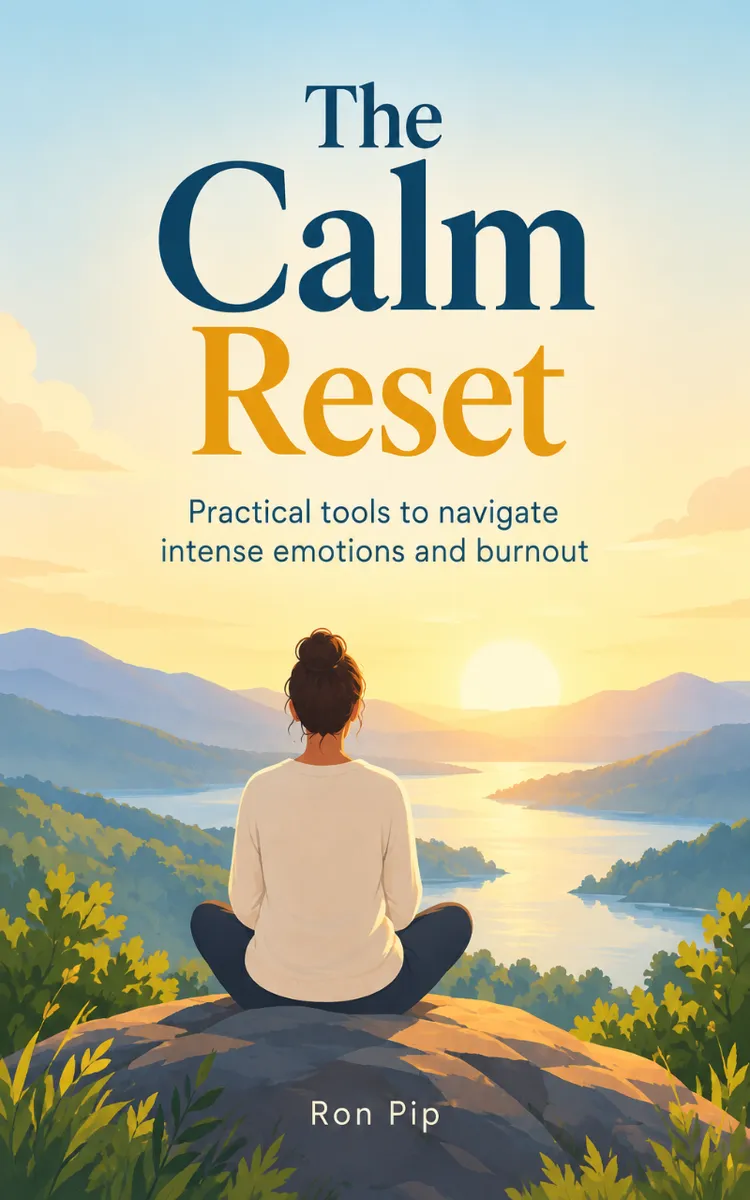
"The Calm Reset" is a self-help book by Ron Pip with 8 chapters and approximately 12,210 words. Managing emotional triggers, frustration, and burnout with realistic self-help strategies.
This book was created using Inkfluence AI, an AI-powered book generation platform that helps authors write, design, and publish complete books. It was made with the AI Self-Help Book Writer.
Frequently Asked Questions
What is "The Calm Reset" about?
Managing emotional triggers, frustration, and burnout with realistic self-help strategies
How many chapters are in "The Calm Reset"?
The book contains 8 chapters and approximately 12,210 words. Topics covered include Recognizing Your Emotional Triggers, Separating Feelings from Identity, Using the Four-Step Pause, Cooling Frustration Before It Spreads, and more.
Who wrote "The Calm Reset"?
This book was written by Ron Pip and created using Inkfluence AI, an AI book generation platform that helps authors write, design, and publish books.
How can I create a similar self-help book?
You can create your own self-help book using Inkfluence AI. Describe your idea, choose your style, and the AI writes the full book for you. It's free to start.
Write your own self-help book with AI
Describe your idea and Inkfluence writes the whole thing. Free to start.
Start writingCreated with Inkfluence AI


