

Read the first chapter
The whole of chapter one, free. About 6 min. Turn the pages with the arrows, your keyboard, or a swipe.
Chapter 1
Boxing Day, 1898
Before I take you to that paddock, I want you to meet the Murphys. Before they were a crime scene, a headline and a mystery, they were a family. Three of them woke up on Boxing Day morning in 1898 with plans for the night ahead. None of them would see another sunrise.
First, you need to picture where they lived, and when.
In 1898, there was no Australia. There was no Commonwealth, no federal parliament and no such thing as an Australian. There were six British colonies sharing one big continent, each with its own government, its own laws and its own police force. That year, four of them put the question of joining together to a vote. Queensland didn't even take part. It would be another three years before the colonies became one country.
So when I say the Gatton Murders shocked a nation, I have to be careful, because the nation didn't exist yet. What the murders did was shock the colony of Queensland to its core. Then, as the story spread through the newspapers, it shocked every other colony too. For a few weeks that summer, people who agreed on almost nothing were all reading about the same three young people.
Gatton sits in the Lockyer Valley, about 98 kilometres west of Brisbane, on the road and the railway line between Ipswich and Toowoomba. In 1898, it was a small country town. A census a few years later counted just 449 people living there. It had a post office, a police station, a courthouse, a school, a Catholic church and more hotels than a town that size probably needed. An agricultural college had opened just outside town the year before, and the district around it was turning to dairy farming.
Anyone who has grown up in a small country town, here in New Zealand or across the Tasman, knows what kind of place it was. Everybody knew everybody. Everybody knew everybody's business. You went to the same church, the same shop and the same dances, and you married someone you'd known since school. Doors weren't locked. Children walked the roads on their own. Terrible things happened in the big cities, not in places like Gatton.
But the 1890s had been a hard decade in Queensland. The banks had crashed in 1893, and families had walked off land they had spent years clearing. There had been bitter shearers' strikes, with soldiers sent into country towns. By 1898, the roads were full of men carrying swags on their backs, moving from town to town looking for work that wasn't there and sleeping rough in the bush. Everybody had seen them, and most people didn't think twice about them.
Remember those men on the roads. When something terrible happened in a country district back then, the first thing people thought of was a stranger passing through. That idea would shape the whole investigation into what happened to the Murphys, and it may be the reason their killer was never caught.
Daniel and Mary Murphy had both come out from Ireland in the 1860s, separately, with very little to their names. Daniel worked as a labourer building the very railway line between Ipswich and Toowoomba that made Gatton a town. Mary worked in service, cooking and cleaning in other people's houses. They met, they married, and they worked hard.
By 1898, they were renting a dairy farm of a little over 300 acres out at Blackfellow's Creek, about 13 kilometres from Gatton. Over thirty years they had raised ten children. They were Irish Catholics, and devout ones, and every Sunday the family went to Mass at St Mary's in Gatton. They weren't rich, but they were respected, and for two Irish labourers who had started with nothing, that respect meant everything. It was what they had built.
Eight of their ten children were still living at home, squeezed into a five-room cottage on the farm. Two of the sons had moved away to work. Daniel junior, who was 21, was a police constable in Brisbane. Michael, who was 29, worked on a government experimental farm out at Westbrook, near Toowoomba.
Michael had come home for Christmas.
By all accounts he was a fine young man. He was good-looking, fit and strong, a good horseman and a quiet, good-natured sort of fellow. He had a steady government job and a bit of money in his pocket. He was the kind of son a mother is proud of, and the kind of brother his younger sisters looked up to.
Norah was 27. Her proper name was Honora, but nobody called her that. She was the one who kept the household running alongside her mother, cooking, cleaning, washing and helping to look after the little ones. In a big farming family, there is always someone like Norah, the one who holds everything together and doesn't get thanked for it nearly enough.
Ellen was 18, the baby of the three. She had been christened Theresa, but the family called her Ellen. From everything that has come down to us, she was the bright, lively one of the family. She was well liked and full of fun, and she had more young men interested in her than she had time for. She was right at the age where life was just beginning to open up.
Their eldest sister, Polly, was married to a man named William McNeil. He will turn up again and again in this story, so remember his name.
On Christmas Day, 1898, the whole Murphy family went to Mass together. Everyone who later spoke about that day said they were in good spirits. It was Christmas, Michael was home, and the family was together. It was a happy time.
Boxing Day dawned hot. A Queensland summer was settling in, the kind of heat that sits on you from first light. The creeks were already lower than they should have been. Nobody knew it yet, but a long, cruel drought was on its way.
There were races that day at Mount Sylvia, not far from the farm, and several of the Murphys went along. Michael took Ellen, and some of their brothers went too, along with Polly and her husband, William McNeil. For a farming family who worked from dawn till dark every other day of the year, a day at the races was a real treat. They watched the horses, they ate and drank, and they caught up with the neighbours.
But the main event was still to come. That night, there was to be a dance at the hall in Gatton.
You have to understand what a country dance meant to young people in 1898. There was no television, no radio, no picture theatre and no cars to drive into the city. In a farming district, the dance was the social event of the season. It was where you saw your friends, showed off your best clothes and, if you were lucky, met someone special. For a lively 18-year-old girl like Ellen, a Boxing Day dance would have been the highlight of the holidays.
Michael offered to drive his two sisters into town. It was a kind thing to do. A brother home from work, taking his sisters out for the night and seeing that they got there and back safely. That was the plan.
William McNeil lent them his sulky, a light two-wheeled horse-drawn cart, so the girls wouldn't have to ride on horseback in their good clothes. It was an old cart, and one of its wheels had a wobble in it. Remember that wobble. It's going to matter.
As the heat of the day eased off, the three of them went to get ready. Michael put on his good suit. Norah and Ellen put on long dark skirts and light blouses. Michael tucked a small leather purse into his pocket with fifteen shillings in it, enough money to make a proper night of it.
They were three grown-up brothers and sisters heading out together to a dance, as country kids had done for generations.
Their mother would stand and watch them drive away down the track that evening.
She would never see them alive again.
End of chapter one. 11 more chapters in the full book.
Swipe or use the arrows to turn the page

THE KILLER WHO STAYED

THE KILLER WHO TURNED CABIN 28 INTO A SLAUGHTERHOUSE

THE KILLER WHO WORE A WHITE MASK
What's inside: 12 chapters
- 1. Boxing Day, 1898
- 2. The Dance That Never Was
- 3. The Wobbly Wheel
- 4. Moran's Paddock
- 5. Trampled
- 6. A Hoax in Brisbane
- 7. What the Bodies Told
- 8. Dug Up Again
- 9. The Butcher's Man
- 10. The Vagabond and the Family
- 11. A Rotten System
- 12. Who Killed the Murphys?
About this book
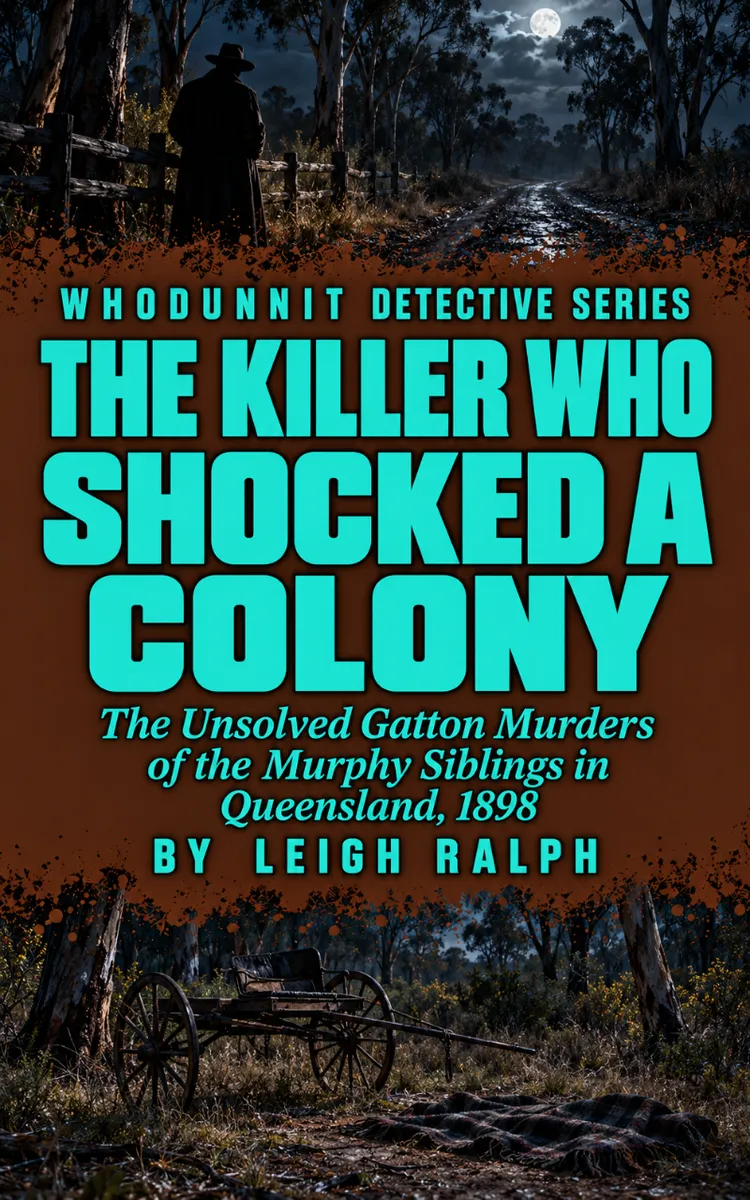
"THE KILLER WHO SHOCKED A COLONY" is a general book by Leigh Ralph with 12 chapters and approximately 15,185 words. It covers key insights and practical takeaways on the topic.
This book was created using Inkfluence AI, an AI-powered book generation platform that helps authors write, design, and publish complete books.
Frequently Asked Questions
What is "THE KILLER WHO SHOCKED A COLONY" about?
"THE KILLER WHO SHOCKED A COLONY" is a general book by Leigh Ralph covering key insights and practical takeaways on the topic.
How many chapters are in "THE KILLER WHO SHOCKED A COLONY"?
The book contains 12 chapters and approximately 15,185 words. Topics covered include Boxing Day, 1898, The Dance That Never Was, The Wobbly Wheel, Moran's Paddock, and more.
Who wrote "THE KILLER WHO SHOCKED A COLONY"?
This book was written by Leigh Ralph and created using Inkfluence AI, an AI book generation platform that helps authors write, design, and publish books.
Write your own book with AI
Describe your idea and Inkfluence writes the whole thing. Free to start.
Start writingCreated with Inkfluence AI


