
Read the first chapter
The whole of chapter one, free. About 9 min. Turn the pages with the arrows, your keyboard, or a swipe.
Chapter 1
The Soft Power Sales Pitch
The Offer That Arrives as Help
In 2011, the United Nations appointed Hillary Rodham Clinton, then the United States secretary of state, to deliver a speech in Geneva defending the rights of gay people. The speech was presented not as a demand that societies abandon their traditions, but as an extension of familiar principles: freedom, dignity, safety, and equal treatment. The language was carefully chosen. It made advocacy sound less like cultural export than humanitarian assistance.
That distinction matters because foreign policy rarely travels under its own name. Governments do not usually announce that they are sending influence abroad. They speak of partnership, technical support, public health, civil society, or human rights. LGBTQ advocacy can be included within each of those categories, and once it is, the political question becomes harder to see.
The central mystery is not whether Western governments support LGBTQ rights. Many openly do. It is how support becomes an international offer - and why that offer can appear, in one place, as solidarity and, in another, as pressure.
When does help remain help after it crosses a border?
How Advocacy Learned the Language of Assistance
The modern Western approach did not emerge all at once. It grew from several older traditions that were gradually joined together: missionary work, development aid, public-health campaigns, democracy promotion, and the international human-rights system created after the Second World War.
The Universal Declaration of Human Rights, adopted in 1948, gave governments and organizations a common vocabulary for discussing human dignity. It did not specifically mention sexual orientation or gender identity. Those terms entered international debate much later, through legal arguments, court decisions, United Nations resolutions, donor programs, and the work of local activists. A concern that had once been treated as private or criminal was increasingly described as a matter of equal protection.
This shift changed the shape of Western advocacy. Instead of saying, “Our society has reached the correct answer,” officials could say, “No person should be beaten, imprisoned, or denied basic services because of who they are.” That claim has a wider reach. It can be attached to constitutions, police training, health clinics, refugee assistance, and anti-discrimination law without requiring every society to adopt the same family customs or public style.
The language of human rights is powerful partly because it sounds universal. The language of development is powerful because it sounds practical. A foreign ministry may fund legal aid for vulnerable people, a health agency may support HIV prevention, and an international foundation may train community organizations. Each program can be described as assistance. Yet each also carries assumptions about which institutions should change, which identities should be publicly recognized, and what a fair society ought to look like.
This is the first layer of the Soft-Power Packaging Test: identify the label on the parcel before judging what is inside. Is the program presented as emergency relief, health work, legal reform, democracy support, or identity advocacy? The label does not prove that the work is manipulative. It reveals how influence is made acceptable.
A striking example came after the United States formally recognized LGBTQ rights as part of its foreign-policy agenda. American embassies hosted events, diplomats met activists, and grants supported organizations working against discrimination. European governments and institutions pursued similar policies through development funding and diplomatic statements. The message was often framed around protection from violence or unequal treatment rather than around copying Western social life.
That distinction was not merely public relations. It reflected a genuine tension. Many local activists wanted outside resources and international attention, especially where domestic institutions ignored abuse. At the same time, they understood that foreign support could make their work easier to dismiss as imported. The same grant that helped pay for legal assistance could be cited by opponents as evidence that activists were agents of another country.
Soft power works through this ambiguity. It persuades not only by force of argument, but by making one set of ideas appear connected to useful services, respected institutions, and moral legitimacy.
Why the Package Travels So Easily
The appeal of this framing rests on a simple human fact: people often encounter politics through services before they encounter it through theories.
A clinic does not begin by asking a patient to accept a philosophy of sexuality. A lawyer helping someone contest an unlawful arrest does not need a seminar on Western individualism. A shelter, hotline, or document-replacement program can meet an immediate need. This makes LGBTQ advocacy portable. It can move through familiar channels of humanitarian work even when the surrounding political language is controversial.
The international aid system also has established machinery for carrying ideas across borders. Embassies, nonprofit organizations, United Nations agencies, universities, and philanthropic foundations already know how to fund projects, measure results, and identify local partners. A new concern can enter this system by adopting its vocabulary. “Protection,” “capacity building,” “access to justice,” and “inclusive health services” are terms that can pass through a budget meeting more easily than “social transformation.”
There is a practical reason for this. Directly telling another government to change its moral or family laws is likely to provoke resistance. Supporting a local organization that documents violence may be seen as less intrusive. The policy may be substantially similar in its long-term effect, but its presentation is different. Influence is softened by the route it takes.
The comparison is not entirely cynical. A fire department that teaches safety standards abroad is spreading a model, but it may also be preventing deaths. Foreign support for LGBTQ people can likewise contain both genuine protection and strategic influence. These motives are not mutually exclusive. Governments can care about human rights while also using human-rights policy to strengthen alliances, distinguish themselves from rivals, or improve their international image.
That mixture is precisely what makes the subject difficult. The question is not whether Western advocacy is “really” humanitarian or “really” political. It is how the humanitarian and political elements interact.
The Soft-Power Packaging Test asks three questions. What immediate problem does the program address? Who defines that problem? And what political identity becomes attached to the solution? Consider HIV prevention. The immediate concern may be infection, access to medicine, or stigma in medical settings. But the project may also create a network of local organizations, introduce new legal language, and encourage public recognition of groups previously treated as invisible. Those effects may be beneficial, contested, or both.
A single program can therefore be read in two ways. Supporters see a neglected population finally receiving protection. Critics see an outside power using money and moral language to rearrange society. The program’s practical details matter, but so does the history surrounding it: colonial rule, unequal trade, military intervention, and the memory of foreign experts arriving with confident answers.
The History Hidden Inside a Modern Message
Western governments often present LGBTQ advocacy as a break from older forms of domination. Yet many societies receiving that advocacy remember a different history. European colonial administrations frequently imposed or strengthened laws criminalizing same-sex relations. In parts of the British Empire, legal codes influenced by Victorian Britain survived after independence. The colonial state’s categories became local law, even when the societies themselves had older and more varied ways of understanding sexuality and gender.
This history creates a political paradox. Some Western governments now urge countries to repeal laws that were, in important cases, introduced or hardened under Western rule. The present message may be defensible, but it arrives carrying the shadow of the past.
That shadow is especially visible when international actors describe LGBTQ rights as evidence of modernity. The implied timeline can sound familiar: traditional society lies behind, enlightened society lies ahead, and Western countries occupy the front of the procession. Even when no official says this directly, funding patterns, conference language, and media coverage can suggest it. Local critics may reject discrimination while also rejecting the idea that their societies need to become culturally Western in order to become just.
The word tradition is equally complicated. Political leaders sometimes invoke tradition to defend criminal penalties or suppress public discussion. Yet local LGBTQ communities may draw on regional histories, religious debates, family networks, and older gender categories to explain their lives. Neither “tradition” nor “the West” is a single, stable thing. Both are political packages assembled for particular arguments.
A useful comparison comes from language itself. Translation is never only the replacement of one word with another. A translator must decide which meaning matters, which associations can be carried across, and which will be lost. International advocacy faces the same problem. Terms such as “gay,” “transgender,” “pride,” and “coming out” have histories rooted in particular movements. They can offer recognition, but they can also flatten local identities into categories designed elsewhere.
That does not make the categories false. It means they have a route, a history, and a price. The Soft-Power Packaging Test keeps those features visible.
The Unexpected Power of the Local Messenger
The surprising fact is that Western funding does not always make LGBTQ advocacy look more Western. In some settings, local groups use foreign resources to build arguments rooted in local law, religion, family life, or national history.
This changes the usual picture. Influence does not move in a straight line from a Western government to a passive population. Money, legal ideas, and public language are received by people who select, revise, and sometimes redirect them. A grant can support a campaign that its donor did not anticipate, while a donor’s preferred language can be quietly replaced by terms that make sense locally.
The distinction matters because it separates support from control without pretending that power disappears. Local actors may have real agency, yet their choices are shaped by which projects donors will fund, which language international institutions recognize, and which forms of evidence count as credible. Independence can exist inside dependence.
Leila, a 34-year-old NGO program coordinator in Amman, occupies this complicated middle ground. Her work involves coordinating services, reporting to funders, and maintaining relationships with local organizations. In practice, that means moving between several vocabularies in the same week: protection from violence, access to health care, family pressure, religious interpretation, legal risk, and donor expectations.
Amman is not a blank stage onto which Western ideas are projected. It is a city with its own political arguments, class divisions, religious traditions, professional networks, and histories of regional displacement. For Leila, an international grant may provide funds for counseling or legal support, but the project still has to survive local scrutiny. A proposal written in the language of global rights may need to be explained through the language of safety, privacy, and family responsibility.
The practical work is therefore less glamorous than the speeches that surround it. It involves deciding what can be said publicly, which partner can safely be named, how a service is advertised, and how a report describes results without exposing people to danger. Leila’s position shows why the phrase “Western influence” can be too blunt. The funds may originate abroad, but the risks are experienced locally, and the final shape of the work is negotiated by people who know the setting far better than distant officials do.
Her situation also reveals the weakness of the simple “dark purpose” story. Foreign governments may use advocacy to gain moral authority, but that does not erase the reality of people seeking assistance. Nor does the reality of need erase the unequal power built into the funding relationship. Help can be sincere and politically useful at the same time.
What the Package Reveals
The soft-power sales pitch succeeds because it connects moral claims to ordinary forms of assistance. A legal clinic, a health program, or a diplomatic statement can protect people while also carrying a picture of what legitimate citizenship and modern government should look like. The package travels because its contents are often useful, its labels are familiar, and its political weight is easy to overlook.
Human beings rarely receive ideas in pure form. We encounter them through institutions, relationships, money, emergencies, and the people who make them understandable. That is why the most important question is not simply who sent the message, but who had to translate it, negotiate it, and live with its consequences.
A border does not stop an idea; it changes the idea’s meaning. Somewhere between the embassy, the grant agreement, and Leila’s crowded office in Amman, advocacy becomes something neither wholly foreign nor wholly local - and that transformation is where the deeper story begins.
End of chapter one. 7 more chapters in the full book.
Swipe or use the arrows to turn the page


What's inside: 8 chapters
- 1. The Soft Power Sales Pitch
- 2. Aid That Comes With Terms
- 3. The Celebrity Lobby Pipeline
- 4. Missionaries of Rights or Control?
- 5. NGOs as the Invisible Embassy
- 6. Crisis Narratives That Mobilize Funds
- 7. Media Wars Over “Western Values”
- 8. The Dark Purpose Question, Reframed
About this book
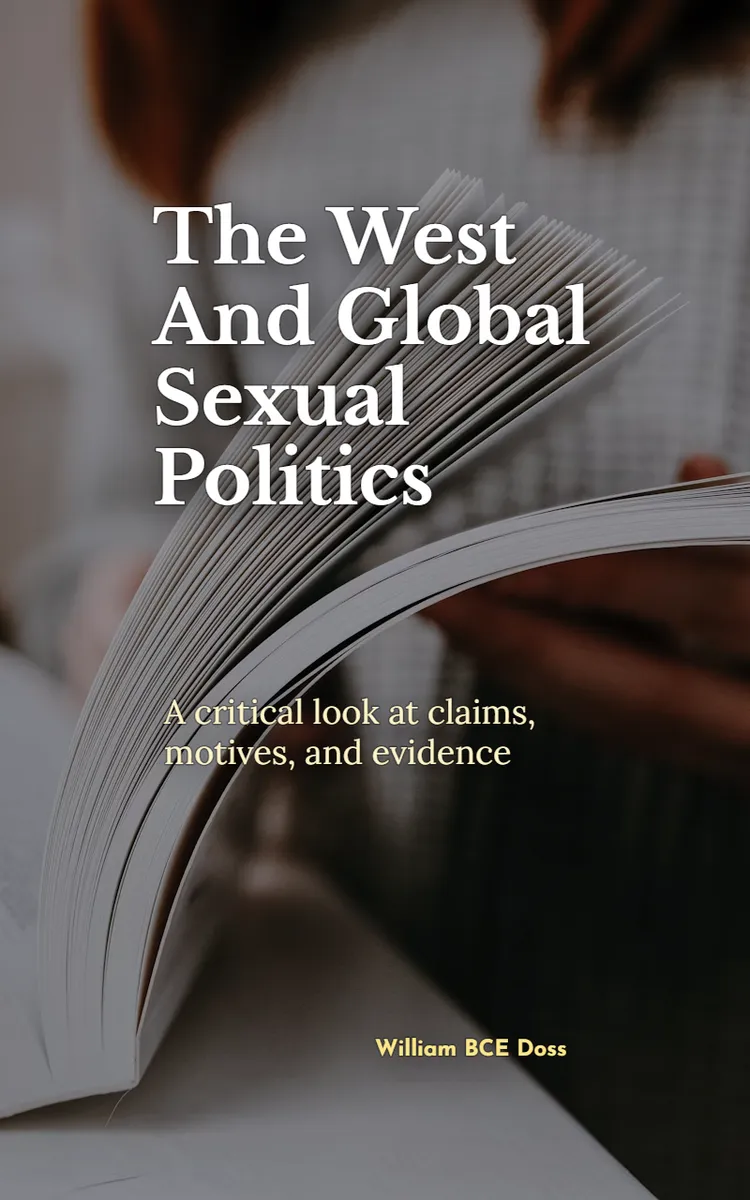
"The West And Global Sexual Politics" is a curiosity book by William BCE Doss with 8 chapters and approximately 13,586 words. Debate over Western influence on global LGBTQ rights.
This book was created using Inkfluence AI, an AI-powered book generation platform that helps authors write, design, and publish complete books.
Frequently Asked Questions
What is "The West And Global Sexual Politics" about?
Debate over Western influence on global LGBTQ rights
How many chapters are in "The West And Global Sexual Politics"?
The book contains 8 chapters and approximately 13,586 words. Topics covered include The Soft Power Sales Pitch, Aid That Comes With Terms, The Celebrity Lobby Pipeline, Missionaries of Rights or Control?, and more.
Who wrote "The West And Global Sexual Politics"?
This book was written by William BCE Doss and created using Inkfluence AI, an AI book generation platform that helps authors write, design, and publish books.
Write your own curiosity book with AI
Describe your idea and Inkfluence writes the whole thing. Free to start.
Start writingCreated with Inkfluence AI


