
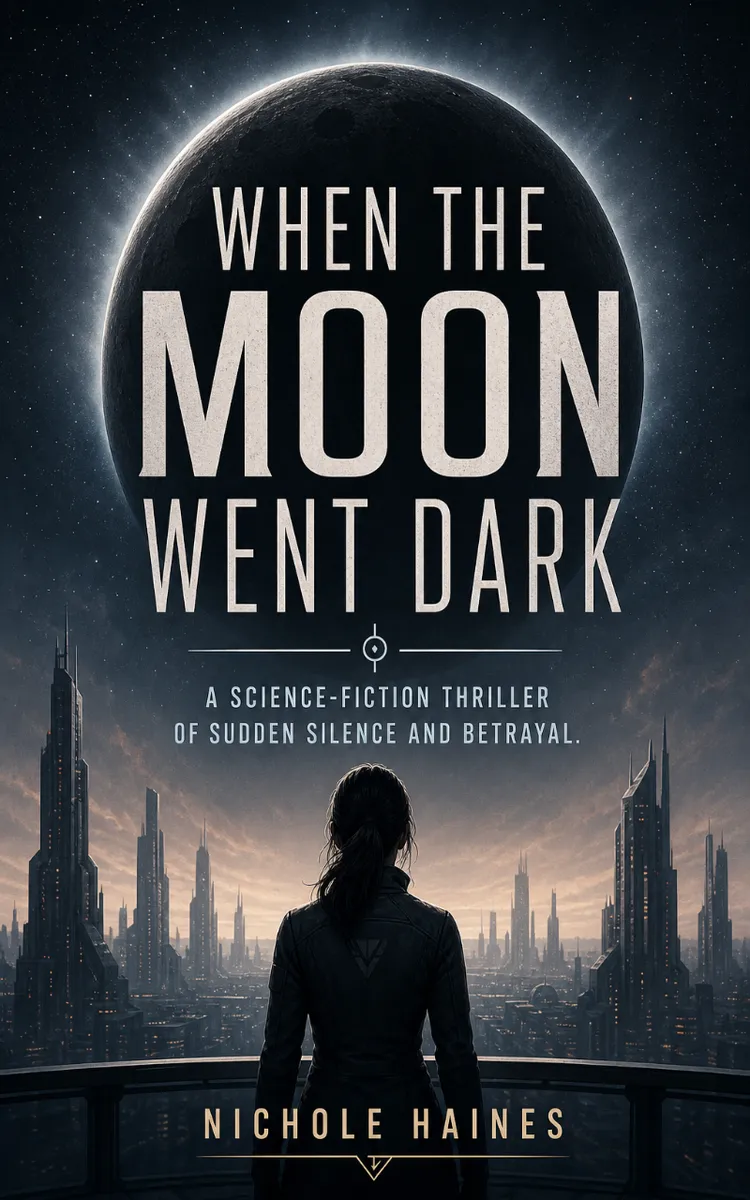

Read the first chapter
The whole of chapter one, free. About 16 min. Turn the pages with the arrows, your keyboard, or a swipe.
Chapter 1
The Moon Shuts Off Overhead
The streetlight outside Mara Kessler’s window didn’t flicker. It died all at once, like someone had yanked the plug from the city. A second later the air-conditioning in her apartment cut out with a wet, mechanical sigh, and the sound of the neighborhood - distant traffic, someone’s late television, the thin music of the building’s ventilation - fell away into a sudden, thick quiet.
Mara stood barefoot on the cold kitchen tile, one hand still on the smart-glass panel where she’d been checking the night forecast. The screen showed a clean, calm sky map a moment ago; now it was a blank field of static with a single error glyph pulsing like an eye. Through the window, the skyline of New Rotterdam looked unfinished. The familiar disk of the Moon was gone - no eclipse arc, no dimming, no slow slide into shadow. Just absence, sharp as a cut.
Her daughter Lina’s night-light glowed for a heartbeat, then dimmed, then went out. In the living room her son, Kai, was on the floor with toy blocks, listening to the bedtime story Mara had recorded for him earlier. The recording kept talking for a few seconds after the power dropped, then the voice stuttered and vanished mid-syllable. In the dark, Kai’s hands froze on a plastic corner. “Mom?”
Mara moved before she thought it through. She crossed the apartment in two strides, grabbed the flashlight from the counter and snapped it on. A hard beam carved a tunnel through her hallway, catching dust motes that hung in the air like tiny drowned things. From the balcony door came the first wave of panic noise - people calling to each other, the muffled thud of doors slamming somewhere below, the sharp metallic clatter of something dropped on a stairwell.
“Mara?” her partner Jory’s voice came from the bedroom, strained, as if he’d been halfway out of sleep already. “What happened?”
“The Moon is gone,” she said, and heard how insane it sounded even as she said it. She didn’t have time to correct herself. She grabbed her phone with her free hand, the flashlight beam wobbling as she fumbled with the lock. The screen stayed black except for emergency text that crawled and broke apart. No network. No location services. Only a single line, repeated over and over: LOCAL GRID FAILURE.
The building shuddered with other people’s movements. A baby cried on another floor. Someone shouted, “Keep your doors locked!” then another voice answered, “Locked doesn’t mean anything if the elevators don’t work!” The words rose and fell like waves against the walls.
Mara’s objective was simple and immediate: get her family out of the apartment block before the chaos found the stairwells. The street was already filling with unknowns, and in New Rotterdam the streets weren’t empty places; they were corridors packed with strangers, delivery drones, and the kind of crowd that could turn into a mob faster than you could say the word “accident.”
She yanked the door chain free - habit, even in the dark - and swung the apartment door open. Heat from the hallway felt wrong without the building’s air system; it wasn’t just cooler, it was stale, like the air had been waiting too long. The stairwell door at the end of the corridor had a red emergency latch, but the indicator above it was dead. The whole floor smelled faintly of burned plastic, though she hadn’t seen any smoke.
“Mara!” Jory came into the hallway, pulling on a jacket that reflected the flashlight beam in dull flashes. His hair stuck up as if electricity had tried to cling to him and failed. “Lina’s terrified.”
“I know.” Mara aimed the light toward their kids, then caught Lina in the beam - small shoulders tucked, eyes too wide, her face pale in the harsh glare. Lina clutched her stuffed fox so tight its fur looked flattened. Kai stood behind her, holding a block like it could be a weapon.
Jory crouched and put a hand on Lina’s arm. “Hey. We’re going to Mom’s friend’s building. It has backup power.”
Mara didn’t argue. She had heard the claim earlier in the week from a neighbor who liked to brag about their block’s private contract with a microgrid supplier. She’d believed it then because it sounded better than admitting the city’s fragility. Now she needed belief to function like oxygen.
They moved fast, but the building wouldn’t let them. At the bottom of the corridor, the elevator bank sat in darkness behind a metal mesh door like a closed mouth. The indicator panel beside it was blank. Mara tried the call button anyway; a dead click answered her.
The stairwell was worse than the elevator. The door at the end of the hall swung inward with a groan. Inside, the air smelled of old concrete and damp socks. The walls were lined with emergency strips that were supposed to glow - thin lines of safety light - but those strips were unlit, too. The only illumination came from Mara’s flashlight, which made the stairs look like a narrow throat descending into black.
Somewhere above, footsteps hammered. Someone else’s flashlight cut through the darkness and then disappeared as the beam got swallowed by a corner. Mara heard voices in multiple directions, overlapping: “ - no trains - ” “ - my son’s at the park - ” “ - the elevators are stuck - ” and beneath it all the sound of people trying to talk over fear.
They started down. Each stair creaked under their weight, and Mara’s mind kept grabbing at details that shouldn’t matter - how the metal rail felt slick under her palm, how the vibration of other people’s panic traveled through the building like a second heartbeat. She could hear the city beyond the stairwell through cracks in the door seams, a distant roar without the usual layer of traffic noise.
Halfway down, Jory paused, breath turning visible in the flashlight’s beam. “Wait,” he whispered.
Mara stopped and leaned her head toward his. “What?”
He pointed with two fingers toward the landing. A thin ribbon of light seeped under the stairwell door - someone had cracked it open upstairs, letting in a sliver of illumination from a nearby unit. The light wasn’t the building’s emergency glow. It was flickering, blue-white and irregular, like a device running on a battery that couldn’t decide whether to survive.
A woman’s voice came from above, sharp with command. “No, you can’t go out there. You don’t know what’s happening to the traffic. The street’s - ”
A man snapped back, “We have to get to my mother! Her building’s higher and the power is - ”
Mara’s chest tightened. She’d heard enough to know the conflict wasn’t just fear. People needed direction, and direction turned into control. Control turned into violence when no one could enforce it.
Mara reached the landing and pressed her shoulder against the stairwell door, listening. Through the crack, she heard coughing and then a different sound - glass rattling, metal clanging, the thump of feet running too fast for a confined space. Her flashlight beam caught a smear on the wall: dark, wet-looking streaks that might have been from a spilled drink or something worse. In the strobing sliver of light, the smear looked like a fresh bruise.
“Come on,” she said, and grabbed Lina’s hand. “We’re not waiting.”
Kai protested softly. “If we go down, we’re - ”
“Staying here is worse,” Mara cut in, and hated how clipped she sounded. The words tasted like guilt. She didn’t have time for gentleness; she had time only for motion.
They continued down, step after step, until the stairwell opened onto the lobby. The lobby’s security gate hung halfway closed, its motor dead. The glass doors at the front were smeared with fingerprints and streaks, as if someone had shoved their palms against them and then pulled away. Outside, the night was not night. Without the Moon, the sky was a featureless dark ceiling, and it made the city’s lights - what remained of them - look like islands.
Mara pushed the front door open. A cold gust of air hit her face, sharp with something metallic. The street beyond was packed with people, and the sound was wrong: not the normal distant hum of a city at night, but a dense, anxious chorus of voices, alarms, and the occasional scream that arrived like a dropped object.
A few cars sat at intersections with their hazard lights still blinking, but they blinked out of rhythm, as if separate systems were failing in different places. A delivery drone lay twisted in the gutter, its rotors still twitching under a thin layer of dust. Mara could see small fires flicker at the edges of dumpsters - someone’s candles, someone’s heating system gone rogue, someone’s attempt to make light where none existed.
Jory grabbed Lina’s shoulder. “Stay close. Don’t - ”
A shout erupted near the curb. Mara turned her flashlight beam in time to see a man in a dark hoodie running toward a group of neighbors clustered around a street kiosk. The kiosk display was dead, but people were still pressing their hands against it like the screen might respond out of shame.
The man shoved someone aside and barked, “My wristband says the shelter’s at Dockline Tower. That’s where the radio - ”
Another voice answered, “No radio. Nothing’s coming through!”
The man’s face turned toward the sound of that denial, and in the moment Mara saw his eyes, she recognized the look: the specific kind of desperation that makes a person decide someone else is responsible for their fear.
“Stop,” Jory said, and his voice tried to hold authority, but it was thin against the crowd. “We’re leaving. Move back.”
The man laughed once, ugly. “You think you can leave? The grid’s dead. Everyone’s trapped. Everyone’s - ”
Mara stepped forward, flashlight beam steady on his chest. “We’re going to the nearest shelter with backup power.” She forced her voice to stay level. “If Dockline Tower is a lie, we don’t waste time arguing.”
His mouth opened to retort, but the crowd surged. Someone behind Mara shoved her shoulder; she stumbled, catching herself on the doorframe. Lina cried out, a small sound that cut through the noise like a wire snapping. Mara swung the light toward Lina and saw Lina’s fox stuffed toy had come loose and fallen into the gutter.
“Mara!” Jory’s hand clamped around her elbow. “Don’t - ”
“I have her,” Mara snapped, and dropped to grab the toy from the gutter. The pavement felt slick under her fingertips, as if rain had fallen - though the air was dry. When she pulled the fox free, her hand came away with fine gray dust, and the dust clung to her skin with an unpleasant static cling.
She stood fast, bringing Lina back into her grip. The crowd had shifted in the space of seconds. A line of people had formed where no line had been before, and at its center someone was trying to pry open a locked gate with a crowbar. The crowbar struck metal with a ringing clang that made Mara’s molars ache.
“Shelter!” someone screamed, and the word spread like a match catching.
They were being pulled into the mass. Every instinct Mara had screamed to flee sideways, to find a route that didn’t pass through the densest cluster of strangers. But Lina was crying, Kai was gripping her jacket hem too hard, and Jory looked like he was running out of patience and breath.
“Microgrid,” Jory said suddenly, the word coming out like a plan. “Our neighbor said there’s a basement node. There’s a manual override.”
Mara’s mind flashed to that conversation from days ago - someone boasting about the building’s private power contract, about the basement batteries and the way they could keep a few blocks alive if the main grid went down. She hadn’t needed the information then. Now she did, and it felt like a lifeline.
“Basement,” Mara said. “We cut through the service corridor.”
Jory didn’t argue. He moved them toward the building side entrance, where a narrow service door led to a corridor that smelled of detergent and damp. A maintenance panel sat beside the door, its cover slightly ajar as if someone had already been trying to reach the controls. Mara shoved it closed and pressed her forehead against the metal for a fraction of a second, feeling the cold through her skin.
The panel was unpowered, but the override lever wasn’t. Mara yanked it down. A dull click sounded - too quiet to be meaningful in the chaos - but then the lights in the corridor blinked once, twice, and stayed on. Not bright. Not even steady. But enough to reveal a line of emergency LEDs along the ceiling, stubborn as embers.
“Come on,” Mara said, hauling Lina along.
As they moved, the crowd outside surged against the street-facing door. The sound of fists and voices came through the walls, muffled but relentless. The corridor’s air grew colder as they descended a set of stairs into the building’s underbelly. The smell changed, from detergent to something sour - old moisture, rust, and the faint burned sweetness of electronics that had overheated and died.
In the basement, a low hum finally replaced the silence. It came from a bank of battery units behind a metal safety screen. Mara could see their status lights - dim, amber, and blinking irregularly. The microgrid was alive, but it was breathing through pain.
Jory leaned close to the panel and squinted. “It’s not enough for the whole block,” he said.
“Enough for a family,” Mara answered, and felt the strange relief of having something concrete to do. She pulled Kai toward the screen. “We need the radio channel for the shelter. This node should have - ”
The panel’s interface flickered to life when she touched it. A text line scrolled in a blocky font: LOCAL BROADCAST ACTIVE. SIGNAL SOURCE: SATELLITE RELAY.
Then the interface went blank again.
“Of course,” Jory muttered. “It’s trying and failing.”
Mara wiped her palm on her jacket and tried the input dial anyway. The dial resisted, then gave with a soft metallic grind. She turned it until the panel’s speaker popped with static, and a voice - thin, distorted, but unmistakably human - cut through.
“ - moon event - ” the voice began, then snapped into a cadence of emergency protocol. “ - all lunar illumination sources are unavailable. Power systems dependent on - ”
Mara pressed her hand to the speaker. “Say it again,” she demanded, though the voice was too broken to respond to her. The static hissed and swallowed words, then returned them in fragments.
“ - still off - global - repeat - still off - ”
Lina clutched Mara’s sleeve so hard Mara felt Lina’s nails through fabric. “What does that mean?” she whispered, not to anyone in particular.
Mara’s throat tightened. Jory stared at the screen as if it might change its mind and become comforting. “It means the Moon isn’t coming back,” he said.
The basement hum deepened, then faltered. The battery lights blinked faster, amber turning to a harsher red for a heartbeat. Mara heard a new sound from above - a scraping, like metal dragged across concrete.
Then the microgrid panel emitted a short, angry tone and shut itself down, leaving them in a darkness that wasn’t total anymore. It was the specific darkness of a place pretending to be safe while it lost power in measured bites.
Outside the basement door, the building’s alarms - those that were supposed to be independent - began to chirp. A different kind of sound joined them: the pounding of boots and bodies against the stairwell walls, closer than before.
Jory grabbed Mara’s wrist. “The crowd found the service entrance.”
Mara looked at her family in the dimness, at Lina’s fox, at Kai’s block clutched like a shield. She wanted to believe the shelter was still accessible, that the radio would guide them, that the microgrid would hold long enough to get them to somewhere with real backup.
She also heard the cost unfolding in the noises above: the building had become a target point. People were converging on any place that might still be alive, and alive meant control.
Mara forced herself to breathe through the sour basement air. She found the flashlight on the floor where it had rolled when the panel went dead and snapped it on. The beam hit the corner where a maintenance hatch sat, its latch scratched open already. Someone had been here. Someone had tried to reach this node before they did.
“Do we go up?” Kai asked, voice small.
“We don’t go through the lobby,” Mara said. “We use the hatch. Service route to Dockline side road.”
Jory’s jaw tightened. “Dockline Tower?” he said, and there was anger in the question, anger at the radio fragments, at the city for lying to people with dead signals.
Mara didn’t answer with certainty. She answered with action. She shoved Lina forward, then followed, pushing the hatch open just enough for them to squeeze through. Warm air from the tunnel licked her face, carrying the unmistakable smell of street smoke.
The tunnel’s soundscape was a mess - distant shouting, the clatter of something breaking, the wet slap of boots against damp concrete. Somewhere overhead, a siren tried to start and couldn’t, then tried again.
Mara crawled until her knees hit ground that shifted under her palms. The flashlight beam caught a smear of fresh blood on the wall - too dark and too recent to be old. She didn’t stop to stare. Her mind had no room for horror; it had only room for survival math.
They emerged into a narrow side alley where the city’s darkness felt heavier, as if it pressed down on their shoulders. A few street signs glinted with reflective paint, but without the Moon, the reflective paint looked like bones in the dark.
In the distance, Dockline Tower’s silhouette rose against the black sky. No lights marked it, but the tower’s shape was familiar enough to anchor Mara’s hope. And hope, she realized with a sudden cold clarity, was just another resource the Moon had taken away.
As they moved toward the tower, Mara kept her hand on Lina’s head and Kai’s shoulder, steadying them through the jostle of panicked strangers who had spilled into the alley. Someone shouted about ration caches. Someone else argued about whether the “Moon-off” event was a weapon or a malfunction. The words were wild, stitched together from fear and rumor.
Then Mara heard a different sound: the crackle of a radio somewhere ahead, low and stubborn, like a heartbeat refusing to stop. A portable set - someone’s personal device - was broadcasting on a narrow band. The voice was the same broken emergency cadence as the basement panel, but clearer now.
“ - still off - repeat - still off everywhere - no lunar power - no - ”
Mara’s stomach turned. The phrase “everywhere” landed in her bones. The Moon wasn’t just gone from the sky. It was gone from every system that depended on the night’s familiar rhythm.
She pushed through the crowd toward the radio signal, and the alley seemed to narrow as people sensed movement. Faces turned. Hands reached. A man in a torn jacket grabbed Mara’s forearm, his grip too strong.
“Where are you going?” he demanded.
Mara looked at his eyes, at the frantic shine there, at the way his lips trembled as if his body was trying to scream without sound. “To my family,” she said. “To the shelter.”
His expression twisted, and for a second she saw the next step in his mind: if she had shelter information, she had power. If she had power, she had control. If she had control, he could bargain, steal, or break her.
Jory stepped between them, jacket open, flashlight beam aimed at the man’s chest like a warning. “Let go,” he said.
The man’s hand loosened, not out of kindness but out of uncertainty. Behind him, the crowd surged again, and the radio crackle spiked as someone else tried to turn the volume up.
Mara used the moment. She guided Lina and Kai forward, moving faster than the crowd could decide whether to stop her. The street ahead opened just enough to show the base of Dockline Tower - dark windows, a lobby door propped with a chunk of concrete, and a thin line of emergency lighting along the steps that flickered as if it were holding on by memory.
She reached for the door handle and felt it vibrate under her palm. Not from motion, but from the building’s strained attempt to stay alive.
Inside, a radio voice continued to repeat the same impossible phrase over and over, each repetition stripping away another layer of normal.
Still off everywhere. Still off.
Mara pulled the door wider and stepped into the shadowed lobby with her family pressed close, the flashlight beam trembling in her hand as the tower’s emergency system tried to decide whether it could keep them safe. Outside the door, the crowd’s shouting rose, and the dark pressed in behind them like something that had learned their shape.
End of chapter one. 40 more chapters and about 120,678 words in the full book.
Swipe or use the arrows to turn the page


What's inside: 41 chapters
- 1. The Moon Shuts Off Overhead
- 2. Power Grid Dies Under Lunar Silence
- 3. The Tide Charts Become Lies
- 4. A Dockyard Lockdown Traps Survivors
- 5. Mara Chooses to Trust a Stranger
- 6. The Corporate Key Opens a False Door
- 7. Juno Follows the Signal’s Origin
- 8. The Lunar Facility Rejects Earth Credentials
- 9. Mara Breaks Quarantine to Save Juno
- 10. A Lab Sample Proves the Moon Was Targeted
- 11. The Missing Test Was Uploaded Elsewhere
- 12. A Service Lift Drops Them Into Control Depths
- 13. Mara Faces the Choice to Go Alone
- 14. The Core’s Voice Demands a Password
- 15. The Simulation Shows Mara’s Unmade Past
- 16. Security Drones Hunt Through the Simulation
- 17. The Atrium Displays the Moon’s True Shape
- 18. A Broadcast Reveals the Real Culprit
- 19. Mara Escapes With a Seed Key
- 20. The Checksum Points to a Second Moon
- 21. Juno Confesses He Was Following Orders
- 22. Halberg Systems Launches a Citywide Trap
- 23. Mara Hunts the Broadcast Source Through Static
- 24. The Rail Platform Vanishes Under Her Feet
- 25. Mara Breaks Her Own Implant to Proceed
- 26. The Pairing Data Resurfaces as a Lie
- 27. A Decoy Ring Contains a Real Message
- 28. The Time Paradox Opens a Hidden Door
- 29. Manual Override Costs the Relay’s Power
- 30. Mara Loses the Only Map She Trusts
- 31. The Map Leads to Halberg’s Hidden Dock
- 32. The Unknown Operator Is Sable Noxley
- 33. Mara Reboots the Relay Using Old Blood
- 34. The Kill Switch Activates at Launch
- 35. The Relay Restores Light-Then Breaks Reality
- 36. Mara Chooses Truth Over Survival
- 37. Sable and Juno Fight the Sky’s Lie
- 38. Halberg’s Dorian Halberg Offers a Deal
- 39. The Reset Erases the Moon’s Script
- 40. Light Returns Without a Second Moon
- 41. Chapter 41
About this book
"When The Moon Went Dark" is a fiction book by Nichole Haines with 41 chapters and approximately 120,678 words. A science fiction thriller where the moon suddenly turns off.
This book was created using Inkfluence AI, an AI-powered book generation platform that helps authors write, design, and publish complete books. It was made with the AI Novel Writer.
Frequently Asked Questions
What is "When The Moon Went Dark" about?
A science fiction thriller where the moon suddenly turns off
How many chapters are in "When The Moon Went Dark"?
The book contains 41 chapters and approximately 120,678 words. Topics covered include The Moon Shuts Off Overhead, Power Grid Dies Under Lunar Silence, The Tide Charts Become Lies, A Dockyard Lockdown Traps Survivors, and more.
Who wrote "When The Moon Went Dark"?
This book was written by Nichole Haines and created using Inkfluence AI, an AI book generation platform that helps authors write, design, and publish books.
How can I create a similar fiction book?
You can create your own fiction book using Inkfluence AI. Describe your idea, choose your style, and the AI writes the full book for you. It's free to start.
Write your own fiction book with AI
Describe your idea and Inkfluence writes the whole thing. Free to start.
Start writingCreated with Inkfluence AI


