

Read the first chapter
The whole of chapter one, free. About 8 min. Turn the pages with the arrows, your keyboard, or a swipe.
Chapter 1
A Roof Shoring Gives Way
The inspection lamp on Ethan Mercer’s helmet picked out a fresh seam of black coal, its surface shining like wet glass beneath the timber braces.
“Give me another minute,” he called.
His voice traveled down the newly shored corridor and came back thin. The mine answered with its usual summer-shift noises: the distant grind of a conveyor, the tick of cooling metal, water tapping steadily into a shallow gutter along the floor. Above him, the mountain pressed down through layers of timber and steel.
Ethan crouched beside the exposed vein and ran his glove over the coal. Solid. Clean. Worth cutting.
He wanted the inspection finished before the shift ended. That was all. Sign the vein report, walk back with the crew, and reach the surface before the long Alaska evening turned the yard gold. His wife would be waiting in Healy, and he had promised not to come home coated in black dust again.
Behind him, boots scraped rock.
“You said that ten minutes ago,” Nolan Voss called.
Ethan glanced over his shoulder. Voss stood beneath the nearest set of roof supports, broad and stiff-backed, his lamp aimed at the ceiling. Across the corridor, Caleb Rusk leaned against a rib of coal with his arms folded. Rusk and Voss had not exchanged a civil word in three years. Even underground, with the roof groaning above them, they found room for hatred.
“Then you’ve had ten minutes to practice patience,” Ethan said.
Rusk gave a humorless laugh. “Careful, Mercer. Voss might mistake that for leadership.”
Voss turned his lamp toward him. “You want to inspect the roof, Rusk, or keep talking until it inspects us?”
The timber above them creaked.
The sound was small, almost polite. Ethan felt it through the soles of his boots before he heard it again. A pressure shifted somewhere overhead. Dust sifted from the roof and settled across his gloves.
He stood.
“Everyone back,” he said.
Voss moved first. Rusk pushed away from the coal. The fourth miner, Luis Ortega, had been checking the ventilation line farther down the corridor. He came around the bend with one hand raised, his lamp bobbing.
“What is it?”
“Back,” Ethan said louder. “Now.”
The roof gave a deep, wooden crack.
Ethan lunged toward the main passage. The first support buckled beside him. Timber split with a report like a rifle shot, and a slab of rock dropped across the corridor. The impact punched the air from his lungs. His knees struck the floor. For an instant his lamp showed nothing but spinning dust and shattered boards.
Then the mountain came down.
Rock hammered the corridor behind him. Steel screamed. The floor jumped beneath his hands. Ethan crawled forward as chunks of shale clattered against his helmet and shoulders. Someone shouted his name. Someone else cursed. The ventilation line snapped with a sharp metallic pop, and the mine filled with the grinding roar of collapsing earth.
Ethan reached for Luis and caught a sleeve.
“Move!”
They dragged each other toward the wider section of the corridor. Voss stumbled after them. Rusk appeared through the dust, one hand pressed to his forehead, blood running between his fingers.
A final crash rolled through the passage.
The sound faded into a thick, unnatural silence.
Ethan turned his lamp toward the way out.
The corridor was gone.
A wall of broken stone, timber, and coal filled the passage from floor to ceiling. Dust crawled through the beam of his lamp. Somewhere behind the blockage, rock settled with slow, heavy knocks.
Luis bent over, coughing. Voss braced himself against a support and stared at the collapse.
Rusk wiped blood from his brow. “That wasn’t a fall. That was a burial.”
“Save the poetry,” Voss said. “Check the men.”
“I’m standing.”
“Then check the others.”
Rusk’s jaw tightened, but he moved. Ethan watched him cross the narrow chamber and inspect Luis’s arms and shoulders. Voss had a cut along his cheek. Luis’s left knee was bleeding through his work pants, but he could stand.
Four men. Alive.
Ethan swept his lamp across the chamber. The newly shored vein corridor had become a pocket of timber, coal, and darkness. The ceiling still held above them, but not evenly. One brace leaned inward, its base buried beneath rubble. Another had split halfway through.
He knelt beside the ventilation line and touched the broken pipe. No air moved through it.
“Ethan,” Luis said. “Tell me that’s not what I think.”
Ethan did not answer.
Voss crouched beside him. “Main line’s on the other side.”
“Probably.”
“Probably?”
“The collapse took the return duct too.”
Rusk looked toward the sealed passage. “Can we clear it?”
Ethan studied the debris. The nearest slab was larger than a truck tire. More rock pressed behind it, packed tight against the roof. Every piece they removed could bring down the next layer.
“Not by hand,” he said.
Voss struck the rubble with his boot. The impact sent a tremor through the ceiling.
The damaged brace shifted.
“Stop,” Ethan snapped.
Voss froze.
A thin stream of grit spilled from the joint above his head. Ethan seized the back of his jacket and pulled him away. A fist-sized stone struck the floor where Voss had been standing.
For several seconds, nobody spoke.
The mine ticked around them. Water tapped in the gutter. Somewhere beyond the collapse, a piece of timber rolled and came to rest.
Rusk looked at Voss. “Still want to kick it?”
Voss turned on him. “Say another word.”
“Both of you,” Ethan said. “Enough.”
Rusk stepped closer. “You’re in charge now?”
“No. I’m the only one looking at the roof.”
That stopped them.
Ethan forced himself to breathe slowly. The air felt warm and used. His lamp cast four pale circles against the blackness, each one shrinking as dust settled on the lenses. He checked the battery indicator. The green mark had already faded toward amber.
“How long until someone misses us?” Luis asked.
“Shift change is in forty minutes,” Ethan said.
“If they know we’re in this corridor.”
“They know.”
Rusk gave a short, bitter laugh. “They know we came in. They don’t know where the mountain put us.”
The words struck harder than the collapse.
Ethan pictured the surface: the office windows, the haul trucks, the rail line beyond the yard. A routine shift had begun under a clear Alaska sky. Men were drinking coffee, arguing over football, checking gauges. Nobody up there yet understood that four lamps were burning in a pocket beneath their feet.
He reached for the radio clipped to his belt.
The casing was cracked. He pressed the transmit button.
“Control, this is Mercer in the new vein corridor. Roof collapse. Four trapped. Do you copy?”
Static answered.
He tried again.
“Control, this is Mercer. Roof collapse. We need rescue.”
The radio hissed, then died.
Voss took it from him and smacked the side with his palm. “Battery?”
“Still on.”
“Then the antenna’s buried.”
Rusk bent over the radio. “Try the emergency channel.”
Ethan switched frequencies and pressed the button. Nothing came back but a low electric murmur.
Luis sat against the coal rib, breathing through clenched teeth. “My knee’s getting worse.”
Ethan knelt beside him. The wound was a deep scrape, not a break. He tore a strip from the bottom of his shirt and tied it around Luis’s leg.
“Can you move your foot?”
Luis flexed it. “Yes.”
“Then you can walk.”
“Good. I was worried I’d have to stay here.”
No one laughed.
A new groan rolled above them. The split brace bent another inch.
Ethan looked at the roof, then at the blocked passage. The chamber was narrowing. They had no working radio, no clear exit, and no way to know how much air remained beyond the broken duct.
“We need to get under the strongest supports,” he said. “Away from that brace.”
Rusk pointed toward the vein. “The face is wider.”
“The roof there hasn’t been tested.”
“It’s coal. It won’t fall.”
Voss stared at him. “That’s what you said about the north cut.”
Rusk’s eyes hardened. “And you’re still alive because I said it.”
“You’re alive because I dragged you out.”
“You dragged my brother out.”
The chamber seemed to contract around them.
Ethan looked from one man to the other. He had heard pieces of the story, always in separate conversations and never from either of them. A collapsed cut. A dead brother. An accusation that had survived three winters and followed them underground.
“Not now,” Ethan said.
Rusk’s face twisted. “It’s always now with him.”
Voss stepped forward.
Ethan shoved his shoulder between them. “Move to the face. Both of you.”
For a moment, neither man moved.
Then another crack snapped overhead.
This one came from the brace behind them.
They ran.
Ethan led them toward the exposed vein, ducking beneath the lowest crossbeam. Luis limped behind him. Voss grabbed his arm and hauled him over a ridge of broken stone. Rusk brought up the rear, his lamp jerking across the walls.
The damaged brace collapsed behind them.
Timber slammed down. Dust surged through the passage. Ethan threw himself against the coal face as the chamber filled with grit. Luis cried out. Voss swore. Rusk shouted something lost beneath the roar.
When the dust thinned, Ethan lifted his lamp.
The corridor they had just crossed was sealed by a second fall.
The last open route was gone.
He checked his lamp. The beam fluttered once, dimmed, then steadied.
“Everybody here?” he called.
No answer.
Ethan swung the light left, then right. Luis was on his knees, coughing. Voss had one hand pressed to his ribs. Rusk was nowhere in the beam.
“Rusk!”
A scrape came from beyond the fallen timber.
Then a voice, muffled by rock.
“I’m here.”
Voss pushed toward the sound. Ethan caught him.
“Don’t touch it.”
“He’s trapped.”
“We all are.”
The words hung in the dark.
Ethan crouched and pressed his ear to the rubble. At first he heard only the faint ticking of settling stone. Then came a scrape. A breath. Another scrape, weaker than the first.
“Rusk,” Ethan said. “Can you move?”
A pause.
“Not my left leg.”
Voss closed his eyes. “Damn it.”
Ethan raised his lamp toward the ceiling. The beam trembled across the timber braces, across the coal walls, across the dust still drifting like gray snow.
Behind him, the tunnel had sealed completely. Ahead, three men were crowded into the narrow face, and the fourth lay somewhere beyond the collapse. Their lamps were the only stars beneath the mountain.
Ethan pressed the transmit button on the dead radio one more time.
“Control,” he said into the static. “This is Mercer. Four trapped in the new vein. We are alive.”
The lamp flickered.
For one breath, darkness swallowed the corridor.
Then, from behind the rubble, came a faint movement - stone scraping against stone, followed by Rusk’s strained voice.
“Mercer?”
Ethan turned toward it.
“I’m here.”
The mine gave a low, settling groan, and the darkness closed around all four of them.
End of chapter one. 32 more chapters and about 72,700 words in the full book.
Swipe or use the arrows to turn the page


What's inside: 33 chapters
- 1. A Roof Shoring Gives Way
- 2. The Headlamp Lanterns Burn
- 3. Rivals Share the Same Darkness
- 4. The Surface Counts Missing Men
- 5. Ventilation Maps Don’t Match Reality
- 6. A Rescue Plan Needs Off-Site Gear
- 7. Dispatch Won’t Approve the Train
- 8. The Mine Radio Finally Speaks
- 9. Ethan Bargains for Cooperation
- 10. The Command Is Made Illegal-By-Delay
- 11. A Tourist Group Gets Stuck Waiting
- 12. The Train Leaves Denali Behind
- 13. Ethan Tests the Air Pocket
- 14. A Tool List Becomes a Deadline
- 15. Mara Finds the Right Entry Point
- 16. The Mine’s Power Goes Quiet
- 17. A Hidden Message in the Dust
- 18. The Enemies Nearly Come to Blows
- 19. Mara’s Crews Start the Bore
- 20. Dispatch Questions the Train’s Detour
- 21. Ethan Counts Breaths Like Coins
- 22. Mara Learns the Bore Is Off
- 23. A New Access Doorway Appears
- 24. Ethan Hears the Wrong Sound
- 25. Hope Breaks, Then Rebuilds
- 26. Mara Reaches the Signal Zone
- 27. Ethan Chooses Trust Over Revenge
- 28. Mara Breaks Through the Debris Wall
- 29. The Extraction Starts at Last
- 30. Four Alive Step Into Daylight
- 31. Tourists Finally Learn Why They Waited
- 32. Ethan Faces the Rivalries After Rescue
- 33. The Mine Learns What Hope Requires
About this book
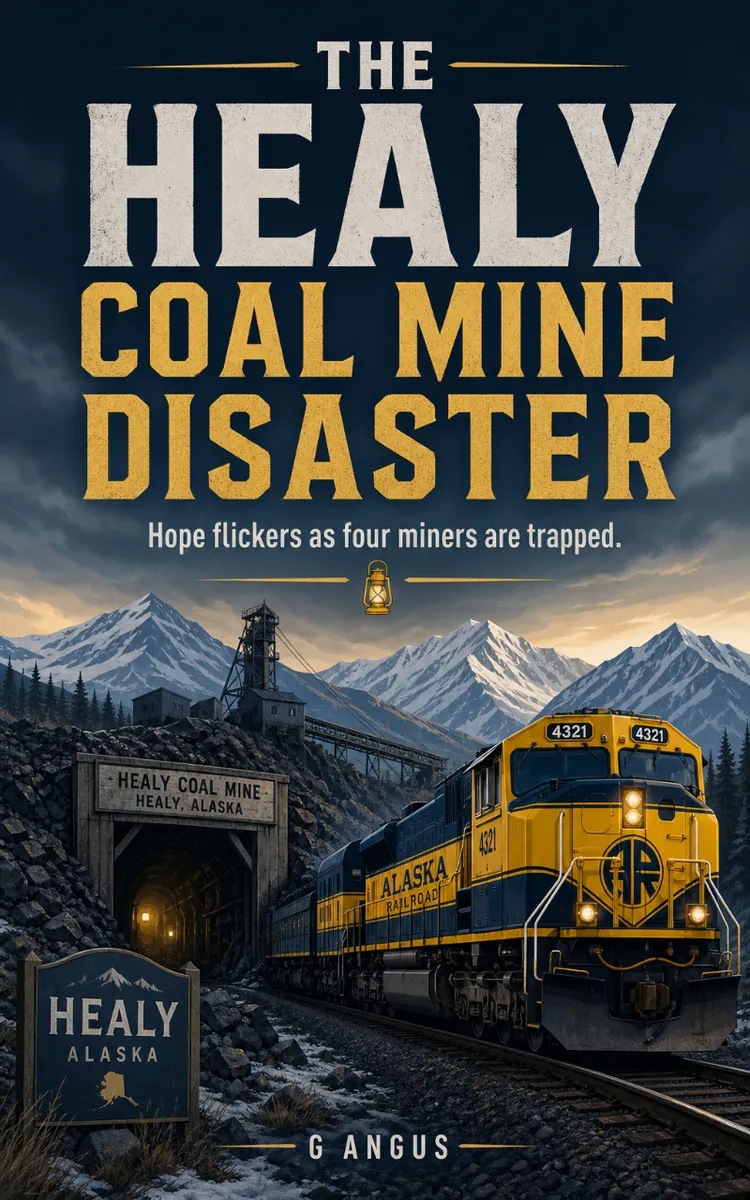
"The Healy Coal Mine Disaster" is a fiction book by G Angus with 33 chapters and approximately 72,700 words. A suspenseful rescue story set in Alaska's Healy coal mine..
This book was created using Inkfluence AI, an AI-powered book generation platform that helps authors write, design, and publish complete books. It was made with the AI Novel Writer.
Frequently Asked Questions
What is "The Healy Coal Mine Disaster" about?
A suspenseful rescue story set in Alaska's Healy coal mine.
How many chapters are in "The Healy Coal Mine Disaster"?
The book contains 33 chapters and approximately 72,700 words. Topics covered include A Roof Shoring Gives Way, The Headlamp Lanterns Burn, Rivals Share the Same Darkness, The Surface Counts Missing Men, and more.
Who wrote "The Healy Coal Mine Disaster"?
This book was written by G Angus and created using Inkfluence AI, an AI book generation platform that helps authors write, design, and publish books.
How can I create a similar fiction book?
You can create your own fiction book using Inkfluence AI. Describe your idea, choose your style, and the AI writes the full book for you. It's free to start.
Write your own fiction book with AI
Describe your idea and Inkfluence writes the whole thing. Free to start.
Start writingCreated with Inkfluence AI


