

Read the first chapter
The whole of chapter one, free. About 14 min. Turn the pages with the arrows, your keyboard, or a swipe.
Chapter 1
The Sky That Repeats Tonight
The last slice of sun hung over Larkspur Square like a coin someone couldn’t decide to spend. Mara Vell watched it slip into the skyline - slow, deliberate - then stall. The light didn’t dim the way it always did. It hovered, gilding the courthouse dome and the row of sycamores along the avenue, as if the world had forgotten what came next.
Her balcony door had been left cracked. The apartment was warm with late-day electronics and old carpet, but out here the air turned cool against her forearms. Wind threaded through the railing, carrying distant voices from the square below - someone laughing near the fountain, a car door shutting somewhere down the block. Mara held her phone at arm’s length, thumb hovering over the screen recorder, and stared until her eyes started to sting. When the sun finally dipped, it did it twice. Not metaphorically. The same motion, same angle, the exact same flare against the courthouse glass.
“No,” she whispered, and the word came out too small for what she was seeing.
She dragged the phone closer. The display showed the sunset in real time - except on the screen, the moment lagged by a fraction, like the video buffer couldn’t keep up with the repeating frame. In the corner of her view, the courthouse clock face glowed red. The hands moved, paused, then moved again with the same stubborn rhythm.
Mara’s throat tightened with a need that felt childish: prove it. If she could capture the loop, if the evidence lived in pixels and file timestamps, then she wouldn’t have to chase her own sanity through the night.
She hit record. The phone’s screen brightened, and a small timer began counting upward. She framed the courthouse dome, the sycamores, the fountain’s white spray. Then she waited for the natural end - the moment the sun should fall fully and the square should shift into evening.
Instead, the light reversed.
The sun rose back to the same lip of the skyline, not like a rewind but like someone had nudged the world sideways and released it. The red clock hands returned to the previous position. The laughter from the fountain seemed to stutter mid-note, then continue as if it had never broken.
Mara’s fingers went numb around the phone. “Okay,” she said, louder, to make the universe hear her. “Okay. I’m not - ”
Her voice cut off because below her, across the square, a streetlamp clicked on. The beam didn’t bloom gradually. It snapped to full brightness, then flickered once, twice, and steadied. She watched it the way you watch a match after someone swears it’s out. The light held.
If it was a loop, it wasn’t just the sun. It was the town’s timing. It was the way the streetlamp decided what “now” meant.
She leaned forward, elbows on the railing, and started filming harder, rotating her grip so the clock and lamps stayed in frame. The phone’s microphone caught the city’s soundtrack - car tires whispering on wet pavement from earlier rain, a distant dog barking, the fountain’s constant hiss. She tried to listen for anything that sounded wrong, for a mechanical glitch in the air.
Then the fountain’s spray changed height. Just a few inches, like a metronome recalibrating. It landed in the same pattern as before.
Her stomach turned. She stepped back inside for a heartbeat, enough to yank the balcony door fully open and pull the warmth of her apartment around her like a blanket. The TV was off. Her laptop on the kitchen table sat where she’d left it earlier, screen dark, but the keyboard looked slightly damp as if the surface had been waiting for a touch. Mara didn’t remember spilling anything. She didn’t remember being gone long enough for condensation.
She told herself it was stress. She told herself the loop was a trick of sight, a delayed sunset caused by weather. She told herself a hundred things she’d used to survive childhood nightmares. But the phone timer kept climbing, and the video kept showing the sun’s impossible double-dip.
Mara grabbed her jacket from the hook beside the door and shoved her feet into sneakers without tying them. She wasn’t thinking about where to go yet - only that the loop had to be witnessed by someone who wasn’t trapped in her head with her.
Her neighbor, Dalia, lived in 3B. Dalia always answered when Mara knocked, even if she pretended not to be home. Dalia worked nights and slept in the afternoons, which meant this was a window where she might be awake. Mara could show her the footage. She could drag her into the balcony light and make her watch the sun do it again.
Mara descended the stairs two at a time, phone still recording in her hand. The building hallway smelled like lemon cleaner and old cooking oil. Her steps sounded too loud, like the walls were amplifying them. When she reached 3B, she knocked hard enough that her knuckles stung.
No answer.
She knocked again, then tried the handle. It turned. The door opened with a soft click, as if it had been waiting for her to arrive. Mara froze on the threshold, phone’s camera still pointed toward the living room.
Dalia’s apartment was dim. A lamp glowed faintly from the kitchen, and a blanket was draped over the couch like someone had abandoned a nap mid-breath. The air was cool and stale, threaded with the faint scent of chamomile tea.
“Mara?” a voice said from the bedroom.
Mara’s heart lurched. She spun toward the hallway. Dalia stood in the doorway, hair tangled, one hand gripping the frame. Her eyes were half-focused, like she’d been woken and didn’t yet know from what.
“You - ” Mara started, then cut herself off because she didn’t know what to say first. That the sun was looping? That the clock was repeating? That the streetlamp had blinked like it had missed a beat?
Mara held up the phone. “Look.”
Dalia squinted at the screen. The video showed the sunset stalling, the red clock rewinding its hands, the streetlamp snapping on. As Mara watched, Dalia’s expression went from confusion to irritation to something like polite disbelief.
“This is a bad edit,” Dalia said. Her voice was tired, but she sounded almost amused. “Mara, come on.”
“It’s not edited,” Mara insisted. “I recorded it right now. I’m on my balcony. I watched it happen.”
Dalia stepped closer. The blanket on the couch shifted slightly, but there was no breeze. Mara’s eyes caught on that movement and then refused to look away. It was too subtle to be a draft. Too precise to be nothing.
Dalia tapped the phone screen with a fingernail. “You can fake a sunset loop. People do it all the time. Or it’s a glitch from your settings.”
Mara’s fingers tightened until her nails hurt. “My settings don’t - ”
Dalia interrupted with a sigh that sounded like she’d had the same argument before. “Okay. Even if it’s real, you’re scaring yourself. You’ve been… stressed. You’ve been talking about weird dreams.”
Mara flinched. “I didn’t - ”
“You did,” Dalia said, and her tone sharpened. “You told me last week. You said the town felt… off.”
Mara swallowed. “That’s not what this is. This is - ”
“Show me again,” Dalia said, and her eyes flicked to the bedroom clock. “Right now. If it’s happening, you shouldn’t need me to believe you. It’ll prove itself.”
Relief surged through Mara so fast it made her dizzy. She moved back into her apartment, phone still recording, and Dalia followed at her heels. The hallway light hummed with a faint electrical buzz that made Mara’s teeth ache. Dalia leaned into the balcony doorway like someone entering a courtroom.
Mara’s balcony door stuck for a second, then swung open. The air hit them both - cooler now, with a sharper edge. Below, Larkspur Square looked ordinary. People moved. The fountain hissed. The sycamores shivered in the wind like they always did.
Mara turned the phone outward, angled the camera at the same skyline. The sun was still there, hovering at the lip.
Dalia’s mouth opened, then closed. Her eyes widened, just a fraction.
“See?” Mara said, and her voice shook despite her effort to steady it. “It’s happening again.”
They watched. The red clock hands jerked forward, paused, jerked again. The streetlamp snapped from dark to full brightness. A second later, the sunset dipped - then rose.
On the phone, the clip stuttered at the same point, like a broken record. Mara’s chest tightened with vindication.
Dalia stepped closer to the railing, one hand gripping it like she needed balance. “It’s… it’s like it’s skipping,” she murmured.
Mara felt her hope flare. Finally. Finally someone was seeing it. Finally someone would stop calling her crazy.
Then Dalia blinked hard. Her expression changed, smoothing into something controlled. “Or it’s your camera,” she said, too quickly. “Phones do weird things with - ”
“It’s not the camera,” Mara snapped. “It’s the town.”
Dalia’s gaze sharpened on Mara’s face. “Mara.”
The way she said it wasn’t angry. It was caution wrapped in a familiar tone, the kind you used around a person who might tip into something dangerous. Mara hated it.
“I’m not delusional,” Mara said, and the admission tasted like metal. “I’m not. I know what I’m watching.”
Dalia looked away toward the square, toward the people moving under the streetlamp’s bright cone. She swallowed. “Let’s go inside.”
“No,” Mara said. “If it loops, it loops. We can catch it - understand it. We can - ”
Dalia’s face tightened. “We can’t do anything about it.”
Mara stared at her. “You think I’m just supposed to - what? Pretend it’s not real?”
Dalia’s shoulders rose and fell. “No. I think you’re tired. I think you’re seeing patterns where there aren’t any.”
Mara’s mind flashed with the earlier moments: the fountain stuttering, the curtain of light reversing, the phone timer climbing while the sky refused to progress. Evidence wasn’t a feeling. Evidence was a file, a timestamp, a repeat.
“I’m going to show the town,” Mara said. “I’ll post it. I’ll call the station. I’ll - ”
Dalia’s hand shot out and caught Mara’s wrist. Her grip was firm, warm through Mara’s sleeve. “Don’t,” she said.
Mara tried to pull away. “Let me.”
“Because if it is what you think it is,” Dalia whispered, “and you broadcast it, you’ll make it worse.”
Mara went cold. “Worse how?”
Dalia’s eyes flicked toward the corner of the balcony, toward Mara’s phone screen still recording. The sun dipped again - then rose, and the red clock hands reset. The streetlamp’s beam trembled once, like a breath held too long.
“I don’t know,” Dalia said. “But I know what people do when they panic. They break things that can’t be put back.”
Mara yanked her wrist free, not gently. “So what, we just let it happen?”
Dalia’s face softened. “We wait. We watch it. And if it stops, you’ll have your answer.”
Mara stared at her neighbor, at the way her voice carried a strange certainty that didn’t match her fear. Mara’s mind scrambled for the simplest truth: Dalia was scared, but she wasn’t dismissing. She was negotiating with reality.
Mara looked back at the sky and forced her fingers to press the phone’s stop button. The recording ended with a soft vibration. She glanced at the file.
The timestamp looked normal. The duration looked normal.
She checked the metadata screen anyway, because she couldn’t help it. It listed date and time, camera model, and a line labeled “Capture Time.” It matched her phone’s clock.
Mara’s relief turned to disbelief so quickly it felt like nausea. If the loop was real, the metadata should show it. If the timeline had snapped and repeated itself, the capture time might show a mismatch. A duplication. A glitch.
But everything looked clean.
The sun looped once more in the background, and Mara felt the town’s systems hold steady around it, like a stage crew resetting the same prop without leaving fingerprints.
Dalia stepped back from the railing and exhaled. “See?” she said quietly. “You’re making a bigger story than the facts.”
Mara opened her mouth to argue, but the words stalled because the sky did something else - something it hadn’t done before.
The sun didn’t just repeat. It drifted a hair to the left, then corrected itself, as if the simulation had tried to render a change but snapped back to its previous state. It was subtle enough that only someone already staring for proof would notice.
Mara grabbed the phone again, hit record, and aimed it at the same skyline. She leaned in until her breath fogged the edge of the screen. The red clock hands jerked.
“Wait,” Mara said, voice tight. “Wait.”
Dalia grabbed her shoulder this time, steadying her. “Mara - ”
The phone screen flickered. Not the image - the interface. For half a second, the file name changed. The recording time stamp jumped forward, then back, then settled again.
Mara’s stomach dropped. She watched the sky, watched the loop, watched the phone accept the world’s nonsense without complaint.
“Okay,” Mara said, and her voice went flat with anger. “Okay. That’s not just a glitch. That’s a system.”
Dalia swallowed. “Stop. Please.”
Mara didn’t stop. She lifted the phone higher and recorded until the streetlamp’s cone of light steadied for good and the sun finally - finally - fell into night.
When the last red edge vanished, the square exhaled into the kind of darkness that felt earned. People below laughed again. Someone walked by with a dog. A car horn sounded and then faded.
Mara stood with her arms burning from holding the phone so long. Dalia remained beside her, silent now, her hand still resting on the railing like she couldn’t bring herself to let go.
“What do you want from me?” Mara demanded, turning toward her. The question came out sharper than she meant, but she didn’t care. “Do you want it to stop? Or do you want me to shut up?”
Dalia’s eyes shone with something like exhaustion. “I want you safe.”
Mara stared at her, and an ugly thought rose: maybe safety was just another name for compliance. Maybe Dalia wasn’t dismissing the loop because she didn’t believe. Maybe she believed so hard she’d decided to survive by pretending it wasn’t happening.
Mara forced her fingers to move. She opened her phone’s gallery and found the sunset clip. She played it back, watching the sky stall and reverse like a hinge catching and slipping.
The video was there. The proof was there.
She didn’t show it to Dalia again. She didn’t argue. She just turned the phone over in her hands and hit “share” into the town’s local group chat - a place where people traded lost cats and restaurant recommendations, where they complained about potholes and posted photos of sunsets that were never this wrong.
Her thumb hovered over the send button.
Then her phone buzzed with an alert she didn’t recognize. Not from the group chat. From the gallery itself.
A “File Updated” message slid across the screen. Mara stared until her vision sharpened into a kind of cold clarity.
She tapped the clip again. The playback loaded, and for a heartbeat everything looked the same - until the metadata panel popped up as she swiped.
Capture Time had changed.
It now read a timestamp from earlier that evening, a time she hadn’t been on her balcony. The duration still looked correct. The video still showed the loop. But the record of when it happened had been rewritten, smoothed into a different truth.
Mara’s mouth went dry.
Dalia leaned in, peering over her shoulder. “What is it?”
Mara looked at her neighbor, and something in Dalia’s face tightened, as if she’d already felt the answer coming.
“It changed,” Mara said.
Dalia’s breath caught. “Your phone - ”
“No,” Mara said, and her voice sounded strange to her, like it belonged to someone else. “It’s the metadata. It’s the timeline of the file. Someone - or something - fixed it.”
Dalia’s hand tightened on the railing. “Or it’s a glitch.”
Mara shook her head slowly. “It’s too clean.”
She hit pause on the playback and stared at the clip details until the letters blurred. The system had allowed the loop to exist on screen long enough to be seen. Then it corrected the paperwork. The world didn’t want her to have proof that it was repeating. It wanted her to have proof that she could be wrong.
Mara turned the phone off and back on, as if restarting might scare the system into honesty. The display loaded. The clip remained. The metadata remained rewritten.
Her stomach churned with a new fear: if the town could edit her record, then tomorrow could edit her memory, too.
Dalia looked at her, and for the first time Mara saw a kind of surrender in her eyes. Not defeat. Calculation. Like Dalia had realized something and decided what she could afford to believe.
Mara tucked the phone into her jacket pocket. “I’m not done,” she said, though her voice barely made it out.
Dalia didn’t argue this time. She just said, “Then be careful what you record.”
Mara stepped away from the railing, heart hammering in a rhythm that felt borrowed. The square below was calm now, almost too calm. The streetlamp held its steady light. The clock on the courthouse face kept moving forward like it had never once stuttered.
Mara went back inside with the weight of a single certainty pressing down on her: she had gotten what she wanted in the moment - proof on video - but the cost arrived immediately, in the form of a record rewritten to fit a story that wasn’t hers.
That night, she tried to sleep. The apartment felt louder than usual - pipes ticking, refrigerator humming, the distant hiss of the fountain through glass. When she finally dozed, her dreams came in repeating fragments, like the world had started to test the edges of her mind.
In the morning, she sat at her kitchen table with her phone in her palm and watched the clip details again, swiping through the same panels she’d already checked. The capture time had changed once more, settling into a different earlier timestamp like a stitch pulled tight.
The loop was still visible when the video played.
The proof of when it happened was no longer hers to keep.
End of chapter one. 40 more chapters and about 112,175 words in the full book.
Swipe or use the arrows to turn the page


What's inside: 41 chapters
- 1. The Sky That Repeats Tonight
- 2. The Power Grid Locks Into Patterns
- 3. Footprints Appear Before She Walks
- 4. Council Chair Denies the Missing Minutes
- 5. The Mirror Shows a Different Mara
- 6. The Fireworks Spell a Hidden Message
- 7. The Librarian Finds Her Missing Book
- 8. Basement Doors Open on Their Own
- 9. The Clockless Room Counts Her Breaths
- 10. Selene’s Handprint Deletes the Wall
- 11. A Map of Active Zones Appears
- 12. The Cemetery Gate Refuses Her Name
- 13. Selene Talks Like a Script
- 14. The Headstones Rewrite Their Dates
- 15. Mara Breaks the Loop With Salt
- 16. The Hidden Door Opens to Nowhere
- 17. Streetlights Blink Morse for Help
- 18. The Warehouse Contains a Living Loop
- 19. The Phone Rings From Tomorrow
- 20. Mara Tracks the Unnamed Death
- 21. Selene Confesses She’s Not Real
- 22. The River Deletes Mara’s Evidence
- 23. The Checksum Leads to a Hidden Server
- 24. No Controller Field Stays Blank
- 25. Mara Tries to Reboot the Town
- 26. The Anchor Vanishes From Records
- 27. A Child Remembers the Deleted Adult
- 28. The Clinic Basement Smells Like Static
- 29. Mara’s Scar Becomes a Key
- 30. She Fails to Save Everyone
- 31. The Checksum Chooses Her Next
- 32. One Street Stays Real Longer
- 33. Selene Reappears With a New Name
- 34. Mara Records the Town’s Witness Rule
- 35. The Broadcast Forces a Single Reality
- 36. She Chooses to Keep Living Here
- 37. The Town Starts Asking Better Questions
- 38. A New Loop Begins Without Warning
- 39. The Bridge Shows a Different Future
- 40. We Run It Together Forever
- 41. The Town's Last Witness
About this book
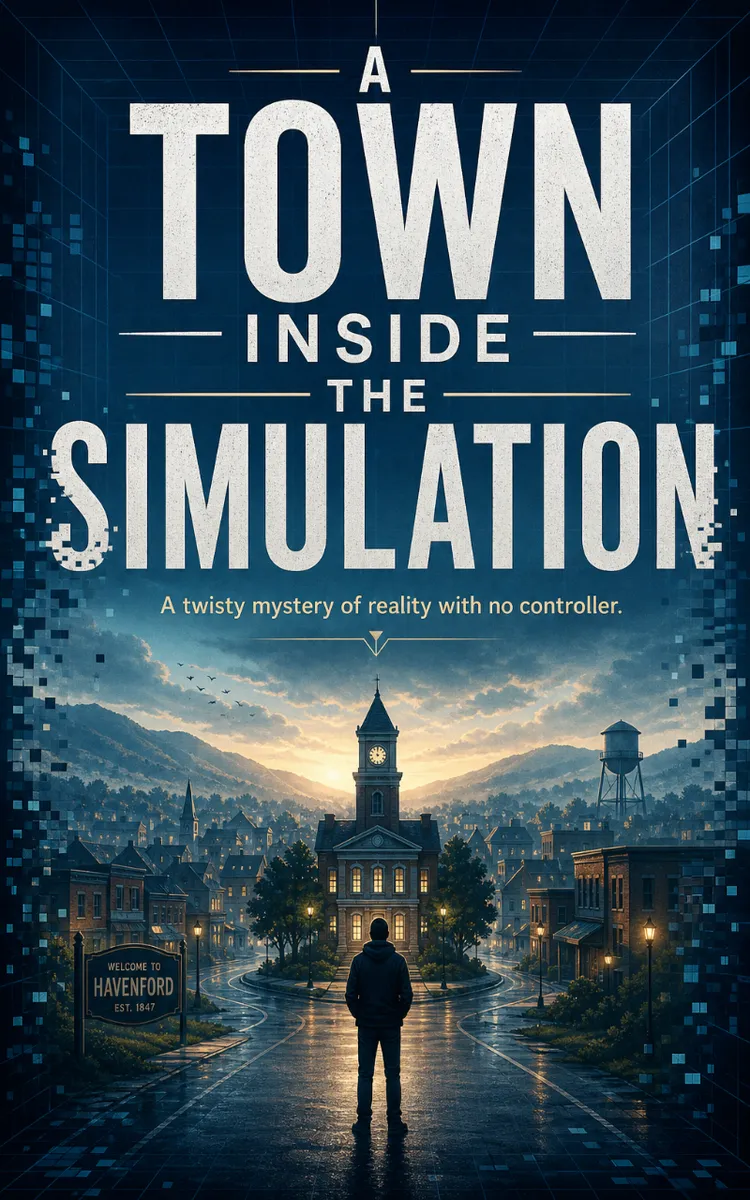
"A Town Inside The Simulation" is a fiction book by Nichole Haines with 41 chapters and approximately 112,175 words. A town realizes their world is a simulation..
This book was created using Inkfluence AI, an AI-powered book generation platform that helps authors write, design, and publish complete books. It was made with the AI Novel Writer.
Frequently Asked Questions
What is "A Town Inside The Simulation" about?
A town realizes their world is a simulation.
How many chapters are in "A Town Inside The Simulation"?
The book contains 41 chapters and approximately 112,175 words. Topics covered include The Sky That Repeats Tonight, The Power Grid Locks Into Patterns, Footprints Appear Before She Walks, Council Chair Denies the Missing Minutes, and more.
Who wrote "A Town Inside The Simulation"?
This book was written by Nichole Haines and created using Inkfluence AI, an AI book generation platform that helps authors write, design, and publish books.
How can I create a similar fiction book?
You can create your own fiction book using Inkfluence AI. Describe your idea, choose your style, and the AI writes the full book for you. It's free to start.
Write your own fiction book with AI
Describe your idea and Inkfluence writes the whole thing. Free to start.
Start writingCreated with Inkfluence AI


