
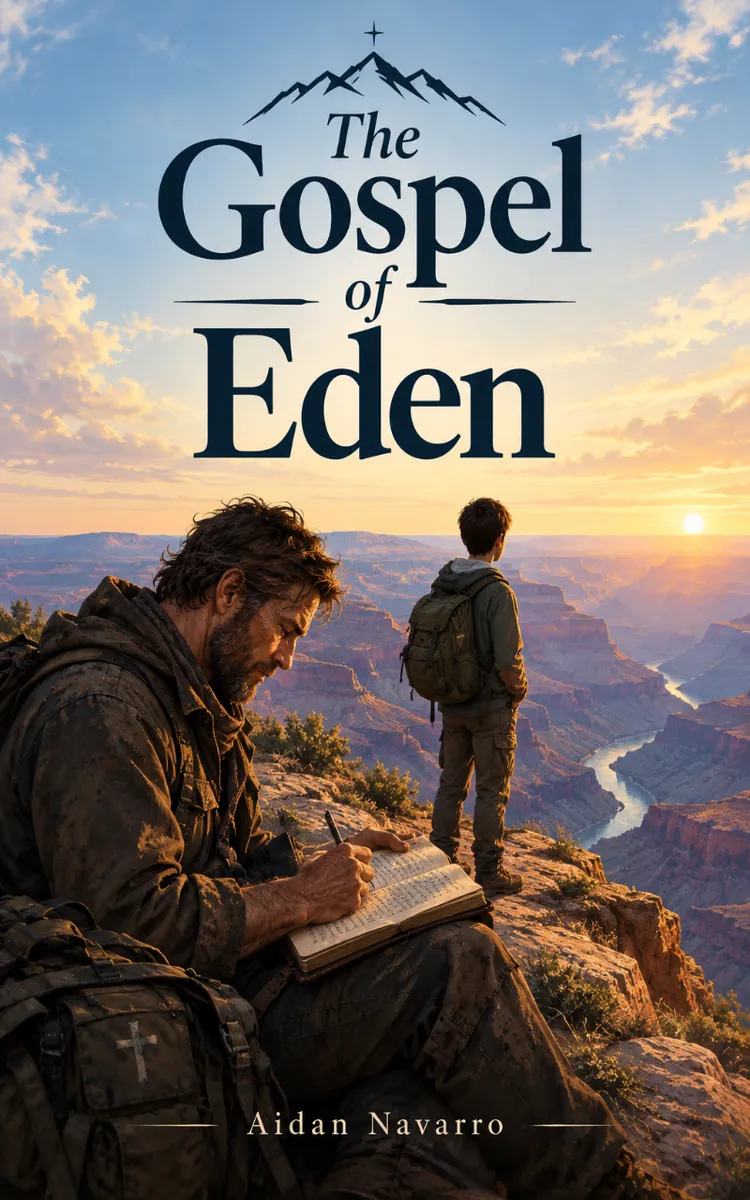
Read the first 2 chapters
The opening of the book, free: 2 chapters. About 17 min. Turn the pages with the arrows, your keyboard, or a swipe.
Chapter 1
The Gospel of Malachi
The snow under David’s cheek had frozen to the shape of his face.
He opened his eyes to a sky the color of old iron. Above him leaned the broken watchtower at Coldwater Pass. Its antenna had fallen years ago, but one black cable still hung from the roof and ticked against the metal whenever the wind came through the dead military camp. Tick. Pause. Tick. Like a small clock nobody had bothered to stop.
His hands were tied behind his back with wire. It had cut into his wrists. His left eye was swollen shut, and every breath dragged a hot line of pain through his ribs. Around him the camp was waking up: boots on packed snow, the snap of a rifle bolt, someone coughing into a sleeve. Past the chain-link fence the Sierra rose white and hard, the old highway buried under drifts and pine shadow.
David wanted water.
Not freedom. Not revenge. Water first. Then, if the Lord had any mercy left for him, a place to stand up before they killed him.
A man kicked his hip. “Up.”
David tried. His arms gave out.
The man kicked him again, harder. “You hear me?”
“I hear you.”
His voice was thick. Dried blood coated his mouth. He got one knee under him and the world tipped sideways. Soldiers had built this camp once. Concrete bunkers squatted under the snow. Fuel drums, rusted trucks, and coils of razor wire made a crooked yard around the barracks. The mercenaries kept their fire beside a caved-in motor pool. They had torn their patches off, but David knew the rifles, the way they stood, the way they changed the watch.
He had fought men like these before the country finished breaking. Some had fought beside him. Others had hunted him across the Nevada line after the last command fell apart.
In the middle of the yard stood a post set in concrete. A rope hung from its crossbar.
The man grabbed David by the collar and dragged him toward it.
“Easy,” said someone else. “The captain wants him standing.”
David looked up.
The captain was a broad woman in a gray coat, her hair cut close to the skull. She stood by the fire holding a tin cup. She looked older than he remembered. The scar across her chin had not changed.
“Rusk,” David said.
Her eyes narrowed. “You remember.”
“I remember the ones I missed.”
A few of the men laughed. Rusk didn’t. She walked over and crouched in front of him. Smoke drifted between them and stung his good eye.
“Western battalion,” she said. “The bridge at Bishop. The fuel convoy.”
“Long time ago.”
“You put three rounds through my truck.”
“You drove it at us.”
“You left me under it.”
David looked at the scar. “You lived.”
“Our kind always does.”
She stood and tipped her head at the post. “Put him there.”
They hauled him up. His knees shook. The rope scratched his throat, though they hadn’t pulled it tight yet. A soldier went through his coat and came out with the little folding knife David had carried since the army.
Then the soldier found the oilcloth pouch strapped inside the coat. He tore it open. Two worn notebooks, a stub of pencil, a fold of blank paper.
“Paper,” he said, disgusted.
Rusk flipped one notebook open with her thumb. Lists. Names. Miles walked. Rough sketches of passes and rivers. She snorted and tossed it back onto his chest. “Keep your diary. You can write in it on the other side.”
The soldier shoved the notebooks back inside David’s coat. Paper wasn’t worth stealing. Nobody could eat it.
Rusk took the knife, turned it once in her hand, and dropped it in the snow.
David watched it sink out of sight.
“Anything to say?” she asked.
He nearly said no. No was simple. He had buried too many men to think words followed anybody into the ground.
Then he saw a boy behind Rusk, maybe fifteen, hauling ammo boxes between the barracks. The boy’s face was gray with cold. He was watching David. Not with pity. With a hard, steady kind of attention.
David looked down.
“I want water,” he said.
Rusk smiled, and there was nothing kind in it. “Eat snow.”
The rope pulled tight.
For a while there was only the pressure on his throat and the wind moaning through the broken antenna. His boots slid. His ribs burned. He thought of the men he’d killed back when killing was called service, and the ones after, when it was only called necessary.
His whole world shrank to white ground, black rope, and the plain stubborn fact of breathing.
Somebody yelled from the barracks.
“Captain! North fence!”
Rusk turned her head.
That was enough.
David drove his heel back into the shin of the man holding him. The man swore and let go. David twisted, caught the rope against the post, and slammed his shoulder into concrete. A rifle cracked overhead. Snow blew off the roof.
He hit the ground hard.
Men shouted. Boots pounded toward him. Rusk cursed his name.
David crawled for the barracks, dragging his tied hands through the snow. He had no plan except cover. A boot came down on his back. His face smacked ice. The wire bit deeper.
“Hold him!”
A small hand came out from under the barracks floor.
It grabbed his sleeve.
He stared at it. Narrow, dirty, bare in the cold.
“Don’t fight,” a boy whispered. “Roll to me.”
David didn’t move. “Who are you?”
“Roll.”
The boot lifted. David rolled as the mercenary reached for his collar. The hand pulled, stronger than it looked. David slid through a gap where the boards had rotted out, scraping his ribs on a beam. His mouth filled with snow and splinters. The mercenary caught his ankle.
David kicked until the grip broke.
Then he was under the barracks.
It was low and black down there, full of old pipes and frozen mud. Something crawled ahead of him. The boy. David followed, every breath tearing at his chest.
Above them men shouted and fired into the floor. Bullets punched through the boards and sprayed dust into the dark.
The boy stopped by a broken foundation wall. He had a knife in his teeth. He took it out and went to work on the wire around David’s wrists.
David watched his fingers. They shook. The blade didn’t.
“They’ll kill you,” David said.
“They’ll kill you first.”
The wire snapped.
Blood rushed back into David’s hands, hot and stinging. He nearly cried out. The boy grabbed his wrist and put a finger to his lips.
Overhead Rusk was shouting. “Close the camp! He’s under there!”
The boy leaned close. His black hair hung in his eyes. His face was young. His eyes weren’t.
“There’s a ditch behind the fuel shed,” he whispered. “It runs up into the trees.”
“Why help me?”
“You were going to die.”
“People die.”
“Not today.”
He pressed the knife into David’s palm. It was small, the handle wrapped in blue thread.
“What’s your name?”
“Malachi.”
The name caught at David. He’d heard it once, long before the roads emptied, from a chaplain who kept a Bible under his coat. A name from the old world of prophets and kings.
“Malachi,” David said.
The boy nodded. “Can you run?”
David flexed his hands. Numb. Bleeding. Weak. He could barely get air.
“Yes.”
It was a lie. He decided to make it true.
Malachi kicked out a panel at the back of the crawlspace. Hard blue daylight poured in. The fuel shed was ten yards off. Past it the slope climbed into black pines, snow whipping between the trunks.
They crawled out.
A mercenary came around the corner of the barracks. Malachi threw a stone. The man turned toward the sound. David came up behind him and drove the knife in under the edge of his vest.
The man made a small, wet sound, like he was surprised.
David pulled the blade out.
Malachi looked at the body for a long second.
“You said you could run,” he said quietly.
“I can.”
They ran.
David crossed the yard with one hand clamped to his ribs. The camp exploded behind them. One rifle shot. Another. Rounds kicked up frozen dirt near his boots. Malachi moved light and quick, picking the gaps between drifts, never once looking back.
At the fence he ducked under a sagging stretch and waited. David dropped down beside him, gasping.
“Up,” Malachi said.
David looked toward the pass. The slope above was steep and thick with pine. Past it lay the high country. Miles of snow and rock and nothing.
“Where’s that go?”
“Away.”
“Away isn’t a place.”
“Today it is.”
They climbed.
In places the snow came to David’s thighs. His boots filled with ice. Below, men crashed through the fence. Rusk called his name once, not loud. That was worse than yelling.
David slipped and caught himself on a tree. His ribs screamed at him.
Malachi was three steps above. He turned. “Don’t stop.”
“I need to breathe.”
“Breathe and walk.”
“You talk a lot for a kid.”
“I’m fourteen.”
“So, a kid.”
Malachi didn’t blink. “The Lord doesn’t count a man by his years.”
David started to laugh. It turned into a cough, and blood spotted his glove.
The mercenaries reached the trees below. Their voices carried up through the pines.
Malachi reached for his arm.
David pulled back. “If they catch us, leave me.”
“No.”
“You don’t know me.”
“I saw what they were doing to you.”
“That’s not knowing me.”
Malachi looked at him a long moment. Snow caught in his lashes.
“Then I’ll get to know you on the road.”
A shot cracked. The tree beside David split, and a strip of bark slapped his cheek.
Malachi grabbed his sleeve. They climbed together.
The slope pinched between two rock outcrops. Malachi led him through a gap hidden under fallen branches. On the far side the ground dropped hard into a ravine packed with fir and snow. The camp disappeared below them.
David went down on his knees.
Malachi crouched beside him. “Can you stand?”
David looked back. Small figures moved through the trees. Rusk had reached the gap.
He closed his fist around the blue-threaded knife. Inside his coat the notebooks pressed flat against his chest, still there.
“Yes,” he said.
Malachi’s eyes went to the blood on David’s coat, then out to the mountains. “There’s a spring under the ridge. We can make it before dark.”
“You know this country?”
“I know the way.”
“Who taught you?”
Malachi turned uphill.
“Come on,” he said. “I’ll tell you.”
They climbed into the trees while the mercenaries found the blood trail below. The wind wiped out their tracks one by one. It did nothing about the sound of the men coming.
By dark, David would learn that Malachi carried no map, no real weapon, and not one written word.
He carried only the stories.
Chapter 2
The Boy Who Knew the Way
David stumbled after him, one hand pressed hard over his ribs, while the mercenaries climbed through the trees below.
Snow slid under his boots. Pine branches whipped his face and sent cold water down his neck. Every breath scraped. The blood at his wrists was starting to freeze in the torn cuffs of his coat.
“Faster,” Malachi said.
David grabbed the boy’s shoulder and nearly pulled him over. “You want faster, find me a new body.”
Malachi caught himself on a trunk. “Use the one you’ve got.”
A rifle cracked below. The shot went wide, but the sound rolled through the forest and bounced back off the cliffs. David felt the old habit wake up in him. Listen. Count. Figure the angle. Three voices. Maybe four. Rusk had sent them up spread out.
He looked uphill. The pines thinned there into pale rock and a long shelf of loose scree. Above that, the white shoulder of the mountain, bare under a bruised evening sky.
“That way?”
“No.”
Malachi pointed east, at a wall of trees so thick it looked solid. “There.”
“You said uphill.”
“I said away.”
A branch snapped below them.
David pulled the small knife from his belt. The blue thread on the handle was dark with his blood. “We get on those rocks, they’ll see us.”
“They can already see the rocks.”
“Then where?”
Malachi didn’t answer. He walked into the trees.
David followed. There was nothing else to do. The forest closed in. Fir needles muffled their steps, but the slope got steeper until David was dragging himself from trunk to trunk. His ribs ground every time he lifted an arm. Once his knee folded. Malachi came back, grabbed his sleeve, and pulled him up.
“I can walk.”
“I know.”
“Then quit carrying me.”
“I’m not.”
“You’re thinking about it.”
Malachi glanced back. “I’m thinking about the spring.”
Just the word made David’s throat ache.
“How far?”
“Not far.”
“That tells me nothing.”
“It tells you we’re not there yet.”
The boy kept climbing.
David had known men who lied because they were scared and men who lied because they were proud. Malachi did neither. He talked as if the whole world had already been walked and measured, every danger sitting where it belonged. That made David angry. It also kept his feet moving.
They ducked under a fallen pine and came out at the stream.
It wasn’t a gentle one. Snowmelt tore down the mountain in a brown, furious channel, slamming into boulders and throwing white spray into the air. The far bank rose under a stand of twisted fir. Between the banks lay one narrow log, slick with ice.
David stopped.
Malachi crouched at the edge. “We cross here.”
David looked back. A man shouted through the trees. Another answered from higher up.
“That water will take us.”
“Not if we cross.”
“And if the log breaks?”
“Then it breaks.”
David gave one short laugh. “You got an answer for everything?”
“No. Just for what’s in front of us.”
Malachi stepped onto the log.
It bowed under him. He held his arms out and took small, careful steps. Halfway over, a gust hit him. His foot slipped. He dropped to one knee and hugged the bark while the water roared under him.
David was in the stream before he’d decided anything.
The cold grabbed his legs through his pants. Not snow cold. Not wind cold. It went straight into the bone like a blade. He caught the log with one hand and reached for Malachi with the other.
“Don’t move,” he said.
Malachi looked down at him. “You’re in the water.”
“I noticed.”
“You can’t stand there.”
“Noticed that too.”
A rifle cracked behind them. Bark exploded off the bank.
David pushed up. Pain ripped through his side. He grabbed Malachi’s ankle and shoved him toward the far bank.
“Go!”
The boy slid off the log and landed hard on the stones. David tried to follow, but the current hit his knees and his hand tore loose.
For one second he saw the water under him, black between the white folds. Then Malachi threw himself back onto the log and grabbed David’s coat.
Those thin arms locked tight.
“Let go,” David said.
“No.”
“It’ll pull you in.”
“No.”
“Malachi.”
The boy jammed one foot against a rock. His face had gone white, but he held on. David found the log again and hauled himself along it. They crawled up the far bank together, soaked to the waist.
David lay on the stones and couldn’t breathe. Water poured from his sleeves. The wound under his ribs had opened, and warmth spread through the cold cloth. He pressed a hand to his coat. The notebooks were still there, wrapped tight in their oilcloth. Damp at the edges. Not ruined.
Malachi knelt beside him. “You’re bleeding.”
“I was bleeding before.”
“More now.”
“Then we both learned something.”
The boy looked at the trees. “They’ll cross.”
“Let them.”
“They’ll see the wet on the stones.”
David forced himself to sit up. “Then fool them.”
Malachi stared at him.
David pointed at the bank. “Pine needles. Mud. Break branches where we came out. Make it look like we went downstream.” He wiped two fingers through the blood on his side and held them out. “And take this. Rub it on the rocks down there. They’re hunting a hurt man. Give them one.”
Malachi did it right away.
David watched him work. He tossed stones into the water farther down. He dragged a broken limb along the bank. Then he walked back into the stream and waded twenty paces downstream, smearing David’s blood on the rocks as he went. When he came back his lips were blue.
“You didn’t have to go back in,” David said.
“You told me to.”
“I told you to make a trail.”
“You didn’t say stay out.”
David had nothing to say to that.
They climbed through the firs until they couldn’t hear the stream. The trees thinned and the mountain opened into a slope of gray stone. No cover except a few junipers and the deep cracks between rocks.
Malachi pointed across the open ground. “There.”
David looked at the sky. Evening had turned into a dark line under the clouds. “They’ll see us.”
“They’ll see us if we stay.”
The first mercenary came out on the far bank below. He raised his rifle and swept the trees. Another man joined him. They’d found the false trail.
David wanted to lie down. The dark hollow under a cedar looked like a bed. He knew what came if he stopped. Sleep. Fever. The rope again.
Malachi was already across the rocks.
David followed.
The scree moved under him. Stones rolled downhill, clicking against each other. He stayed low and used his hands where it got steep. The sharp edges split his palms. Behind them, someone shouted.
“They went downstream!”
“Spread out!”
Malachi reached the far side and was gone.
David crawled faster. A rock hit his shoulder. He nearly slid. When he made the last shelf, Malachi caught his arm and pulled him behind a slab of granite.
The boy put a finger to his lips.
Below, the mercenaries stepped onto the open slope.
David could see them clearly now. Three men, rifles across their chests, moving slow and sure, the way hunters move when they think the animal is too hurt to get far. One stopped by the stream and bent over the rocks.
“Blood,” he called.
Malachi’s hand closed on David’s sleeve.
The man followed the red marks downstream.
The others went with him.
Malachi didn’t breathe until the men were gone under the trees.
David leaned back on the granite. “You knew they’d follow the water.”
“Hurt men go to water. They know that.”
“You knew the rocks would hide us.”
“They won’t climb where the ground moves.”
“You know a lot for a kid with no map.”
Malachi looked up at the mountain. “Maps burn.”
“And you?”
“I remember.”
That bothered David more than it should have.
They kept to the shelf until full dark. The cold got sharper. His wet clothes went stiff against his skin. He couldn’t feel his hands. He started to sway.
Malachi caught him. “We’re close.”
“You said that before.”
“This time it’s true.”
They passed under an overhang and into a narrow crack between two stone walls. The wind dropped away. Somewhere ahead, water was dripping.
Malachi pushed through a screen of dead brush.
On the other side was a hollow about the size of a small room. Rock on three sides. A shelf hid the opening from below. Under a dark seam in the cliff, a shallow pool caught water that fell one drop at a time, clear as glass.
David sank down beside it.
He didn’t drink right away. He just listened. No rifles. No voices. No boots in the brush. Only the spring making its small, steady sound, and the mountain keeping quiet about them.
Then he bent and drank.
The water hurt his teeth. He kept drinking until Malachi pulled him back.
“Slow.”
David wiped his mouth. “Don’t tell me how to drink.”
“Then don’t drink like you want to die of it.”
The boy knelt and drank more carefully. His hands were shaking now. With nothing chasing them, he looked fourteen again.
David peeled off his coat and wrung it out. He laid the notebooks on a dry rock to air. “Where after this?”
“South.”
“South is a lot of ground.”
“To Eden.”
The name didn’t mean much to David. He’d heard it from traders and from dying men. They always said it like it was less a town than a promise nobody had checked.
“Eden’s real?”
“Yes.”
“What’s there?”
“People.”
“That’s it?”
“That’s enough.”
David looked at him. “Why take me?”
Malachi looked down at the water. Then at the notebooks drying on the rock. “Because you can write.”
It sounded crazy in that stone hole, with death walking the mountain below them.
“Write what?”
“The stories.”
“What stories?”
Malachi looked up. His face was pale in the last of the light, but his eyes didn’t move off David.
“The ones God gave us.”
David thought of the chaplain’s Bible, of that old name under the barracks, of the way this boy talked about the Lord like He was close enough to overhear.
“I’m no preacher.”
“I didn’t ask you to preach.”
“I’ve killed men.”
“I know.”
“I almost hung today.”
“I know that too.”
“So why me?”
Malachi touched the water with two fingers. “You know your letters. I know the Word. Together we can carry it farther than either of us can alone.”
Wind moved over the hollow but didn’t come in.
David looked at his hands. They’d written orders once. Names of targets. Reports that turned dead men into numbers and wounds into acceptable losses. Lately his notebooks held nothing but miles and the names of the dead. He hadn’t written anything that mattered in years.
“What if I say no?”
Malachi stood. “Then I’ll still get you to Eden if I can.”
“Why?”
“Because my Father sent me to find you.”
David nearly told him nobody had sent anybody to Coldwater Pass. Men had tied that rope and pulled it with their own hands. But he couldn’t make himself say it.
Far below, a rifle fired once.
Malachi turned to the mouth of the hollow. “They’re searching the ridge.”
David pushed himself up. His body complained but held.
The spring was behind them. The mercenaries were below. Between them stood the dark mountain and the narrow path Malachi remembered.
David tucked the notebooks back inside his coat and closed his hand on the blue-threaded knife.
“Show me the way,” he said.
Malachi nodded. For the first time that night, David saw something like relief cross the boy’s face.
Then Malachi stepped into the dark beyond the spring, and David followed him into the mountains.
End of the sample. 18 more chapters and about 40,364 words in the full book.
Swipe or use the arrows to turn the page


What's inside: 20 chapters
- 1. The Gospel of Malachi
- 2. The Boy Who Knew the Way
- 3. The First Page
- 4. The Pass
- 5. A Name for the Dead
- 6. The Watercourse Ambush
- 7. The Road Beneath the Salt
- 8. The Basin Without Shade
- 9. The Psalm in the Ruins
- 10. The Names in the Ledger
- 11. The Exodus at the Fire
- 12. The Tracks at Willow Draw
- 13. The River That Rose
- 14. The Camp Beyond the Rim
- 15. The Boy Left Behind
- 16. The Lights Below the Cliffs
- 17. The Door in the Stone
- 18. The Stories Returned
- 19. The Mercy in the Boy
- 20. The Gospel of David
About this book
"The Gospel of Eden" is a fiction book by Aidan Navarro with 20 chapters and approximately 40,364 words. David wakes at Coldwater Pass with wire biting his wrists and mercenaries deciding whether to keep him alive. He wants water before freedom.
This book was created using Inkfluence AI, an AI-powered book generation platform that helps authors write, design, and publish complete books. It was made with the AI Novel Writer.
Frequently Asked Questions
What is "The Gospel of Eden" about?
David wakes at Coldwater Pass with wire biting his wrists and mercenaries deciding whether to keep him alive. He wants water before freedom. Then Malachi cuts him loose and leads him into the pines, with Rusk’s men close behind. Malachi says Eden has wells and people who pray. Its Scriptures are gone. David carries the stories they need, but the trail runs through winter forest where rifle shots roll off the cliffs and a fire must stay under the stones. Every mile tests his battered body and the faith he has left. At Eden, survival will not be enough. David must reach the people waiting to hear what he remembers.
How many chapters are in "The Gospel of Eden"?
The book contains 20 chapters and approximately 40,364 words. Topics covered include The Gospel of Malachi, The Boy Who Knew the Way, The First Page, The Pass, and more.
Who wrote "The Gospel of Eden"?
This book was written by Aidan Navarro and created using Inkfluence AI, an AI book generation platform that helps authors write, design, and publish books.
How can I create a similar fiction book?
You can create your own fiction book using Inkfluence AI. Describe your idea, choose your style, and the AI writes the full book for you. It's free to start.
Write your own fiction book with AI
Describe your idea and Inkfluence writes the whole thing. Free to start.
Start writingCreated with Inkfluence AI


