
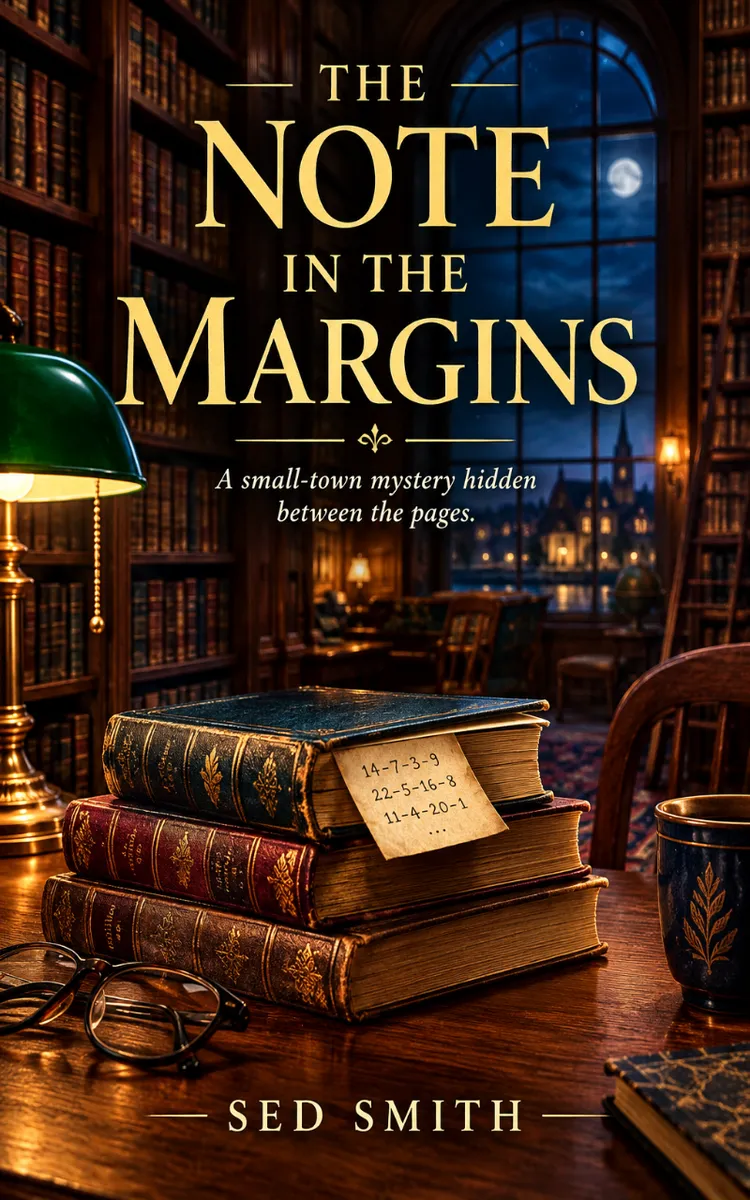
Read the first chapter
The whole of chapter one, free. About 11 min. Turn the pages with the arrows, your keyboard, or a swipe.
Chapter 1
The Note in the Returned Book
The basement light flickered above Eleanor Vale just as the returned book slipped from her stack and landed open in the dust.
“Of course,” she murmured.
The old library had been closed for nearly six months, yet its basement still managed to make demands. Water stains climbed the stone walls in brown, wavering lines. A pipe clicked somewhere overhead. Beneath Eleanor’s sensible shoes, the concrete floor gave a soft, damp crunch where plaster had fallen from the ceiling.
She crouched beside the book and brushed grit from its cover. The title, stamped in faded gold, read The History of Bellwether County. It was exactly the sort of volume she had hoped to avoid.
The community book sale was three weeks away. Eleanor had promised the volunteers at the new library that she would sort the older donations, decide what could be sold, and rescue anything too valuable or too delicate for an outdoor table. She wanted the work finished before noon, her list checked, and herself home in time to water the window boxes.
Instead, she was in the old basement, retrieving one stubborn book from the archive room.
The archive door stood twelve feet away, swollen in its frame. A strip of yellow caution tape sagged across it, left there after the spring flood. Eleanor had no business going inside. The town council had made that clear, though the council had also left half the library’s records behind when the new building opened.
She lifted the book and tucked it under her arm.
Then the ceiling gave a low, gritty sigh.
Eleanor froze.
A pebble struck the floor near her hand. Somewhere in the darkness beyond the archive door, water dripped with steady patience.
“Retrieve the book,” she told herself. “Do not explore. Do not fall through anything. Do not give Margaret Pritchard another reason to say retirement has made you reckless.”
Margaret, chair of the library board and Eleanor’s oldest friend, had said precisely that the previous afternoon when Eleanor mentioned sorting the basement.
“You retired,” Margaret had reminded her. “That means you’re allowed to stop crawling into places with warning tape.”
“I’m retrieving donated books.”
“You’re trespassing among structural hazards.”
“Those are not mutually exclusive.”
Margaret had not laughed.
Now Eleanor turned toward the stairs, but the book’s pages shifted under her arm. A narrow square of paper slid free and fluttered to the floor.
She bent to pick it up.
The paper was cream-colored, stiff with age, and folded twice. No name appeared on the outside. Eleanor unfolded it carefully, expecting perhaps a grocery list or an old library receipt.
Instead, she found six lines of writing in dark blue ink.
The letters were neat, but the words made no sense.
MARCH WRENDS BELOW
THREE LANTERNS TURN
ASH BEFORE IRON
NORTH WHEN BELLS
SEVEN AFTER SILENCE
CLOSE THE BOOK
Eleanor read it twice.
The basement seemed to grow quieter around her.
She knew codes. She had spent thirty-eight years watching people hide messages in returned books - apologies tucked between pages, phone numbers written in margins, a pressed flower meant for someone who would never know. But this was not a child’s secret or a lover’s note. The lines had been arranged with care. Each began at the left edge. The ink had not bled, despite the damp.
She turned the paper over. Blank.
The book lay open at her feet. Its binding had cracked near the middle, and a page corner stuck out farther than the others. Eleanor pulled the book against her chest and flipped through it.
The paper was brittle. Dust rose in a thin veil, catching the weak light. A penciled mark appeared beside a paragraph about the construction of Bellwether’s first courthouse: a small cross, almost invisible.
Eleanor ran her fingertip over it.
The mark was fresh.
Not fresh enough to shine, but darker than the surrounding pencil. Someone had made it recently.
A sound came from behind the archive door.
Not a drip this time.
A scrape.
Eleanor straightened, clutching the book. The door shuddered once in its frame.
“Hello?”
Her voice traveled badly in the basement, swallowed by stone and stacks of shelving.
The scrape came again, followed by a soft thump.
Eleanor backed toward the stairs. The caution tape trembled in the draft. She could leave the book on the sorting table, call Margaret, and let someone from the town inspect the archive in daylight. That was the sensible choice.
But the note was in her hand.
And if someone had used the book to carry a message, whoever had placed it there might return for it.
The thought settled with unpleasant certainty.
Eleanor glanced at the archive door. Its brass knob was green with tarnish. A thin line of water darkened the floor beneath it.
She should go.
Instead, she crossed the basement.
The door resisted when she pushed it. Wood groaned. Eleanor put her shoulder against it, ignoring the sharp pull in her left knee, and forced it open just wide enough to slip through.
The archive smelled of wet cardboard and old stone. Shelves leaned at uneven angles, their contents swollen from the flood. Boxes marked LOCAL HISTORY, TAX RECORDS, and SCHOOL PLAYS crowded the narrow aisles. A fallen ceiling tile blocked the center passage.
Eleanor held the book above her head and stepped over the tile.
“Ridiculous,” she whispered.
Her shoe caught on something.
She looked down. A length of electrical cord lay across the floor, its rubber coating split. Eleanor stepped over it and gripped the nearest shelf for balance. The metal shifted beneath her hand.
A box toppled from above.
She ducked. It struck the floor and burst open, scattering index cards across the damp concrete.
Eleanor stared at the mess.
The cards were handwritten in her own predecessor’s narrow script. Names, dates, addresses. Fragments of Bellwether’s past, all sliding toward a drain clogged with plaster.
“No,” she said.
She knelt and began gathering them.
A sharp crack sounded overhead.
This time, dust sifted onto her hair.
Eleanor shoved the cards into the box without sorting them. She had come for one book, not a rescue operation. With the history volume pressed under her elbow, she moved toward the back wall, where the archive’s oldest shelves stood behind a sagging wire barrier.
The book’s penciled cross had marked a page about the sealed bell tower.
Eleanor found the paragraph again.
The original bell tower, built in 1872, had been closed after a fire damaged the upper stairwell. The bell remained in place, though no record could be found of its final ringing.
Beneath the paragraph, someone had drawn another cross.
Her pulse gave a small, irritated jump.
The page opposite had been cut near the gutter. Eleanor slid a fingernail into the narrow gap and pulled. A second folded paper emerged, wedged beneath the binding.
This one was smaller.
She opened it beneath the beam of her flashlight.
The same handwriting filled the page, but the message was shorter.
DO NOT BRING THE BOOK
IF YOU HEAR THE BELL, LEAVE
THE LAST DOOR IS NOT LOCKED
Eleanor read the final line again.
Behind her, something shifted in the aisle.
She turned so quickly that the flashlight beam swung across the shelves. Boxes, broken chairs, and a rolled carpet filled the narrow passage. Nothing moved.
Then a drop of water struck the book’s cover.
Eleanor looked up.
A dark crack ran across the ceiling.
She folded both notes and pushed them into the inner pocket of her cardigan. The book went beneath her arm. There was no reason to stay another second.
The way out had narrowed.
A section of shelving had collapsed across the aisle, spilling ledgers and warped cardboard into the passage. Eleanor tried the left side first. Her shoulder brushed the wall. A jagged shelf bracket caught her cardigan and held fast.
She tugged once.
The fabric tore.
“Wonderful.”
She backed up, freed the snag, and turned toward the opposite gap. The floor dipped there, hidden beneath a sheet of cloudy water. Eleanor tested it with her shoe. The concrete held.
She stepped forward.
A box slid from the shelf and struck her ankle. Pain flashed up her leg. She caught herself against the wall, the history book nearly falling from her grasp.
For one breath, she stood in the dark with the water creeping around her soles and the damaged ceiling whispering overhead.
Then she heard a bell.
It was faint, muffled by earth and stone, but unmistakable: one dull note from somewhere above the library.
Eleanor stopped breathing.
The bell tower had been sealed for decades.
A second note did not come.
She moved.
By the time she reached the archive door, her knee ached and her torn cardigan sleeve hung loose. She shoved the door closed behind her and climbed the stairs without looking back.
In the main library, sunlight lay across the empty reading room. Dust floated through it, bright and harmless. Eleanor set the book on the circulation desk and locked the basement door, though the lock had not been used in years.
Her hands shook as she unfolded the first note again.
MARCH WRENDS BELOW. THREE LANTERNS TURN. ASH BEFORE IRON.
The words were strange, but the first letters formed M T A N S C.
Not useful.
She examined the lines more closely. The second line had three words. The third had three. The fourth had three. The fifth had three. The final line had three.
The first line had three as well.
Eleanor fetched a pencil from the desk and wrote the words in columns, using the first, second, and third words of each line. She had taught children to look for patterns in catalog cards, but this was different. This felt like standing at the edge of a locked room and hearing someone move inside.
The middle words read:
WRENDS
LANTERNS
BEFORE
BELLS
AFTER
THE
The first letters gave W L B B A T.
The last words read:
BELOW
TURN
IRON
NORTH
SILENCE
BOOK
B T I N S B.
Eleanor frowned.
Then she noticed the punctuation - or rather, the lack of it. Every line ended without a mark except the last, which had a small dot after the word BOOK. Not ink. A pinprick in the paper.
She held the note toward the window.
Three tiny holes appeared along the lower edge.
Eleanor placed the note over the page she had marked. The holes aligned with three words in the book’s paragraph: tower, fire, closed.
Tower. Fire. Closed.
She turned to the second note. Its final line had two pinpricks beneath the words LAST and DOOR.
The old library’s history room had a door that was always locked.
The bell tower had a door that had been sealed.
Eleanor lowered the notes.
A truck rumbled along Main Street outside. Somewhere nearby, a dog barked twice. The ordinary sounds of Bellwether returned, but they no longer felt reassuring.
She put the notes back inside the book, then stopped.
No.
If someone had hidden them there, the book was not safe. Eleanor removed the papers and slipped them into her handbag. She wrapped the history volume in brown paper from the supply cabinet and tied it with twine, as though a neat parcel could make its contents innocent.
The library clock ticked above the circulation desk.
She should call Margaret.
Eleanor reached for the telephone, then looked at the basement door.
Margaret would come. She would bring the board chair, perhaps the police, and certainly a lecture. By evening, half the town would know that Eleanor Vale had found a mysterious note in a returned book. By morning, the note might be dismissed as a prank.
But the message had been hidden recently. Someone had entered the archive after the flood. Someone had marked the book and left instructions that ended with a warning.
And the bell had rung.
Eleanor opened her handbag and looked once more at the second note.
DO NOT BRING THE BOOK.
She took the wrapped volume from the desk and carried it to the locked basement door. For a moment, she considered returning it to the archive, where it had been found.
Instead, she placed it in the old library’s book drop, an iron hatch set into the wall beside the stairs. The hatch had not been used since the new library opened. Eleanor pulled it open, slid the parcel through, and let it fall into the empty receiving bin below.
The thud echoed through the building.
A small choice, perhaps. But the book was no longer in her hands.
The notes were.
She turned toward the front windows.
Across the square, beyond the courthouse roof and the bare branches of the elms, the old bell tower rose above Bellwether’s brick buildings. Its upper windows were boarded. A length of chain still hung across the entrance, visible from the street whenever the sun struck it.
Eleanor had never climbed those stairs.
She had never even stood inside the tower.
Her phone rang.
She flinched and answered without checking the screen.
“Eleanor?” Margaret’s voice sounded brisk, close, and concerned. “Are you still in the old library?”
Eleanor looked at the notes in her palm.
“Yes.”
“Tell me you haven’t gone into the basement.”
Eleanor glanced at the torn sleeve of her cardigan.
“I went in for a book.”
Margaret exhaled. “Eleanor.”
“I found something.”
“What sort of something?”
Eleanor looked again toward the tower.
The first note had been a warning. The second had been more direct. Beneath the last line, almost hidden by the fold, a final phrase had appeared when she held it to the light.
SEALED BELL TOWER.
She had thought the words were a location.
Now she understood they were an instruction.
“I found a note,” Eleanor said. “And I think someone wants me to go to the bell tower.”
There was silence on the line.
Then Margaret said, very quietly, “You are not going there alone.”
Eleanor watched a crow settle on the tower’s highest ledge.
“No,” she said, folding the note into her handbag. “I don’t think I am.”
End of chapter one. 7 more chapters and about 17,474 words in the full book.
Swipe or use the arrows to turn the page
What's inside: 8 chapters
- 1. The Note in the Returned Book
- 2. A Retired Librarian's Choice
- 3. The Locked History Room
- 4. The Ledger's Hidden Account
- 5. The Bell Tower's Open Door
- 6. The Deed No One Believes
- 7. The Book Sale Confession
- 8. A New Place on the Shelf
About this book
"The Note In The Margins" is a fiction book by Sedrick with 8 chapters and approximately 17,474 words. A retired librarian uncovers a coded note in a returned book.
This book was created using Inkfluence AI, an AI-powered book generation platform that helps authors write, design, and publish complete books. It was made with the AI Novel Writer.
Frequently Asked Questions
What is "The Note In The Margins" about?
A retired librarian uncovers a coded note in a returned book
How many chapters are in "The Note In The Margins"?
The book contains 8 chapters and approximately 17,474 words. Topics covered include The Note in the Returned Book, A Retired Librarian's Choice, The Locked History Room, The Ledger's Hidden Account, and more.
Who wrote "The Note In The Margins"?
This book was written by Sedrick and created using Inkfluence AI, an AI book generation platform that helps authors write, design, and publish books.
How can I create a similar fiction book?
You can create your own fiction book using Inkfluence AI. Describe your idea, choose your style, and the AI writes the full book for you. It's free to start.
Write your own fiction book with AI
Describe your idea and Inkfluence writes the whole thing. Free to start.
Start writingCreated with Inkfluence AI


