
Read the first chapter
The whole of chapter one, free. About 8 min. Turn the pages with the arrows, your keyboard, or a swipe.
Chapter 1
Why Ritual Makes Belief Feel True
The Body Learns Before the Mind Objects
A person can enter a religious service as a skeptic and leave having knelt, stood, bowed, sung, breathed incense, and repeated ancient words in the company of strangers. Nothing has been proven, yet something has happened: the body has participated in a world that the mind may still doubt.
That is the quiet power of ritual. It does not usually argue for belief. It rehearses belief until belief feels less like an opinion and more like the texture of reality. A gesture repeated across generations, a melody carried by an entire room, or the scent of burning resin can turn an invisible claim into a physical event.
Religious institutions have understood this for thousands of years. Their ceremonies do more than express ideas; they organize attention, emotion, posture, memory, and belonging. The Ritual Imprint Model names this process: repeated action leaves a mark, and the mark can make a claim feel familiar, embodied, and therefore true.
When the body has already agreed, how much work remains for the mind to resist?
The Ritual Imprint Model
Consider the ordinary choreography of a Catholic Mass. Congregants stand, sit, kneel, cross themselves, answer the priest, and rise again. The sequence is not decoration around the theology. It is theology translated into movement. The body is instructed when to submit, when to speak, when to remain silent, and when to receive.
The same principle appears across traditions. Muslims perform the cycles of salah, moving from standing to bowing to prostration five times a day. Jewish worshippers sway, recite, cover their heads, and handle sacred texts. Hindu puja uses lamps, bells, flowers, food, fragrance, and repeated gestures directed toward an image or deity. Buddhist practice may coordinate breath, posture, chanting, and the turning of prayer wheels.
The doctrines differ sharply. The machinery is familiar.
Repetition reduces the distance between an idea and an action. A child who learns to fold their hands before praying does not first master a philosophical argument about divine attention. They learn the posture. The posture arrives before the explanation, and often remains after the explanation has become complicated. Religious instruction therefore begins not only with words but with timing, muscle memory, and sensory association.
The imprint grows through regularity. A weekly service, a daily prayer, or an annual fast divides time into sacred patterns. Ordinary life becomes punctuated by signals that announce when attention must turn toward the unseen. Bells, calls to prayer, candles, drums, scripture readings, and processions act as external clocks. They do not merely remind believers what to think. They help determine when thinking should occur.
A repeated gesture also carries social information. Kneeling beside hundreds of people is not the same as kneeling alone. The crowd confirms the act while the act confirms the crowd. Each person sees others performing the same submission and receives the impression that the gesture is natural, expected, and widely shared. Agreement becomes visible before it becomes verbal.
Why Synchrony Feels Like Truth
Human beings are unusually responsive to rhythm. Marching armies, rowing crews, factory workers, dancers, and congregations all demonstrate the same basic fact: coordinated movement changes how a group feels from the inside.
When people clap together, sing together, or walk in procession, their separate bodies briefly behave like one system. Breathing may align. Attention narrows. Individual hesitation becomes harder to detect. The experience can feel emotionally powerful even when no new information has been introduced.
Religious ritual makes extensive use of this effect. Gregorian chant stretches words into a shared vocal environment. Gospel worship may build through call-and-response, handclapping, and collective singing. Buddhist monks chant in measured sequences. Hindu ceremonies use bells and repeated mantras. In each case, sound occupies the room before anyone evaluates the proposition carried by the sound.
A congregation does not encounter a creed as a sentence printed on a page. It encounters the creed spoken by many voices, often in a familiar cadence, surrounded by people who have already accepted it. The claim is wrapped in evidence of commitment. The social fact - everyone is saying this - can begin to resemble evidence for the supernatural fact - therefore this is true.
A brief anecdote from the history of public worship captures the problem. In the early modern period, reformers who wanted to change religious belief often fought over music, language, and ceremony rather than doctrine alone. Protestant reformers challenged Latin worship, altered the role of images, and promoted congregational singing. These disputes were not merely aesthetic. Whoever controlled the words, rhythms, and visible gestures of worship controlled how ordinary people encountered religious authority.
Synchrony also makes dissent conspicuous. A person who remains seated while others kneel is not simply holding a private opinion; their body announces separation. Ritual creates a public standard against which deviation can be seen. The same rhythm that produces solidarity can expose disobedience.
Scent, Light, and the Shortcut to Certainty
Sensory cues are especially effective because they often reach emotion and memory before conscious reasoning. The smell of incense may be associated with childhood, funerals, solemn music, family members, or the architecture of a particular church. A candle flame can signal reverence before anyone explains why fire matters. Gold, stained glass, polished stone, and choral sound create an environment in which ordinary categories feel temporarily suspended.
The sensory world of religion is not accidental. Ancient temples used incense, processions, sacred meals, and dramatic architecture to distinguish ritual space from daily life. In the Roman Empire, public sacrifice joined political authority to religious spectacle. The emperor’s image, the altar, the priestly costume, and the crowd’s participation made loyalty visible as a sacred duty. A ruler did not need to explain every political demand when the state appeared inside the ritual order of the universe.
The connection between smell and memory is particularly useful to religious institutions because olfactory associations can remain durable. A person may forget a sermon while remembering the smell of wax, dust, flowers, or smoke. The sensory detail becomes an anchor for an entire emotional setting. Later, encountering the same scent can revive not only the memory but the feeling of reverence attached to it.
Architecture performs a similar operation. A cathedral’s height directs the eye upward. A mosque’s ordered rows organize bodies toward a common direction. A shrine’s restricted inner space creates a visible boundary between ordinary access and sacred privilege. The building tells the visitor what kind of attention is required before a priest, imam, monk, or custodian says anything.
One sentence deserves to stand alone:
The sacred often feels different because the room has been engineered to make ordinary perception behave differently.
This does not mean every believer is being consciously manipulated by scenery. It means that conviction is never produced by argument alone. Light, distance, sound, clothing, silence, and movement all contribute to the sense that an encounter is weightier than everyday experience. Religious authority becomes easier to accept when it arrives inside an environment already marked as exceptional.
The Counterintuitive Finding: Ritual Can Come Before Belief
The surprising point is that ritual does not always express belief; sometimes it helps manufacture the conditions in which belief becomes plausible. People may adopt a practice because their community expects it, then later experience the practice as evidence that the belief was already theirs.
This reverses the usual story. We tend to imagine that a person believes first and performs the ritual afterward. In reality, performance can precede conviction, especially in childhood, conversion, initiation, or moments of social pressure. The body learns the pattern while the mind is still undecided.
That matters because it complicates the idea of religious consent. A person may sincerely report that a ritual feels meaningful, yet that meaning has been shaped by years of repetition, sensory conditioning, and public participation. Sincerity does not prove independence from influence. It may be the final product of influence so deeply absorbed that it no longer feels external.
The Ritual Imprint Model therefore treats belief as partly embodied. A doctrine gains force when it is repeated in language, enacted through posture, synchronized with others, attached to powerful memories, and placed inside a controlled environment. None of these elements proves the doctrine. Together, they can make the doctrine feel self-evident.
This is why institutions concerned with obedience have repeatedly invested in ceremony. Courts, armies, schools, and nations also use uniforms, oaths, salutes, anthems, flags, and synchronized movement. Religion is not unique in discovering that coordinated bodies can produce coordinated minds. It is simply one of the oldest and most elaborate users of the technique.
Lourdes and the Making of a Shared Miracle
The sanctuary at Lourdes offers a concrete example of how ritual, sensation, and collective expectation reinforce one another. After reported visions of the Virgin Mary by Bernadette Soubirous in 1858, Lourdes developed into a major pilgrimage site. Visitors encountered a specific landscape of grotto, candles, water, prayers, processions, and crowds organized around healing and intercession.
The famous baths are not merely medical facilities, and the candles are not merely illumination. The water, the repeated prayers, the movement toward the grotto, and the presence of other pilgrims form a sequence in which private suffering enters a public ritual structure. A person arrives with pain or fear and is given a set of gestures through which that pain can be expressed, witnessed, and placed within a sacred story.
At night, the torchlight procession turns thousands of individual flames into one moving field of light. Participants recite prayers together while carrying candles through the grounds. The visual effect is immediate: separate people become a single body advancing through darkness. Whether a cure occurs is a different question. The ritual can still produce certainty about belonging, devotion, and the reality of the sacred encounter.
Lourdes also shows how institutions preserve an experience through repetition. The site’s power does not depend on one extraordinary event alone. It depends on the continuing reproduction of the event’s forms: the water, the prayers, the candles, the procession, the stories of healing, and the authority of the sanctuary. Each pilgrim enters a ritual already thick with earlier pilgrims.
The result is not proof in the scientific sense. It is something more socially durable: a setting in which the supernatural claim is repeatedly performed, emotionally reinforced, and publicly confirmed. A person may question one report of a miracle. It is harder to question an entire environment that has taught generations how to feel the presence of one.
Human beings do not encounter truth as detached observers. They encounter it through bodies trained to notice certain signals, rooms designed to focus attention, and communities that reward particular interpretations. Ritual can make an invisible power feel present without making it demonstrable.
That is the unsettling brilliance of the machinery: belief may feel most unquestionable at the precise moment when the believer is least aware of how many hands shaped the experience. And once a claim has entered the muscles, the senses, and the rhythm of a crowd, where exactly does evidence end and imprint begin?
End of chapter one. 39 more chapters and about 68,947 words in the full book.
Swipe or use the arrows to turn the page


What's inside: 40 chapters
- 1. Why Ritual Makes Belief Feel True
- 2. The Social Cost of Doubt
- 3. When Leaders Speak for God
- 4. The Promise of an Afterlife
- 5. Confession as Social Surveillance
- 6. Sacred Calendars, Governed Lives
- 7. Teaching Children What Cannot Be Questioned
- 8. Purity Rules and Private Bodies
- 9. The Power Hidden in Sacred Texts
- 10. Miracles, Rumors, and Crowd Belief
- 11. How Empires Borrowed the Altar
- 12. Converting Conquest into Consent
- 13. The Census Behind the Pulpit
- 14. Marriage Laws as Population Policy
- 15. Charity That Builds Dependence
- 16. Who Owns the Sacred Land?
- 17. When Heresy Became a Crime
- 18. The Inquisition’s Machinery of Fear
- 19. Holy War’s Recruitment Promise
- 20. Making Enemies Beyond the Faith
- 21. The Sermon as Political Broadcast
- 22. Printing Faith, Standardizing Belief
- 23. Religious Schools and Civic Loyalty
- 24. The Nation Dressed as a Faith
- 25. Gender Roles Called Divine Order
- 26. The Missionary’s Cultural Bargain
- 27. When Ritual Becomes Public Theater
- 28. The Mind’s Search for Hidden Agency
- 29. Fear, Guilt, and Moral Self-Policing
- 30. Why Certainty Survives Contradiction
- 31. The Comfort That Can Bind
- 32. Charismatic Leaders and Group Surrender
- 33. Leaving a Faith, Losing a World
- 34. Reformers Who Rewired Authority
- 35. Secular States, Sacred Habits
- 36. Faith in the Age of Algorithms
- 37. The Market for Spiritual Certainty
- 38. When Religion Resists the State
- 39. Separating Meaning from Control
- 40. Who Gets to Shape the Human Mind?
About this book
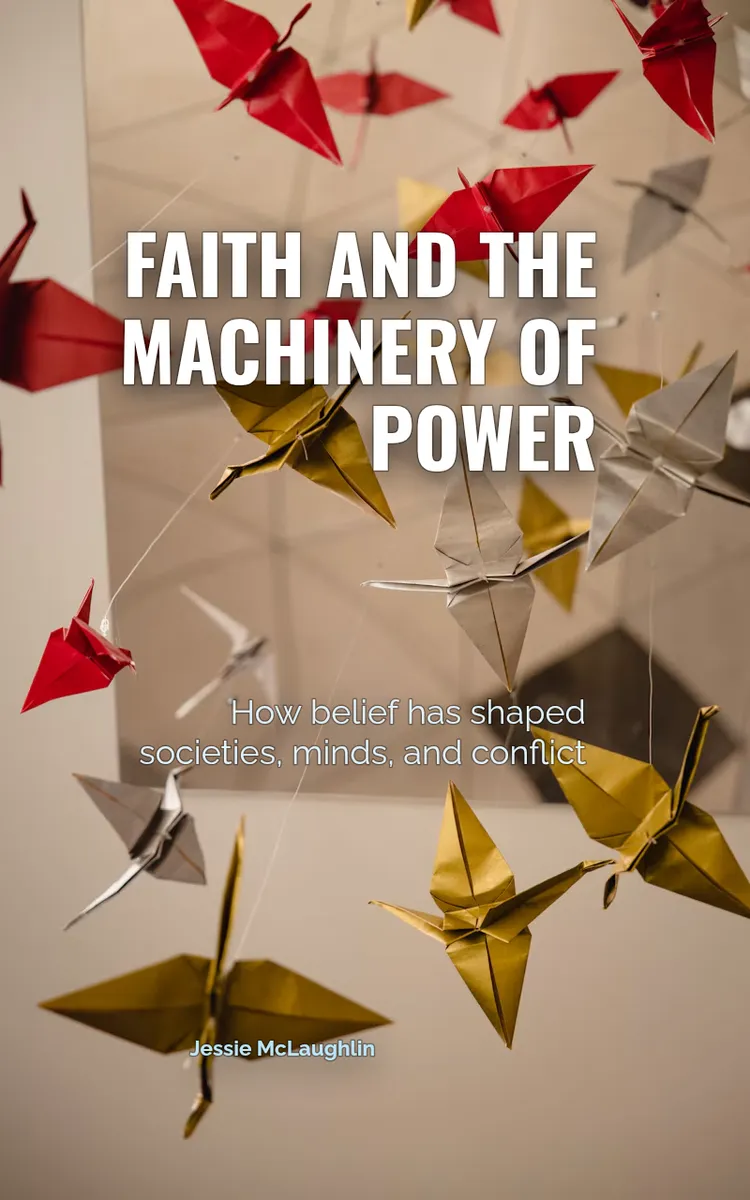
"Faith And The Machinery Of Power" is a curiosity book by Jessie McLaughlin with 40 chapters and approximately 68,947 words. Religion's historical role in social control, culture, warfare, and belief.
This book was created using Inkfluence AI, an AI-powered book generation platform that helps authors write, design, and publish complete books.
Frequently Asked Questions
What is "Faith And The Machinery Of Power" about?
Religion's historical role in social control, culture, warfare, and belief
How many chapters are in "Faith And The Machinery Of Power"?
The book contains 40 chapters and approximately 68,947 words. Topics covered include Why Ritual Makes Belief Feel True, The Social Cost of Doubt, When Leaders Speak for God, The Promise of an Afterlife, and more.
Who wrote "Faith And The Machinery Of Power"?
This book was written by Jessie McLaughlin and created using Inkfluence AI, an AI book generation platform that helps authors write, design, and publish books.
Write your own curiosity book with AI
Describe your idea and Inkfluence writes the whole thing. Free to start.
Start writingCreated with Inkfluence AI


