
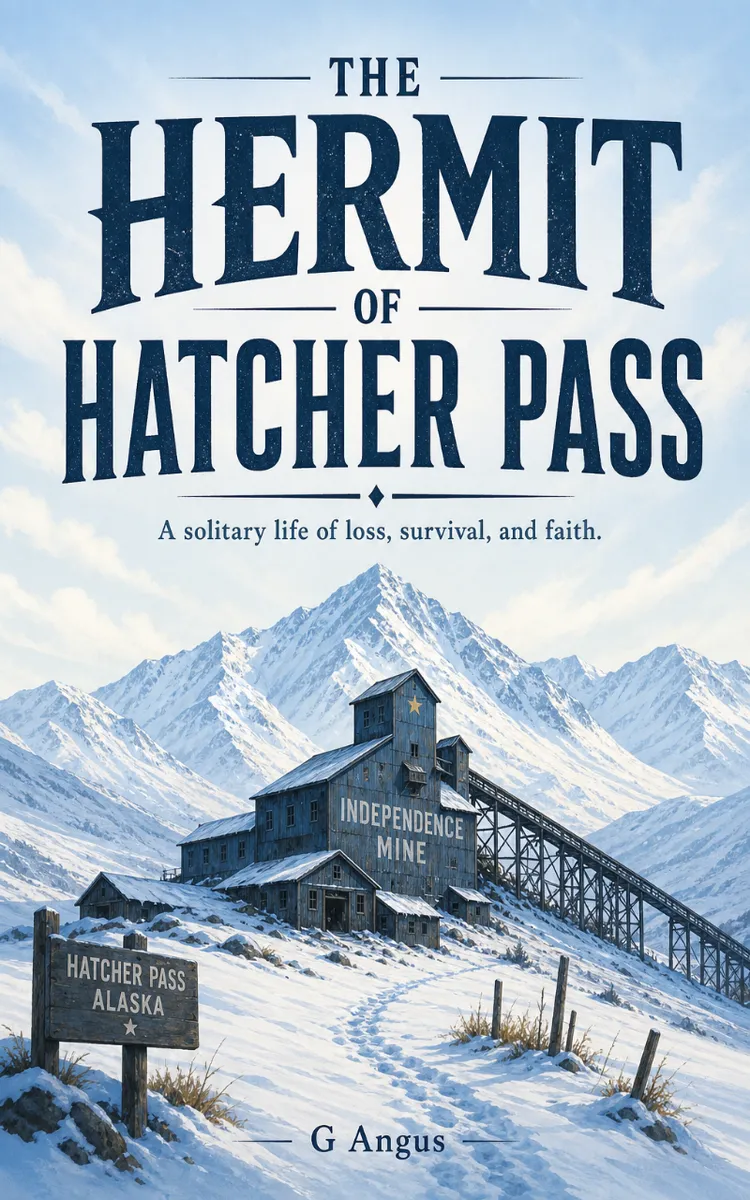
Read the first chapter
The whole of chapter one, free. About 8 min. Turn the pages with the arrows, your keyboard, or a swipe.
Chapter 1
The Maine Letter Never Sent
The mine entrance stood black beneath a shelf of snowmelt, and water fell from the rock in a steady silver thread. Sam Caldwell stopped before it with one hand closed around the sealed letter in his coat.
Behind him, Hatcher Pass rose in broken ridges, gray stone showing through the last patches of spring snow. Ahead, the mine yard clattered with iron, boots, and the cough of a hoist engine. Men moved between sheds with their collars turned up against the wind. A mule stamped beside a stack of timber, its harness bells giving a nervous little jingle.
Sam had come to work. That was all.
His pack held a spare shirt, a blanket, a tin cup, and the few dollars left from the long journey north. The letter was heavier than all of it. He had carried it from Maine without opening it, though the fold had softened beneath his thumb and the paper had gone warm against his ribs.
A man in a canvas coat came out of the office and looked him over.
“You the new hand?”
“If there’s work.”
The man’s eyes traveled from Sam’s worn boots to his narrow shoulders. He was not tall, but the mountains had already taken the softness from him. His hands were raw from travel and hard labor along the way.
“Name?”
“Sam.”
“Sam what?”
“Caldwell.”
The foreman glanced toward the mine mouth. “You got a card?”
“No.”
“References?”
“No.”
The foreman’s mouth tightened. “Then you got nothing.”
Sam felt the letter press against his chest. The seal was red wax, cracked at one edge but unbroken.
“I can work,” he said.
“That’s what every man says before the first shift.” The foreman stepped closer. “Where’d you come from?”
“Maine.”
“Long way to come with no papers.”
Sam looked past him at the dark opening. Water ran over the rails and vanished underground. Somewhere below, metal struck stone three times, then stopped.
“I came for the mine.”
The foreman studied him as if the answer had hidden something rather than revealed it. “Mine’s changing.”
Sam said nothing.
“Vein’s pinching off in the east cut. Timber’s bad in two places. We lost a man yesterday.”
A gust came down from the pass, lifting dust and old snow into the yard. The mule shied against its traces.
“Dead?” Sam asked.
“Missing.”
The word settled between them.
The foreman turned toward the office. “Come inside.”
The office was a low plank building with tar paper over the seams. Coal smoke crawled along the ceiling. A stove ticked in the corner, and a calendar hung beside it with the month turned to June though the paper still showed May.
The foreman sat behind a scarred desk. Sam remained standing.
“You ever worked underground?”
“Quarry.”
“That’s not the same.”
“Stone is stone.”
“Not when it’s over your head.”
The foreman pulled a ledger toward him and dipped a pen. “You understand the shift is ten hours. You do what you’re told. You don’t wander. You don’t touch blasting powder unless it’s handed to you. You don’t go looking for the missing man.”
“I won’t.”
“You didn’t ask who he was.”
Sam’s fingers tightened around the letter in his pocket.
The foreman noticed. “What’s that?”
“A letter.”
“To whom?”
“No one here.”
“Then why bring it into a mine?”
Sam looked at the stove. A thin blue flame showed beneath the iron grate.
“It came with me.”
“That isn’t an answer.”
“It’s the one I have.”
For a moment, the foreman seemed ready to send him back into the weather. Then a bell rang outside - one sharp pull from the hoist shed. Men shouted. Something heavy scraped along the rails.
The foreman rose. “You want work, prove you can stand where the mountain puts you.”
He pushed a dented helmet across the desk.
Sam took it.
At the shaft mouth, the men fell quiet as he approached. Their faces were gray with dust, though the shift had barely begun. One of them, a broad man with a torn sleeve, looked at Sam’s pack.
“New hand,” the foreman said.
“Looks more like a runaway,” the broad man replied.
Sam set the helmet on his head. It was too large. He folded a strip of cloth beneath the band until it held.
The foreman pointed down the rails. “You’ll ride to the lower cut. Carry timber. Follow the lamp ahead of you. If the lamp stops, you stop.”
“And if it goes out?” Sam asked.
“Then you pray.”
The broad man gave a short laugh. “He’ll fit right in.”
Sam stepped into the cage. The floor shuddered beneath his boots. The shaft opened below him, a square of darkness crossed by wet beams. The letter lay against his chest, and for one instant he saw Maine instead of Alaska: a white road, a ditch full of broken glass, the church steeple beyond the bare trees.
He shut his eyes.
The cage dropped.
Wind tore upward through the shaft. The men’s voices thinned above him, and the daylight narrowed to a pale coin. Sam kept one hand on the cage rail and the other over the letter.
He had not read it because the words belonged to the life he had fled. He had not burned it because burning it would have been an answer. So he carried it, sealed and silent, through towns, rail yards, and miles of wilderness.
The cage struck bottom hard enough to bend his knees.
“Move,” someone said.
A lamp bobbed ahead. Sam followed.
The lower cut was a narrow passage propped with fresh timber. Water dripped from the ceiling onto his neck. The floor was slick, and the air held the sharp smell of oil, wet rock, and powder. Men worked in the dark with picks and shovels, their movements reduced to shoulders, hands, and the yellow circles of their lamps.
The foreman pointed to a stack of timbers.
“Carry those to the east cut.”
Sam lifted the first beam. It was longer than he was tall and rough enough to catch his coat. He braced it against his shoulder and walked.
The tunnel narrowed. Stone pressed close on both sides. His boots slipped twice, but he did not fall. At the east cut, a miner waved him toward a sagging section where the roof had been shored with crooked poles.
“Set it there,” the miner said.
Sam lowered the beam. “Where’s the missing man?”
The miner’s face changed.
“You ask too much.”
“I need to know where I’m standing.”
“You’re standing where he was standing.”
A crack sounded overhead.
Every lamp went still.
Dust sifted from the ceiling. Somewhere behind them, a timber groaned.
“Back,” the miner whispered.
The foreman shouted from the passage. “Back!”
Sam moved, but the beam he had carried caught against the wall. He pulled once. It held. The roof gave another long, splintering complaint.
He dropped the beam and ran bent double.
Rock struck the floor behind him. The sound rolled through the cut like thunder trapped in a box. A cloud of dust swallowed the lamps. Men cursed and stumbled. Sam reached for the wall, found wet stone, and pressed himself against it as a section of ceiling collapsed where he had stood.
The mine became silent.
Then a man coughed.
“Count them,” the foreman said.
Lamps lifted through the dust. Faces emerged one by one.
“Six.”
“Seven.”
“Eight.”
The foreman looked toward the fallen passage. “Nine.”
No one answered.
Sam stared at the broken timber lying across the floor. A strip of blue cloth clung to one splinter.
The foreman saw it too.
“Don’t touch that,” he said.
Sam’s hand had already moved toward it.
“Leave it.”
The order stopped him. He withdrew his hand.
The foreman came close, his face streaked black. “You understand now?”
Sam looked into the dust-filled dark. “The mine’s changing.”
“It was changing before you arrived.”
“Then why bring men in?”
The foreman’s eyes hardened. “Because men need wages.”
The answer struck deeper than it should have. Sam thought of the road out of Maine, of the money counted twice before each meal, of the letter folded against his heart like a wound that had learned to keep its shape.
The foreman pointed back toward the shaft. “You’re done for today.”
“I can keep working.”
“You can obey.”
Sam held his gaze.
The foreman lowered his voice. “The missing man was on this crew. If he’s under that fall, every man who worked beside him will be questioned. You included.”
“I just got here.”
“That won’t matter if they need someone to blame.”
A bell rang faintly above. The sound traveled down the shaft and trembled through the rails.
The foreman looked toward it. “Get out.”
They climbed in silence. At the cage, Sam noticed the broad miner from the yard standing apart from the others. He watched Sam with a guarded expression.
“You bring trouble with you?” the man asked.
Sam stepped into the cage. “No.”
The man glanced at the dark below. “Trouble follows some men anyway.”
The cage rose. Daylight widened overhead. When Sam emerged, the mountain struck him with cold brightness. Snowfields shone above the yard, and the wind carried the clean, hard sound of water running beneath the thawing ground.
The foreman stood beside the office door.
“You’re hired,” he said.
Sam waited.
“Six dollars a week, meals when there’s enough. You sleep in the bunkhouse. Tomorrow you report before the bell.”
Sam nodded.
The foreman’s gaze dropped to his coat pocket. “And that letter stays put. I don’t want secrets in my mine.”
“It isn’t yours.”
The foreman’s face went flat. “Everything underground belongs to the mountain until it kills you. Remember that.”
Sam turned toward the bunkhouse. His legs trembled from the descent and the climb, but he kept walking.
Behind him, the foreman called, “Caldwell.”
Sam stopped.
“If the missing crewman turns up dead, and you disappear, they’ll say you had a reason.”
Sam looked back at the black mouth of the shaft. Water fell there in its steady silver thread, entering the earth as if the mountain had all the time in the world.
He touched the sealed letter through his coat.
“I have a reason,” he said.
Then he walked on, carrying the unopened past into the bunkhouse, while somewhere beneath his feet the mine shifted again.
End of chapter one. 32 more chapters in the full book.
Swipe or use the arrows to turn the page


What's inside: 33 chapters
- 1. The Maine Letter Never Sent
- 2. First Descent Into the Shafts
- 3. Counting Days Without Their Names
- 4. The Avalanche That Misses Him
- 5. Prayer Under a Broken Lantern
- 6. The Bear That Shatters the Quiet
- 7. Following Tracks Toward the Missing Man
- 8. Summer Blasting Days and New Faces
- 9. The Cabin Dream on Willow Side
- 10. Timber Taken, Promises Broken
- 11. The Night He Refuses the Call
- 12. Searchers Vanish in Whiteout
- 13. First Shelter Before the Cabin
- 14. A Cabin Raised From Spare Boards
- 15. Winter Water and the Quiet Routine
- 16. Moose at the Doorway
- 17. The Storm That Teaches Listening
- 18. The Bear That Broke In
- 19. Sewing the Roof Against Snow
- 20. Tracks That Lead to a New Threat
- 21. Spring Melt and the First Footpath
- 22. Summer Fishing for a Quiet Year
- 23. A Sermon Heard Through the Wind
- 24. The Missing Year’s Unanswered Question
- 25. When the Fire Won’t Catch
- 26. Clearing the Pass for One Last Winter
- 27. A Letter From Maine’s New Hands
- 28. Following the Old Mine Road Down
- 29. The River Crossing That Almost Ends
- 30. Maine’s Quiet House and Forgiveness
- 31. Listening to God in Ordinary Morning
- 32. The Day He Stops Fighting
- 33. Homecoming on the Day He Passes
About this book
"The Hermit Of Hatcher Pass" is a fiction book by G Angus with 33 chapters and approximately 70,624 words. A hermit’s survival and reflections in Alaska’s mountains..
This book was created using Inkfluence AI, an AI-powered book generation platform that helps authors write, design, and publish complete books. It was made with the AI Novel Writer.
Frequently Asked Questions
What is "The Hermit Of Hatcher Pass" about?
A hermit’s survival and reflections in Alaska’s mountains.
How many chapters are in "The Hermit Of Hatcher Pass"?
The book contains 33 chapters and approximately 70,624 words. Topics covered include The Maine Letter Never Sent, First Descent Into the Shafts, Counting Days Without Their Names, The Avalanche That Misses Him, and more.
Who wrote "The Hermit Of Hatcher Pass"?
This book was written by G Angus and created using Inkfluence AI, an AI book generation platform that helps authors write, design, and publish books.
How can I create a similar fiction book?
You can create your own fiction book using Inkfluence AI. Describe your idea, choose your style, and the AI writes the full book for you. It's free to start.
Write your own fiction book with AI
Describe your idea and Inkfluence writes the whole thing. Free to start.
Start writingCreated with Inkfluence AI


