

Read the first chapter
The whole of chapter one, free. About 6 min. Turn the pages with the arrows, your keyboard, or a swipe.
Chapter 1
The East End, 1888
Whitechapel was not a place that announced itself with signs or gates. There was no line on any map that a person crossed and thought, now I am somewhere dangerous. It simply grew darker, narrower and poorer the further east you went, until the grand buildings and wide streets of central London gave way to a warren of courts, alleys and lodging houses that most of the city preferred not to think about at all.
By 1888, close to eighty thousand people were crammed into this small corner of London's East End. Whole families lived in single rooms. Streets that had been built for a fraction of that number now held them stacked on top of one another, tenement above tenement, with washing strung between buildings so close that the sun barely reached the cobbles below. The smell of the place was its own kind of warning — tanneries, slaughterhouses, breweries and the Thames itself all pressing their smells together into something that never quite lifted, even on a clear day.
Work, when it could be found, was brutal and irregular. Men queued at the docks each morning in the hope of a day's labour that might or might not come. Match factories paid girls in pennies for shifts that left their jaws rotting from the phosphorus. Sweatshops ran day and night behind blacked-out windows, turning out cheap clothing for wages that could never stretch to cover both food and rent. For thousands of people in Whitechapel, poverty was not a misfortune that visited occasionally. It was the permanent condition of their lives, and it shaped everything else that happened there.
Nowhere was this more visible than in the common lodging houses that lined streets like Dorset Street, Flower and Dean Street, and Thrawl Street. For fourpence a night, a person could buy a narrow bed in a shared room, often no more than a plank with a thin mattress and a blanket that had passed through hundreds of other bodies before it reached them. If a person didn't have the fourpence, some houses would let them lean against a rope strung across the room instead, sleeping upright until morning, when the rope was untied and everyone was tipped forward to start the day. These houses were known simply as "doss houses," and on any given night, thousands of the poorest people in London passed through their doors. Among them were dockers between jobs, drunks with nowhere else to go, the elderly with no family left to take them in — and a great many women who had run out of every other option.
It was this last group who would come to define the story of Whitechapel in the public mind, though almost none of them had chosen the life that led them there. They were widows. They were women whose husbands had left or drunk themselves into the grave. They were mothers who had lost children to disease and never quite recovered their footing afterwards. Some had once had respectable trades — as seamstresses, as domestic servants, as charwomen — before age, drink or simple bad luck had pushed them further and further down the ladder that Whitechapel offered. When there was no other way to find fourpence for a bed, many of these women turned to what the Victorians delicately called being "unfortunate": selling themselves, for pennies at a time, in the same narrow courts and dark corners that made up the rest of their world.
Nobody knew exactly how many women in Whitechapel were living this way in 1888. Contemporary estimates for the whole of London ran into the tens of thousands, and a significant number of them were concentrated in this one square mile of the city. They were not, for the most part, young. Most were well past forty, worn down by years of hard living, and many drank heavily — not for pleasure, but because a few pence spent on gin was sometimes the only way to face another night on the street, or to numb the body enough to get through what the night required of it.
The Metropolitan Police were meant to keep order in all of this, but Whitechapel fell under H Division, and H Division was stretched thin in every direction. A handful of constables, walking fixed beats through streets that ran off into dozens of unlit courts and alleyways, were expected to patrol an area with one of the highest concentrations of poverty, crime and desperation anywhere in England. Robbery was common. Violence, particularly against women who had no one to protect them, was common. Murder, while it made headlines when it happened, was not itself a novelty in this part of London — there had already been unsolved killings of women in the area in the years before 1888, cases that stirred brief attention and were then quietly absorbed back into the general unease of the district.
Adding to the volatility of the streets was a wave of relatively recent immigration. Thousands of Jewish families, fleeing violent pogroms in Russia and Eastern Europe, had settled in Whitechapel through the 1880s, drawn by cheap rents and the presence of an existing Jewish community. Many found work in the same overcrowded sweatshops as everyone else, living in conditions just as desperate as their neighbours. Their arrival was met, in some quarters, with suspicion and resentment from a local population already fighting over scarce jobs and scarcer housing. This tension sat quietly beneath the surface of the district — until, before long, it would be pulled violently into the open by rumour and blame that had nothing to do with the truth.
Fog was a near-constant presence in Whitechapel, thickened by coal smoke from thousands of chimneys and factory stacks until it turned a sickly yellow-brown that Londoners called a "pea-souper." On the worst nights, a person could lose sight of their own hand held out in front of them. Gas lamps, where they existed at all, threw small circles of weak light that did little to push back the darkness beyond them, and in the narrow courts and back alleys that made up so much of Whitechapel's geography, there was often no lamp at all. A woman walking those streets after dark — as thousands of Whitechapel's most vulnerable residents were forced to do, night after night, simply to survive — could vanish into blackness within a few steps of a main road.
It was into this world — overcrowded, impoverished, patrolled too thinly, and already carrying an undercurrent of violence against the women who had the least protection of all — that a killer was about to step. Nobody in Whitechapel knew it yet. The late summer of 1888 carried on much as any other had before it: the same queues at the docks, the same fourpenny beds filled and emptied each night, the same women working the same stretches of pavement along Whitechapel Road, Commercial Street and the narrow courts that ran off them. There was no sense, in those final ordinary days, that anything was about to change.
But in the early hours of the 31st of August, that would end. A body would be found in a narrow street called Buck's Row, and Whitechapel — a place the rest of London had spent decades trying not to think about — would suddenly become impossible to ignore.
End of chapter one. 11 more chapters in the full book.
Swipe or use the arrows to turn the page

THE KILLER WHO TURNED CABIN 28 INTO A SLAUGHTERHOUSE

THE KILLER WHO WORE A WHITE MASK

Color My Little Pooch
What's inside: 12 chapters
- 1. The East End, 1888
- 2. Mary Ann Nichols
- 3. Annie Chapman
- 4. Elizabeth Stride
- 5. Catherine Eddowes
- 6. Mary Jane Kelly
- 7. The Letters
- 8. Scotland Yard's Hunt
- 9. The Press and the Panic
- 10. The Prime Suspects
- 11. The Modern Clues
- 12. The Killer Who Was Never Named
About this book
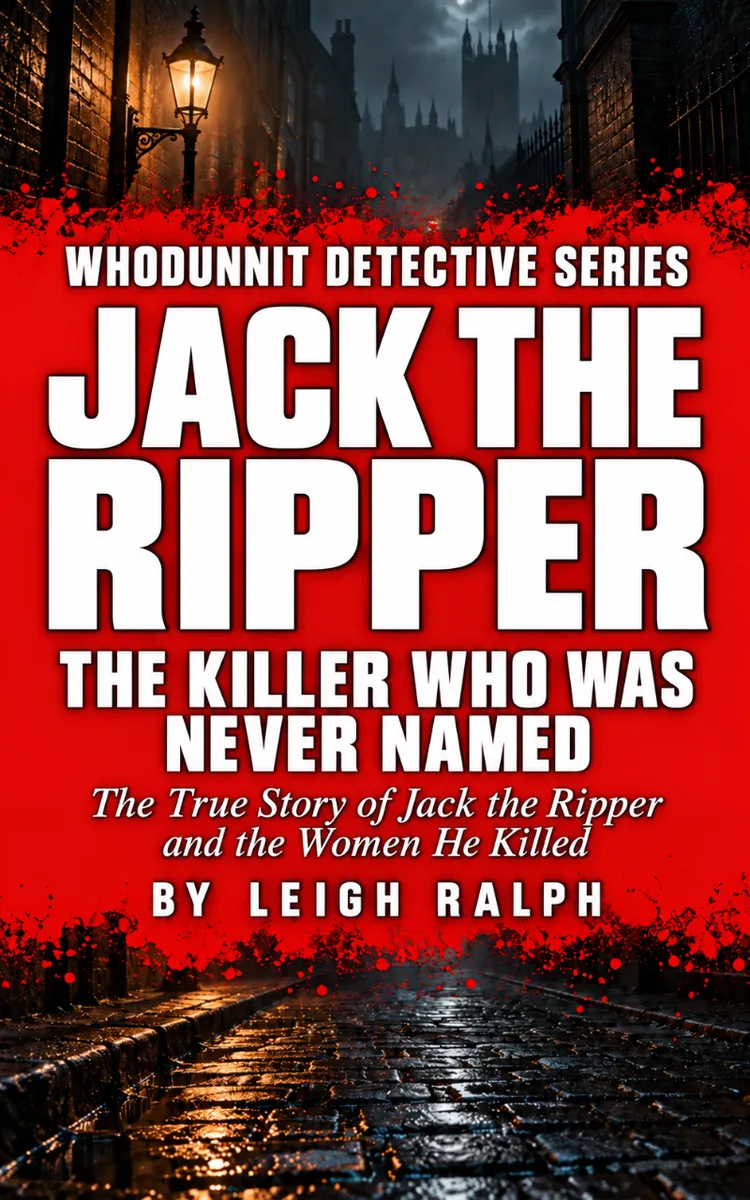
"JACK THE RIPPER" is a general book by Leigh Ralph with 12 chapters and approximately 11,059 words. It covers key insights and practical takeaways on the topic.
This book was created using Inkfluence AI, an AI-powered book generation platform that helps authors write, design, and publish complete books.
Frequently Asked Questions
What is "JACK THE RIPPER" about?
"JACK THE RIPPER" is a general book by Leigh Ralph covering key insights and practical takeaways on the topic.
How many chapters are in "JACK THE RIPPER"?
The book contains 12 chapters and approximately 11,059 words. Topics covered include The East End, 1888, Mary Ann Nichols, Annie Chapman, Elizabeth Stride, and more.
Who wrote "JACK THE RIPPER"?
This book was written by Leigh Ralph and created using Inkfluence AI, an AI book generation platform that helps authors write, design, and publish books.
Write your own book with AI
Describe your idea and Inkfluence writes the whole thing. Free to start.
Start writingCreated with Inkfluence AI


