
Read the first chapter
The whole of chapter one, free. About 7 min. Turn the pages with the arrows, your keyboard, or a swipe.
Chapter 1
Identify Your Emotional Avoidance Loops
The Moment You Start Running
What do you do when a feeling shows up that you don’t want to deal with?
Do you reach for your phone, crack a joke, pick a fight, work until midnight, eat something, clean something, or tell yourself you’re “fine” with the emotional conviction of a person absolutely not fine? Talia, 31, an ER nurse, knows this routine well. After a brutal shift, she gets home angry and shaken. Instead of admitting she’s scared and exhausted, she scrolls for an hour, orders food she doesn’t want, then snaps at her partner for asking a simple question.
The next morning, she feels guilty. That guilt makes her avoid the conversation. Avoidance creates more tension. More tension makes her feel like she’s failing at home, even though she held it together for twelve hours at work. Her confidence doesn’t collapse in one dramatic moment. It gets quietly picked apart by the same loop, repeated over and over.
Are you managing your feelings - or are your feelings secretly managing your life?
The Belief That Keeps the Loop Alive
Old Belief: If I avoid the feeling, it will go away.
New Reality: Avoided feelings don’t disappear; they change shape and start running your behavior.
You may not be consciously choosing avoidance. That’s the trick. It often looks productive, funny, tough, or harmless. You take extra shifts instead of dealing with resentment. You “keep the peace” instead of saying what you need. You stay busy because stillness might let the truth catch up with you.
Talia’s problem wasn’t that she felt fear after a hard shift. Fear made sense. Her problem was the story she attached to it: “If I admit I’m shaken, I’m weak.” So she buried the fear under distraction and irritation. The feeling still needed somewhere to go. It came out as sarcasm, distance, and a short fuse.
That’s how emotional avoidance sabotages confidence. Every time you dodge an uncomfortable feeling, you teach yourself that you can’t handle it. You may look calm on the outside, but inside, your brain is collecting evidence against you. “I can’t have this conversation.” “I’ll fall apart if I stop.” “I need a drink, a snack, a screen, or somebody else’s approval before I can cope.”
The new reality is less comfortable but far more useful: you don’t build confidence by never feeling afraid, angry, ashamed, or sad. You build it by staying present long enough to discover that a feeling is not a command.
The Avoidance Loop Map
The Avoidance Loop Map gives you a way to catch the pattern before it steals another day. The map has four points: Trigger, Feeling, Escape, Cost.
A trigger happens. A feeling rises. You choose an escape route. Then you pay a cost, usually in confidence, connection, energy, or self-respect. The cost becomes another trigger, and the loop starts again.
Talia’s map might look like this:
• Trigger: A patient dies during her shift. - Feeling: Fear, grief, helplessness. - Escape: Scroll, overeat, act irritated, refuse to talk. - Cost: Poor sleep, guilt, distance from her partner, less trust in herself.
The point isn’t to judge the escape. It worked for a few minutes. That’s why you keep doing it. Avoidance gives fast relief, and your brain loves fast relief. It doesn’t care that tomorrow’s problem just got bigger. It only notices that the discomfort dropped right now.
Signs This Pattern Is Running Your Life
1. You keep saying “I’m fine” while your body says otherwise. Your jaw is tight, your chest is heavy, your stomach is twisted, and yet you keep performing normal.
2. You become busy whenever something matters. The moment a hard conversation, decision, or honest feeling appears, suddenly your laundry, inbox, garage, or phone becomes urgent.
3. You react to small things with surprising force. The forgotten errand isn’t really the issue. It’s carrying the weight of three unspoken resentments behind it.
4. You feel temporary relief followed by shame or regret. You avoid the call, buy the thing, eat past comfort, or explode - and then wonder why you don’t trust yourself.
Your escape route is not random; it reveals the feeling you’re unwilling to face.
Look closely at your favorite distraction. Anger often protects hurt. Busyness often protects fear. Perfectionism often protects shame. People-pleasing often protects the fear of rejection. The behavior is the cover story. The feeling underneath is the real information.
That doesn’t mean every emotion deserves a microphone or every impulse deserves action. It means you need to know what is happening before you can choose what happens next. Otherwise, you’re not being “easygoing.” You’re being operated by an unexamined loop.
Questions That Expose Your Pattern
1. What feeling do you most often rename as something more acceptable? Maybe you call fear “being realistic,” sadness “being tired,” or resentment “just being busy.” Write the blunt version: “I’m afraid they’ll say no,” or “I’m angry that I keep doing everything.”
2. What do you do within the first ten minutes of discomfort? Name the actual behavior, not the flattering version. Do you grab your phone, start cleaning, send a sharp text, open a bottle, eat, shop, or start working? The first move is often the clearest clue.
3. What does your escape protect you from today - and cost you tomorrow? Avoiding a difficult conversation may protect you from ten minutes of tension. It may cost you another month of resentment. Be specific about both sides.
4. Where has avoidance weakened your confidence? Think of a promise you keep making and breaking, such as speaking up, setting a boundary, or addressing a problem early. Confidence drops when your actions repeatedly tell you that discomfort is in charge.
5. What would you do differently if the feeling could be present without making the decision? Talia could feel shaken and still tell her partner, “That shift got to me. I need ten quiet minutes, then I want to talk.” The fear remains, but it no longer drives the car.
Don’t turn these questions into another performance. You’re not trying to produce impressive answers. You’re trying to stop lying to yourself in small, socially acceptable ways. Honesty is useful because it gives you something real to work with.
The Seven-Day Loop Catch
Challenge: Map the Moment Before You Escape
For the next seven days, catch one avoidance loop each day. Don’t wait for a dramatic breakdown. Use the small moments - the irritated text, the unnecessary snack, the sudden urge to check your phone during an important task.
• Write down the trigger in one sentence. - Name the feeling using one clear word: fear, anger, grief, shame, loneliness, disappointment, or another honest word. - Record your usual escape. - Write the immediate relief it gave you. - Write the cost twelve or twenty-four hours later. - Choose a replacement response that takes five minutes or less, such as breathing slowly, walking outside, saying “I need a minute,” or writing the unsent truth in your notes. - At the end of each day, circle the escape route you used most often.
Difficulty: Medium
You’ll probably feel ridiculous at first. Good. That means you’re noticing behavior you used to perform automatically. You may also discover that your “random” habits are painfully predictable. That’s not failure. Predictability gives you leverage.
You’ll know it’s working when...
• You catch the trigger before the behavior takes over. - You can name the feeling without adding a speech or excuse. - You pause for five minutes instead of escaping immediately. - You recover faster after an uncomfortable moment. - You stop calling every reaction “just who I am.” - You make one honest choice that your old loop would have avoided.
The goal isn’t perfect emotional control. That’s fantasy dressed up as discipline. The goal is to create enough space between feeling and reaction for your actual values to show up.
Your Feelings Aren’t the Boss
You don’t lose confidence because you have difficult feelings; you lose it when you repeatedly abandon yourself to avoid them.
• You learned to identify the four parts of the Avoidance Loop Map: Trigger, Feeling, Escape, and Cost. - You saw how quick relief can create a larger problem later. - You identified the common escape routes that quietly weaken self-trust. - You started a seven-day practice to catch your own loops in real time.
Talia doesn’t need to become fearless before she changes. Neither do you. She needs to stop treating fear as proof that she’s incapable. You need to stop treating discomfort as an emergency.
The next time the loop begins, don’t ask, “How do I get rid of this feeling?” Ask, “What is this feeling trying to show me, and what choice would make me respect myself tomorrow?” That question is where you start taking your life back.
End of chapter one. 4 more chapters in the full book.
Swipe or use the arrows to turn the page


What's inside: 5 chapters
- 1. Identify Your Emotional Avoidance Loops
- 2. Rewire Beliefs With the Set-Point Shift
- 3. Build a Daily Courage Habit Stack
- 4. Say No Without Negotiating Your Worth
- 5. Turn Setbacks Into Purpose-Driven Resilience
About this book
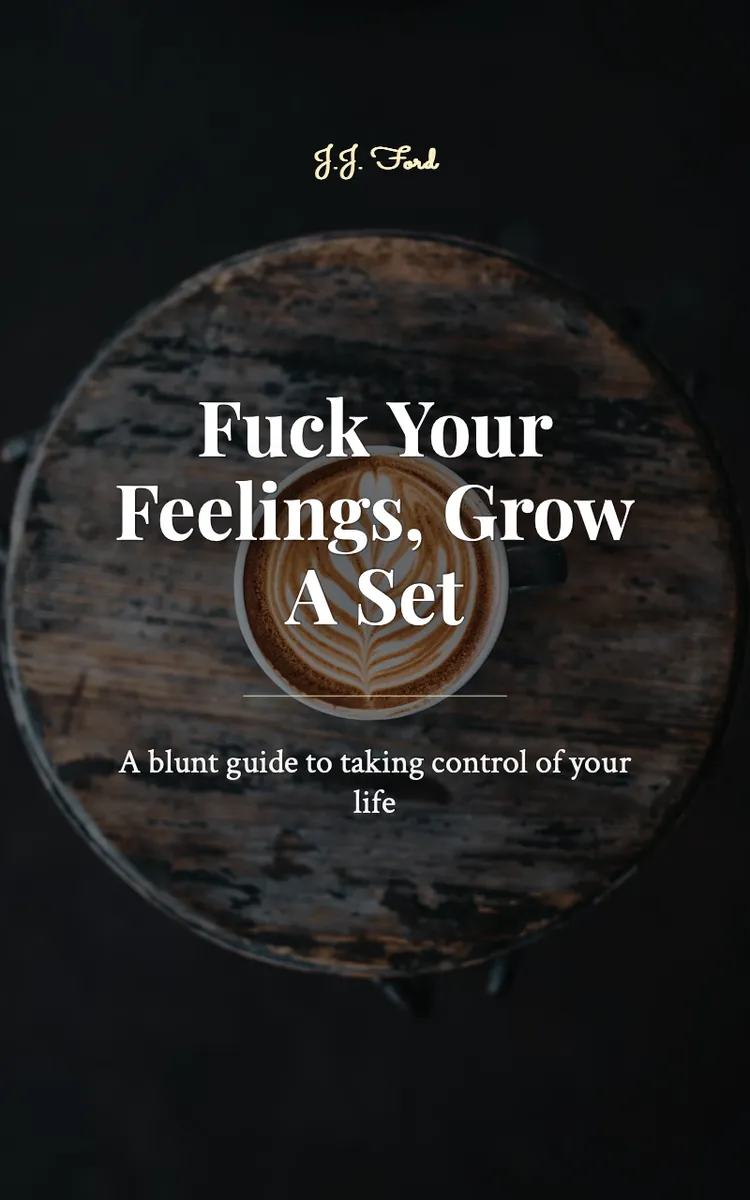
"Fuck Your Feelings, Grow A Set" is a self-help book by J.J. Ford with 5 chapters and approximately 8,166 words. Motivational self-help to overcome emotional avoidance.
This book was created using Inkfluence AI, an AI-powered book generation platform that helps authors write, design, and publish complete books. It was made with the AI Self-Help Book Writer.
Frequently Asked Questions
What is "Fuck Your Feelings, Grow A Set" about?
Motivational self-help to overcome emotional avoidance
How many chapters are in "Fuck Your Feelings, Grow A Set"?
The book contains 5 chapters and approximately 8,166 words. Topics covered include Identify Your Emotional Avoidance Loops, Rewire Beliefs With the Set-Point Shift, Build a Daily Courage Habit Stack, Say No Without Negotiating Your Worth, and more.
Who wrote "Fuck Your Feelings, Grow A Set"?
This book was written by J.J. Ford and created using Inkfluence AI, an AI book generation platform that helps authors write, design, and publish books.
How can I create a similar self-help book?
You can create your own self-help book using Inkfluence AI. Describe your idea, choose your style, and the AI writes the full book for you. It's free to start.
Write your own self-help book with AI
Describe your idea and Inkfluence writes the whole thing. Free to start.
Start writingCreated with Inkfluence AI


