
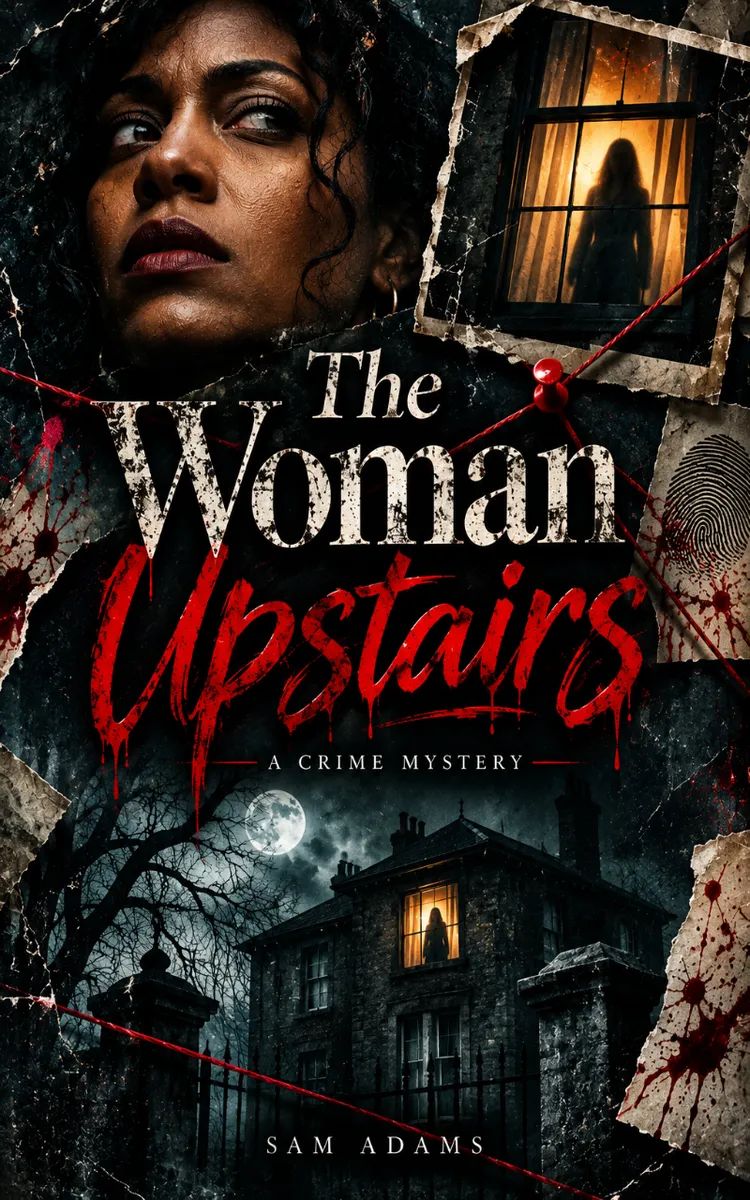

Read the first chapter
The whole of chapter one, free. About 7 min. Turn the pages with the arrows, your keyboard, or a swipe.
Chapter 1
The Room Beneath the Roof
The removal van blocked half the pavement on Bellwether Street, its hazard lights blinking against the rain-dark windows of the Victorian townhouse. I stood beneath the peeling blue lintel with a cardboard box cutting into my arms and watched a thin stream of water run down the front steps.
“Flat 1?” the driver called.
“Ground floor.”
He carried the box past me, boots thudding over the tiles in the narrow entrance hall. The sound travelled upwards, multiplying in the stairwell until it seemed several men were moving through the house.
I looked up.
Three storeys of dark-painted banister disappeared beneath the ceiling. Above it, somewhere beyond the plaster and old timber, was the flat Martin Vale had told me was empty.
“Mind the corner,” I said, though he was already through the doorway.
My flat was smaller than the photographs had suggested. The sitting room opened directly off the hall, with a fireplace sealed by a sheet of black metal and a window overlooking the basement railings. The ceiling was high enough to make the room feel taller, not larger. Every box had to be turned sideways to pass through the doors.
Still, it was mine.
I set my keys on the mantelpiece and stood in the middle of the room, listening to the house settle around me. Pipes ticked behind the walls. Somewhere above, a board gave a soft, reluctant creak.
I told myself it was the building greeting me.
At thirty-two, I had become tired of treating temporary places as if they were waiting rooms. This time I had brought my books, my blue mug, the framed photograph of my mother that had been wrapped in two jumpers. I wanted to unpack before dark, make tea, and sleep in a room that did not belong to somebody else.
The driver returned for the last box.
“Nice old place,” he said.
“That’s one word for it.”
He glanced towards the ceiling. “Bit of a maze, though.”
“Have you been upstairs?”
“Only to the first landing. Your landlord said the upper flat’s shut.”
“Shut?”
“Empty, apparently.”
He said it without interest, but his eyes remained on the stairwell.
By half past four, the van had gone and the rain had thickened. I closed the front door and slid the bolt across. It fitted badly, requiring a hard shove before the metal caught. The click seemed too small for the amount of comfort it offered.
I unpacked the kitchen first. The cupboards were painted cream over several older layers, and one door refused to close unless I lifted it by the handle. I placed the blue mug beside the kettle, lined up two plates, then opened the drawer beneath the sink.
A folded scrap of paper lay at the back.
I reached for it, expecting instructions from the previous tenant. The paper was blank on one side. On the other, in cramped black handwriting, were four words.
LEAVE WHILE YOU CAN.
For a moment I assumed Martin had left it as some kind of joke. Then I turned it over again. Nothing. No signature. No explanation.
I carried it into the hall and looked at the front door. The lock was still engaged. The windows were latched from inside.
The house made another noise overhead.
Not a creak this time.
A footstep.
It crossed from left to right, slow and deliberate, directly above the sitting room.
I stopped with the note between my fingers.
Another step followed. Then another. A measured walk across the ceiling, each footfall softened by distance but unmistakably human.
I went to the sitting-room window and looked out. The basement railings were slick with rain. No one stood on the pavement. The front entrance remained closed.
The footsteps continued.
“Hello?” I called.
They stopped.
The silence that followed felt arranged, as if the house had been waiting for me to speak.
I laughed once, quietly, because the alternative was to admit how quickly my body had tightened. The floorboards above could have expanded. A pipe could have knocked. The removal men might have left something behind.
But the walking had been too even.
I took the note back to the kitchen and put it beneath the sugar jar. Then I unpacked faster.
At six, Martin Vale arrived with a ring of keys and a smile that did not quite reach his eyes. He was a narrow man in a charcoal coat, with rain shining on his shoulders.
“Settling in?”
“I found a note.”
His smile faded by a fraction. “What sort of note?”
I brought it from beneath the sugar jar. He read it without touching it, leaning close enough for me to see the pale scar beside his left nostril.
“Probably from a previous tenant,” he said.
“It was in the kitchen drawer.”
“People leave all sorts behind.”
“Someone’s walking upstairs.”
Martin looked towards the ceiling. “The upper flat has been empty for months.”
“I heard footsteps.”
“Pipes. This is an old building.”
“It sounded like someone walking.”
“Then it was probably the removal men.”
“They’ve gone.”
He glanced at his watch. “The sound carries. You’ll learn that.”
He took a key from the ring and held it out. “These open the front door, your flat, the cellar and the garden gate. The upstairs entrance is permanently locked. There’s no reason for you to go up there.”
“Why keep it locked?”
“Because nobody lives there.”
“That isn’t an answer.”
“It’s the only one you need.”
The words sat between us. Rain tapped the window behind him, quick and nervous.
I folded the note. “Who wrote it?”
Martin’s gaze dropped to my hand. “If you’re unhappy, Sophie, tell me now. I’ve had enough tenants who invent problems because they don’t like old houses.”
“I haven’t said I’m unhappy.”
“You’ve been here three hours.”
“And already someone’s warning me to leave.”
“Someone who may have been trying to frighten the last tenant. Or you. It doesn’t mean anything.”
He placed the keys on the table. They were cold and heavy, more numerous than I expected.
“Try to get some sleep,” he said.
After he left, I tested each key in the locks. The front door. The cellar. The garden gate. The small cupboard beneath the stairs.
Then I climbed to the first landing.
The stairwell narrowed above my flat, the walls pressing in beneath the sloping roofline. A bare bulb hung from a twisted cord. At the top stood a grey door with no number, its paint blistered around the lock.
I tried the largest key.
It slid in, but would not turn.
I tried another. Then another.
Nothing.
From the other side came a faint sound.
Not a footstep. A scrape, as though something had been dragged across the floor.
I withdrew my hand.
The door seemed to lean towards me.
I went back downstairs and locked my flat.
By ten, the boxes had become dark shapes around the sitting room. I made tea and sat on the floor because the sofa was buried beneath books. The blue mug warmed my hands. For a little while, the room felt almost ordinary.
Then someone moved above me.
The footsteps began at the far end of the flat, slow at first, then quicker. They crossed the ceiling, turned, and crossed back. I could hear the faint pressure of each step through the plaster.
I stood.
“Martin?” I called.
No answer.
The footsteps stopped over the hallway.
A muffled voice followed.
I could not make out the words, only the rise and fall of a conversation. Another voice answered, lower and closer to the ceiling. I moved beneath it, craning my head as if position alone could sharpen the sound.
A sudden cry broke through.
It was brief, strangled, and unmistakably human.
The mug slipped from my hand and struck the floor. Tea spread across the boards, running into the grooves between them.
I grabbed my phone and recorded.
The voices had stopped. The house seemed to contract around the silence. I could hear the refrigerator humming in the kitchen, the rain ticking against the glass, my own breathing too loud in the room.
Then one final footstep sounded above me.
I followed it.
Through the hall, past the kitchen, into the bedroom at the back of the flat. The ceiling here was lower, sloping gently towards the wall. My bed stood beneath it, still covered in the sheet I had thrown over the mattress that morning.
Another step crossed overhead.
I pressed my palm to the ceiling. The plaster was cold and faintly gritty beneath my skin.
The footsteps came nearer.
One.
Two.
Three.
They stopped directly above my bed.
I stood beneath them, phone recording in my hand, with the locked upstairs flat above and the dark room behind me. There was nowhere else in the flat to sleep.
End of chapter one. 39 more chapters and about 72,163 words in the full book.
Swipe or use the arrows to turn the page


What's inside: 40 chapters
- 1. The Room Beneath the Roof
- 2. The Landlord’s Empty Flat
- 3. Voices Through the Ceiling
- 4. The Locked Landing Door
- 5. A Name I Buried
- 6. The First Handwritten Warning
- 7. The Neighbour’s Missing Years
- 8. The Cellar Ledger
- 9. The Voice in My Recording
- 10. The Fire Alarm at Midnight
- 11. The Old Tenancy File
- 12. The Narrow Service Stair
- 13. The Photograph’s Second Face
- 14. The Second Note
- 15. The Missing Page
- 16. The Roof Hatch
- 17. The Childhood Room
- 18. The Cut Telephone Line
- 19. The Empty Flat’s Shadow
- 20. My Mother’s Last Address
- 21. The Story I Was Given
- 22. The Broken Address Book
- 23. The Name in the Margin
- 24. The Sealed Coal Chute
- 25. The Face in the Mirror
- 26. The False Fire
- 27. The Caretaker’s Photograph
- 28. The Room Behind the Wardrobe
- 29. The Landlord’s Hidden Key
- 30. The Night I Cannot Remember
- 31. The Voice Beneath the Floor
- 32. The Passage Behind the Wall
- 33. The Memory I Choose
- 34. The Voice on the Tube
- 35. The Woman Behind the Door
- 36. My Mother’s Last Message
- 37. The House Without Its Echo
- 38. The Letter in the Floorboard
- 39. The Last Key Returned
- 40. The Woman Who Stayed
About this book
"The Woman Upstairs" is a fiction book by Sam with 40 chapters and approximately 72,163 words. A tenant investigates mysterious noises and hidden identities in her townhouse.
This book was created using Inkfluence AI, an AI-powered book generation platform that helps authors write, design, and publish complete books. It was made with the AI Novel Writer.
Frequently Asked Questions
What is "The Woman Upstairs" about?
A tenant investigates mysterious noises and hidden identities in her townhouse
How many chapters are in "The Woman Upstairs"?
The book contains 40 chapters and approximately 72,163 words. Topics covered include The Room Beneath the Roof, The Landlord’s Empty Flat, Voices Through the Ceiling, The Locked Landing Door, and more.
Who wrote "The Woman Upstairs"?
This book was written by Sam and created using Inkfluence AI, an AI book generation platform that helps authors write, design, and publish books.
How can I create a similar fiction book?
You can create your own fiction book using Inkfluence AI. Describe your idea, choose your style, and the AI writes the full book for you. It's free to start.
Write your own fiction book with AI
Describe your idea and Inkfluence writes the whole thing. Free to start.
Start writingCreated with Inkfluence AI


