
Read the first chapter
The whole of chapter one, free. About 7 min. Turn the pages with the arrows, your keyboard, or a swipe.
Chapter 1
Reclaim Your Calm Identity
When Your Mind Gets Loud at the Worst Possible Moment
You’re about to send an important message. Your thumb hovers over the screen, and suddenly your mind starts firing: What if they misunderstand me? What if I sound foolish? What if I can’t handle what comes next? Your shoulders creep upward. Your breathing turns shallow. The message is still unsent, but your body is already reacting as if something has gone terribly wrong.
You may know, logically, that one message doesn’t define you. Still, anxious self-talk can feel convincing because it arrives with physical force. A tight jaw, restless hands, a heavy chest - your body seems to confirm the story your mind is telling. But you’re not stuck with that identity. You can practice returning to a steadier version of yourself, one small signal at a time.
What if calm isn’t a personality trait you’re missing, but a state you can learn to access?
The Calm Identity Reset: From Automatic Fear to Steady Choice
Old Belief: I’m an anxious person, so anxious thoughts and reactions are simply who I am.
New Reality: Anxiety may be a familiar pattern, but it isn’t your whole identity. With a pause, a clear phrase, and acupressure, you can reconnect with the steadier self already inside you.
This shift matters because the words you use about yourself can quietly become instructions. When you say, “I always panic,” your mind begins scanning for proof. A racing thought becomes evidence. A tense conversation becomes another reason to label yourself. Before long, “I’m anxious” feels less like a description and more like a permanent sentence.
The Calm Identity Reset interrupts that sentence. You notice the anxious story, use gentle pressure to give your body a different signal, and choose language that leaves room for action. You aren’t pretending everything is fine. You’re reminding yourself that a stressed moment is not the same as a fixed identity.
Try this when you feel your thoughts speeding up: place two fingers on the soft area between your eyebrows, where the bridge of your nose meets your forehead. Press lightly for thirty seconds while breathing out a little longer than you breathe in. Then say, quietly or aloud, “I’m having an anxious thought. I can respond steadily.” The phrase works because it separates you from the thought. The pressure works as a physical anchor, giving your attention somewhere calm to land.
Picture the message you were afraid to send. After the reset, the worry may not disappear. That’s not the goal. The goal is to create enough space to reread the message once, remove the unnecessary apology, and press send without asking anxiety for permission.
How Anxious Self-Talk Takes the Wheel
Anxious self-talk often begins as an attempt to protect you. Your mind predicts problems so you can avoid embarrassment, rejection, conflict, or failure. The trouble starts when the warning system stays switched on after the useful information is gone.
Acupressure can help because it gives you a repeatable action during that gap between thought and reaction. A steady touch at the inner wrist, about three finger-widths below the base of your palm, can become a cue: Pause before believing the alarm. The point is not to force your body into instant calm. It’s to create a moment where a different response becomes possible.
Signs this pattern is running your life
1. You treat every worried thought as a fact. “They haven’t replied” quickly becomes “They’re upset with me,” even though you don’t have enough information to know that.
2. You explain yourself before anyone asks. You add three paragraphs to a simple message because your mind is already defending you against an imagined criticism.
3. You make decisions mainly to reduce immediate discomfort. You avoid the conversation, delay the task, or say yes when you mean no. The short-term relief strengthens the anxious pattern.
4. You describe yourself with permanent words. “I’m bad under pressure” sounds final. It leaves little room for practice, progress, or a different response next time.
A steadier identity begins when you stop treating anxiety as your name and start treating it as a signal you can answer.
Notice the difference between “I’m panicking” and “My body is sending a panic signal.” The first statement can make the feeling seem like your entire self. The second gives you a little distance. That distance is where choice lives.
Use the inner-wrist point whenever you catch yourself rehearsing a disaster. Press with the thumb of your opposite hand for 30 to 60 seconds. Keep your shoulders loose. As you press, name three things you can see. Then finish with one identity statement: “I’m someone who can take the next useful step.” This works best when the next step is small - open the document, ask one clear question, or wait ten minutes before replying.
Questions That Bring Your Steadier Self Forward
1. What exact sentence does anxiety repeat when you’re under pressure? Write the sentence word for word, not a polished version. “I’m going to mess this up” is useful because you can answer it. Try: “I’m worried about messing this up, and I can prepare for one part.”
2. Which situations make you abandon your calm identity fastest? Look for a specific pattern: unanswered messages, crowded rooms, money decisions, difficult customers, or speaking up at work. Knowing the trigger helps you use acupressure before the reaction reaches full volume.
3. What do you do to get quick relief, and what does it cost you later? Maybe you check your phone repeatedly, cancel plans, over-explain, or keep working long after you’re exhausted. Be honest without attacking yourself. The habit probably helped once; now you’re deciding whether it still serves you.
4. What would the steadier version of you do in the next five minutes? Keep the answer practical. It might be taking five slow breaths, sending a shorter message, drinking water, or saying, “I need a moment to think.” Calm becomes believable when it has a visible behavior attached to it.
5. What phrase feels true enough to use when anxiety appears? Choose words you can believe on a difficult day. “I’m completely fearless” may feel false. “I can feel anxious and still move carefully” is more grounded. Repeat it while applying gentle pressure between your eyebrows or at your inner wrist.
These questions aren’t designed to produce perfect answers. They help you catch the old identity in real time. Each honest answer weakens the idea that anxiety gets to narrate every moment.
Your Seven-Day Calm Identity Reset
Challenge: Practice the Steady Signal for 7 Days
For the next seven days, use the same short routine once in the morning and once during a real moment of anxious self-talk.
• Choose one acupressure point: the inner wrist or the area between the eyebrows. - Apply comfortable pressure for 30 to 60 seconds. Never press so hard that it hurts. - Breathe in gently for a count of four and out for a count of six. - Name the anxious thought: “I’m afraid I’ll be judged,” or “I’m expecting bad news.” - Say one steady identity phrase: “I can pause and choose,” or “I’m learning to respond with steadiness.” - Take one small action that matches the phrase. - At night, record three quick notes: the trigger, the phrase you used, and what you did next.
Keep the routine simple enough to use in a bathroom stall, parked car, break room, or quiet corner before a meeting. You’re building a pathway, not performing a ceremony. Repetition teaches your body that pressure, breath, and steady language can belong together.
Expected difficulty: Medium
You’ll know it’s working when...
• You notice anxious self-talk before it turns into a full reaction. - You use the acupressure point without waiting to feel desperate. - Your identity language changes from “I always panic” to “I’m practicing a steadier response.” - You take one useful action while anxiety is still present. - The pause between a trigger and your reaction becomes even slightly longer.
Some days will feel smooth. Other days, you’ll remember the exercise ten minutes after sending the frantic message. That still counts. Catching the pattern afterward gives you information for the next attempt. Progress here isn’t never feeling anxious. It’s returning to yourself sooner.
Calm Is a Practice You Can Return To
You are not the anxious story your mind tells; you are the person who can pause, apply a steady signal, and choose what happens next.
• Anxious thoughts are protective signals, not permanent definitions of who you are. - The Calm Identity Reset combines acupressure, slower exhalations, and believable identity language. - Naming a thought creates space between you and the thought. - Small actions make a steadier identity feel real and repeatable.
The next time your mind races, don’t wait for perfect calm before you trust yourself. Touch the point, lengthen the exhale, and give yourself one steady sentence to stand on. That small return is how confidence grows - and it gives you a strong foundation for the practical relaxation work ahead.
End of chapter one. 7 more chapters in the full book.
Swipe or use the arrows to turn the page


What's inside: 8 chapters
- 1. Reclaim Your Calm Identity
- 2. Break the Stress Belief Loop
- 3. Release Jaw and Shoulder Tension
- 4. Use the 60-Second Reset Routine
- 5. Build Boundaries Without Guilt
- 6. Train Your Nervous System Daily
- 7. Practice Resilience After Setbacks
- 8. Align Purpose With Body Signals
About this book
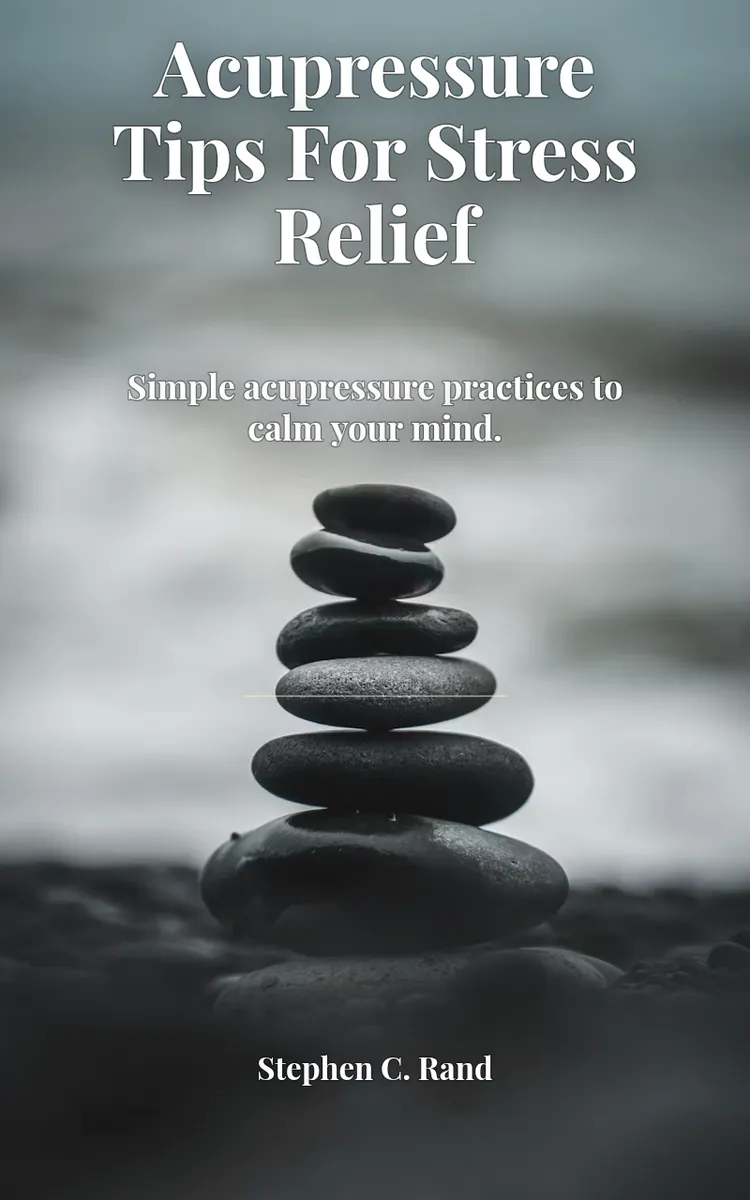
"Acupressure Tips For Stress Relief" is a self-help book by Stephen C. Rand with 8 chapters and approximately 12,257 words. Acupressure techniques for reducing stress and promoting relaxation.
This book was created using Inkfluence AI, an AI-powered book generation platform that helps authors write, design, and publish complete books. It was made with the AI Self-Help Book Writer.
Frequently Asked Questions
What is "Acupressure Tips For Stress Relief" about?
Acupressure techniques for reducing stress and promoting relaxation
How many chapters are in "Acupressure Tips For Stress Relief"?
The book contains 8 chapters and approximately 12,257 words. Topics covered include Reclaim Your Calm Identity, Break the Stress Belief Loop, Release Jaw and Shoulder Tension, Use the 60-Second Reset Routine, and more.
Who wrote "Acupressure Tips For Stress Relief"?
This book was written by Stephen C. Rand and created using Inkfluence AI, an AI book generation platform that helps authors write, design, and publish books.
How can I create a similar self-help book?
You can create your own self-help book using Inkfluence AI. Describe your idea, choose your style, and the AI writes the full book for you. It's free to start.
Write your own self-help book with AI
Describe your idea and Inkfluence writes the whole thing. Free to start.
Start writingCreated with Inkfluence AI


