

Read the first chapter
The whole of chapter one, free. About 7 min. Turn the pages with the arrows, your keyboard, or a swipe.
Chapter 1
Chapter 1: Mara and the Incubi of Paralysis
Chapter 1: Mara and the Incubi of Sleep Paralysis
The chest pressure that appears during awakening does not belong exclusively to the language of superstition. It is an experience documented across numerous cultures, described with unsettling regularity: consciousness returns before movement, the body remains immobile, and an invisible pressure seems to settle on the chest. In that interval, brief yet closed in upon itself, sleep takes on the substance of a presence.
Demonological tradition called certain nocturnal entities associated with immobility, bodily weight, and the terror of the sleeper incubi. The term comes from the Latin incubare, “to lie upon,” and retains an almost clinical precision: it refers not merely to an apparition, but to a form of aggression perceived as pressure. In medieval records, the incubus occupied an ambiguous place between demon, specter, and moral explanation for a disturbance of sleep. The experience, however, is older than its names.
Sleep Paralysis and Trapped Consciousness
Sleep paralysis occurs when the mechanisms of immobility associated with sleep persist into awakening or begin before sleep sets in. During certain phases of sleep, especially those in which vivid images appear, the brain naturally reduces the activity of numerous muscles. This inhibition prevents the body from reenacting every dream movement. When consciousness emerges before that inhibition has disappeared, a person may perceive the room, recognize sounds, and think clearly, yet be unable to move or speak effectively.
The sensation of chest pressure has a possible physiological explanation. Breathing continues, though it may feel irregular or insufficient; the conscious effort to inhale, combined with immobility and fear, turns an automatic function into a perceived threat. The chest seems to sink beneath a weight. Attention focuses on each breath, and that vigilance heightens the impression of suffocation.
Images and sounds arising from dream activity accompany this state. A shadow beside the bed, a figure leaning over the sleeper, a buzzing, footsteps, or a voice with no clear source may appear during the transition between sleep and wakefulness. This is neither a deliberate lie nor a chosen fantasy. For the person experiencing it, the perception has the force of a physical event.
Mara appears in the documents and testimonies of this tradition as the name of a nocturnal force that oppresses the sleeper. In Germanic folklore, Mara denotes an entity associated with nightmares and the weight on the chest; words related to nightmare in several European languages derive from this root. Her figure needs neither horns nor visible instruments. Her essential traits are pressure, immobility, and the certainty that something is far too close.
Mara, the Nighttime Weight, and Its Ancient Names
Before sleep medicine described paralysis, communities interpreted the episode through the categories available to them. In some regions, people spoke of a witch sitting on the chest; in others, of a household spirit, a restless dead person, or a creature that entered at night. The form varied, but the core remained stable: a person awake inside their own body, unable to defend themselves or call for help.
Scandinavian folklore preserved the figure of the mara with particular clarity. In traditional tales, her visit brought nightmares and an unbearable physical burden. In other parts of Europe, the same experience acquired different names, though they were almost always linked to riding, pressure, or nocturnal assault. The diversity of names does not diminish the similarity of the testimonies; on the contrary, it makes it more significant. Wherever societies did not share demonologies, a comparable sensory pattern appeared.
Christian demonology incorporated these episodes into its classification of tempting spirits. The incubus became associated with the male figure who oppresses or visits a sleeping woman, while the succubus represented its female counterpart. These distinctions belong to a particular theological system and should not be confused with a neutral description of the experience. In practice, accounts of nocturnal pressure do not always respect this division. The presence may have no sex, face, or defined form.
What persists most is not the entity’s anatomy, but its position. The specter is perceived beside the bed, over the torso, or at the very edge of the field of vision. This proximity turns the bedroom - a space associated with rest - into a place of surveillance. The familiar room retains its objects, but loses its ordinary sense of safety.
The Sensory Architecture of Terror During Sleep
The terror of paralysis does not depend solely on seeing a figure. It arises from the combination of three contradictory certainties: the mind recognizes its surroundings, the body does not respond, and a threat seems to occupy the space. The person knows they are in bed, but cannot sit up to check. They know they are breathing, but feel that each inhalation meets resistance. They know the door, window, and furniture remain where they were, though the darkness lends them a different presence.
Hallucinations associated with these episodes tend to fall into three forms: an intruding presence, pressure on the chest, and experiences of movement or leaving the body. The first introduces an agent; the second turns breathing into a struggle; the third alters one’s relationship with one’s own body. All three need not occur. A single one may be enough to fix the episode in memory.
Deprived of movement and gripped by intense vigilance, the brain searches for a cause for ambiguous signals. A household noise may become footsteps. A change in light may take on the shape of a silhouette. Cultural memory then offers a vocabulary: Mara, incubus, demon, dead person, or visitor. Perception does not arise from culture as a simple invention, but culture provides the face through which perception becomes intelligible.
That is why two people may describe a similar experience in terms of different entities. The bodily mechanism may be the same; the interpretation changes according to tradition, religion, place, and the images available. Terror is physiological and cultural at the same time. Reducing it to either dimension alone leaves out an essential part of the phenomenon.
The Incubus Between Theology and Sleep Medicine
In medieval treatises, the incubus was no marginal creature. Its presence was linked to temptation, nocturnal emission, illness, and moral vulnerability. Theology sought to determine whether the demon acted upon the body, upon the imagination, or through a combination of both. That debate reveals a concern that still persists: determining whether a terrifying experience comes from an external entity or from an altered state of the organism.
Modern medicine shifted the focus toward the physiology of sleep, but did not eliminate the human question of meaning. Identifying sleep paralysis can explain immobility, pressure, and intrusive perceptions; it does not erase the horror of having experienced them. A bodily explanation does not make the episode insignificant. It only changes the framework through which it is viewed.
A rigorous distinction should be maintained between testimony and interpretation. Testimony may precisely describe pressure, a figure, or a voice. Interpretation asserts what that was. The first belongs to experience; the second, to the belief system that seeks to order it. In the study of nocturnal specters, confusing these two layers leads both to naïve credulity and to unjustified contempt.
In the internal tradition of this compendium, Kelazbiel serves as a reference name for the symbolic reading of these phenomena, not as a character in a narrative. Its conceptual presence reminds us that demonology also describes the forms fear takes when the body becomes unfamiliar territory. Belial and Abigor belong to other registers of infernal classification and should not be conflated with the incubi of paralysis: this chapter examines neither mental discord nor legions of chaos, but the concentrated oppression of an incomplete awakening.
The Threshold Between Sleeping and Waking
Sleep paralysis occurs at a threshold. It is neither full sleep nor ordinary wakefulness, and for precisely that reason its images possess a disturbing authority. In ordinary dreams, strangeness may be accepted without resistance. During wakefulness, an unfamiliar object usually prompts a closer look. In paralysis, the two conditions overlap: the mind retains the ability to recognize the bedroom, while dream perceptions retain their force.
That threshold explains the sensation of an intelligent presence. The brain receives no clear signal of danger located in a visible object; it receives immobility, altered breathing, darkness, and alarm. The mind organizes these signals around an agent. In this sense, the incubus is a figure of concentration: it gathers the pressure on the chest, the inability to move, and the proximity of the unknown into a single form.
Testimonies also show that the episode can alter the perception of time. A brief interval seems to stretch because each second is registered intensely. The absence of movement removes the usual reference points that allow us to measure it. With no changes in posture, light, or activity in the surroundings, consciousness remains suspended in a duration without markers.
When immobility disappears, the room regains its ordinary proportions. The pressure recedes, the voice returns, and the muscles obey. But the experience does not end entirely with movement. The memory retains a texture unlike that of an ordinary nightmare: it does not seem as though one has visited an imaginary place, but rather that the sleeper’s real space has been invaded.
Mara and the incubi of sleep paralysis belong to that boundary where the body provides the symptoms and culture supplies the masks. Demonology named them to make visible an oppression with no stable form; sleep science described the mechanisms that can produce it. Between these two readings remains the same dark fact: for a few moments, consciousness can awaken before the body is free.
End of chapter one. 7 more chapters and about 10,780 words in the full book.
Swipe or use the arrows to turn the page


What's inside: 8 chapters
- 1. Chapter 1: Mara and the Incubi of Paralysis
- 2. Chapter 2: The Larvaries of the Lower Astral Plane
- 3. Chapter 3: The Morax of the Thresholds
- 4. Chapter 4: The Lemures and Specters of Mourning
- 5. Chapter 5: Belial and the Whisperers of the Rift
- 6. Chapter 6: The Vigil Eaters (Psychic Vampires)
- 7. Chapter 7: Abigor and the Legions of Chaos
- 8. Part II - Chapter 8: Treatise on Defense, Seals, and Protective Rituals
About this book
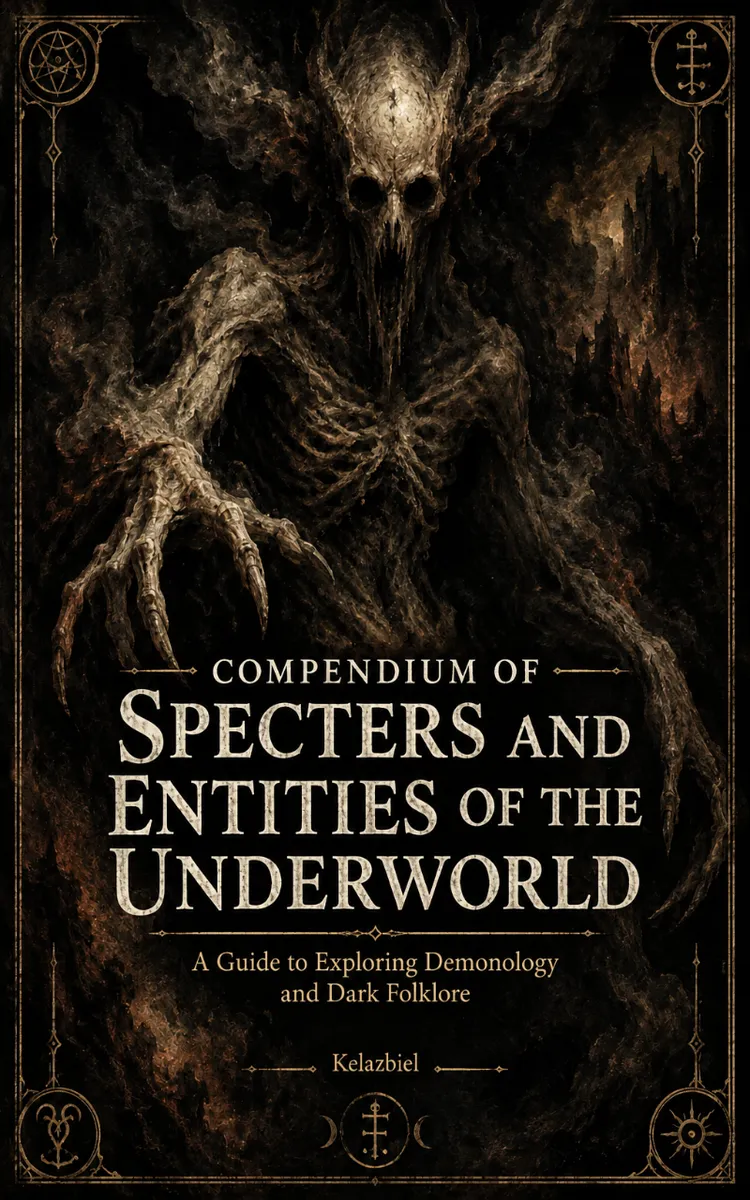
"Compendium of Specters and Entities of the Underworld" is a curiosity book by Kelazbiel with 8 chapters and approximately 10,780 words. Classical demonology, astral specters, dark folklore, and symbolic protection rituals.
This book was created using Inkfluence AI, an AI-powered book generation platform that helps authors write, design, and publish complete books.
Frequently Asked Questions
What is "Compendium of Specters and Entities of the Underworld" about?
Classical demonology, astral specters, dark folklore, and symbolic protection rituals
How many chapters are in "Compendium of Specters and Entities of the Underworld"?
The book contains 8 chapters and approximately 10,780 words. Topics covered include Chapter 1: Mara and the Incubi of Paralysis, Chapter 2: The Larvaries of the Lower Astral Plane, Chapter 3: The Morax of the Thresholds, Chapter 4: The Lemures and Specters of Mourning, and more.
Who wrote "Compendium of Specters and Entities of the Underworld"?
This book was written by Kelazbiel and created using Inkfluence AI, an AI book generation platform that helps authors write, design, and publish books.
Write your own curiosity book with AI
Describe your idea and Inkfluence writes the whole thing. Free to start.
Start writingCreated with Inkfluence AI


