

Read the first chapter
The whole of chapter one, free. About 7 min. Turn the pages with the arrows, your keyboard, or a swipe.
Chapter 1
Ray’s Last Voyage Begins
The last suitcase thumped onto the Tustumena’s car deck just as a gull stole a strip of bacon from a tourist’s breakfast sandwich.
Captain Ray McKinnon watched the gull bank over Ketchikan’s crowded waterfront, bacon snapping in its yellow bill. Behind him, the ferry’s loading ramp groaned beneath rental cars, bicycles, coolers, and enough luggage to outfit a small expedition. Summer had packed the dock solid. Rain shone on the planks, and the green mountains beyond the harbor rose steeply into low cloud, their slopes stitched with waterfalls.
“Somebody tell that bird it still owes me for breakfast,” Ray said.
No one answered. The dock crew was too busy waving the final passengers toward the gangway.
Ray checked his watch. Fifty-nine years old, twenty-one years with the Alaska Marine Highway, and on his final voyage before retirement, he had promised himself one thing: Ketchikan would not send him into the sunset late.
He turned toward the purser’s table. “Passenger count?”
The clerk lifted a clipboard. “One hundred seventy-seven.”
“Say it like you mean it.”
“One hundred seventy-seven passengers, Captain.”
“That’s better. The ship can carry more, but I’ve always found fewer people easier to keep track of.”
The clerk smiled nervously. Ray’s reputation had arrived before he did each morning: hard as a steel bulkhead, fair as a calm sea, and capable of making a joke while everyone else was looking for the fire extinguisher.
He glanced through the open terminal doors. Tourists streamed in beneath rain jackets and camera straps. A family argued over a rolling suitcase. Two men in matching fishing hats stopped in the gangway to photograph one another, blocking everyone behind them.
Ray raised his voice. “Gentlemen, the ship is not moving yet, but the line behind you is.”
They hurried aboard.
The Tustumena vibrated under his boots as generators came alive. Her old steel hull carried the familiar tremor into his knees. Ray had felt that vibration in storms, in fog, beside glaciers, and once while a bear wandered across the loading ramp in Haines. The ship had a thousand noises, and he knew most of them by heart.
This morning, one noise was missing.
He held out his hand toward the manifest clerk. “Give me the final page.”
The clerk shuffled the papers, frowned, and shuffled them again.
Ray looked at the stack. “That expression usually means either bad news or a very small sandwich.”
“The last page isn’t here.”
“Which last page?”
“The passenger manifest. Page four.”
Rain ticked against the terminal windows. Somewhere below, a winch clanged and stopped.
Ray held out his hand again. “Look in the folder.”
“I did.”
“Look in the printer.”
“I did.”
“Look under the folder. Paper has a strong sense of adventure.”
The clerk checked anyway. Nothing.
Ray took the manifest and counted the pages. One, two, three, five.
“Who had it last?”
“It was printed at the office.”
“Who carried it here?”
“I don’t know.”
“That’s not a promising answer on a ship carrying one hundred seventy-seven people.”
The clerk’s cheeks reddened. “The count is right.”
“Maybe. The names are what concern me.”
He scanned the third page. Families, couples, tour groups, a handful of deck passengers with camping gear. Page five began with a cabin reservation and ended with a line of names that appeared to belong to a fishing party. Between them lay a gap large enough to hide more than paperwork.
The terminal doors opened again. A gust pushed rain across the floor, carrying diesel fumes and the sharp cry of gulls. Ray saw the final passengers coming through: an elderly couple with matching red hats, a young woman dragging a duffel bag, and a broad man in a soaked canvas coat who kept glancing over his shoulder.
The man reached the gangway and stopped.
Ray stepped toward him. “Sir, the scenic view is better from aboard.”
The man looked at Ray, then at the ferry. “I’m meeting someone.”
“On the ship?”
“That’s what I said.”
“Most people meet someone by knowing their name.”
The man’s jaw tightened. “I’ll find him.”
Ray watched him pass. The canvas coat sagged strangely around the shoulders, as if it contained more than one man’s belongings. The young woman with the duffel followed several yards behind, head down, moving fast.
“Check those two against the manifest,” Ray said.
The clerk hurried after them.
At the foot of the gangway, a family of four stood arguing with a deckhand about cabins. The father waved a reservation slip like a distress flag.
“We paid for a room,” he said.
“You paid for a room with two bunks,” the deckhand replied.
“We have four people.”
Ray stepped between them. “Then we have discovered the ancient maritime mystery of arithmetic.”
The father stared at him.
Ray pointed toward the passenger deck. “Two adults in the cabin. Children in the lounge. Nobody sleeps in the lifeboats, the elevator, or the captain’s bathtub. I need that bathtub for emergencies.”
The mother pulled the children along. The father muttered, but the line moved.
A horn sounded from the harbor. The vibration rolled through the dock and into Ray’s chest. Across the water, fishing boats rocked against their lines. Beyond them, the forest climbed in layers of dark spruce and bright moss, and clouds dragged low across the mountains like torn wool.
For a moment, Ray let himself look.
His last voyage. Ketchikan to Petersburg, then Sitka, then Juneau. A summer route through the Inside Passage at the height of tourist season, with whales somewhere beyond the rain and enough passengers aboard to fill every chair, bunk, and complaint.
He had imagined leaving quietly. A clean departure. A final wave from the dock.
The Tustumena gave a heavy shudder.
Ray looked back at the paperwork.
“Captain,” the clerk called from the gangway, “the man in the canvas coat is listed.”
“Name?”
The clerk lowered his voice. “Not on the page I have.”
Ray’s humor thinned. “And the woman?”
“Not listed either.”
A deckhand appeared behind them. “They’re already aboard.”
Ray looked up at the ship. The gangway stretched into the passenger deck, its metal sides wet and shining. Beyond it waited one hundred seventy-seven passengers, though the manifest might have been counting something else entirely.
“Stop closing the ramp,” Ray said.
The deckhand froze. “We’re scheduled to cast off in six minutes.”
“Then we’ll be six minutes late.”
Ray climbed aboard. The passageway smelled of coffee, wet wool, and hot machinery. Passengers crowded the windows, pointing at the harbor. A boy pressed both hands to the glass as a bald eagle lifted from a piling and swept over the water.
Ray moved through the crowd, scanning faces. The broad man in the canvas coat had vanished. So had the young woman.
He found the purser near the stairwell. “Lock down the passenger count. Nobody leaves the vessel until I say so.”
“Are we looking for someone?”
“We’re looking for two someones.”
The purser blinked. “Stowaways?”
“I’d prefer misplaced tourists. They’re less paperwork.”
A cheer rose from the forward lounge as the eagle circled back over the harbor. Ray heard the engines deepen below his feet. The ship was ready to leave, but readiness was not permission.
He turned toward the stairwell leading down to the car deck. “Search the public areas first. Then storage rooms, lounges, and every place a person could fit without becoming a permanent part of the ship.”
The purser hurried away.
Ray returned to the manifest table. The clerk had spread the remaining pages across the counter. A smear of rainwater blurred the bottom corner of page three.
“Captain,” the clerk said, “I found this in the printer tray.”
He held up a thin sheet.
Ray took it. The paper was not page four. It was a duplicate of page five, but someone had written two names across the top in blue ink.
The names did not match the passengers listed below.
Ray read them twice.
“Where did you get this?”
“It was underneath the paper roll.”
“Who wrote the names?”
“I don’t know.”
A sharp bang came from below. Passengers turned toward the deck doors.
Ray folded the sheet and slipped it into his jacket pocket. “Now we have a missing page, two unlisted people, and handwriting that doesn’t belong to anyone who wants to be found.”
The ship’s whistle sounded again, longer this time.
Outside, Ketchikan blurred behind sheets of rain. The mountains stood dark and watchful above the harbor, while a pair of humpback whales surfaced beyond the breakwater, their backs rolling through the gray water before disappearing.
Ray watched the last curl of spray vanish.
“Captain,” the purser called from the stairwell, “we found someone.”
Ray headed toward the voice.
The Tustumena’s engines began to turn in earnest, and the dock lines strained against the rising tide. The final voyage had not even cleared Ketchikan, and already the passenger list was lying to him.
End of chapter one. 29 more chapters and about 54,396 words in the full book.
Swipe or use the arrows to turn the page


What's inside: 30 chapters
- 1. Ray’s Last Voyage Begins
- 2. Stowaways Slip Past Watch
- 3. The Hidden Name in Ink
- 4. Whales Break the Quiet Watch
- 5. Ray Quells a Cabin Riot
- 6. Kitchen Flames in the Galley
- 7. The Smoke Leads to a Clue
- 8. Petersburg Dock Chaos
- 9. Ray Faces His Old Fear
- 10. Drunken Crew Returns to Trouble
- 11. The Missing Steward’s Whisper
- 12. Sitka’s Lights Hide a Storm
- 13. Ray Finds the Stowaway Route
- 14. A Passenger Falls, Then Vanishes
- 15. Whale Song Turns to Panic
- 16. The Restricted Stairwell Locks
- 17. Ray Chooses Between Two Risks
- 18. The Bridge Alarm Goes Off
- 19. A Lifeboat That Shouldn’t Be Empty
- 20. Ray Spots the Plane’s Plunge
- 21. Whales Circle the Wreckage
- 22. Two Survivors, One Narrow Window
- 23. Ray’s Humor Can’t Fix This
- 24. The Survivor’s Map of Trouble
- 25. Juneau Approaches, Tension Peaks
- 26. Ray Stops the Final Saboteur
- 27. Ray’s Farewell to the Crew
- 28. Juneau Dock, Lights on the Water
- 29. What the Manifest Finally Reveals
- 30. Ray Watches Juneau Fade In
About this book
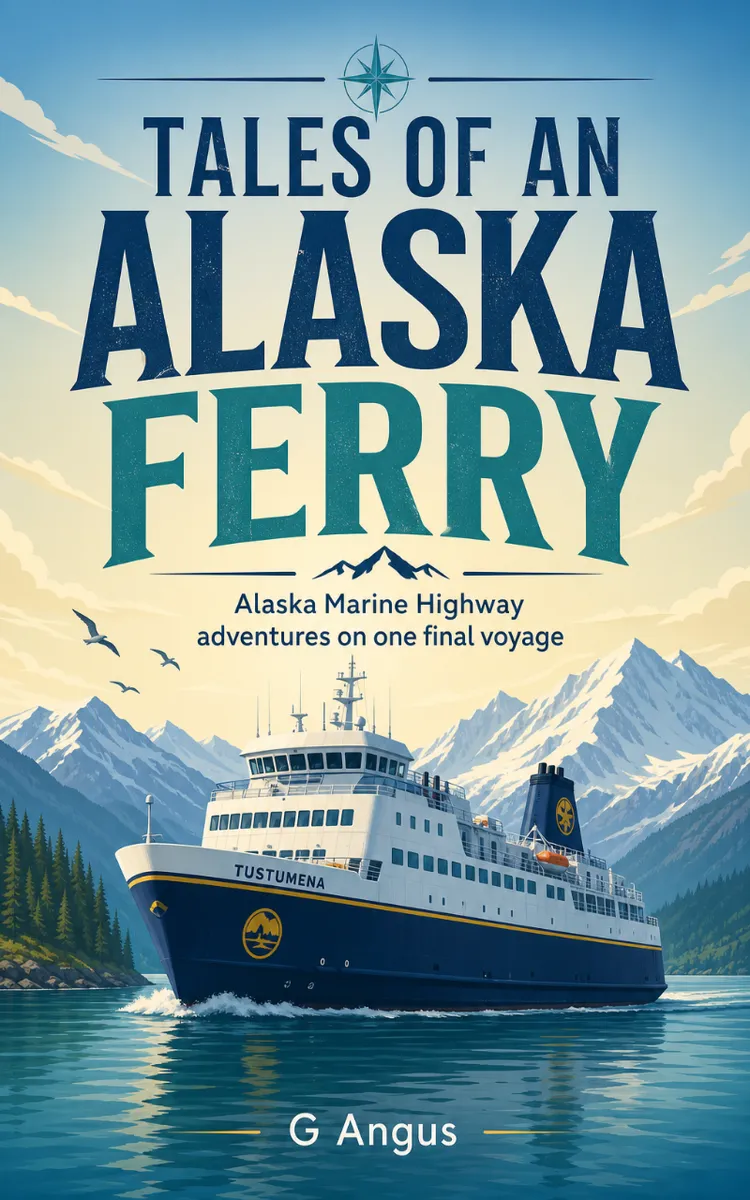
"Tales Of An Alaska Ferry" is a fiction book by G Angus with 30 chapters and approximately 54,396 words. A ferry captain’s final Ketchikan-to-Juneau summer adventure.
This book was created using Inkfluence AI, an AI-powered book generation platform that helps authors write, design, and publish complete books. It was made with the AI Novel Writer.
Frequently Asked Questions
What is "Tales Of An Alaska Ferry" about?
A ferry captain’s final Ketchikan-to-Juneau summer adventure
How many chapters are in "Tales Of An Alaska Ferry"?
The book contains 30 chapters and approximately 54,396 words. Topics covered include Ray’s Last Voyage Begins, Stowaways Slip Past Watch, The Hidden Name in Ink, Whales Break the Quiet Watch, and more.
Who wrote "Tales Of An Alaska Ferry"?
This book was written by G Angus and created using Inkfluence AI, an AI book generation platform that helps authors write, design, and publish books.
How can I create a similar fiction book?
You can create your own fiction book using Inkfluence AI. Describe your idea, choose your style, and the AI writes the full book for you. It's free to start.
Write your own fiction book with AI
Describe your idea and Inkfluence writes the whole thing. Free to start.
Start writingCreated with Inkfluence AI


