
Read the first chapter
The whole of chapter one, free. About 5 min. Turn the pages with the arrows, your keyboard, or a swipe.
Chapter 1
AI Automation Services for Small Businesses
Overview
A missed call, an unanswered website question, or a forgotten quote can cost a local business a customer before the owner notices. This chapter covers five practical AI service hustles for fixing that lost time: workflow audits, no-code automation, customer-support assistants, appointment and lead follow-up systems, and review-response workflows.
You do not need to build software from scratch. Your job is to find repetitive work, connect reliable tools, and make sure a human can step in when needed. Each service can begin with one business, one process, and one measurable improvement.
The Breakdown
#1: Workflow Audit for Repetitive Tasks
Problem: Small businesses often repeat the same manual steps dozens of times each week. A cleaning company may copy booking details into a spreadsheet, send the same confirmation message, and manually remind customers the day before each visit. These small tasks can consume 5-10 hours every week and create errors.
Solution: Sell a workflow audit that maps what happens from the first customer contact to payment or follow-up. Interview the owner and one employee, then record each step in a simple table:
| Question | Example | |---|---| | What starts the task? | A website form submission | | Who handles it? | Office manager | | Which tool is used? | Gmail and Google Sheets | | How long does it take? | Eight minutes per lead | | What can be automated? | Confirmation and task creation |
Identify the three tasks with the highest time cost or error risk. Deliver a short action plan showing the current process, the recommended tools, and an estimated monthly time saving.
Result: The owner receives a clear automation roadmap instead of a confusing list of AI possibilities. You can charge for the audit first and use its findings to offer the next service.
#2: No-Code Automation Setup
Problem: Business owners may know that a new lead should create a task, send an email, and alert a staff member, but they rarely have time to connect those steps. When information is copied by hand between forms, email, calendars, and spreadsheets, leads are delayed or lost.
Solution: Set up no-code automation using tools such as Zapier, Make, Google Forms, Gmail, Google Sheets, or Airtable. For example, connect a roofing company’s quote form to a spreadsheet, send an immediate confirmation email, create a follow-up task, and notify the owner in Slack or by email. Build one workflow at a time, test it with sample data, and document what happens if a field is missing or an email fails.
Ask the owner to approve every customer-facing message before turning the workflow on. Use test records rather than real customer data during setup, and add a manual review step for unusual requests.
Result: A business can respond to new inquiries in minutes instead of hours while keeping its existing tools. Your offer becomes concrete: one tested workflow, clear documentation, and support for future changes.
#3: AI Customer-Support Assistant
Problem: Local businesses answer the same questions repeatedly about prices, opening hours, service areas, preparation instructions, and cancellation policies. If replies are slow, staff lose time and customers may call competitors. An AI assistant that gives an incorrect answer can be even worse, especially for medical, legal, or financial topics.
Solution: Build a narrow assistant from approved business information rather than asking it to answer everything. Collect the company’s website pages, service list, policies, and frequently asked questions, then organize them into a reference document. Configure the assistant in a platform such as Chatbase, Tidio, or a website chat tool to answer only from that information.
Add clear rules: it should say when it does not know, avoid making promises, and transfer requests involving complaints, refunds, emergencies, or sensitive information to a person. Test at least 20 questions, including misspellings and questions the assistant should refuse to answer.
Result: Staff spend less time repeating basic information, while customers receive fast answers at any hour. The business keeps control because the assistant has a limited knowledge base and a clear handoff process.
#4: Appointment and Lead Follow-Up System
Problem: Many local businesses lose revenue after a customer submits a form or requests an appointment. The first reply may arrive the next day, and a customer who misses an appointment may never receive a reminder. Even a modest flow of 30 leads per month can create a large loss when follow-up depends on memory.
Solution: Create a follow-up sequence tied to the business’s booking tool or customer relationship management system, often called a CRM. Start with a confirmation message sent immediately after the inquiry. Add a reminder after one business day, a second message after three days, and a final “still interested?” message after seven days.
Use an AI tool to personalize drafts from safe details such as the service requested and preferred appointment time. Keep messages short, include a booking link, and stop the sequence as soon as the customer replies or books. Set up reminders for staff when a lead asks a question that automation cannot handle.
Result: The business follows up consistently without sending messages after a customer has responded. Track three numbers each month: reply rate, booked appointments, and missed appointments. Those figures show the owner whether your system is producing value.
#5: AI Review-Response Workflow
Problem: A business with new reviews may spend hours writing replies, ignore positive feedback, or respond emotionally to criticism. Slow or careless responses can make future customers question the business’s reliability. Copying the same sentence into every review also looks impersonal.
Solution: Create a review workflow using Google Business Profile, a spreadsheet, and an AI writing tool such as ChatGPT. Copy each new review into a row with its rating, main topic, and response status. Use a prompt that asks for a warm, specific draft based only on the review and approved business facts.
Create separate instructions for positive, neutral, and negative reviews. For negative reviews, require the draft to acknowledge the concern, avoid arguing, invite private contact, and never reveal personal customer information. A staff member must approve every response before publishing, particularly when the review mentions an injury, dispute, refund, or employee.
Result: The business can respond within one or two days while keeping a human approval step. You can sell this as a setup package, a monthly review-monitoring service, or both.
What Comes Next
These five services begin with visible business problems: wasted time, missed leads, repeated questions, and neglected reviews. Next, the book moves into AI side hustles that help freelancers produce and manage marketing content without turning every project into a full-time job.
End of chapter one. 9 more chapters and about 10,121 words in the full book.
Swipe or use the arrows to turn the page
What's inside: 10 chapters
- 1. AI Automation Services for Small Businesses
- 2. AI Content and Marketing Production
- 3. AI Design, Branding, and Digital Assets
- 4. AI Research, Data, and Business Intelligence
- 5. AI Tools and Workflow Kits for Freelancers
- 6. AI Education, Coaching, and Implementation
- 7. AI E-Commerce and Online Seller Services
- 8. AI Audio, Video, and Localization
- 9. AI Products, Micro-SaaS, and Niche Publishing
- 10. Trust, Quality, and AI Opportunity Hunting
About this book
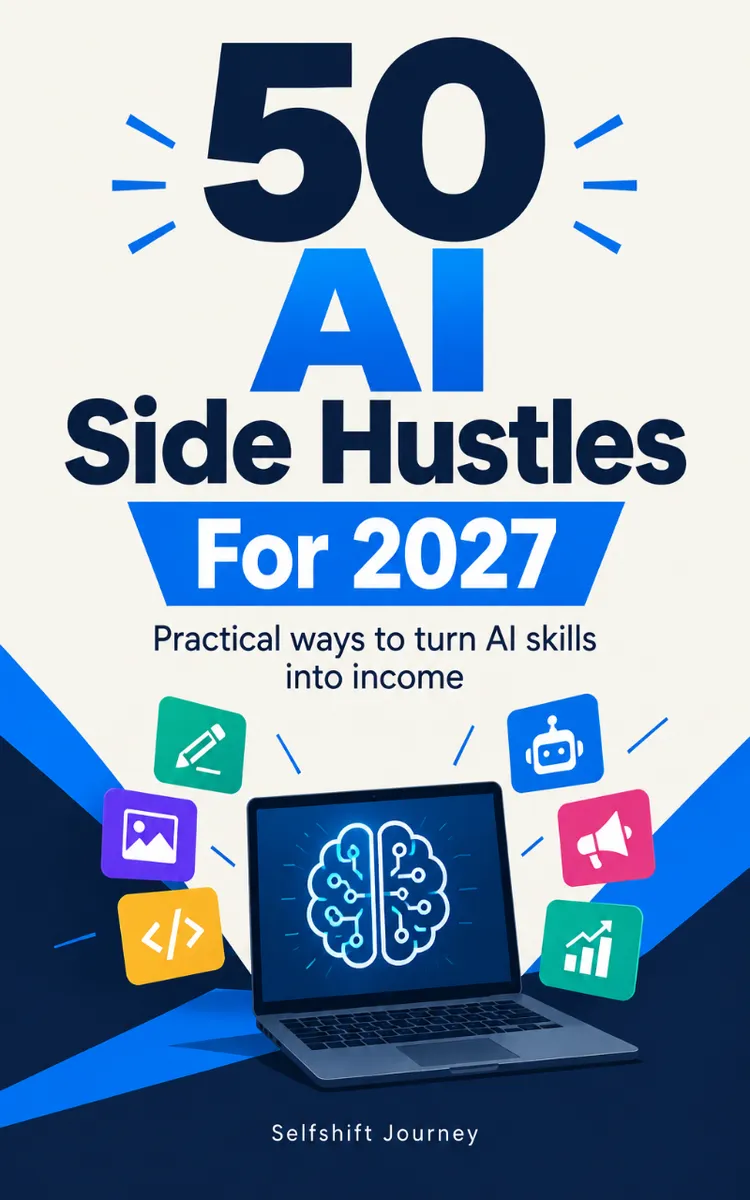
"50 AI Side Hustles For 2027" is a list book by Anonymous with 10 chapters and approximately 10,121 words. AI-powered side hustles, automation services, and freelance income opportunities.
This book was created using Inkfluence AI, an AI-powered book generation platform that helps authors write, design, and publish complete books.
Frequently Asked Questions
What is "50 AI Side Hustles For 2027" about?
AI-powered side hustles, automation services, and freelance income opportunities
How many chapters are in "50 AI Side Hustles For 2027"?
The book contains 10 chapters and approximately 10,121 words. Topics covered include AI Automation Services for Small Businesses, AI Content and Marketing Production, AI Design, Branding, and Digital Assets, AI Research, Data, and Business Intelligence, and more.
Who wrote "50 AI Side Hustles For 2027"?
This book was written by Anonymous and created using Inkfluence AI, an AI book generation platform that helps authors write, design, and publish books.
Write your own list book with AI
Describe your idea and Inkfluence writes the whole thing. Free to start.
Start writingCreated with Inkfluence AI


