

Read the first chapter
The whole of chapter one, free. About 10 min. Turn the pages with the arrows, your keyboard, or a swipe.
Chapter 1
The Cake at the Ledger Table
Emma balanced the cake box against her hip and nudged open the planning room door with her elbow.
The box caught on the doorframe.
A ribbon of buttercream scraped against the wood.
“No,” she whispered.
She twisted sideways, holding the cake away from the wall as if it were a small, fragile moon. The planning room at Magnolia House had been designed for ledgers, blueprints, and perhaps three people who did not carry desserts. It was not designed for Emma, a twelve-inch cake, a narrow doorway, and Lucas Reed’s latest financial objections waiting on the other side.
The door gave at last. Emma slipped through.
Inside, the room smelled of old paper, lemon cleaner, and the damp Florida heat that pressed through the tall windows. Rolled plans leaned in every corner. A drafting table occupied most of the center. Two wooden chairs had been pushed against a cabinet, and a stack of restoration samples teetered beside Lucas’s open laptop.
Lucas looked up.
His gaze went first to her face, then to the box, then back to her face.
“Please tell me that’s not for me.”
“It’s for Magnolia House,” Emma said, setting the box on the only clear space she could find - the edge of his financial projections. “You’re merely the person who gets to taste it.”
“That sounds suspiciously like being used.”
“You questioned whether a bakery would bring enough value to the estate.”
“I questioned whether it would bring enough revenue to justify a permanent kitchen right now.”
Emma lifted the lid.
The cake rose in three tiers, each covered in ivory buttercream piped to resemble the lacework along Magnolia House’s balconies. Tiny sugar magnolias curved around the base. Between the flowers, she had tucked miniature fondant cottages, each with a golden window and a green roof. The top tier carried a delicate edible rendering of the estate’s glass conservatory.
Lucas leaned closer despite himself.
Emma saw the exact moment his accountant’s caution met his appreciation for beautiful things. His mouth softened. His shoulders lowered by half an inch.
Then his eyes went to the spreadsheet beneath the cake box.
“It’s a sample,” she said.
“It’s a very elaborate sample.”
“It’s a visual argument.”
“It has a conservatory.”
“It has a future.”
The corner of his mouth moved. Not quite a smile, but close enough to make her pulse skip in a way she found deeply inconvenient.
Lucas stood, careful not to bump the table. He was tall enough that the low ceiling beams seemed to crowd him, though Emma suspected he would look composed in a broom closet. His sleeves were rolled to his forearms, and a faint streak of pencil marked one knuckle. He had probably been working since breakfast, turning the estate into columns and totals while she had been turning sugar, flour, and butter into something that could make people linger at a table.
“Eleanor Whitmore wants the property financially sustainable,” he said. “Clara Bennett wants the restoration moving before the centennial. Daniel Hayes wants everyone to stop placing furniture where he needs to carry lumber.”
“Daniel has made that last point very clearly.”
Lucas glanced at the cake again. “And you want a bakery.”
“I want the bakery the estate needs.”
“That’s not the same thing.”
The words landed harder than they should have. Emma kept one hand on the box lid. The cardboard had gone soft beneath her fingers from the warmth of the kitchen.
“My home kitchen is already booked three weeks out,” she said. “I’m baking wedding cakes beside the toaster. Yesterday, I had a tray of lemon bars in the laundry room because the counters were full.”
“That sounds inconvenient.”
“It sounds impossible.”
His expression changed, but he did not retreat from the point. That was one of the things she disliked about him. He listened as if every word mattered, then refused to let any word do more work than it could support.
“A permanent kitchen requires construction, equipment, permits, staffing, insurance, and operating capital,” he said. “The estate has cottages that still need plumbing repairs. The conservatory roof is not finished. The garden paths flood after a hard rain.”
“People will pay to stay here longer if there’s food worth staying for.”
“They might.”
“They will.”
“Emma - ”
“You saw the order list.”
“I saw projected interest.”
“You saw the sign-up sheet Clara collected.”
“I saw names and email addresses.”
“You sound as if people voluntarily giving us their contact information is a suspicious activity.”
His eyes warmed. “In my profession, everything is suspicious until it becomes a deposit.”
She wanted to stay angry. It would have been easier if he were smug, or dismissive, or even careless. Instead, he reached around the cake and rescued the stack of samples from the edge of the table before it slid to the floor. His fingers brushed hers.
The contact lasted only a second.
It was enough to make the room feel smaller.
Emma drew her hand back first. “Taste it.”
Lucas looked at her.
“The cake. Taste the cake.”
“That sounded less like an invitation and more like a court order.”
“Then consider yourself summoned.”
He took the knife she offered. The planning room’s only clear surface was occupied by blueprints, so Emma held out a small plate and watched him cut into the bottom tier. The knife moved cleanly through the buttercream and vanilla sponge. Raspberry filling pressed against the blade in a bright red line.
He placed the slice on the plate.
Emma folded her arms. “Well?”
“I haven’t eaten it yet.”
“You’re taking too long.”
“I’m evaluating.”
“You’re cutting cake, not buying a bridge.”
His gaze lifted to hers, amused now. “You’re very patient with financial analysis.”
“I’m patient with customers who pay.”
He tasted the cake.
For one suspended moment, Lucas Reed - the man who had reduced her dream to construction costs and projected margins - said nothing.
Emma could hear the old ceiling fan ticking overhead. Outside, a mockingbird called from the magnolia branches. Somewhere in the hall, a pipe gave a hollow knock.
Lucas took another bite.
Her satisfaction rose too quickly. She tried to press it down, but his eyes had gone thoughtful, and his hand had returned to the plate.
“The raspberry is good,” he said.
“The raspberry is excellent.”
“The sponge is balanced.”
“Thank you.”
“The icing is not too sweet.”
“It’s Italian buttercream.”
“I know what it is.”
“Do you?”
A laugh escaped him, quiet and unexpected. It changed his whole face. Emma had seen him smile before, usually at something Clara said or when Henry made a dry observation about the estate’s plumbing. She had not seen him laugh at her.
It made her want to say something that would do it again.
Instead, she said, “You can admit it’s worth the investment.”
Lucas set down his fork. “I can admit it’s worth eating.”
“Lucas.”
He looked toward the window, where sunlight flashed over the glass of the conservatory beyond the lawn. “I’m not trying to stop you from succeeding.”
“It feels remarkably similar.”
His jaw tightened. “Because I’m asking questions?”
“Because you keep asking whether the dream can afford to exist.”
“That’s not what I’m asking.”
“Then what are you asking?”
For the first time, he seemed to have no immediate answer. He moved the plate aside and rested both hands on the table, careful and deliberate.
“I’m asking what happens if the bakery opens before the estate can support it,” he said. “If the money goes into equipment and the bookings don’t come. If you end up carrying the loss because everyone loved the idea but not enough people bought the cake.”
Emma’s confidence faltered - not because the concern was foolish, but because he had found the fear she kept hidden beneath every polished order and every cheerful promise.
She knew what happened when people loved the idea of a baker but expected her time to be free. They praised her creativity, asked for one more revision, one more flavor, one more delivery, and then blinked at the price. Her home kitchen had outgrown itself because she had spent years saying yes before asking whether the work sustained her.
Lucas’s spreadsheet had counted flour, sugar, butter, and electricity.
It had not counted the hours she stood on aching feet, the careful piping, the failed batches, or the part of herself she put into every finished cake.
“You think I don’t understand risk,” she said.
“I think you understand a different kind.”
The answer was gentle. That made it worse.
Emma looked at the cake. The tiny cottages seemed almost absurdly hopeful, their fondant windows shining beneath the room’s dusty light.
“I understand what it means to wait,” she said. “I’ve waited three years for enough space. I’ve waited through customers who promised to order and never did. I’ve waited while my business grew around a kitchen that was never meant for it. If I wait much longer, I’ll have to turn people away.”
Lucas’s expression softened. “I didn’t know that.”
“You didn’t ask.”
“No,” he said. “I didn’t.”
The admission settled between them. It was not an apology, exactly, but it carried weight.
He picked up the folder beneath the cake box and opened it. “What if we test the demand before committing to construction?”
Emma’s brows drew together. “You mean a survey?”
“I mean a weekend pop-up.”
She stared at him.
“Use the conservatory once the roof work is complete,” he continued. “Limited menu. Advance orders. A few tables, coffee, cake boxes for takeaway. We track sales, labor, waste, and repeat customers. If the numbers support it, we have stronger evidence for the kitchen.”
“You want me to prove the bakery deserves to exist by selling cake from a temporary table.”
“I want you to prove the business can support the permanent space you want.”
“That sounds like proving a house is worth building by sleeping in a tent.”
“It sounds like avoiding a very expensive tent.”
Despite herself, Emma smiled.
Lucas noticed. His gaze held hers a fraction too long, and the humor between them shifted into something warmer. The room seemed to narrow around the table, around the cake, around the quiet awareness of how close he stood.
“You would control the menu,” he said. “And the presentation. I’d handle the numbers.”
“I’m not letting you turn my pastries into a spreadsheet.”
“I wouldn’t dare.”
“You already tried.”
“I asked how many servings were in a cake.”
“You asked as if the cake had committed fraud.”
His smile deepened. “Then we’ll begin again.”
She should have rejected the idea. A pop-up was smaller than the bakery she had imagined, less permanent, less satisfying. It meant hauling equipment, working in a borrowed space, and letting Lucas measure every success against a column of figures.
But it also meant a door opening.
A narrow one, perhaps. Still a door.
“What kind of weekend?” she asked.
“One we can organize quickly. Two days. A focused menu. Advance orders so we know what to prepare.”
“And if it works?”
“Then we revise the projections.”
“Not build the kitchen?”
“If the numbers support construction, we make the case to Clara and Eleanor.”
Emma studied him. “You really believe numbers can make the case for something beautiful?”
“I believe numbers can keep something beautiful from collapsing.”
The words touched a place in her she had not meant to expose. She looked away first.
“Fine,” she said. “One weekend.”
Lucas exhaled, and relief crossed his face before he hid it behind practicality. “One weekend.”
“But the menu and presentation remain mine.”
“Agreed.”
“And no reducing the cake to cost per slice when customers are standing in front of it.”
“I’ll try to restrain myself.”
“And you’ll taste everything before you calculate anything.”
“That may be the most persuasive condition you’ve offered.”
Emma closed the cake box, though the scent of raspberry and vanilla lingered in the cramped room. She had come expecting to win a permanent kitchen. Instead, she had agreed to a trial that could either strengthen her case or give Lucas more evidence against it.
At the door, she paused.
Lucas was still looking at the cake, his fingertips resting near the folder of projections. He seemed less guarded than when she entered, but not unguarded. That distinction mattered.
“Lucas?”
He looked up.
“Don’t mistake a pop-up for permission to redesign my business.”
His eyes met hers, steady and unexpectedly warm. “I won’t.”
Emma opened the door and maneuvered the cake into the hall. Behind her, Lucas said, “Emma.”
She turned.
He lifted the fork with the last trace of buttercream still on it. “For the record, the cake is worth the investment.”
Her smile arrived before she could stop it.
“Good,” she said. “Try to remember that when you see the invoice.”
Then she carried the cake away, leaving him with the taste of it - and herself with the uneasy feeling that the first step toward her bakery had also placed her much closer to Lucas Reed than she had planned.
End of chapter one. 29 more chapters in the full book.
Swipe or use the arrows to turn the page


What's inside: 30 chapters
- 1. The Cake at the Ledger Table
- 2. A Pop-Up with Strings Attached
- 3. What the Numbers Leave Out
- 4. The Conservatory’s Narrow Door
- 5. The Price of Saying Yes
- 6. The Oven That Wouldn’t Cooperate
- 7. The Missing Hours
- 8. Rain at the Cottage Walk
- 9. A Recipe for Rest
- 10. The Order List Doubles
- 11. Who Owns the Forecast?
- 12. The Carriage House Detour
- 13. The Work Behind the Whisk
- 14. The Trial Table Goes Dark
- 15. The Guests Who Asked Twice
- 16. The Kitchen Behind the Kitchen
- 17. A Quiet Table for Two
- 18. The Price Sheet in Public
- 19. The Assumption Beneath the Totals
- 20. The Cottage Path at Dusk
- 21. The Boundary Between Us
- 22. The Orders That Fell Through
- 23. When the Dream Feels Too Large
- 24. Advice Beyond the Estate
- 25. The Conservatory After Hours
- 26. The Phased Plan Takes Shape
- 27. A Partnership Without Fine Print
- 28. The First Batch for Guests
- 29. The Next Cottage Inquiry
- 30. Sweetness on Magnolia Lane
About this book
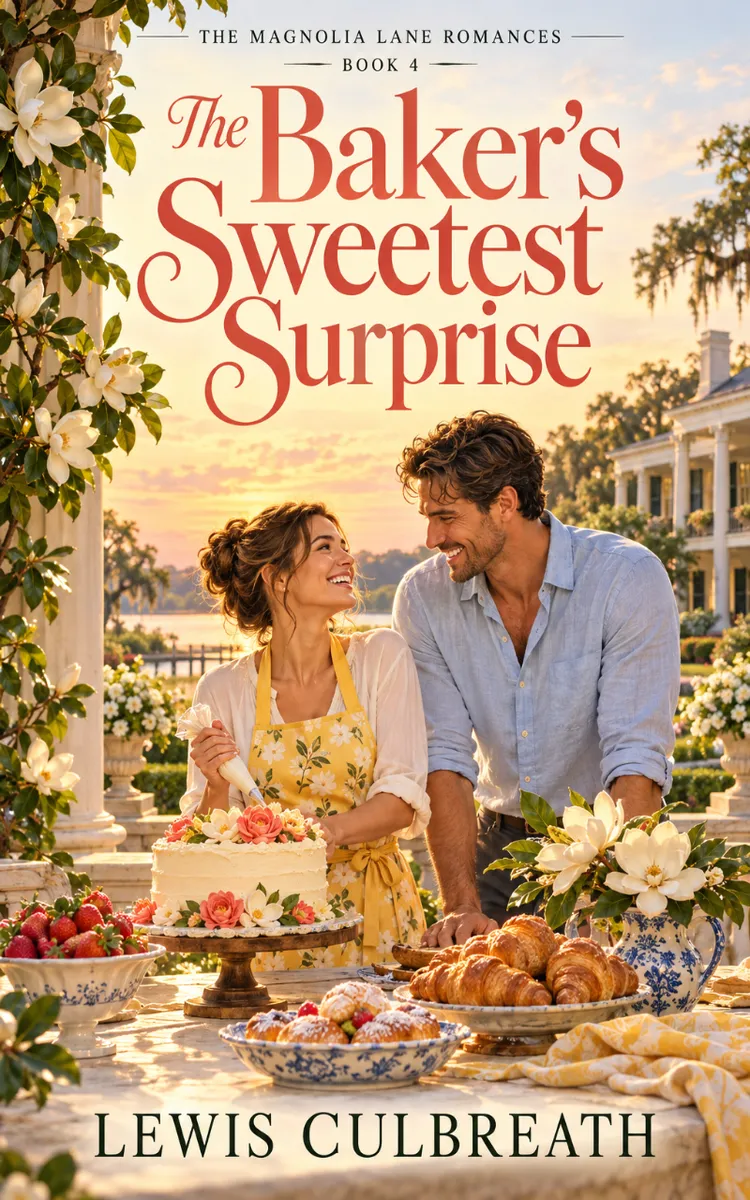
"The Baker’s Sweetest Surprise" is a romance book by Lewis Culbreath with 30 chapters and approximately 72,298 words. A baker and accountant fall in love while planning an estate bakery.
This book was created using Inkfluence AI, an AI-powered book generation platform that helps authors write, design, and publish complete books. It was made with the AI Romance Novel Writer.
Frequently Asked Questions
What is "The Baker’s Sweetest Surprise" about?
A baker and accountant fall in love while planning an estate bakery
How many chapters are in "The Baker’s Sweetest Surprise"?
The book contains 30 chapters and approximately 72,298 words. Topics covered include The Cake at the Ledger Table, A Pop-Up with Strings Attached, What the Numbers Leave Out, The Conservatory’s Narrow Door, and more.
Who wrote "The Baker’s Sweetest Surprise"?
This book was written by Lewis Culbreath and created using Inkfluence AI, an AI book generation platform that helps authors write, design, and publish books.
How can I create a similar romance book?
You can create your own romance book using Inkfluence AI. Describe your idea, choose your style, and the AI writes the full book for you. It's free to start.
Write your own romance book with AI
Describe your idea and Inkfluence writes the whole thing. Free to start.
Start writingCreated with Inkfluence AI


