Ebook SEO Checklist 2026 (Step-by-Step)
Actionable ebook SEO checklist for 2026: intent, CTR, landing-page structure, and internal linking.
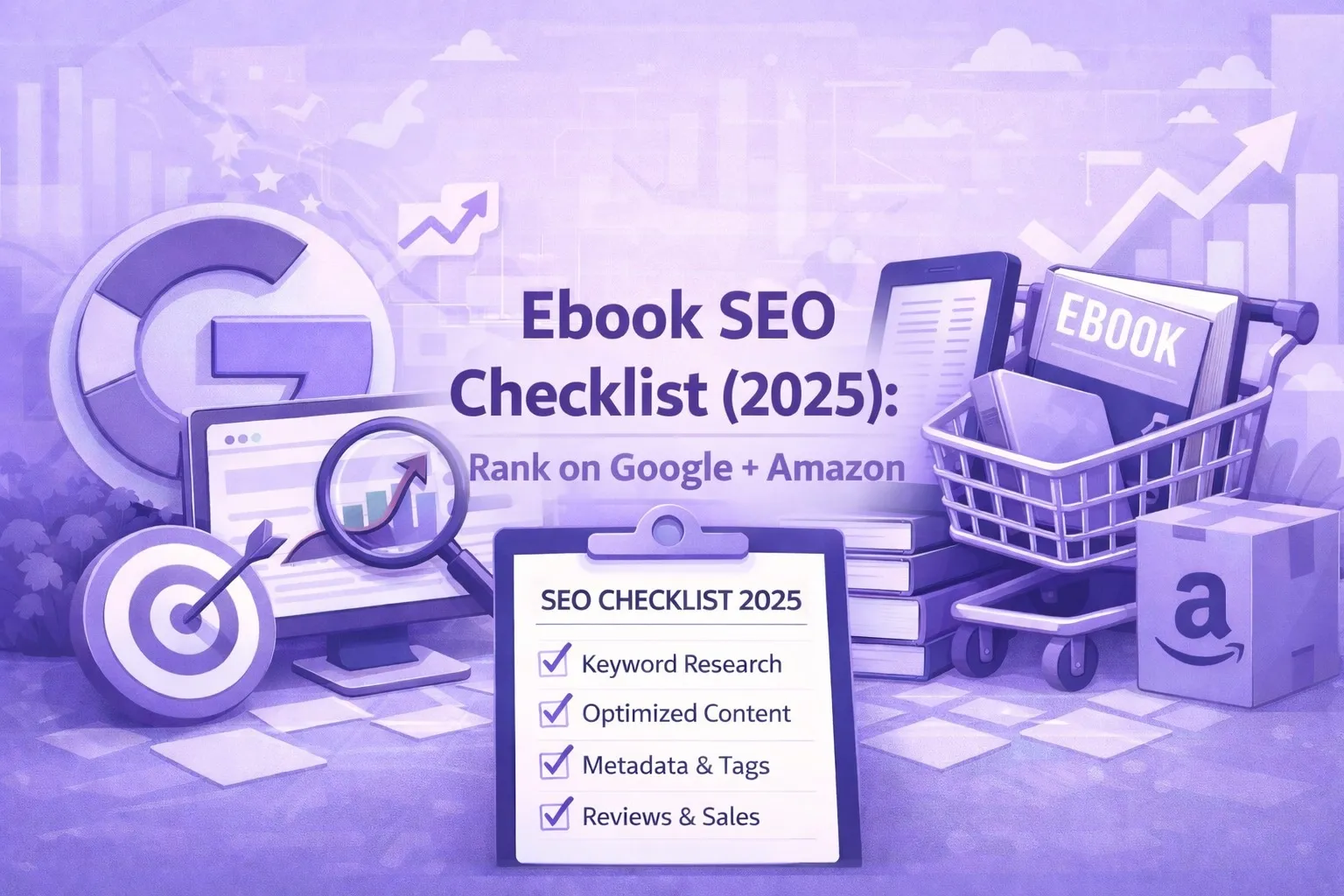
Quick Answer
The essential ebook SEO checklist for 2026 covers intent-matched landing pages, keyword-rich titles and meta descriptions, internal linking across topic clusters, schema markup, excerpt content for Google crawling, mobile-optimised design, and CTR-focused titles. Start with the Ebook SEO flagship page for strategy, then use this checklist for execution.
This is the execution checklist for ebook SEO. If you want the flagship intent page, start with Ebook SEO. If you want the long-form Google guide, use Ebooks Search Engine Optimization.
Why a Checklist Beats Guesswork in 2025
Ebook SEO used to be a narrow trick: add a keyword, add a landing page, collect a few links. That worked when the web was thin and Google was generous. In 2025 it is a different game. Google tests every page against intent, depth, and behaviour. Amazon tests every listing against conversion, pricing psychology, and category fit. The result is that most ebooks now sit in a visibility limbo: they show up, but they do not get clicked.
This checklist is built to move you out of that limbo. It is not a generic SEO overview. It is the operational sequence that turns impressions into clicks and clicks into rankings. For the flagship intent page, start with Ebook SEO, then use this checklist to execute. If you need the creation flow before SEO, start with the AI Ebook Workflow.
If you want to see what “good output” looks like before you build a landing page around it, browse AI ebook examples and export-ready lead magnets.
The Search Behaviour Shift You Have to Design For
In 2025, the search journey for ebooks almost always begins before the ebook exists. People search for a niche, a framework, a template, or a fast creation method. That means you are ranking for intent, not for a file. The page that wins is the one that captures the earliest curiosity and then gives a credible next step. This is why pages like Best Ebook Niches and How to Create an Ebook in Minutes are now primary entry points into the funnel.
That shift changes how you should write. You are no longer optimizing for someone who has already decided to buy. You are optimizing for someone who is comparing options, testing trust, and looking for a reason to click. Your checklist has to serve that moment.
The 2025 Ebook SEO Checklist (Fast Scan)
- Intent: One keyword, one promise, one search state.
- Snippet: Title + meta mirror the exact query language.
- Structure: H1 + H2 hierarchy, quick checklist block, clear CTA.
- Landing Page: Dedicated page with proof and a focused conversion path.
- Amazon: Title, subtitle, backend keywords, and category strategy aligned.
- CTR: Freshness, specificity, numbers, and intent matching.
- Links: Internal links to niches, launch, marketing, monetisation.
- Tracking: Weekly CTR review, quarterly title testing.
1) Lock the Search Intent Before You Write
Most ebook pages fail because they try to satisfy multiple intents at once. A checklist page tries to educate, sell, and promote tools in the same breath. Google treats that as incoherent. Pick a primary intent and build everything around it.
If your target query is "ebooks search engine optimization," the user wants understanding. If the query is "ebook SEO checklist," the user wants a fast, tactical list. Those are two different pages. Your title, first paragraph, and section headings need to make the intent obvious immediately.
Use intent clusters across your content library instead of cramming them into one page. For exploration, link to high-demand niche analysis. For creation, point to fast creation workflows. For monetisation, point to monetisation strategy and funnel design.
If you are not sure which intent your page is serving, a simple diagnostic helps: can you summarize your page in one sentence that starts with “This page helps someone who is trying to ____”? If that sentence is vague, your intent is vague, and your rankings will drift.
2) Your Title and Meta Are the CTR Engine
CTR is the first real ranking signal you control. If you show up and people do not click, you slide. Your snippet must read like the exact answer to the query.
- Title under 60 characters.
- Use the exact query terms.
- Include "2025" if the topic is time-sensitive.
- Meta description under 155 characters with a clear outcome.
Example structure: Keyword + Year + Outcome. "Ebook SEO Checklist (2025): Rank on Google + Amazon" is specific, time-bound, and outcome-focused. A vague "Ebook SEO Guide" is not.
If you are sitting at positions 4 to 8 with low CTR, the fix is rarely content depth. It is almost always snippet mismatch. Tighten the title to match the query language. Use the same nouns and phrases the searcher used. That is why “ebook SEO checklist” often outperforms “ebook SEO guide” even when the content is similar.
Mini example: if the query is "ebook SEO checklist," do not lead with "Ebook Marketing Strategy." That is a different intent. You can still link to the strategy page, but the snippet must promise the checklist. This is the exact problem that hurts pages like SEO for Ebooks when they rank for checklist queries without an explicit checklist hook.
3) Structure the Page for Scanners, Not Readers
Checklist pages are skimmed. Your structure should reward skimming with clarity.
- One H1 only, H2s for each major section.
- A quick checklist block near the top.
- Short paragraphs and bullet lists for steps.
- Internal links to relevant guides like Ebook Marketing Strategy and Ebook Launch Checklist.
Use anchors or internal nav if the page is long. The user should be able to jump straight to “landing page,” “Amazon,” or “CTR fixes” without scrolling for a minute. That behaviour improves dwell time and reduces bounce, both of which feed ranking signals.
4) The Google Landing Page Checklist
Google does not rank your PDF. It ranks the landing page describing it. Treat that page like a conversion asset, not a blog summary.
- Value proposition above the fold.
- One primary CTA and one supporting CTA.
- FAQs to earn extra SERP real estate.
- Social proof or mini outcomes if available.
If you are selling or collecting emails, pair the page with a lead magnet strategy from ebook lead magnet examples and a workflow guide like fastest way to create an ebook.
A simple test: if a user lands on the page and cannot explain the ebook outcome in under five seconds, the landing page is too vague. Tighten the first paragraph, add a short bullet list of outcomes, and make the CTA action explicit.
Example: instead of "Create an ebook with AI," say "Generate a 12-page lead magnet that grows your email list." One is a tool description, the other is a tangible outcome. Searchers click outcomes.
5) Amazon and KDP Listing Checklist
Amazon rewards conversion. SEO here is about sales velocity and relevance, not backlinks.
- Keyword-rich title and subtitle.
- All backend keyword fields filled (no duplicates).
- Categories you can rank in, not just big categories.
- First 200 characters optimized for skimming.
If your strategy includes Amazon, use the KDP SEO checklist alongside this page.
Think of Amazon like a mini-search engine with ruthless conversion logic. A weaker book with stronger conversion can outrank a better book with weaker conversion. That is why title and subtitle pairing matters as much as your content itself.
Title template that works in 2025: Main Keyword: Specific Outcome for Audience. Example: "Ebook SEO Checklist: Rank on Google in 30 Days for Creators." Subtitle template: Proof + Scope + Format. Example: "A 12-step checklist for landing pages, metadata, and Amazon listings." Use these templates to align with the conversion-first reality of Amazon.
Backend keyword rule: do not repeat words already in your title. Use adjacent terms, plural variations, and intent qualifiers. If your title includes "ebook SEO checklist," use backend fields for "ebooks search engine optimization," "ebook metadata," and "rank ebooks on Google." This protects coverage without stuffing.
6) CTR Fixes That Actually Move the Needle
Most low CTR pages are not ranking problems, they are snippet problems. This is especially true in positions 4 to 8.
- Use numbers and specificity: "12-step checklist."
- Add freshness: "2025 update."
- Match the query language, not brand language.
This is why pages with niche specificity like low competition niches often outperform broader pages at the same position. The snippet matches the intent more tightly.
Another CTR lever: clarify the format in the snippet. “Checklist,” “template,” or “step-by-step” sets expectations and filters out low-intent clicks. That filtering improves engagement and can lift rankings over time.
Diagnostic: if your average position is stable but CTR declines after a title update, revert the wording or test a sharper outcome. If position drops after a CTR drop, the snippet mismatch is costing you rankings. Fixing CTR often restores position within a few weeks.
6.1) Match SERP Features With Structure
Google rewards pages that match the layout it wants to show. If the results page is full of list-like answers, your page should include a visible list near the top. If the query triggers FAQ rich results, your page should include clear FAQ blocks with direct answers.
For ebook SEO topics, the SERP often favors quick answers and structured sections. That is why a short checklist block near the top and a Q and A section near the bottom tend to lift CTR. Pair this with pages like Ebook Marketing Blueprint and Ebook Marketing Strategies to keep users moving through your cluster.
6.2) Show the Format and the Outcome
Readers want to know what they are getting. If your page promises an ebook, show the format clearly and mention how it is used. This is why pages like multi-format ebook creation and ebook versus PDF workflows matter. They answer the format question before it becomes friction.
When someone clicks your page and immediately understands the output format, your bounce rate drops. That positive engagement signal feeds rankings.
7) Internal Linking Is the Authority Signal
Google reads internal links as your own map of expertise. A checklist page without links looks isolated and thin. A checklist page connected to a cluster looks authoritative.
At minimum, link to:
- Best Ebook Niches 2025
- Ebook Marketing Strategy
- Ebook Monetisation Strategies
- Ebook Launch Checklist
If you want to show the creation path, link directly to the tools: AI Ebook Generator and PDF Ebook Maker.
Internal links also guide Google to the pages you want treated as pillars. If you want your niche content to rank, link to it from SEO and marketing pages. If you want your tool pages to rank, link to them from “how-to” articles. That structure is how you create a defensible moat.
Suggested anchor patterns that work well:
- "best ebook niches 2025" linking to best ebook niches
- "ebook launch checklist" linking to launch checklist
- "ebook marketing strategy" linking to marketing strategy
- "ebook monetisation strategies" linking to monetisation
7.1) Build a Cluster That Proves Expertise
Google does not reward single articles. It rewards topic depth. A strong ebook SEO cluster includes creation, design, monetisation, and distribution. Use pages like how to create an ebook, ebook design best practices, and how to create an ebook that sells to show depth beyond SEO alone.
That cluster should also include tool comparisons such as AI ebook generators and strategic context like AI vs human creation. The goal is to look like an authority, not a single landing page.
8) Tracking and Iteration
SEO for ebooks compounds slowly and then accelerates. The goal is not to perfect a page in a day. The goal is to improve CTR and intent alignment over time.
- Review Search Console weekly for CTR drops.
- Test 1 to 2 title variants per quarter.
- Update internal links as new pages ship.
A simple framework that works: if a page sits at positions 4 to 8 with low CTR, test the title. If a page sits at positions 12 to 20, expand the content depth and add supporting links. If a page is new, give it 30 to 60 days before you judge. This pacing prevents you from chasing noise.
Use three buckets to guide action:
- CTR problem: Stable position, low CTR. Fix snippet and title.
- Depth problem: Low position, low impressions. Add content and internal links.
- Intent problem: Rankings fluctuate wildly. Align title and opening to the exact query.
Common Failure Modes (and How to Avoid Them)
The checklist fails if you miss the fundamentals. These are the patterns that repeatedly show up in underperforming ebook pages:
- Trying to rank a PDF instead of a dedicated landing page.
- Optimizing for a broad keyword when the query is specific.
- Ignoring CTR while obsessing over backlinks.
- Publishing one ebook page with no supporting cluster.
- Writing like a brochure instead of an expert.
Each of these failures is solved by aligning intent and improving structure. That is why this checklist exists.
If you want to see how this plays out in practice, compare a niche article like most profitable ebook niches with a generic category page. The niche page converts because it matches a precise search intent. The generic page is often too broad to win clicks.
Final Pass: The Checklist You Actually Use
If you only do three things, do these: match the intent, tighten the snippet, and connect the page to the cluster. Those three changes create most of the lift. The rest of the checklist improves stability and keeps rankings from decaying.
For distribution beyond Google, pair this checklist with Ebook Marketing Strategy 2025 and the practical launch steps in Ebook Launch Checklist. For lead capture, link directly to turn blog posts into lead magnets and ebooks for lead generation.
If you want the full narrative strategy, pair this checklist with SEO for Ebooks and 2025 Ebook SEO. If you want a fast execution path, the Ebook SEO tool can help you apply these steps without guesswork.

Inkfluence AI Team
Tips, tutorials, and strategies from the Inkfluence AI team to help you write, publish, and sell ebooks faster.
Helpful links
Ready to Create Your Own Ebook?
Start writing with AI-powered tools, professional templates, and multi-format export.
Get Started FreeRelated Articles
 Self-Publishing
 How to Actually Sell Your Ebook on Amazon KDP (Not Just Publish It)
Publishing on KDP is the easy part. This guide covers what most authors skip: keyword research, category strategy, book description copywriting, pricing psychology, launch week tactics, Amazon ads, and building review velocity. Practical strategies that drive real sales.
 Marketing
 Ebook Marketing Strategy 2026: The Complete Guide to Selling More Books
Learn proven ebook marketing strategies for 2026. From pre-launch planning to Amazon KDP optimization, email funnels, and paid ads. Step-by-step guide for authors.
 SEO
SEO Ebooks Search Engine Optimization: Free SEO Guide for Ebooks (2026)
Free guide to ebooks search engine optimization. Learn how to rank your ebook on Google with landing pages, internal links, metadata & excerpts.
Get ebook tips in your inbox
Join creators getting weekly strategies for writing, marketing, and selling ebooks.