SEO for Ebooks: Multi-Platform Strategy (Google + Amazon)
Multi-platform ebook SEO strategy across Google, Amazon, and marketplaces. Use this for cross-channel visibility.
Quick Answer
SEO for ebooks requires a multi-platform strategy: optimise your landing page for Google (title tags, meta descriptions, structured data), your listing for Amazon KDP (keywords, categories, subtitle), and your marketplace pages for Etsy/Gumroad search. Use Ebook SEO for the Google-focused cornerstone guide and KDP SEO for Amazon-specific tactics.
This guide is the multi-platform SEO strategy for ebooks (Google + marketplaces). It is not the single Google intent page. If you want the flagship Google page, start with Ebook SEO.
Popular playbooks: Use this SEO workflow for marketers, content creators, small businesses, and coaches.
Want the landing-page version? Start with Ebook SEO (cornerstone guide) for the "ebooks search engine optimization" intent page we want ranking long-term.
Optimizing for Amazon too? Use KDP SEO for title/subtitle/keywords/category strategy, then use this post for the Google side.
Need a draft first? Start with the AI Ebook Generator (or the Free Ebook Creator), then come back here to optimize the page you want to rank.
The Invisible Ebook Problem
You spent three months writing it. The content is solid. Real insights. Practical strategies. Everything your target audience needs.
You hit publish. Wait for the downloads to roll in.
crickets.
Month one: 14 downloads (12 were friends). Month two: 23 downloads. Month three: you stop checking because it hurts too much.
Here's the brutal truth: your ebook isn't failing because it's bad. It's failing because nobody can find it. You're competing against 4 million books published last year, and yours is buried on page 47 of Amazon search results.
But there's good news. The books dominating search results aren't necessarily better than yours. They just understand SEO. And SEO for ebooks isn't complicated, it's just different from regular content SEO.
This guide breaks down exactly how to make your ebook discoverable, rankable, and actually profitable through organic search. Real strategies. No fluff.
Why Ebook SEO Is Different (And Most Authors Get It Wrong)
If you're approaching ebook SEO like website SEO, you're already losing. Ebooks exist in a strange hybrid space between traditional publishing and digital content. The rules are different.
Your ebook lives on multiple platforms simultaneously. Amazon. Your website. Apple Books. Google Books. Each platform has its own algorithm, its own ranking factors, its own weird quirks.
On Amazon, sales velocity matters more than backlinks. On Google, your landing page structure matters more than your actual ebook content (because Google can't read your ebook file). On Apple Books, your category selection can make or break you.
Most authors optimize for one platform and wonder why they're invisible everywhere else. The smart approach? Build a multi-platform SEO strategy from day one.
Here's what actually matters for ebook SEO across all platforms:
Your title is 60% of the battle. Not your content quality. Not your cover design. Your title. If your title doesn't contain the exact words people are typing into search boxes, you're invisible. End of story.
Reviews are ranking rocket fuel. A book with 50 reviews will outrank a book with 500 downloads but 5 reviews. Every time. Reviews signal quality to algorithms and humans alike.
The first 48 hours determine everything. Amazon's algorithm pays insane attention to initial sales velocity. Launch week performance predicts your ranking for months.
Let's dive into exactly how to dominate each of these areas.
Keyword Research That Actually Works
Forget generic keyword tools for a second. Here's how real authors find keywords that convert.
Open Amazon. Type your ebook topic into the search bar. Don't hit enter. Just watch the autocomplete suggestions. Those suggestions? That's Amazon literally telling you what thousands of people are searching for right now.
Write down every single suggestion. Then do it again with slight variations of your topic.
Now go to the top 10 books in your category. Not the most popular books overall. The top 10 in your SPECIFIC sub-category. Read their titles. Notice patterns? Those patterns are your keyword goldmine.
Example: You're writing an AI writing guide. Top books have titles like "AI Writing for Beginners," "ChatGPT Content Creation," "AI-Powered Copywriting." Those aren't accidents. Those are proven keywords.
Here's the formula I use for title keywords:
[Main Topic] + [Specific Promise] + [Target Audience]
Bad title: "Writing Better With AI"
Good title: "AI Ebook Writing Guide: Create Professional Books 10x Faster for Beginners"
The good title includes: main keyword (AI ebook writing), specific promise (10x faster), target audience (beginners), and a qualifier (professional books). All searchable terms.
Don't overthink this. The best keywords are boring and descriptive. "Advanced AI Strategies" sounds cool but nobody searches for it. "How to use AI to write a book" is boring but gets 2,400 searches per month.
Boring wins. Every time.
Your Ebook Title: The 60% Factor
I'm going to say something controversial: your ebook title matters more than your ebook content for SEO.
I know, I know. That sounds backwards. But think about it. If your title doesn't get clicked, nobody ever sees your brilliant content. Your title is the gateway. Mess it up and everything else is irrelevant.
Here's the Amazon title optimization formula that works:
Main Keyword: Specific Benefit for Target Audience
Examples that work:
"Email Marketing for Real Estate Agents: Get 10 Listings Per Month"
"Keto Meal Prep: 100 Easy Recipes for Busy Professionals"
"Instagram Growth Hacks: 0 to 10K Followers in 90 Days for Small Business"
Examples that fail:
"The Email Advantage" (what does this even mean?)
"Delicious Keto" (boring, no promise)
"Social Media Success" (too generic, no specificity)
Your title needs to pass the "search test." Would someone actually type those words into Amazon search? If not, rewrite it.
And please, for the love of SEO, don't get cute with your title. "The Purple Elephant Method" might sound clever, but nobody is searching for purple elephants. Save the clever stuff for chapter titles.
Amazon SEO: Where 80% of Ebook Sales Happen
Amazon isn't just a platform. It's THE platform. If you only optimize for one place, make it Amazon.
Amazon's algorithm (A10) cares about three things, in this order:
1. Sales velocity (how fast you're selling)
2. Conversion rate (clicks that turn into sales)
3. Keywords (what you're targeting)
Notice what's NOT on that list? Backlinks. Domain authority. Page speed. All that Google SEO stuff? Amazon doesn't care.
So here's the Amazon SEO playbook:
Week before launch: Build a small email list (even 100 people). Tell them the book is coming. Get them excited.
Launch day: Email that list. Price your book at $0.99 for 48 hours. Goal: spike sales velocity fast.
Days 2-7: Keep momentum. Every sale in week one counts triple for ranking purposes (not official, but tested repeatedly).
Week 2+: Raise price to normal ($4.99-9.99). By now you should have established ranking.
The backend keywords section in Amazon KDP? Use all 250 characters. Don't repeat words from your title. Include misspellings people actually make. Separate with spaces, not commas. For a full listing walkthrough, use the KDP SEO checklist.
Categories matter too. Choose the most specific category possible. "Business > Marketing > Email Marketing" is better than just "Business" because it's easier to rank in smaller categories.
Your Landing Page: The Google Play
If you're selling direct (not just Amazon), your landing page IS your SEO strategy for Google.
Google can't read your ebook file. So it judges your ebook entirely based on your sales page. Make it count.
Your landing page needs:
A killer title tag - Your main keyword first, brand name last. Under 60 characters.
Example: "AI Ebook Writing Guide: Create Books 10x Faster | Inkfluence AI"
Meta description that sells - 155 characters of pure conversion copy.
Example: "Write professional ebooks in days, not months. AI-powered tools, proven templates, and step-by-step guidance. Start free today."
H1 with main keyword - One H1 tag per page. Make it your main keyword in sentence form.
Example: "Learn How to Write Professional Ebooks Using AI"
1,500+ words of content - Google rewards substantial content. Write about the problem, your solution, benefits, social proof.
Include your keyword 4-6 times naturally. Stuff it in there 20 times and Google will penalize you.
Internal links to related content - Link to your blog posts about ebook creation, AI writing features, and pricing page. Google loves internal link structure.
The Review Game (And How to Win It Ethically)
Reviews are ranking gold. A book with 30 three-star reviews will often outrank a book with 5 five-star reviews.
But here's the thing: you can't buy reviews. You can't offer incentives. Amazon will nuke your book if you try.
What you CAN do:
Ask directly. At the end of your ebook: "If you found this valuable, I'd be grateful for an honest review on Amazon. It helps other readers find this book." Simple. Honest. Works.
Follow up via email. 7 days after purchase, send a quick email: "Hey! Hope you're enjoying the book. If it's been helpful, would you mind leaving a quick review? Here's the link: [direct Amazon review link]"
Use Amazon's Early Reviewer Program. Pay Amazon $60 and they'll email recent buyers asking for reviews. Totally legit and approved.
Send advance copies. Before launch, send 20-30 free copies to your target audience. Not professional reviewers. Real people who would buy this book. Ask for honest reviews on launch day.
Never, ever, EVER buy fake reviews or offer rewards for positive reviews. One bad report and your book is gone forever.
Content Marketing: The Long Game That Pays Off
Here's where most authors quit too early. They optimize their listing, launch, and then wonder why traffic plateaus.
The secret to sustained ebook SEO? Content marketing around your topic.
Take one chapter from your ebook. Expand it into a 2,000-word blog post. Add examples. Add screenshots. Make it genuinely valuable on its own.
At the end, include: "Want the complete system with templates and worksheets? Get the full ebook here."
Do this for 10-12 chapters. Suddenly you have 10-12 SEO-optimized blog posts all linking back to your ebook. Each post ranks for related keywords. Each drives qualified traffic.
This takes time. Months, not weeks. But it compounds. Month 1 you get 50 visitors from blog posts. Month 6 you get 800. Month 12 you get 3,000. All organic. All free.
Bonus: repurpose those blog posts as YouTube videos, LinkedIn articles, Medium posts. Every platform is another SEO opportunity. Need help structuring your ebook for maximum sales potential? Read how to create an ebook that actually sells.
The Biggest SEO Mistakes Authors Make
Keyword stuffing. Stop cramming keywords into every sentence. Write naturally. Google is smarter than you think.
Ignoring mobile. 65% of Amazon browsing happens on mobile. If your landing page looks broken on phones, you're losing sales and rankings.
One and done. Launching without a long-term content strategy. SEO compounds. One blog post won't cut it.
Generic categories. Choosing broad categories where you'll never rank instead of specific niches where you can dominate.
No tracking. Not measuring what's working. Use Amazon's analytics. Use Google Search Console. Follow your rankings weekly.
Your 90-Day SEO Action Plan
Month 1: Foundation
Week 1: Keyword research. Find your main keyword and 10 related terms.
Week 2: Optimize title, subtitle, description, categories. Need help creating your ebook quickly? Try the fastest way to create an ebook.
Week 3: Build landing page if selling direct. Optimize for Google.
Week 4: Write first 5 blog posts from ebook content.
Month 2: Launch and Content
Week 1: Launch with email list spike. Hit Amazon hard.
Week 2-3: Email follow-ups for reviews. Get to 15+ reviews minimum.
Week 4: Publish 5 more blog posts. Start building content library.
Month 3: Scale and Optimize
Week 1-2: Analyze what's working. Which keywords are ranking? Which blog posts are getting traffic?
Week 3: Double down on winners. Write more content in those areas.
Week 4: Set up ongoing content calendar. One post per week minimum.
The Truth About Ebook SEO
Here's what nobody tells you: SEO isn't a hack. It's not a shortcut. It's consistent, strategic work that pays compound interest.
Your ebook won't hit #1 overnight. Month one might be discouraging. Month three you'll see momentum. Month six you'll have a traffic engine that runs on autopilot.
The authors who dominate Amazon search results aren't lucky. They're not gaming the system. They're just playing the long game while everyone else quits after week two.
Start with the basics: killer title with clear keywords, optimized Amazon listing, landing page built for Google. Then commit to content marketing for 6-12 months.
Do that, and SEO will become your most profitable ebook marketing channel. Free traffic. Qualified leads. Compound growth.
That's the game. Now go play it.
Create SEO-optimized ebooks that rank and convert with Inkfluence AI →
Frequently Asked Questions
How long does it take to see SEO results for an ebook?
Realistic timeline: 30-60 days for Amazon rankings to stabilize, 90-120 days for Google blog traffic to build momentum. Initial launch week determines Amazon ranking baseline, but long-term SEO compounds over 6-12 months of consistent content marketing.
Should I use KDP Select or publish wide for better SEO?
KDP Select (Amazon exclusive) gives you promotional tools and Kindle Unlimited exposure, which can boost sales velocity and Amazon rankings. Publishing wide (multiple platforms) gives you more total ranking opportunities but splits your review count. For new authors, start with KDP Select for 90 days to build Amazon momentum, then evaluate going wide.
How many keywords should I target for my ebook?
Focus on 1 main keyword for your title, 3-5 secondary keywords for subtitle/description, and use all 250 characters of Amazon backend keywords for related terms. Don't spread yourself thin trying to rank for 50 keywords. Dominate 5-10 highly relevant terms instead.
Do backlinks matter for Amazon ebook rankings?
No. Amazon's algorithm doesn't consider backlinks at all. Sales velocity, conversion rate, and keyword relevance are what matter. Backlinks DO matter if you're selling direct and trying to rank your landing page on Google, but they won't help your Amazon listing.
Can I change my ebook title after launch without hurting SEO?
Yes, but do it strategically. Amazon allows title changes. If your current title isn't working after 60-90 days, test a new keyword-optimized version. You'll lose review count display temporarily while Amazon reindexes, but if the new title converts better, it's worth it. Wait until you have 15+ reviews before changing titles.
How important are categories vs keywords for ranking?
Both matter, but categories might be more important than most authors realize. Choosing niche categories where you can realistically rank top 20 beats targeting massive categories where you'll be invisible. Your main keyword determines what searches find you; your category determines what bestseller lists you appear on. Use both strategically.
Should I hire an SEO agency for my ebook?
Probably not. Most SEO agencies don't understand ebook-specific SEO (especially Amazon's unique algorithm). The fundamentals are simple enough to implement yourself: keyword research, optimized metadata, content marketing. Save your money and invest 2-3 hours learning the basics. Only consider agencies if you're publishing 10+ books and need to scale operations.
How do I optimize for voice search and AI assistants?
Create SEO-optimized ebooks that rank and convert with Inkfluence AI →

Inkfluence AI Team
Tips, tutorials, and strategies from the Inkfluence AI team to help you write, publish, and sell ebooks faster.
Helpful links
Ready to Create Your Own Ebook?
Start writing with AI-powered tools, professional templates, and multi-format export.
Get Started FreeRelated Articles
 SEO
SEO Ebooks Search Engine Optimization: Free SEO Guide for Ebooks (2026)
Free guide to ebooks search engine optimization. Learn how to rank your ebook on Google with landing pages, internal links, metadata & excerpts.
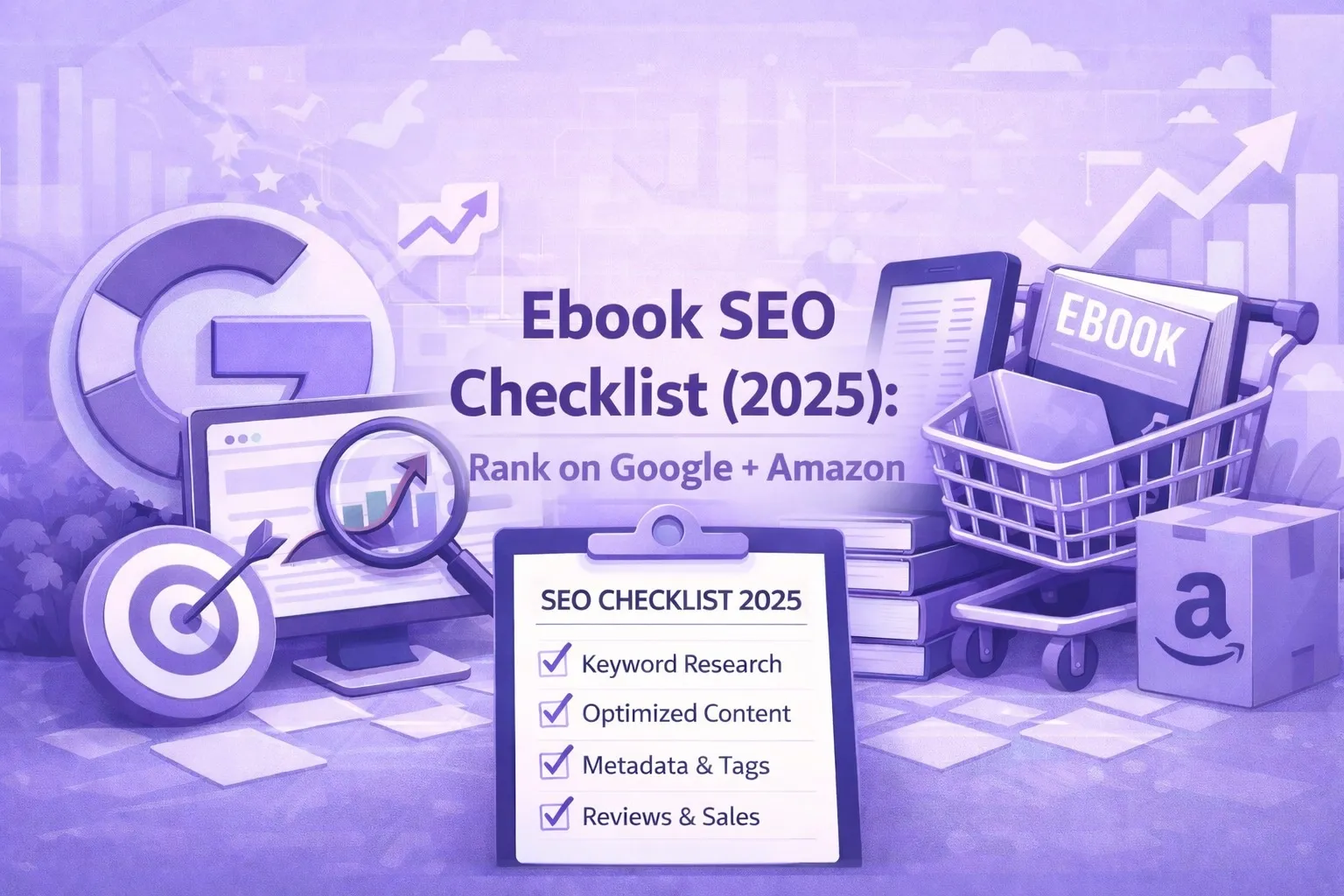 SEO
SEO Ebook SEO Checklist 2026 (Step-by-Step)
Actionable ebook SEO checklist for 2026: intent, CTR, landing-page structure, and internal linking.
 SEO
SEO 2026 Ebook SEO: How Digital Books Are Actually Ranked Now
The quiet shift no one noticed: Google now rewards depth of understanding over breadth of content. Learn how ebook SEO changed in 2025 and why narrative structure outperforms keyword optimization.
Get ebook tips in your inbox
Join creators getting weekly strategies for writing, marketing, and selling ebooks.