
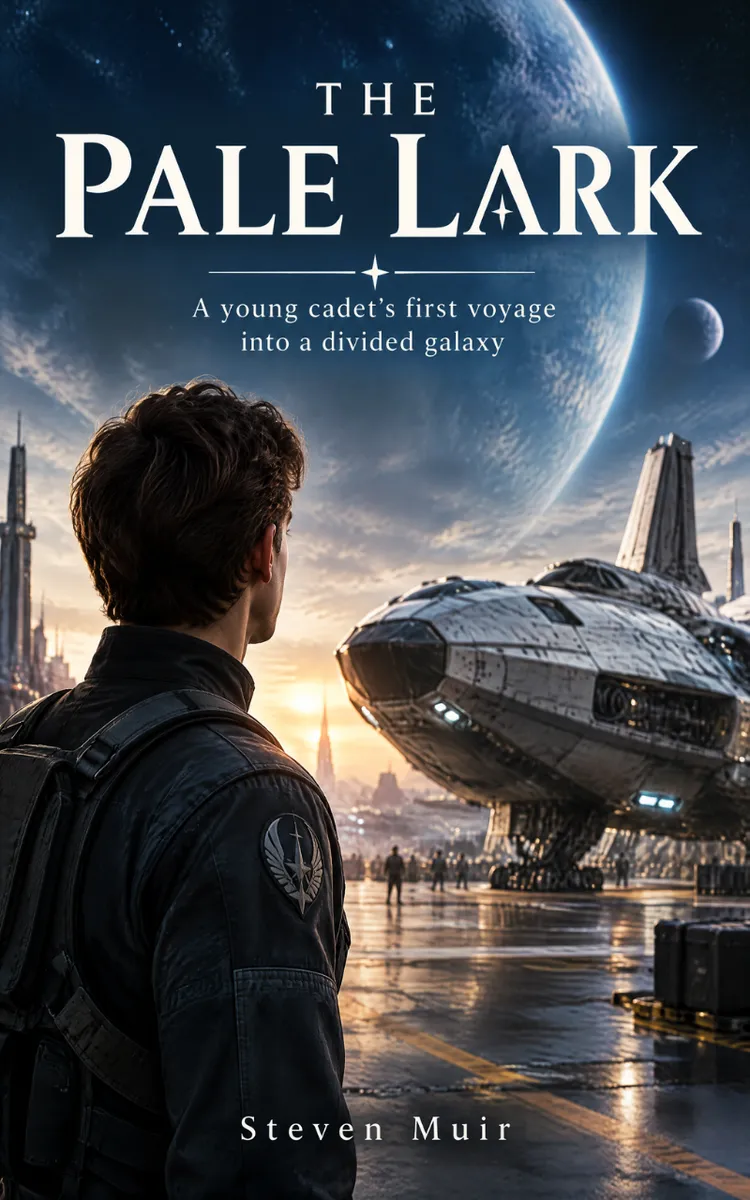

Read the first 3 chapters
The opening of the book, free: 3 chapters. About 42 min. Turn the pages with the arrows, your keyboard, or a swipe.
Chapter 1
The Wrong-Colored Coat
The lift coughed halfway to the third rack and dropped six inches.
I caught the crate against my shoulder before it crushed my foot. Something inside clanged like a fist in a metal box. The warehouse lights flickered overhead, turning the freight depot into a sequence of bad photographs: rusted shelving, dust hanging in the beams, my own face reflected in the black strip of the loading-bay door.
“Hold!” I shouted.
The lift held.
For three seconds.
Then it groaned downward again.
I shoved the crate onto the rack and jumped clear. The pallet beneath me shuddered. A strip of old tape peeled from the floor and curled in the hot draft coming through the open bay.
“Ardell!”
I looked down.
Marta stood beside the lift controls with one hand on her hip and the other wrapped around a paper cup. She had a silver streak in her hair that hadn’t been there last winter. Either that or I’d stopped noticing things until they changed enough to threaten me.
“Unless you’ve learned to stack from the ceiling,” she said, “get down.”
“I’m working on it.”
“You’re standing on a machine that’s trying to kill you.”
“It’s not personal.”
“It’s a lift.”
“Exactly. No feelings.”
The lift coughed again.
I climbed down the side rails, boots slipping on grit. The metal was hot through my gloves. When I reached the floor, Marta snatched the control box from its hook and smacked the casing with the heel of her hand.
The lift stopped complaining.
“That’s maintenance?” I asked.
“That’s Arizona maintenance.”
Outside, a truck engine started and failed. The sound rolled across the lot, followed by a silence wide enough to fit the whole town inside it. Red Mesa had been dying in installments for years. The mine closed first. Then the diner lost its night shift. Then the highway signs started pointing toward places that still had reasons to exist.
The freight depot remained because cargo had to pass through somewhere, even if nobody stayed.
Marta pointed at the pallet. “Finish that stack. Then sweep dock four.”
“I thought the lift was out.”
“It’s resting.”
“On what?”
“Hope, apparently.”
She walked away before I could argue. That was one of her management techniques. The other was pretending she hadn’t heard a question.
I looked up at the crate I’d nearly dropped. White shipping label. Black bar code. Destination: Flagstaff. Contents: replacement seals for agricultural pumps. The seals had traveled farther than most people in Red Mesa ever would.
I dragged the next crate across the pallet by hand.
My shift ended in forty-three minutes. I knew because I’d checked the clock seventeen times since lunch. I wanted to finish without losing a toe, collect my pay, and get home before my mother started asking whether I’d applied anywhere else.
The answer was no.
The truth was worse. I had applied everywhere that would take an application without laughing. The grocery store wanted someone with open availability. The tire shop wanted experience. The county wanted a clean driving record and a patience I did not possess. The depot wanted me because I could lift until my back hurt and didn’t complain until afterward.
I had a plan, technically. Save enough to leave. Go north. Find work that didn’t involve forklifts with personalities. Maybe community college, if the numbers ever stopped looking like a joke.
The plan had not survived contact with rent.
I shoved the crate into place and reached for another.
That was when the woman in the wrong-colored coat walked into the warehouse.
I noticed the coat before I noticed her face. Everything around her was brown, gray, sun-bleached, or the particular yellow of old plastic. Her coat was blue, but not any blue I could name. It had a green cast near the seams and a thin violet sheen when she moved. Under the loading lamps, the color seemed to decide what it wanted to be.
She stopped just inside the bay.
Dust blew around her shoes and did not settle on them.
I kept both hands on the crate.
“Can I help you?” I called.
She looked at the pallet, the lift, then me. Her gaze paused on the name patch stitched crookedly over my chest.
“Kael Ardell?”
The way she said it made my surname sound like a question she had already answered.
“Depends who’s asking.”
Her mouth tilted. Not a smile. More like she had found a loose screw and decided not to touch it yet.
“My name is not important.”
“That’s convenient.”
“I need to speak with you.”
“Marta handles complaints.”
“I’m not here about the shipment.”
“Then you’re going to have to wait. I’m not allowed to abandon freight because a mysterious stranger has entered through the loading bay.”
“You have forty-one minutes left in your shift.”
The crate dug into my palms.
“Do you work for the depot?”
“No.”
“Do you work for the county?”
“No.”
“Then you’re trespassing.”
“I walked in through an open door.”
“That’s not the same thing.”
“It is in most places.”
She had a narrow face, dark hair cut just below her jaw, and a pale line across one knuckle. Her eyes were ordinary brown. I found that disappointing. Someone wearing a coat like that should have eyes that glowed or at least came with a warning label.
She reached into her coat.
I set the crate down.
The movement was small, but her hand stopped halfway.
“I’m not armed,” she said.
“That’s what armed people say when they want you to stop looking at their hands.”
“I’m carrying a card.”
“Worse.”
She withdrew a rectangle of stiff white material and held it between two fingers. No logo. No name. No phone number. Just a thin black border and, in the center, a symbol made of three intersecting lines.
It might have been a bird if birds were designed by someone who hated them.
I didn’t take it.
“What is it?”
“A contact card.”
“For what?”
“For an opportunity.”
I laughed once. It came out dry. “That word has ruined more lives than alcohol.”
“I was told you would be suspicious.”
“Who told you?”
“You tested well.”
The warehouse seemed to get louder around us. A compressor kicked on near the cold-storage rooms. Somewhere behind the racks, a box slid and thumped.
I stared at her.
“Tested for what?”
“That’s what we need to discuss.”
“No, it’s what you need to explain.”
“You took an assessment two months ago.”
“I take a lot of assessments. The depot makes us do safety quizzes.”
“This was not a safety quiz.”
“Then I didn’t take it.”
“You did.”
“Did I pass?”
Her gaze moved over me again, measuring something I couldn’t see. “You tested well.”
“That isn’t an answer.”
“It’s the answer I’m authorized to give.”
“Authorized by who?”
She glanced toward the office windows. Marta was visible beyond the dusty glass, arguing with a driver and pointing at a clipboard. She hadn’t looked our way.
The woman lowered the card.
“You should not discuss this here.”
“Then you shouldn’t have come here.”
“I came because you are difficult to locate.”
“I work at the only freight depot in town.”
“Your records are inconsistent.”
“My records are fine.”
“Your birth certificate is fine. Your school records are fine. Your employment history is fine. The assessment result is not.”
The crate behind me creaked as the pallet settled.
“What assessment?”
She gave me the card.
I took it because refusing would have required more effort than accepting. The material was colder than it should have been. Not refrigerated cold. Deep-earth cold, the kind that lived in the bottom of a well.
There was no writing on the reverse.
I turned it over.
Blank.
“Is this supposed to impress me?”
“No.”
“Good, because it’s doing a poor job.”
“You may contact the number on the front.”
“There is no number.”
“Not yet.”
I looked at the front again. The black lines of the symbol had shifted. I was almost sure they hadn’t. The center intersection now sat a fraction higher than before.
I blinked.
It was still a bird-shaped mistake.
“What does that mean?”
“You’ll know if you decide to find out.”
“That’s not how information works.”
“It is how invitations work.”
She stepped back toward the bay.
I held up the card. “Wait. What is the job?”
“It isn’t a job.”
“Then what am I being invited to?”
“A school.”
I stared at her long enough for the lift behind me to give a soft, warning click.
“A school,” I repeated.
“Yes.”
“Do I look like I’m looking for school?”
“You look like you’re looking for a way out.”
That landed harder than it had any right to.
I kept my face still. I had gotten good at that. At home, at work, in the mirror. If I looked tired, people offered advice. If I looked angry, they offered reasons I was wrong. If I looked scared, they offered nothing.
The woman watched the effort happen.
“What kind of school?” I asked.
“The kind that selects its students carefully.”
“Why me?”
“You tested well.”
“Stop saying that.”
“Then stop asking.”
I folded the card once.
Her expression changed for the first time. Not fear. Irritation.
“Don’t damage it.”
“So it is valuable.”
“It is important.”
“To you?”
“To you.”
“Do you know me?”
“I know enough.”
“That’s not comforting.”
“It wasn’t intended to be.”
Marta shouted from the office, “Ardell! Dock four!”
I looked over my shoulder.
The woman said, “Three days.”
I turned back. “What happens in three days?”
“If you want answers, bring the card to the warehouse after dark.”
“That’s it?”
“That’s enough.”
“You expect me to come back here after dark because a stranger in a coat that can’t pick a color told me to?”
“I expect you to decide whether uncertainty is worse than whatever you think is waiting for you.”
“That sounds like a threat.”
“It’s a choice.”
She walked away.
I followed her three steps before common sense caught me by the collar.
“Hey!”
She stopped at the edge of the loading bay.
“What’s the school called?”
The wrong-colored coat turned in the sunlight. Blue, green, violet. For one second it looked black.
“Vigil Academy.”
Then she crossed the lot and disappeared behind a row of empty trailers.
I stood there with the card in my hand.
Marta shouted again.
I shoved the card into my pocket and went to sweep dock four.
• * *
The card did not melt, transmit a voice, or grow a second side while I was working.
I checked twice.
On the third check, I noticed a shallow groove along the edge. It had been there before, probably. The card was too smooth to hold fingerprints and too heavy to be paper. I ran my thumb over it while dragging a broom through a drift of packing foam.
Vigil Academy.
The name sounded invented. Not fake, exactly. More like something a government would call a building after spending six months arguing over a committee report.
I searched it on my phone.
No results.
I tried quotation marks. Nothing.
I tried adding school, academy, admissions, Arizona, military, private, scholarship. The phone spun, thought about it, and produced advertisements for online tutoring.
A forklift beeped behind me.
I stepped aside without looking up.
“Careful,” Marta said.
“I’m being careful.”
“You’re staring at your phone while sweeping.”
“I’m multitasking.”
“You’re sweeping the same square meter.”
I looked down. She was right. The floor had become the cleanest surface in the county.
Marta leaned on the broom she’d brought from the office. Her gaze dropped to the card when it slid halfway from my pocket.
“New girlfriend?”
“Recruiter.”
“For what?”
“School.”
She gave me the expression usually reserved for damaged machinery. “You’re already out of school.”
“I know.”
“College?”
“Maybe.”
“Then it’s not a recruiter. It’s someone selling a course.”
“She said I tested well.”
Marta’s mouth tightened.
“What?” I asked.
“Nothing.”
“That was a very loud nothing.”
“People say things to get you to listen.”
“I listened.”
“Clearly.”
She nodded toward the card. “What do they want?”
“Apparently, I’m supposed to show up here after dark.”
“Absolutely not.”
“You don’t even know what it is.”
“I know what people do when they want to meet somewhere after dark and won’t say why.”
“Usually they want to sell me a timeshare.”
“Usually they want you in a van.”
“I’m eighteen.”
“Exactly old enough to think that makes you difficult to kidnap.”
“I’m not going anywhere.”
The lie arrived smoothly. I was proud of it for almost a second.
Marta studied me.
“You planning to leave town?”
I pushed the broom harder. Foam gathered in front of the bristles like snow.
“Not tonight.”
“That wasn’t my question.”
“I have a shift.”
“You have a life, Kael.”
“Do I?”
She looked toward the bay. Beyond it, the late afternoon sun had turned the freight yard white. Empty trailers sat in rows, their doors chained shut. The depot’s sign had lost two letters. RED MESA FREIGHT had become RED MESA FREI, which sounded like a failed political movement.
“Your mother called,” Marta said.
My hand stopped.
“What did she want?”
“She asked if you were working late.”
“Why?”
“She didn’t say.”
“She always says.”
“Then maybe she didn’t want to tell me.”
I folded the card tighter in my pocket. The cold rectangle pressed against my thigh.
“Did she sound sick?”
“No.”
“Upset?”
“Kael.”
“What?”
“She asked if you’d been contacted.”
The broom slipped from my hand.
For a moment, the only sound was the lift motor trying to start.
“Contacted by who?”
Marta’s face changed. There it was again: that careful nothing.
“I don’t know.”
“You just said she asked.”
“I said she asked whether you’d been contacted. I didn’t say she explained herself.”
“Did you tell her?”
“That you were working? Yes.”
“Anything else?”
“No.”
I believed her. Marta lied badly. Her left eyebrow always rose when she did it, and this time it hadn’t moved.
The lift jolted behind us.
A crate slid from the top rack.
I turned as it fell.
Marta shouted my name, but I was already moving. I grabbed the nearest pallet jack and drove it beneath the crate as it hit the lower shelf. The impact burst the cardboard seam. Metal pump seals spilled across the floor, bright and silver, skittering under the racks.
One struck my boot.
The lift groaned overhead.
“Kill the power!” Marta yelled.
I hit the emergency switch.
The motor died. The warehouse lights flickered once, then steadied.
We stood among the scattered seals.
Marta exhaled through her nose. “That was almost expensive.”
“Almost?”
“Actual damage is more expensive.”
I crouched to gather the pieces. My hands had started shaking, which annoyed me. I had not been scared when the crate fell. I had been busy. Fear waited until afterward, when it could be less useful.
Marta knelt beside me.
“Your mother knows about the recruiter?” I asked.
“I don’t know.”
“You said she called.”
“I said she called.”
“Did she ask about a woman?”
Marta picked up a seal and wiped dust from it with her sleeve. “She asked if anyone had come by.”
“Why would she ask that?”
“Maybe because someone had.”
The seal slipped from her fingers.
I looked at her.
She looked back.
“What aren’t you telling me?”
“Nothing that belongs to me.”
“That’s a strange answer.”
“It’s the only one I’ve got.”
She stood and took the full box from the pallet jack. “Finish cleaning. Then go home.”
“I’m not done with my shift.”
“You are now.”
“Why?”
“Because I said so.”
“You can’t just - ”
“Kael.” Her voice lost its edge. “Go home.”
That frightened me more than the falling crate.
I gathered the last seal and put it back in the box. The card stayed cold against my leg.
• * *
My mother was not home when I got there.
The house sat behind the old irrigation ditch, its paint faded to the color of dry bone. The porch light had been broken since January. I unlocked the door and found the kitchen empty, one cabinet hanging open.
“Mom?”
No answer.
Her truck was gone. The keys weren’t on the hook. I checked the refrigerator because panic makes idiots of everyone, and found a note beneath the grocery list.
Back soon. Don’t wait up.
Her handwriting leaned hard to the right. The note had been written in a hurry.
I read it twice.
Then I searched the house.
Not because I expected to find anything. Because there was nothing else to do.
Her bedroom looked normal. The bathroom looked normal. The living room had the same cracked blinds and stack of unopened mail. My own room had laundry on the floor and a textbook I had not opened since graduation.
Under the bed, I found dust, a missing sock, and a box of old photographs.
No hidden weapons. No mysterious documents. No second recruiter.
I sat on the edge of my bed and pulled out the card.
The symbol on the front had changed again.
This time it was not a bird. It was a set of lines curving around an empty center, like something had been removed from the middle and the edges had learned to live without it.
I searched Vigil Academy again.
Nothing.
I searched the woman’s description. Nothing.
I searched the symbol by drawing it with my finger on the image search screen. The phone offered me plumbing fixtures, a tattoo design, and a logo for a company that made industrial fans.
I threw the phone onto the bed.
The card landed beside it.
For a while I listened to the house settle. Pipes clicked in the walls. A truck passed on the highway, its tires making a long wet hiss despite the clear night. The sound faded toward the interstate.
I should have thrown the card away.
Instead, I put it in my wallet.
Three days passed.
Not cleanly. Not in the way calendars suggested.
The next morning, my mother came home before sunrise and said she had been helping a friend. I asked which friend. She said I didn’t know her. I asked why Marta had been asked whether I’d been contacted. My mother dropped a spoon into the sink and did not answer.
At work, the lift was tagged out and a mechanic from Tucson arrived with a toolbox that looked older than he was. He spent four hours hitting the motor with a wrench, then told Marta the machine needed a part.
The part would arrive in two weeks.
The depot stopped taking new freight.
On the second night, I searched every public channel I could find for Vigil Academy. I found a defunct scholarship program, a church youth group, and a video of a man named Vigil Academy trying to repair a lawn mower.
On the third day, I went to work.
Marta handed me a paper schedule without meeting my eyes.
“You’re on dock two.”
“The lift’s still dead.”
“Then don’t use it.”
“What should I use?”
“Your arms. You tested well.”
I looked at her.
She looked at me.
Neither of us smiled.
By sunset, my shoulders felt packed with gravel. The sky beyond the loading bays turned orange, then pink, then the bruised purple that came before full dark. The last truck left at 8:17. Marta locked the office and paused beside me.
“You’re not staying,” she said.
“I have to finish the inventory.”
“No, you don’t.”
“I can do it.”
“I know.”
That was worse than doubt.
She handed me the keys to the side door. “Lock up when you leave.”
“Where are you going?”
“Home.”
“Are you meeting my mother?”
The question came out before I could stop it.
Marta’s fingers tightened around the keys.
“No.”
“Do you know where she is?”
“She’s safe.”
I took a step toward her. “You don’t know that.”
“I know enough.”
“That phrase is getting old.”
“So am I.”
She put the keys in my palm and closed my fingers around them.
“Go home, Kael.”
“Why does everyone keep saying that?”
“Because you’re standing in a freight depot after dark waiting for a woman who may not come.”
“She said three days.”
“She said if I wanted answers, I should bring the card here.”
Marta looked past me at the warehouse.
“Did she say that to you?”
“Yes.”
“Then she knows you’re coming.”
“Probably.”
“That’s not reassuring.”
“No.”
The loading lamps buzzed overhead. Their light fell in hard white rectangles across the concrete. Beyond them, the warehouse became a dark maze of stacked freight and hanging chains.
Marta took one step toward the side door.
I thought of the card in my wallet. The cold edge. The woman’s coat shifting colors in the sun. The impossible blankness of the reverse.
“Wait,” I said.
Marta stopped.
I took the card out.
The front looked ordinary now. Black border. Strange symbol. No number.
I turned it over.
Blank.
Marta stared at it. “That’s what she gave you?”
“Yes.”
“Don’t go looking for a message.”
“I wasn’t.”
“You were.”
“I’m just checking.”
“Kael.”
I walked beneath the nearest loading lamp.
The card warmed in my hand.
At first I thought the surface had caught a reflection. A thin gray line appeared near the center, then faded. I tilted the card. The line returned, brighter, bending into an angle that had not been there before.
Marta came closer.
“What is that?”
“I don’t know.”
The blank reverse darkened.
Not all at once. The change traveled across it in narrow bands, as if ink were moving beneath the surface. A mark formed where the light struck hardest: three lines folding into one another, then opening again. The shape shifted with every breath.
I stepped beneath the next lamp.
The mark changed.
Marta grabbed my wrist.
“Put it away.”
The card flashed.
For one heartbeat, letters appeared across the reverse.
I read them before they vanished.
COME ALONE.
The loading lights went out.
In the dark, something unlocked at the far end of the warehouse.
Chapter 2
Three Days of Searching
The lock clicked again.
I had one hand around Marta’s wrist and the other around the card. Somewhere beyond the stacked freight, metal slid against metal with the slow confidence of a door that had never heard the word impossible.
Marta pulled free. “We’re leaving.”
“That’s the plan.”
Neither of us moved.
The warehouse smelled of cardboard, hot dust, and the faint electrical bite left behind by the dead loading lamps. Without the lights, the aisles were black from floor to ceiling. The emergency strips should have come on. They didn’t. The only brightness came from the card, where the hidden words had vanished and the shifting symbol crawled across its face like ink trying to escape.
COME ALONE.
Marta’s fingers found my sleeve. “Kael.”
“I know.”
“No, you don’t. You’re doing that thing.”
“What thing?”
“Where you decide being afraid is a personality defect.”
“I don’t have a personality defect.”
“You have several.”
At the far end of the warehouse, something gave a soft hydraulic sigh.
I looked toward the sound. I could make out the loading bay’s old steel partition, the one that had been welded shut before I started working at Red Mesa. Beyond it sat the dead section of the depot, full of returned pallets and broken refrigeration units. There was no exterior door back there. I knew because Marta had made me count the exits during my first week.
Three doors. Two loading bays. One roof hatch nobody could reach without the lift.
The sound came again.
This time, the warehouse floor trembled under my boots.
Marta swore under her breath. “Call the police.”
I took out my phone.
The screen lit my hand blue. No service.
“Of course,” I said.
“Try emergency.”
“I’m not calling emergency services to report a door.”
“You’re calling them to report trespassing, a power failure, and an unknown mechanical event.”
“That sounds much more reasonable.”
I tapped the emergency icon. The phone searched, failed, and offered me a prerecorded message about network availability.
Marta leaned close. Her breath smelled like peppermint gum. “We go out the side door. We lock it. We call from my truck.”
I looked at the card.
The symbol had stopped moving.
A thin black line pointed toward the far end of the warehouse.
“No,” I said.
Marta’s hand closed around my arm. “That was not an invitation to become stupid.”
“I need to see what’s there.”
“You need to see a doctor if you think that’s a good idea.”
“I need to prove this is a scam.”
The words sounded better than the truth.
The truth was that I had spent three days searching every public channel for Vigil Academy and finding nothing. I had searched school registries, government databases, archived newspaper scans, scholarship directories, military forums, aviation boards, satellite maps, and the dark corners of the internet where people sold haunted dolls and claimed the moon was a surveillance balloon.
Nothing.
Not a mention. Not a rumor. Not a badly designed website. The name did not exist anywhere except in the woman’s mouth and on the card in my hand.
That was proof enough for any sensible person.
I had never been especially gifted at being sensible.
Marta’s grip tightened. “Kael, your mother is gone.”
“She came back.”
“Before sunrise. Wouldn’t tell you where she’d been.”
“She said she was safe.”
“She didn’t say that. I did.”
The door made another sound.
A latch withdrawing.
Marta glanced toward the side exit. “We are leaving now.”
The black line on the card bent.
It pointed more sharply toward the sealed partition.
I stepped away from her.
“Kael.”
“I’ll be right back.”
“Don’t say that.”
“Why?”
“Because people who say that are usually wrong.”
I slipped the card into my pocket and started down the aisle.
Marta caught the back of my shirt. The fabric pulled tight against my throat.
“Absolutely not.”
I turned. “You can come with me.”
The words were out before I understood them.
Her expression hardened. “The card says come alone.”
“Then stay here and call someone when the lights come back.”
“Or I can drag you outside.”
“You’re five feet four.”
“And you’re eighteen.”
“That’s not a measurement.”
“It is when you’re making decisions like this.”
A noise came from the far end. Not metal this time. A low vibration, almost too deep to hear. It moved through the floor and into my knees.
Marta let go of my shirt.
“What are you looking for?” she asked.
“A door.”
“There are no doors back there.”
“That’s what I’m checking.”
“You’re checking with your eyes?”
“I have a flashlight.”
“That makes it safer?”
“No.”
She stared at me, furious and frightened in equal measure. I knew the look. I had seen it when the freight lift dropped half a meter with her inside. She had climbed out, slapped the emergency switch, and then spent ten minutes yelling at me for standing too close.
I took out my phone and switched on the flashlight.
The beam shook.
Marta saw it. “You’re scared.”
“Yes.”
That stopped her more effectively than an argument would have.
I moved on.
The warehouse had changed without its lights. Pallets rose on either side of me, their plastic wrap catching the phone beam in pale, distorted flashes. A tower of boxed pump seals leaned over the aisle. Somewhere in the dark, a loose chain tapped against a rack.
I kept expecting the recruiter to step out between the freight stacks, her coat turning blue, then green, then some color I didn’t have a name for. She didn’t.
At the end of the aisle, the old partition stood exactly where it always had.
Except it wasn’t a partition anymore.
A door cut through the steel wall.
It was tall enough for a truck and narrow enough to make no sense. Its edges were clean, without sparks or torn metal. No dust had fallen. No paint had cracked. The surrounding wall remained dull gray and welded shut, while the door itself looked darker than the dark around it.
There was no handle.
No hinges.
No frame.
Just a vertical seam and a small black rectangle at shoulder height.
I raised the phone.
The rectangle lit.
Marta’s voice came from behind me. “Kael.”
“I see it.”
“No. You don’t.”
The card heated in my pocket.
I pulled it out.
The symbol on the front had flattened into a single black mark. The mark matched the rectangle on the door.
My mouth had gone dry.
Marta came up beside me, stopping just short of the seam. “That wasn’t there.”
“Correct.”
“Did you do this?”
“I don’t know how.”
“Did the woman?”
“I don’t know.”
“Do you know anything?”
“I know there’s a door.”
“That’s not enough.”
“It’s more than I had three seconds ago.”
The black rectangle brightened. The card answered with a thin pulse of warmth against my palm.
I lifted it toward the door.
Marta grabbed my elbow. “Wait.”
I looked at her.
She was trying not to shake. The loading bay’s darkness had turned her face into planes and hollows, but I could still see the peppermint gum moving in her cheek.
“Listen to me,” she said. “If that thing opens, we don’t go through it.”
“That’s reasonable.”
“I’m serious.”
“So am I.”
“We don’t know where it goes.”
“Exactly.”
“That is not an argument for entering.”
“It is if the other option is pretending this never happened.”
“You can pretend very convincingly. You’ve been doing it since your mother started disappearing.”
That landed cleanly.
I looked at the card instead of her.
The hidden message was gone. The reverse had returned to blank white, smooth and featureless. No words. No explanation. Just a rectangle that had brought me to an impossible door and expected me to be grateful.
I thought of the search results. The lawn mower video. The dead scholarship program. The empty maps.
I thought of my mother coming home before sunrise and refusing to meet my eyes.
“Marta,” I said, “if this is a scam, I need to know how.”
“You need a witness.”
“I have one.”
“You need a safe distance.”
“I have no idea what a safe distance is.”
“Then don’t move closer.”
The black rectangle clicked.
A narrow line of pale light appeared along the seam.
Marta stepped backward.
I stepped forward.
“Kael.”
“If I leave, the door might close.”
“Good.”
“If I stay, it might close anyway.”
“Also good.”
The light widened by a fraction. Cold air spilled through the gap and touched my face.
It smelled wrong.
Not chemical. Not like refrigeration or the dry metal stink of the depot. The air carried something sharp and green, like crushed leaves after rain, layered beneath a mineral scent that made my teeth ache.
Arizona did not smell like that.
Marta’s phone chimed.
She flinched and nearly dropped it. The screen came alive with a flood of missed notifications. Her service had returned.
Mine stayed dark.
“Call,” she said.
I reached toward her phone.
The door opened another inch.
Beyond it was not another warehouse.
There was a strip of floor, pale and seamless, marked by narrow lines of blue light. Past that, darkness. Not the familiar dark between freight stacks. This darkness had depth. It seemed to continue away from us forever.
Marta stepped between me and the opening.
“No.”
“Marta.”
“No, I don’t care who sent the card. I don’t care what they promised. You are not walking into a hole because you’re curious.”
“I’m not curious.”
“Then what are you?”
I tried to answer.
The honest answer was humiliating.
“I need to know why they picked me.”
Her expression shifted. Anger loosened around the edges.
“Why would that matter?”
“Because they tested me two months ago and I don’t remember taking it.”
“You took some test?”
“That’s what she said.”
“And you believe her?”
“No.”
“Then why are you going?”
“Because she knew.”
Marta looked toward the open door. The pale light painted one side of her face. For a second, she looked older than she had at the depot, older than my mother, older than the town.
“Your mother knew too,” she said.
My stomach tightened. “What does that mean?”
“I don’t know.”
“You said she was safe.”
“She is.”
“How?”
Marta’s mouth pressed into a line.
The door gave a quiet warning tone.
The card’s surface flashed.
COME ALONE.
Marta saw it this time.
“So that’s it,” she said. “They want you separated from anyone who might stop you.”
“That’s what I thought.”
“And you’re still considering it?”
“I’m not considering it.”
Her eyes narrowed.
“I’m going,” I said.
The words made the warehouse feel smaller.
Marta reached for my shoulder. “Kael, listen to me. A stranger found you at work. Your mother vanished. A door appeared in a building that doesn’t have one. That is not an opportunity. That is how people become evidence.”
“I know.”
“Do you?”
“No.”
The admission came out raw. I had spent three days collecting proof that the offer was fake. Every search had made the blank space larger. Every hour had made the card heavier in my wallet. I had wanted a clean answer, something I could show Marta and my mother and myself.
This was not clean.
It was real.
That was worse.
“I can’t stay here,” I said.
Marta’s hand fell away.
“You can,” she said. “You’re choosing not to.”
“Yes.”
The door opened another foot.
The cold air washed over us. Somewhere beyond the threshold, something hummed with a steady, patient rhythm. It reminded me of the freight lift before it failed, except the sound was too deep and too smooth to belong to any machine Red Mesa had ever owned.
Marta caught my sleeve again.
“If you go through, I can’t follow.”
“I know.”
“Don’t promise me you’ll come back.”
“I wasn’t going to.”
Her eyes flashed. “You could at least lie politely.”
“I’m trying not to.”
That almost made her smile. Almost.
She pulled me close and slapped the back of my head.
“Ow.”
“That was for the recruiter.”
“She didn’t hit me.”
“I’m getting ahead of the situation.”
Then she shoved something into my hand.
Her key ring.
The depot keys pressed into my palm, cold and familiar.
“What am I supposed to do with these?”
“Come back and lock up.”
“Marta.”
“I’m not giving you permission.”
“I didn’t ask.”
“You’re taking responsibility for leaving me with a warehouse full of unpaid inventory.”
The attempt at normality broke something in my chest.
I closed my fingers around the keys.
“Call my mother,” I said.
“I will.”
“Tell her I went through the door.”
“No.”
“Tell her exactly.”
“If I tell her that, she’ll think I’m insane.”
“She already knows something.”
Marta looked at the opening again. Her face had gone still.
“Maybe she does,” she said.
The warning tone sounded twice.
The door began to close.
I had expected myself to freeze. That would have been understandable. Sensible, even.
Instead, I moved.
I stepped onto the pale floor.
The temperature dropped so fast my teeth clicked. The air pressed against my skin, clean and sharp. Behind me, Marta shouted my name.
I turned.
The warehouse remained visible through the narrowing gap: dark aisles, leaning freight, the dead loading lamps, Marta reaching for me with one hand and gripping her phone in the other.
For a moment, I could have stepped back.
The card burned in my palm.
The symbol on its front opened like an eye.
I took another step.
The door sealed behind me without a sound.
Chapter 3
The Moonlet With No Welcome
“Identify yourself.”
The voice came from everywhere and nowhere, which was an unfair advantage in an interrogation.
I turned in the corridor. The door behind me had sealed without a sound, leaving a pale wall where the warehouse opening had been. No seam. No handle. No place to put Marta’s depot keys except my pocket, where they pressed against my thigh like a small, practical accusation.
“My name is Kael Ardell,” I said. “I’m from Red Mesa, Arizona.”
A pause.
“World of origin?”
“Earth.”
Another pause, longer this time.
The corridor lights ran in blue strips beneath my feet. They reflected off walls the color of old bone, though nothing about the surface looked manufactured. It was too smooth in places and too scarred in others, as if the building had been repaired by people who disagreed about what counted as finished.
“State your purpose.”
“I was invited.”
“By whom?”
“A woman who said she represented Vigil Academy.”
The air changed.
Not visibly. I felt it in the way the corridor’s hum seemed to tighten around me.
“Remain where you are.”
“I’m not moving.”
“Your cooperation is noted.”
“That’s good.”
“Do not speak unless addressed.”
“That’s less good.”
Silence followed. I had the distinct impression that somewhere, someone had made a mark beside my name.
The corridor ended in a set of doors that opened before I reached them. Warm air moved over my face, carrying hot metal, soap, and something sweet enough to remind me of burnt sugar. I stepped through and stopped.
The concourse was enormous.
That was my first useful thought. Not beautiful. Not impossible. Enormous.
A vaulted chamber stretched away beneath a curved ceiling ribbed with dark supports. Walkways crossed high overhead. Glass lifts moved through them, carrying people and equipment between levels. Signs glowed in scripts I couldn’t read, some made of letters, some made of lines that rearranged themselves while I watched.
The floor beneath me was a patchwork of gray plates, each one scuffed, repaired, or replaced. A yellow line ran from the corridor into the center of the chamber. I followed it because the alternative was standing still while a hundred strangers noticed me.
They noticed me anyway.
A figure with four arms carried a stack of sealed trays past my left shoulder. Two of the hands held the trays. One held a steaming cup. The fourth was tapping at a device strapped to the figure’s wrist. A pair of small, pale people in identical dark uniforms whispered beside a pillar, their eyes reflecting silver in the overhead light.
Then something taller crossed in front of me, dragging a wheeled case that squealed at every rotation.
I looked up.
The person’s skin was the deep blue-black of polished stone, with a face made of sharp planes and a mouth too wide for comfort. Their uniform bore a silver bar at the throat. They glanced down at me, paused, and continued dragging the case.
I had the sudden, unpleasant certainty that I had arrived at the wrong place.
“Where am I?” I called.
The voice from the corridor answered through a speaker near the ceiling.
“Proceed to intake.”
“That didn’t answer my question.”
“Proceed to intake.”
“Is this Earth?”
The nearby traffic slowed. Not stopped. Just slowed enough that I understood the question had been heard.
The speaker clicked off.
A sign above the yellow line lit with a symbol I didn’t recognize. Beneath it, smaller text shifted until it settled into English.
INTAKE - UNREGISTERED ARRIVALS
I stared at the words.
Then I followed the line.
The intake station occupied a glass booth at the far side of the concourse. Behind its counter sat a woman with skin the color of copper wire and a narrow face framed by white hair cut close to the scalp. Her fingers were long, jointed twice at the knuckles, and she wore a dark uniform with no visible wrinkles.
The first thing I noticed was the smell.
Cold tea and electrical dust.
The second was that she looked at me the way Marta looked at a damaged freight lift: not frightened, not impressed, already calculating how much time I would cost.
“Name,” she said.
“Kael Ardell.”
“World.”
“Earth.”
“Designation?”
“Human.”
Her fingers moved over a flat panel. The surface lit beneath them.
“Species designation,” she said.
“Human.”
“That is not a designation.”
“It’s what we call ourselves.”
“Who is we?”
“Humans.”
She raised her eyes.
I had the feeling I was failing a test that had not been explained.
“Origin world,” she said. “Coordinate.”
“Arizona.”
“That is not a world.”
“It’s part of Earth.”
“Coordinate.”
“Red Mesa.”
“Coordinate.”
I looked behind me, toward the concourse and all its moving bodies. None of them appeared interested enough to help. One of the small silver-eyed people had stopped near a pillar and was watching me openly.
“I don’t know,” I said.
The woman touched the panel again. “You crossed an active transit threshold without a registered arrival code.”
“That sounds like a problem.”
“It is.”
“Can I go back?”
“No.”
The answer came so quickly I almost laughed.
“You didn’t even check.”
“I checked before you spoke.”
“That seems efficient.”
“It is.”
“Then check again.”
Her expression did not change, but one of her fingers stopped moving.
“Return transit is not available.”
“Why not?”
“Your arrival is not logged.”
“I’m standing here.”
“That is not the same thing.”
The card in my pocket felt heavier. I took it out and placed it on the counter.
The woman looked at it.
The black symbol shifted once beneath the booth’s white light.
Her face changed.
Not much. A tightening at the corners of her eyes. A slight lift of the chin. But I had spent three days studying the recruiter’s coat and my mother’s silences. Small changes were all I had.
“Where did you get that?” she asked.
“A recruiter gave it to me.”
“Name.”
“She didn’t give one.”
“Description.”
“Coat that couldn’t pick a color.”
The woman’s fingers hovered over the panel.
“She said I’d tested well,” I continued. “She said Vigil Academy selected students carefully. Then she told me to bring the card to the warehouse after dark.”
“You entered through a local threshold?”
“I entered through a door in a freight depot.”
“On Earth.”
“Yes.”
“Which was not listed.”
“No.”
“Which was not authorized.”
“I’m beginning to understand that.”
She picked up the card between two fingers. The symbol flattened, then opened like an eye.
The booth lights dimmed.
Every screen on the counter went black.
The woman dropped the card.
It struck the surface and made a sound too sharp for something that looked like stiff paper.
A warning tone began somewhere behind her.
“Step away,” she said.
I did.
The card remained on the counter.
A red line appeared across the glass booth. Then another. The two lines crossed over my chest.
“Is that bad?” I asked.
“Do not speak.”
“Right.”
The woman leaned toward a wall panel and pressed her palm against it. “Intake anomaly in Concourse Three. Lock local access. Notify registrar.”
The warning tone stopped.
The concourse resumed its traffic, though now people moved around the booth in a wider circle.
The woman looked at me again.
“You are not to leave this station.”
“Am I under arrest?”
“No.”
“Am I free to leave?”
“No.”
“That’s usually the part where arrest gets involved.”
“You are an unprocessed arrival.”
“I’m a person.”
“That remains under review.”
I stared at her.
She gestured toward a bench beside the booth. “Sit.”
The bench was made of dark metal. It was cold through my clothes.
I sat with Marta’s keys in one pocket and the academy card on the counter between us. The woman entered something into her panel. Her fingers made almost no sound.
For several minutes, nobody spoke to me.
That was worse than being questioned. At least questions admitted I existed.
A lift opened nearby. Two uniformed cadets stepped out, talking too quickly for me to follow. One had a pair of translucent membranes along the sides of their neck. The other wore a bandage across one eye and was carrying three books under one arm.
They saw me.
The one with the bandage nudged the other.
“What?” I asked.
They kept walking.
I looked back at the intake woman. “Do they know what’s happening?”
“No.”
“Does anyone?”
“Registrar Vey will determine that.”
“Who’s Registrar Vey?”
“The registrar.”
“That clears it up.”
She ignored me.
The concourse lights shifted from white to amber. Somewhere overhead, a chime sounded three times. A stream of people changed direction at once, flowing toward a set of broad doors on the opposite side.
I watched them go.
“Is this a school?” I asked.
The woman continued typing.
“Vigil Academy,” I said. “That’s what I was told.”
“Those records are restricted.”
“So it is real.”
Her fingers stopped.
The confirmation landed harder than it should have. I had spent three days searching for the name and finding nothing. I had expected a scam, a cult, an elaborate kidnapping, or an explanation involving my mother that would make me furious.
I had not expected a real building in a place where four-armed people carried lunch.
“Vigil Academy is real,” I said.
“You are not authorized to discuss restricted institutions in the public concourse.”
“I’m not discussing it. I’m asking whether it exists.”
“You have been instructed to remain silent.”
“I’ve been instructed to do a lot of things.”
The woman looked at me over the counter. “That may be why you are here.”
Before I could answer, the doors at the end of the concourse opened.
A man came through with two escorts behind him.
He was human-shaped, though that had stopped meaning much. His skin was brown, his hair gray at the temples, and his uniform was cut close to the body in charcoal fabric. A narrow chain of metal disks ran from his left shoulder to his waist. Each disk bore a different mark.
The first thing I noticed was his gait. He placed each foot carefully, as if the floor might object to being trusted.
The second was the smell of rain on hot pavement.
He stopped at the booth and looked at me.
“Kael Ardell?” he asked.
“Yes.”
“I am Registrar Vey.”
“Can I go home?”
“No.”
He glanced at the card on the counter. “Where is the contact officer?”
“I don’t know.”
“Who opened the threshold?”
“I don’t know.”
“Who authorized your transit?”
“I don’t know.”
“Which office issued your invitation?”
“I don’t know.”
His mouth tightened.
“I’m starting to notice a pattern,” I said.
One of the escorts leaned toward him and whispered. The escort had a smooth, pale face with no visible nose. Their voice came in a series of clicks too soft for me to understand.
Vey did not look away from me. “You understand that unauthorized transit between worlds is a serious matter.”
“No.”
“You crossed a threshold from a pre-contact world.”
“I crossed a door from a warehouse.”
“Those are not separate statements.”
“Then why did nobody stop me?”
“That is what we are determining.”
“Can I call someone?”
“Who?”
“My mother.”
Vey’s eyes flicked toward the card. “Your mother is on Earth?”
“Yes.”
“Does she know where you are?”
“I don’t know.”
“Did she send you?”
“No.”
“Did she know about the academy?”
“She knew something.”
That was the first answer that seemed to interest him.
“What did she know?”
“She asked Marta if I’d been contacted. Then she disappeared for part of a night and came home before sunrise. She wouldn’t tell me where she’d been.”
“Who is Marta?”
“My supervisor.”
“On Earth?”
“Yes.”
“Does Marta know about the academy?”
“She saw me go through the door.”
Vey’s expression remained controlled, but one of the metal disks on his chain clicked against the next.
“Witnessed transit,” he said.
“She gave me her keys.”
“Why?”
“Because she thought I might come back.”
“And do you?”
“Want to come back?”
“Yes.”
“To Earth?”
“Yes.”
“Why?”
I looked past him, through the glass walls of the concourse. Beyond the far doors, the ceiling opened onto blackness.
At first I thought it was another chamber.
Then the gas giant moved.
It filled half the view beyond the glass, banded in rust and cream and bruised violet. Storms twisted across its surface, each one large enough to swallow Arizona. A thin ring cut through the darkness behind it. Farther out, stars trembled in the glass.
My body understood the sight before my mind did.
The concourse tilted.
I gripped the edge of the bench.
Vey watched me.
“That,” I said, pointing through the glass, “is not Earth.”
“No.”
“Where are we?”
“Threshold.”
“That’s the moon?”
“That is the academy’s station.”
The gas giant rolled slowly beneath the window. I could see no continents, no lights, no moonlit clouds. Only weather and distance.
“Station,” I repeated.
“Threshold is a hollowed-out moonlet orbiting a gas giant in a system with no habitable planets.”
I stared at him.
He said it as if he were giving me a delivery address.
“How old is it?”
“Older than the Concord.”
“What’s the Concord?”
“The institution that maintains this academy.”
“That’s not an answer.”
“It is the answer you are cleared to receive.”
I stood too quickly. The concourse swayed.
Vey reached out, not quite touching me. “Sit down.”
“I’m fine.”
“You are pale.”
“I’m from Arizona. That’s normal indoors.”
“You are also experiencing vestibular shock.”
“I crossed from a warehouse into a moon.”
“Threshold.”
“Right. Sorry. The moonlet.”
The intake woman pushed a cup toward me through the slot in the glass. Steam rose from it. I picked it up. The liquid smelled like wet stone and mint.
“What is this?”
“Electrolyte suspension.”
“Does it taste like a battery?”
“Drink.”
I did.
It tasted like a battery that had been stored beside mint.
Vey waited until I swallowed. “Vigil Academy trains officers for the Concord’s long-range vessels.”
“Officers.”
“Yes.”
“Military?”
“Not exclusively.”
“Do officers usually come from freight depots in Arizona?”
“No.”
“Then why am I here?”
“That is under review.”
“Everything is under review.”
“That is the nature of your situation.”
He said it without cruelty. That made it worse.
The card remained on the counter between us. The intake woman had not touched it again.
“Can I see the recruiter?” I asked.
“No.”
“Can I speak to whoever sent her?”
“No.”
“Can I go back?”
“No.”
“Can I at least find out how Earth was contacted?”
Vey’s gaze settled on me.
For the first time, he looked less like an official and more like a person who had just reached the edge of a room he did not want to enter.
“That information is restricted,” he said.
“Why?”
“Because your world is pre-contact.”
“I know what Earth is.”
“You do not know what it means to be pre-contact.”
“Then explain it.”
“I cannot.”
“Convenient.”
“Necessary.”
I laughed once. It came out thin.
The woman behind the counter began typing again. “Registrar, the system has no candidate record under Kael Ardell.”
“Search variants.”
She did.
“Nothing.”
“Search Earth-origin applicants.”
“Nothing.”
“Search provisional invitations.”
“Nothing.”
The words settled over me one at a time.
No candidate record.
No applicant record.
No invitation.
The recruiter had known my name. She had known about the assessment. She had brought me to a place that existed outside every public record on Earth.
And here, I did not exist.
“What does that mean?” I asked.
Vey folded his hands behind his back. “It means your arrival has no valid record.”
“Then send me back.”
“We cannot reverse an unlogged transit.”
“Why not?”
“Because we do not know which threshold you used.”
“The warehouse door.”
“That is a location, not a threshold address.”
“It was in Red Mesa.”
“Red Mesa is not indexed.”
“It’s a town.”
“On Earth.”
“Yes.”
He looked at the woman behind the counter. “Can the transit residue be isolated?”
“Not from the arrival field. The signature collapsed when the door sealed.”
“So you know it existed.”
“We know something opened.”
I rose again. This time I kept one hand on the bench.
“You brought me here,” I said.
“No.”
“Your recruiter did.”
“If she was ours.”
“She gave me the card.”
“I can see that.”
“She told me I tested well.”
“Many people claim to represent the academy.”
“She knew about a test I never took.”
“Did you take it?”
“I don’t remember.”
“That is not the same as no.”
“Do you think I’m lying?”
“I think your file is absent.”
“That’s not an answer.”
“It is the only one I have.”
The gas giant’s storm flashed white beyond the glass.
I thought of Marta in the warehouse, holding her phone and shouting my name as the door closed. I thought of the depot keys in my pocket. I thought of my mother returning before sunrise, refusing to tell me where she had been.
“I need to contact Earth,” I said.
“Not yet.”
“I need to know my mother is safe.”
“We have no channel to your world.”
“You just said the academy contacted it.”
“I said nothing of the kind.”
The words stopped me.
“Then how did the recruiter find me?”
Vey’s face went still.
The intake woman stopped typing.
I looked between them. “You know how.”
“No,” Vey said.
“You know something.”
“Those are different statements.”
“Not to me.”
He turned toward the intake panel. “Assign provisional status.”
The woman stared at him. “Registrar.”
“Assign it.”
“She has no authorization.”
“Neither does he.”
“Then he cannot be entered as a cadet.”
“Enter him as an unaccounted arrival pending review.”
“That status requires a sponsor.”
“Use the transit office.”
“The transit office will reject it.”
“Then let them reject it.”
Her long fingers moved across the panel.
A small printer beneath the counter shuddered. It produced a narrow strip of dark material, which the woman tore free and placed beside the card.
A number appeared on it.
Not a name. Not a rank.
A provisional cadet number.
I picked it up.
The strip was warm and slightly flexible. The digits glowed faintly under my thumb.
“Does this mean I’m a cadet?” I asked.
“It means you are accounted for enough to be moved,” Vey said.
“Moved where?”
“That has not been decided.”
“Can I leave the station?”
“No.”
“Can I return to Earth?”
“No.”
“Can I speak to the recruiter?”
“No.”
“Can I find out how Earth was contacted?”
Vey turned away.
“Registrar.”
He stopped.
“How did she know where to find me?”
He did not answer.
“Who contacted Earth?”
His shoulders shifted beneath the uniform. The metal disks along his side made a quiet chain of clicks.
“Registrar Vey.”
He looked back at me.
“Your provisional number is active. Do not lose it. Do not exchange it. Do not allow another person to use it.”
“That’s not what I asked.”
“I know.”
The intake woman slid the card into a shallow tray beneath the counter.
I reached for it.
She closed the tray.
“Hey.”
“The card is evidence.”
“It’s mine.”
“It brought you here.”
“It was given to me.”
“Which is why it is evidence.”
Vey gestured toward the corridor behind the booth. A door opened there, revealing a narrow passage lit in amber.
A uniformed attendant waited beyond it. I smelled disinfectant, wool, and something faintly metallic. The attendant held out a hand.
“Come with me,” Vey said.
“Where?”
“Processing.”
“I’ve already been processed.”
“No. You have been identified.”
“That sounds worse.”
“It is more accurate.”
I looked through the glass one last time.
Threshold curved beyond the concourse windows, a hollowed moonlet wrapped around us. The gas giant turned below, impossibly large and indifferent. Somewhere inside this ancient place, people knew what had happened to Earth. Someone had opened a door in a freight depot and sent me through it.
Someone had decided I belonged here.
The attendant’s hand remained extended.
I closed my fingers around Marta’s keys and the warm strip bearing my number.
Then I stepped into the passage.
Behind me, the registrar’s voice followed, clipped and low.
“Do not tell him how the contact was made.”
The door shut before I could turn.
End of the sample. 37 more chapters and about 142,571 words in the full book.
Swipe or use the arrows to turn the page


What's inside: 40 chapters
- 1. The Wrong-Colored Coat
- 2. Three Days of Searching
- 3. The Moonlet With No Welcome
- 4. Eleven Kinds of Air
- 5. The Fluke on My File
- 6. The First Failed Drill
- 7. The Registrar’s Missing Line
- 8. The Chapel of Borrowed Gods
- 9. A Favor in Plain Words
- 10. The Drill That Went Dark
- 11. The Code Beneath the Dust
- 12. The Service Ring Below
- 13. The Brother in the Harrow
- 14. The Signal in the Exercise
- 15. The Prisoner List
- 16. The Outer Dock Breach
- 17. The Honest Answer
- 18. The Night the Shields Failed
- 19. A Captain Without Flight Hours
- 20. The Ship That Wouldn’t Answer
- 21. The Voice in the Cargo Hold
- 22. The Relay’s False Welcome
- 23. A Defector’s Bargain
- 24. The Collar Without Air
- 25. The Captain’s Bad Order
- 26. The Relay Goes Silent
- 27. What Orla Left Out
- 28. The Maintenance Maze
- 29. The Lucky Door
- 30. The Cost of My Shortcut
- 31. The Manifest of Mercy
- 32. The Prison Ship’s Shadow
- 33. The Name I Couldn’t Earn
- 34. Sableth’s Old Commencement
- 35. The Convoy’s Open Channel
- 36. A Captain’s Shared Table
- 37. The Chapel in the Dark
- 38. Mara’s Unfinished Challenge
- 39. The Earth File Reopened
- 40. The Pale Lark’s Next Course
About this book
"The Pale Lark" is a fiction book by Steven Muir with 40 chapters and approximately 142,571 words. A young cadet thrust into command after an alien academy falls.
This book was created using Inkfluence AI, an AI-powered book generation platform that helps authors write, design, and publish complete books. It was made with the AI Novel Writer.
Frequently Asked Questions
What is "The Pale Lark" about?
A young cadet thrust into command after an alien academy falls
How many chapters are in "The Pale Lark"?
The book contains 40 chapters and approximately 142,571 words. Topics covered include The Wrong-Colored Coat, Three Days of Searching, The Moonlet With No Welcome, Eleven Kinds of Air, and more.
Who wrote "The Pale Lark"?
This book was written by Steven Muir and created using Inkfluence AI, an AI book generation platform that helps authors write, design, and publish books.
How can I create a similar fiction book?
You can create your own fiction book using Inkfluence AI. Describe your idea, choose your style, and the AI writes the full book for you. It's free to start.
Write your own fiction book with AI
Describe your idea and Inkfluence writes the whole thing. Free to start.
Start writingCreated with Inkfluence AI


