
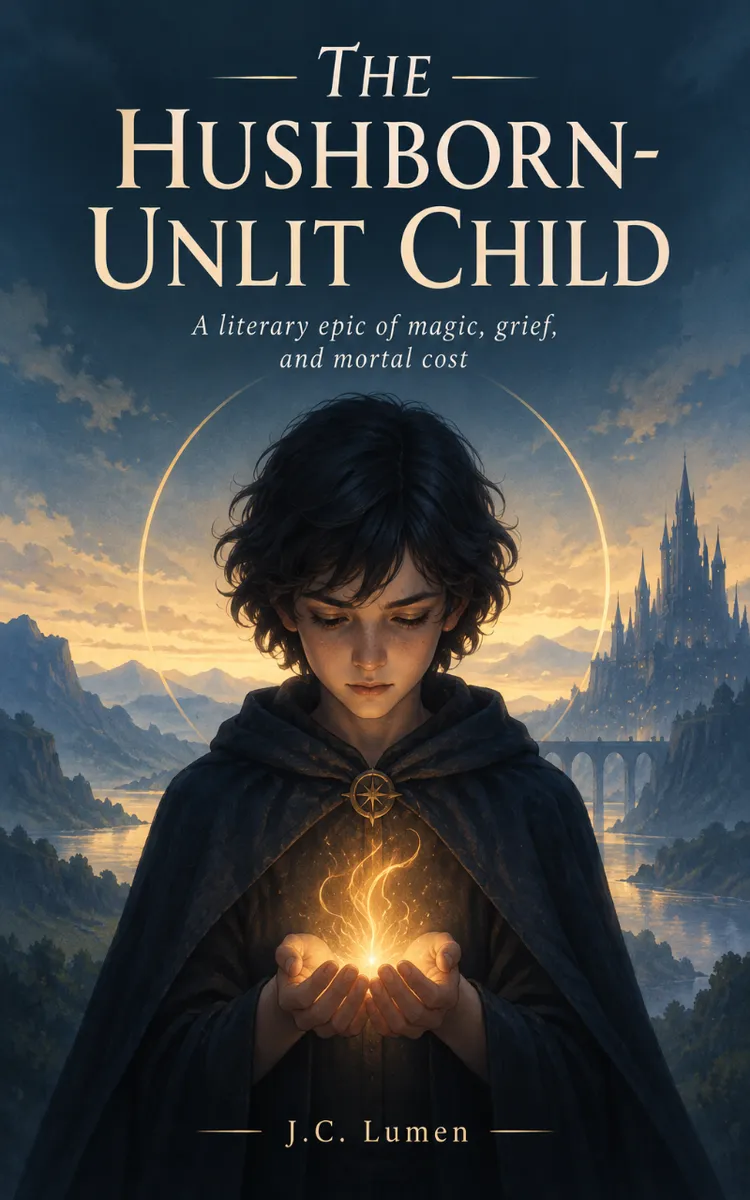
Read the first chapter
The whole of chapter one, free. About 21 min. Turn the pages with the arrows, your keyboard, or a swipe.
Chapter 1
The Kindling Goes Quiet
They had shoved out before dusk. Vell unclenched like a mouth as the ferry threaded a narrower arm of canal, warehouses sliding past with their shutters closed and the smell of frying fish and tar rising in thin bands. Maren stood at the stern with the iron pole balanced across her shoulder, a silhouette against the dying light; Teo watched the city lean away from him and tried to hold the fact of motion like a promise - that he could be moved, taken from one place to another, and not be fixed forever to the grayness that had bloomed on his palm.
He wanted two small things. To be useful and to be unseen. Both were urgent. Being useful meant learning to push the ferry without falling, to tie a proper knot, to hold a rope against the strain of the current. Being unseen meant keeping his head down when Conclave men came to the wharves, keeping his hands tucked in his sleeves, keeping the grayness from showing on the slivers of skin that showed between cuffs. Maren had hustled him aboard as if he were a crate of fish rather than a child branded by ceremony; that was his first miracle of the afternoon.
Obstacles announced themselves like tide. The orphan house had turned him out before the bell had stopped ringing for the Kindling; the matrons said the house could not shelter a thing called Unlit. Twice that week a Conclave attendant had come to the ferry landing, the hem of his robe scorched, eyes like lanternlens; once he had asked the names of all who slept aboard Maren’s ferry, the second time he had only scanned faces and left a thin paper with a ribbon seal behind a loose stone. Strangers spat in the mud when Teo walked past. Wards - small stones set into quay thresholds - fizzed and went dark when he leaned on them to rest. Maren watched each of those things with a face that said she was measuring widths and weights, not pity.
The first nights were the worst. Teo slept on a reed mat that smelled faintly of fish oil and regret. At dawn he woke with the bell of the Kindling still ringing in his teeth. He practiced pushing the pole with his knees until his palms burned, while Maren barked orders at dockhands. She made him stack crates, sweep the deck, carry tarted bundles down into the hold. She taught him how to read a tide by the sound it made against the hull. She never asked him to touch the black stone again.
Over months, other people’s endings taught him the rules of the city. In the second week after the Kindling a tragedy threaded through the canals: a merchant’s little boy had slipped off a board and been swallowed by the canal’s cold throat. Men worked all morning with hooks and curses; by noon they hauled up a small limp thing that still had the whitening blue of drowning in its fingers. The merchant wailed and sent for a licensed Ember to carry a voice - a licensed Ember Rite was small, legal theater: a mage bound to a pyre could speak the remembered cadences of a dead child so a father might kiss a voice at a distance. The Ember-caller stood on the quay with a bowl of smoldering coals. Teo watched the rites from the ferry’s shadowed deck.
The licensed mage’s hands stayed steady as he drew the drowned boy’s echo into the smoke. The man’s face shifted to something like peace as the voice filled the square, a thin, uncanny boy-voice saying a father’s name. The crowd pressed forward to hear. Then the mage fell like a burned thing - his lungs gave once and he bent double at the knees, tongue black at the corner of his mouth. Men swore and dragged him back; no one could rally the rite’s flame after that. The merchant went home carrying a voice in his ears and a son gone all the same - dead stayed dead in Calvaresh; the Ember had only traded a warmth for the silence that cannot be undone. Teo watched the hired mage die on the quay and felt a small, fierce hunger in his ribs: not for power, for meaning. The price had been paid and everything went on.
Not all prices were so public. One night Maren took him upriver where the water breathed cold and the moon cut the canal into a blade. She had a lantern slung low and her pole resting across the stern - a way of measuring trust, Teo supposed. “You did not know,” she said without looking at him, and he wanted her to say forgive. Instead she taught him a thing she probably meant herself as a warning and a map: how Hush closed the small warm blaze of a crafted flame and took from the touch some trade - sometimes warmth, sometimes color, sometimes a name you could not quite place. "It takes bits," she said. "Hushers call it the taking. We live with what it eats."
He learned what it ate the night he hush-trained under a moon so thin it seemed fake. They ran the ferry in a back channel while the city slept. Ysolde and Pell came; Maren had lured them aboard with the promise of a chance to try their Crafts away from prying Conclave eyes. Ysolde flung wind into a wake and laughed when the spray feathered her face. Pell cupped a blue wick in his palm and warmed his fingers with it like someone clinging to a hearth. Maren watched Teo as if she were a smith testing the temper of a blade.
“Try to stop it,” she said at last.
Teo hesitated. He had learned how to shut a candle with his breath when the orphan house forbid matches; this was different. He could feel the hush like a cold instrument in the back of his mouth. He reached and set his palm near Pell’s flame, meaning only to make it sputter so the boy would curse and forget he had been brave. The blue went out. The night air swallowed the smell of smoke. Pell looked surprised, then afraid.
The cost came like the thinning of a rope. Teo reached for the small routine memory of his father’s voice - how he used to say "steady" when he tuned the lamp’s wick - and the sound slipped from Teo’s mind like a coin dropped through a grate. He found himself with a hole where the shape of that syllable had been, a private blankness the size of a child's palm. He looked from Maren to Pell to Ysolde, stomach hollow with shock.
Maren’s face was small in the lantern light. “You missed it,” she said, neither accusation nor comfort. “Hush takes. It takes so you can give.”
He learned the ledger of that taking over years. It ate his certainty that his father’s laugh had ended a joke a certain way. It ate an afternoon when the two of them had sat in the lamp room drinking tea from a chipped red cup; he remembered the tea, not the cup’s color. Once it took a tiny grief and left a larger one in its place - he knew the grief belonged to a man who had been his father but the sound of the man's voice was gone, and the absence itself a new ruin. Each disappearance left him smaller and stranger in other people's eyes and made Maren quieter at dawn.
Friendship arrived like the first thaw. Ysolde’s Gale made her quick and raven-tough, the sort who could lift sails and a man’s stubbornness in the same breath. She teased him when he miscast a line in a barge race - Teo had meant to wedge a fender and instead silenced her Gale mid-course, sending a friend thumping into a piling to the crowd’s hoot and Maren's glare. Pell, who had a knack for quick temper and rekindled grudges, took the hits of the city in his belly and came back smiling, bruises like medals. They made space for him without naming why. They would not be ashamed of the word Hush nor make him less; they accepted him as an accidental and dangerous thing who could pull a light from the night and leave it dark.
The city taught cruelty as well as kindness. The Conclave’s reach showed its teeth when an inquisitor arrived at a quay to execute a family accused of hiding an Unlit child. Teo watched from the ferry as the man in a cloak of metal and prayer raised a hand and gave the word. Steel sang. A woman screamed; children were whirled away. Teo wanted to be a shadow that afternoon, wanted the ground to open and swallow him so the executioner’s blade would not fall on someone because of his silence. The men the Conclave branded as shields for Hushers did not belong to him, but the knowledge that it could have been him sat in his gut like ice. Maren's hand found his in the dark for a moment, fingers like a clamp.
Time sharpened things. By fifteen, Teo could hush a burning wick in a lantern without touching it; by sixteen, he had learned to flatten a ward-stone's song so a whole alley would go dim if he walked past. He learned restraint not because he trusted the city but because he trusted Maren, Ysolde, and Pell, who had made him swear not to hush in crowds, not to answer Conclave summons, not to hush anything where a life might hang on a spell’s breath.
Then the Blaze came.
It began as a hungry misstep - a Flame-crafter in the canal quarter trying a bold weave to warm a winterfest crowd. The weave ran wild, a torch turning into a mouth that ate wooden stalls and bunting. Men screamed and the sky filled with hot ash. The licensed Ember rites could put words into the dead but not bring the ones burned back. Flames ate a child's hair, a merchant's savings, a barge mother’s cooking hearth. Teo stood on Maren's ferry with water slapping the hull and watched the conflagration take teeth.
“Now,” whispered Ysolde.
He had not planned to act. He had planned to hide. He had planned to be unseen. But the river answered him with a cold he knew in his bones: Hush could close a flame. He reached across the minutes that split a decision. He drew the silence down like a net.
The fire stuttered. A roof fell inward and smoke flared as if in pain. The worst tongues of flame that had unmade half a warehouse knotted and died as if someone snuffed a candle. People who had been about to step into an erupting maw found their feet stalled. Ysolde shouted something that might have been his name. Pell yanked a rope and hauled a child out of a burning cart. Maren drove the ferry close and men jumped aboard, coughing and soot-streaked.
Not everyone found breath in the hush. A woman who had been caught too near the heart of the blaze lay at the quay, hands black with ash. A boy's head had been seized by smoke and did not rise. Teo watched faces as the flames died and felt the ledger close: some had been saved because he had taken the heat of the city's worst, and some lay dead because he had not been quick enough. The dead stayed dead. The city smelled of warmed bread and burning oxen and a grief that had work to do long after the flames stopped.
They floated away from ash and sirens as dawn turned the canal the color of old pewter. Maren wrapped a tarred cloth around the ferry's leaky seam and tucked paper forms into her breast as if they were both plans and prayers. That night she did not sleep, or if she did it was the sleep of a person making a map of escape routes in her head. At dawn she set a paper into Teo's hand - documents born of ink and forged signatures that might someday be real, if the Conclave let them stand. “Ashmere takes Ward-craftlings at eighteen,” she said. “You go as a Ward-crafter. They will look for Ember-blood and Gale-lines. They will not cross a poor, slow Ward boy.”
Teo held the paper like a flame. It promised belonging and a place to learn what Hush could mean and cost. It promised also that he would have to leave the ferry, leave Maren's hands that had taught him how to push against currents, leave Ysolde's laugh and Pell's scuffed knuckles. The choice settled in him: to hide forever and rot under Vell's mistrust, or to step toward the academy where Provost Hesper Laine's name had already floated like a shadow.
A courier rattled across the canal on a splintering skiff and handed the ferry a folded report: ash-stained, its margins burned where the fire had pressed too close. Provost Laine, it read in a clerk’s careful hand, had received news of a fire in the canal quarter that simply stopped. The ink underlined a single, small word: halted.
Teo looked at the paper, then at the city sliding by, its windows dully bright, its graveled alleys full of business as usual. He felt guilt coil like a rope at his throat and something else - a tight, trembling thrill - as if a door that had been shut a long time, and left him on the wrong side, might just have a hinge after all.
Maren folded the forged papers into the pocket of his coat. Her palm closed over his shoulder. “You will confess little,” she said. “You will learn to call yourself what they expect.” Her voice was a steely tool. “You will keep your Hush for when it's needed.”
He wanted to say he would never hush again. He wanted to say he would take the cost gladly if it meant saving every life. He said instead, because both things were true, “I will tell them.” He saw Ysolde's mouth shape an oath beside him and Pell’s jaw set like a man who has chosen his scars.
Provost Laine read the clerk’s return under a morning candle several canals away. For the first time in years a small, combustible hope lit behind her eyes.
They shoved out before dusk. Vell unlatched like an aching jaw as the ferry threaded a narrow arm of canal, warehouses gliding by with shutters set; tar and frying fish bled up in thin, brackish ribbons. Maren stood at the stern with her iron pole balanced across her shoulder, a dark silhouette against the dying light. Teo watched the city fall away and held the fact of motion like a promise, that he could be moved, taken from one place to another, and not be fixed forever to the grayness that had bloomed on his palm. He wanted two small mercies: usefulness, and invisibility. Both felt urgent. To be useful meant learning ropework, to tie a proper knot, to hold a line against the strain of the current; to be unseen meant keeping his head down when Conclave men came to the wharves, keeping his hands tucked into his sleeves, keeping the grayness from showing on the slivers of skin that showed between cuffs. Maren had hustled him aboard as if he were a crate of salted fish rather than a child branded by ceremony; that had been his first miracle of the afternoon.
Obstacles announced themselves like tide. The orphan house had turned him out before the bell had stopped ringing for the Kindling; the matrons explained that the house could not shelter a thing called Unlit. Twice that week a Conclave attendant had come to the ferry landing, the hem of his robe scorched, his eyes like polished lantern-lens; once he had demanded the names of all who slept aboard Maren’s boat, the second time he had simply scanned faces and left a thin paper with a ribbon seal beneath a loose stone. Strangers spat in the mud when Teo passed. Wards, small stones set into quay thresholds, fizzed and went mute when he leaned on them to rest. Maren watched each of those things with a face that measured widths and weights rather than pity.
The first nights were the most obscene. Teo slept on a reed mat that smelled faintly of fish oil and regret. At dawn he woke with the bell of the Kindling still jangling in his teeth. He practiced pushing the pole with his knees until his palms burned, while Maren fussed with ropes and barked orders at dockhands. She set him to stacking crates, sweeping the deck, carrying tarred bundles into the hold. She taught him to read a tide by the sound it made against the hull. She never asked him to touch the black stone again.
Over weeks, other people’s endings taught him the rules of the city. In the second week after the Kindling a tragedy threaded the canals: a merchant’s small boy slipped off a board and was swallowed by the river’s cold throat. Men labored all morning with hooks and curses; by noon they hauled up a pale, limp thing that still held the whitening blue of drowning at its fingers. The merchant wailed and called for a licensed Ember to carry a voice, licensed Ember rites were small, legal theater: a mage bound to a pyre could coax the remembered cadences of the dead into the smoke so a father might kiss a voice at a distance. The Ember-caller stood on the quay with a bowl of smoldering coals, and his hands remained steady as he summoned the echo. The smoke spoke a thin, uncanny boy-voice and the crowd pressed forward to hear. Then the mage fell as if struck; his lungs gave with a single convulsion and he bent double, the rim of his tongue black at the corner of his mouth. Men dragged him back; the rite’s flame would not be rallied. The merchant went home with a voice in his ears and his son gone still, death in Calvaresh was final; Ember rites traded warmth for the immutable silence of what had been lost.
Not all prices were so public. One night Maren took him upriver where the water breathed cold and the moon cut the canal into a blade. She carried a lantern slung low and rested her pole across the stern, rituals of trust, Teo supposed. “You did not know,” she said without looking at him, and he wanted her to say forgive. Instead she taught him a fact that served both as warning and map: Hush closed the small blaze of a crafted flame and took from the toucher a trade, sometimes warmth, sometimes color, sometimes a name you could not place. “It takes bits,” she said. “Hushers call it the taking. We live with what it eats.”
He learned what it ate the night Maren let them try in a back channel while the city slept. Ysolde and Pell came; Maren had lured them aboard with the promise of a chance to test their Crafts away from Conclave eyes. Ysolde flung wind into the wake and laughed when spray feathered her face. Pell cupped a blue wick in his palm and warmed his fingers with it as if holding a hearth to his chest. Maren watched Teo like a smith testing the temper of a blade. “Try to stop it,” she said at last.
Teo hesitated. He had learned to snuff a candle with his breath when the orphan house forbade matches; this was different. He felt Hush like a cold instrument at the back of his tongue. He reached and set his palm near Pell’s wick, intending only to make it sputter so the boy would curse and forget he had been brave. The blue went out. The night swallowed the scent of smoke.
The cost arrived like the thinning of a rope. He reached for the small routine memory of his father’s voice, how the man used to say steady when he tuned a lamp’s wick, and the syllable slipped from Teo’s mind like a coin through a grate. He was left with a hollow where that sound had lived, a private blank the size of a child’s palm. He looked from Maren to Pell to Ysolde, his stomach hollowed by shock. Maren’s face was small in the lantern-light. “You missed it,” she said. It was neither accusation nor comfort. “Hush takes. It takes so you can give.”
He kept a ledger of the taking as the years moved. It ate certainty, the precise cadence of his father’s laugh, the color of a chipped red cup from an autumn tea, but it left other things intact, a baffling arithmetic that made him smaller and stranger in other people’s eyes and made Maren quieter at dawn. Friendship arrived like a thaw. Ysolde’s Gale made her quick and raven-tough, able to lift sails and a man’s stubbornness in the same breath; she teased him when he miscast a line in a barge race and sent her friend thumping into a piling to the crowd’s hoot and Maren’s glare. Pell wore his quick temper like armor and came back smiling, bruises like medals. They made space for him without naming why. They would not be ashamed of the word Hush nor make him less; they accepted him as an accidental, dangerous thing who could pull a light from the night and leave it dark.
The city taught cruelty as well as kindness. The Conclave’s reach showed its teeth when an inquisitor arrived at a quay to execute a family accused of sheltering an Unlit child. Teo watched from the ferry as the man in a cloak of metal and prayer raised a hand and gave the word. Steel sang. A woman screamed; children were plucked away and the crowd was shepherded from the square. Teo wanted to be shadow that afternoon; he wanted the ground to open and swallow him so the executioner’s blade would not fall on someone because of his silence. The men the Conclave branded as shields for Hushers did not belong to him, but the knowledge that it could have been him sat in his gut like ice. Maren’s hand found his in the dark for a moment, fingers like a clamp.
Time sharpened him. By fifteen, Teo could hush a lantern wick without touching it; by sixteen, he had learned to flatten a ward-stone’s song so an alley would go dim where he walked. He learned restraint not from trust in the city but from trust in Maren, Ysolde, and Pell, who had made him swear not to hush in crowds, not to answer Conclave summons, and not to hush anything where a life might hang on a spell’s breath.
Then the Blaze came. It began as a misstep: a Flame-crafter in the canal quarter attempting a bold weave to warm a winterfest crowd. The weave ran wild, torch becoming mouth that ate wooden stalls and bunting; men screamed as hot ash rained down. Licensed Ember rites could put words into the dead but could not return the burned. Flames took a child’s hair and a merchant’s savings, a barge mother’s cooking hearth. Teo stood on Maren’s ferry with water slapping the hull and watched the conflagration unmake a roof. “Now,” Ysolde breathed. He had not intended to act; he had planned to hide, to let the city’s indifference carry him. But Hush was a tool that answered to need; he felt the river answer him with a cold he knew in his bones. He drew the silence down like a net.
The fire stuttered. A roof sagged and smoke flared as if in pain. The worst tongues of flame knotted and died as if someone snuffed a candle. People who had been about to step into an erupting maw found their feet stalled. Ysolde shouted; Pell hauled a child from a burning cart. Maren drove the ferry close and coughing, soot-streaked men leapt aboard. Not everyone found breath in the hush. A woman who had been caught too near the heart of the blaze lay at the quay, hands black with ash. A boy’s head had been seized by smoke and did not rise. Teo watched faces as the flames died and felt the ledger close: some had been saved because he had taken the heat of the city’s worst; others lay dead because he had not been quick enough. Death remained inviolate.
They floated away from ash and alarm as dawn washed the canal a pewter gray. Maren wrapped a tarred cloth around the ferry’s leaky seam and tucked paper forms into her breast as if they were both plan and prayer. That night she did not sleep, or if she did it was with the thin, mapping wakefulness of someone making escape routes in the dark. At dawn she set a folded paper into Teo’s hand, documents born of ink and forged signatures that might one day be true, if the Conclave permitted them. “Ashmere takes ward-craftlings at eighteen,” she said. “You go as a Ward-crafter. They will look for Ember-blood and Gale-lines. They will not test a poor, slow Ward boy.”
Teo held the paper like a small, dangerous light. It promised belonging and the chance to learn what Hush could mean and what price its use demanded. It promised, too, that he would leave the ferry and the hands that had taught him the sound of a tide, that he would leave Ysolde’s laugh and Pell’s scuffed knuckles. The choice settled inside him: to hide forever and rot under Vell’s distrust, or to step toward the academy where Provost Hesper Laine’s name had already floated like a shadow. A courier rattled across the canal on a splintering skiff and handed the ferry a folded report, ash-darkened at the margins. Provost Laine, the clerk’s neat hand recorded, had received word of a fire in the canal quarter that simply stopped, the ink underlined a single small word: halted.
Teo read the paper and, looking back at the city sliding by with its windows dim and its alleys full of commerce, felt two things coil in his chest: guilt, like a rope coiled at his throat, and a tight, trembling thrill, as if a long-shut door somewhere might yet have a hinge. Maren folded the forged papers into the pocket of his coat and closed her palm over his shoulder. “You will confess little,” she said with the steely surety of someone who trades in other people’s fortunes. “You will learn to call yourself what they expect.” Her voice was instrumentally blunt. “You will keep your Hush for when it’s needed.”
He wanted to tell her he would never hush again; he wanted to promise that he would take the cost gladly to save every life. He said instead, because both things were true in their different ways, “I will tell them.” He saw Ysolde shape the same oath beside him and Pell set his jaw like a man who has chosen his scars. Provost Laine read the clerk’s return by candlelight several canals away, and for the first time in years a small, combustible hope flickered behind her eyes.
End of chapter one. 7 more chapters and about 35,309 words in the full book.
Swipe or use the arrows to turn the page


What's inside: 8 chapters
- 1. The Kindling Goes Quiet
- 2. A Ferrywoman’s Bargain
- 3. The Wardhouse at Floodgate
- 4. Names Beneath the Ash
- 5. The Licensed Ember
- 6. The Lie That Breaks
- 7. The Gatehouse Silenced
- 8. The Names Left on Stone
About this book
"The Hushborn- Unlit Child" is a fiction book by J.C. Lumen with 8 chapters and approximately 35,309 words. The Kindling goes quiet, and Teo’s palm turns gray. By nightfall, the orphan house has thrown him out for being Unlit, and the Conclave is asking who knows him.
This book was created using Inkfluence AI, an AI-powered book generation platform that helps authors write, design, and publish complete books. It was made with the AI Novel Writer.
Frequently Asked Questions
What is "The Hushborn- Unlit Child" about?
The Kindling goes quiet, and Teo’s palm turns gray. By nightfall, the orphan house has thrown him out for being Unlit, and the Conclave is asking who knows him. Maren takes him aboard her ferry, where staying unseen means hiding his marked hand and staying useful means learning the river. But the Conclave’s questions follow them through rain and canal water, toward a floodgate whose broken magic still glows beneath the surface. Teo has promised to tell the truth. He has also learned that some doors do not open gently. With Ysolde and Pell beside him, Teo must decide what his forbidden power is for before the ruling order decides for him. In a city that fears the Unlit, even a small act of mercy can leave a mark.
How many chapters are in "The Hushborn- Unlit Child"?
The book contains 8 chapters and approximately 35,309 words. Topics covered include The Kindling Goes Quiet, A Ferrywoman’s Bargain, The Wardhouse at Floodgate, Names Beneath the Ash, and more.
Who wrote "The Hushborn- Unlit Child"?
This book was written by J.C. Lumen and created using Inkfluence AI, an AI book generation platform that helps authors write, design, and publish books.
How can I create a similar fiction book?
You can create your own fiction book using Inkfluence AI. Describe your idea, choose your style, and the AI writes the full book for you. It's free to start.
Write your own fiction book with AI
Describe your idea and Inkfluence writes the whole thing. Free to start.
Start writingCreated with Inkfluence AI


