
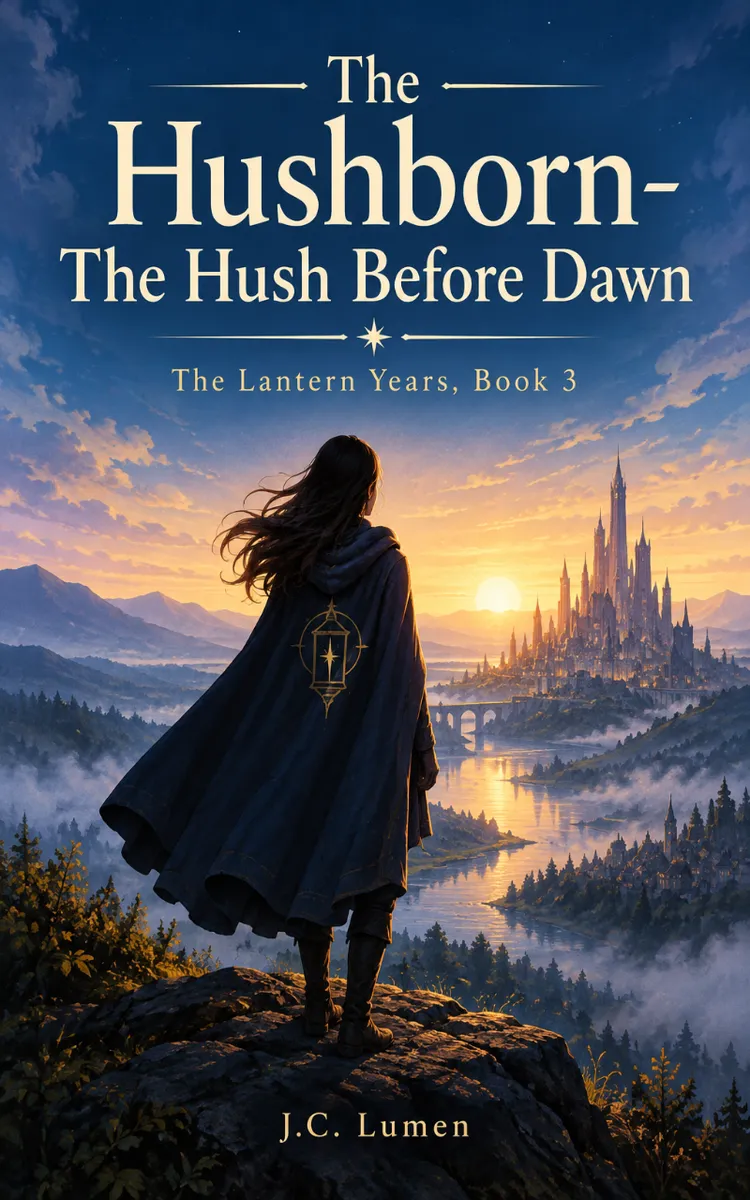
Read the first chapter
The whole of chapter one, free. About 20 min. Turn the pages with the arrows, your keyboard, or a swipe.
Chapter 1
Beyond the River’s Reach
The alder roots rose from the mud like knuckled hands, and Teo caught Ysolde by the sleeve before her boot slid between them.
“Left,” he whispered.
She jerked against his grip. “I can see the path.”
There’s no path.
Ahead, the trees thinned into gray water. The flooded woodland had swallowed the track, leaving only the tops of old marker posts above the surface. Beyond them, the causeway ran upriver beneath a skin of duckweed and broken branches. Dawn had reached the upper leaves but not the ground. Everything below remained the color of bruised iron.
Teo released her.
Pell leaned against an alder, one hand pressed to his ribs. His breath came shallowly. Iven stood beside him with Maren’s iron pole braced in the mud, his fingers closed around it as if the metal had given him an instruction he could still obey.
“We cross there,” Teo said. “The causeway should lead past the river bend.”
“Should,” Ysolde said.
He looked at her. Her hair was wet against her cheeks. Blood - Cassian’s, not hers - darkened the cuff of her coat. She had not spoken of the Ember Rite since the wardhouse. He had not apologized for stopping her. Between them, the refusal remained like a door neither could afford to open.
Pell pushed away from the tree. “If we stand here much longer, the Conclave will find us before the marsh does.”
Teo turned toward the water. He wanted them beyond the river. Not hidden for an hour, not sheltered beneath another broken wardhouse. Beyond the reach of Ashmere, beyond Laine’s lanterns and the hands that had made Iven into a living instrument. He wanted distance enough that Maren’s death would not be followed by another demand.
The first step sank to his knee.
Cold water closed over his boot and climbed beneath his trousers. He clenched his teeth, found the buried stones with his toes, and moved forward. The causeway was there, but the marsh had made a liar of its edges.
“Teo,” Ysolde called.
“I’m going.”
“You’re bleeding.”
He glanced down. A reed had cut his calf. The water carried a thin red thread away from him.
“Keep Pell between us,” he said. “Iven in the middle.”
“That was not what I said.”
“It’s what we have time for.”
She stared at him, then followed.
They crossed in single file. Pell cursed once when the mud took his boot. Ysolde caught him before he fell, and the two of them clung to one another until the ground steadied. Iven did not stumble. He moved with the iron pole held across his body, testing each submerged stone before trusting his weight to it.
Teo watched the pole strike the water.
Maren had used it to guide the ferry. Maren had used it to defend him. The facts remained clean where her face did not. He knew the shape of her hands around the iron. He knew she had died beneath the first lantern. He knew he could no longer summon the expression she had worn when she looked at him.
Iven paused.
“What is it?” Teo asked.
The older man tilted his head. “Someone has been here.”
Teo saw nothing except water, reeds, and the white undersides of drowned leaves.
“Where?”
Iven pointed with the pole. A branch lay across the causeway. Its bark was scraped pale on one side.
Pell crouched, wincing. “That could be anything.”
“Not anything,” Iven said.
Teo stepped closer. The scrape was fresh. Beneath it, a bootprint showed in the mud, narrow and deep at the heel. Another marked the far edge of the causeway. He should have noticed them before. He had been watching the water, watching Iven, watching the place where Maren’s absence kept opening inside him.
Ysolde’s voice hardened. “How many?”
Teo searched the trees. “I don’t know.”
“That answer is becoming a habit.”
He flinched, not from the words but from their accuracy.
A bird broke from the reeds. All four of them froze.
The sound passed overhead, beating toward the river. No shouts followed. No blue ward-light rose through the trees.
Pell let out his breath. “We keep moving.”
They reached the far bank and climbed through thorn and wet fern. The woodland tightened around them. Water dripped from every branch. Somewhere beyond the trees, a bell rang once, low and distant.
Teo stopped.
“That was not a marsh bell,” Ysolde said.
“No.”
The bell rang again.
Pell’s face had gone pale. “Conclave?”
“Could be a flood marker,” Ysolde said.
“It wasn’t,” Iven said.
Teo looked at him. Iven’s gaze had fixed on the river behind them. His expression held no fear, only the blank attention of a man listening to a command buried beneath pain.
“Move,” Teo said.
They left the causeway and entered thicker ground. Teo took them toward a rise between the trees, though the marsh offered no true height. Twice he lost the track. Once he led them into a pool that reached Pell’s waist. They backed out with mud sucking at their boots and water streaming from their coats.
By then the light had strengthened. In it, Teo saw the signs they had missed.
A cut reed bent toward the path. A heel mark pressed into the soft bank. Three alder branches broken at the same height, as though a mounted rider had passed beneath them.
“They’re ahead of us,” Ysolde said.
Teo touched the nearest break. The wood was still wet where it had snapped.
“Or behind,” Pell said.
“No,” Iven murmured. “Ahead.”
Teo turned. “How do you know?”
Iven looked down at the iron pole. “Maren would have taken the high ground.”
The answer struck with such force that Teo nearly laughed. It was not a memory, perhaps. It was something worse: an absence shaped like one.
A whistle sounded from upriver.
Another answered from behind them.
Pell drew the short knife from his belt. Ysolde’s hand went to the clasp at her throat, where her Tide-craft lay dormant and useless beneath exhaustion. Teo felt the old pressure in his palms, the quiet waiting there. Hush could silence a ward. It could silence a licensed Craft. It could also take something from him, and he had no certainty what remained to lose.
“Down,” he said.
They dropped among the ferns.
Blue light moved between the trunks behind them. Not lanterns. Hand-lamps, shielded and narrow. Voices carried over the water.
“Search the causeway.”
“Nothing on the bank.”
“Riders are coming from Ashmere. They’ll take the north path.”
Teo pressed his cheek to the wet earth. Mud chilled his skin. The patrol had crossed the same way they had, but the marsh had hidden the sound. He could see the edge of a Conclave cloak through the reeds.
Ysolde’s fingers closed around his wrist.
He looked at her.
Her mouth formed one word. Wait.
The patrol moved on.
For several breaths, no one shifted. Then the ground beneath Pell gave way. He dropped with a strangled cry, one leg plunging through a mat of roots into black water.
Teo seized his coat. Ysolde grabbed his arm. Together they hauled him free as the hollow swallowed a section of fern with a wet collapse.
The blue lights turned.
“Run,” Teo said.
They ran.
Branches struck his face. Pell staggered but kept moving. Iven carried the iron pole one-handed now, using it to knock aside reeds and test the ground. Behind them, voices rose. A ward flared somewhere in the trees, and the marsh answered with a crack of blue fire along the water.
Teo reached for Hush.
The flare guttered and vanished.
Pain opened behind his eyes. For one instant he saw a red cup on a table, or perhaps only the idea of one. Then it was gone.
He stumbled.
Ysolde caught him. “What did you lose?”
“Nothing.”
Her grip tightened. “Don’t lie to me.”
“Later.”
“Teo - ”
“Later!”
The word broke between them. He pulled free and kept running.
The trees ended at a narrow strip of stone half-hidden beneath reeds. A wagon stood there without horses, its boards painted the dull green of marsh water. Beside it, a figure raised a hooked pole.
“Stop,” the stranger said.
Pell nearly collided with Teo. Iven brought Maren’s iron pole up across his chest.
The stranger wore a patched coat and a hood stiff with rain. A knife hung at the hip. No Conclave mark showed anywhere, but Teo had learned what marks were worth.
“Move aside,” Teo said.
“Where to?”
“North.”
“There’s water north.”
“Then we’ll cross it.”
You’ll be under by midday.
Behind them, a blue light flashed through the trees.
The stranger glanced past Teo. “That yours?”
“No.”
“Conclave riders?”
Teo said nothing.
The marsh guide swore under their breath. “Get in the wagon.”
Ysolde stepped between them. “Why?”
“Because the road is watched and the water is deeper than it looks.”
Pell bent over, fighting for breath. “We don’t have another road.”
“That is why you’re getting in mine.”
Teo studied the wagon. Its rear boards had been cut away and replaced with a woven screen. Beneath the floor, water lapped softly. Smuggler’s work. A hidden channel, perhaps. A route built for things the Conclave did not wish to see.
The guide pointed at Iven. “He stays covered.”
“He goes where we go,” Teo said.
“I didn’t ask who he belonged to.”
“He belongs to no one.”
Something changed in the guide’s face - not trust, but recognition of the danger in the answer.
Another whistle sounded behind them, closer now.
The guide lifted the screen. “Decide.”
Teo looked at Ysolde. Her eyes were fixed on him, furious and exhausted. Pell leaned against the wagon, too pale to argue. Iven stood with the iron pole and Maren’s silence around him.
“Inside,” Teo said.
They climbed in. The guide shoved the screen down, climbed to the front, and struck the flooded path with the hooked pole. The wagon lurched forward without horses, drawn by a low current beneath the reeds. Teo felt the pull through the boards.
The Conclave patrol reached the clearing as the wagon slid into the water.
A blue bolt struck the screen. The woven reeds flashed, blackened, and held.
Ysolde stared at Teo through the dim interior. “You knew this was a smuggler’s route.”
“I guessed.”
“You guessed with all of us inside it.”
“It was that or the patrol.”
Pell gave a weak laugh. “I vote for the route.”
The wagon passed beneath a curtain of willow roots. Darkness folded over them. Water tapped against the hull. Teo crouched beside Iven, who still held the iron pole across his knees.
“How far north?” Teo asked the guide.
“Far enough that Ashmere’s bells won’t reach.”
“Is it safe?”
The guide laughed once, without humor. “Nothing upriver is safe.”
The wagon emerged into a hidden channel. Ahead, stone rose from the marsh in a narrow, ancient line: a causeway concealed beneath reeds and black water. Lanterns had been shuttered along its length. At the far end, figures waited beside a low gate.
Teo felt the first easing in his chest. Not relief. Never that. But direction.
Then the guide looked back through the screen.
“Listen carefully,” they said. “The Conclave is already searching upriver. They have riders at the old locks, attendants in the villages, and a woman in a black mantle asking after a Husher boy.”
The water carried them toward the hidden causeway.
Teo tightened his hand around the edge of the wagon.
“Then take us farther,” he said.
The guide’s eyes held his. “I can take you to people who hide what the Conclave steals. After that, boy, the marsh will decide what you are worth.”
Alder roots rose from the mud like knuckled hands. Teo caught Ysolde’s sleeve before her boot found the gap. “Left,” he whispered.
She jerked back. “I can see the path.”
“There is no path.” The trees thinned into gray water. The flooded wood had claimed the track, leaving only the tops of marker posts above the surface. Beyond them, the causeway ran upriver beneath a film of duckweed and broken branches. Dawn had climbed the upper leaves but not the ground; everything below was the color of bruised iron.
Teo let go. Pell leaned against an alder, one hand pressed to his ribs; his breath was shallow. Iven stood with Maren’s iron pole braced in the mud, fingers curled as if the metal still gave orders.
“We cross there,” Teo said. “The causeway should take us past the bend.”
“Should,” Ysolde said. Her hair clung wet to her cheek; a dark smear, Cassian’s blood, not hers, stained her cuff. She had not mentioned the Ember Rite since the wardhouse. He had not apologized for stopping her. Between them the refusal hung like an unopened door.
Pell pushed away from the tree. “If we dawdle, Conclave finds us first.”
Teo faced the water. He wanted distance, beyond Ashmere’s reach, beyond Laine’s lanterns, beyond the hands that had turned Iven into an instrument. He wanted enough space that Maren’s death would not be answered by another demand.
His first step sank to the knee; cold water crept under his trousers. He clenched his jaw, found the buried stones with his toes, and went on. The causeway was there, but the marsh had falsified its edges.
“Teo,” Ysolde called. “I’m going.”
“You’re bleeding.” A reed had nicked his calf; the water carried a red thread away. “Keep Pell between us. Iven in the middle.”
“That wasn’t what I said.”
“It’s what we have time for.”
She stared, then followed. They crossed single file. Pell cursed when mud sucked a boot; Ysolde caught him and they clung until solid ground steadied them. Iven moved steady and spare, the pole across his body, testing every submerged stone. Teo watched the pole strike the water. Maren had guided ferries with that pole, defended him with it. Facts stayed clear where her face would not. He could name the shape of her hands on the metal; he knew she had died beneath the first lantern. He could not summon the expression she held when she looked at him.
Iven stopped. “Someone’s been here.”
Teo saw only reeds and drowned leaves. “Where?”
Iven pointed. A branch lay across the causeway, bark scraped pale. A heelprint pressed deep. Another marked the far edge. He should have noticed earlier; he had watched the water, watched Iven, watched the hollow Maren left inside him.
“How many?” Ysolde asked.
“I don’t know,” he said.
“That answer’s becoming a habit.”
He flinched at its truth. A bird broke from the reeds; they froze. No shouts, no ward-light. Pell exhaled. “We keep moving.”
They climbed the far bank through thorn and wet fern. The woodland tightened and water dripped from every branch. A bell rang somewhere low and distant.
“That wasn’t a marsh bell,” Ysolde said.
“No.” The bell rang again. Pell paled. “Conclave?”
“Could be a flood marker,” Ysolde offered.
“It wasn’t,” Iven said, staring at the river with the blank focus of a man listening to a command beneath pain. “Move,” Teo ordered.
They left the causeway toward thicker ground. Twice he lost the track; once they backed out of a pool that reached Pell’s waist, mud clinging and cold. Light strengthened and revealed the signs: a cut reed bent toward the path, a heel mark, three alder branches snapped at the same height as if a rider had passed.
“They’re ahead,” Ysolde said.
“Or behind,” Pell countered.
“No,” Iven murmured. “Ahead.”
“How do you know?” Teo asked.
Iven looked at Maren’s pole. “She would have taken the high ground.”
The answer hit with a clarity like grief, maybe not memory, but an absence shaped like one. A whistle sounded upriver; another answered behind them. Pell drew his knife. Ysolde’s hand brushed the clasp at her throat where Tide lay exhausted. Teo felt Hush sit in his palms: a quiet that could unmake a ward and take something from him he could ill afford to lose.
“Down,” he breathed.
They flattened into ferns. Blue light slipped between trunks, hand-lamps, narrow and shielded. Voices moved over the water: “Search the causeway.” “Nothing on the bank.” “Riders coming from Ashmere. They’ll take the north path.” Teo pressed his cheek to cold earth. He could see a Conclave cloak’s edge through reeds.
Ysolde’s fingers closed on his wrist and mouthed Wait. The patrol moved on. For a few breaths nothing shifted.
Then the ground swallowed Pell. He dropped with a strangled cry, one leg gone through roots into black water. Teo hauled him free as the hollow ate a section of fern.
“Run,” he snapped.
They ran. Branches stung his face. Pell faltered but kept pace. Iven carried the pole one-handed, knocking aside reeds and testing the ground. Behind, voices rose; a ward flared in the trees and the marsh answered with a streak of blue fire along the water. Teo reached for Hush. The flare guttered and vanished. Pain opened behind his eyes; for a moment he saw a red cup on a table, or only the notion of one, then it slid away. He stumbled. Ysolde steadied him.
“What did you lose?” she demanded.
“Nothing.”
Her grip went harder. “Don’t lie.”
“Later.”
“Teo, ”
“Later!” He broke free and ran.
The trees ended at a narrow strip of stone half-hidden beneath reeds. A wagon waited without horses, its boards painted marsh-green. A figure raised a hooked pole. “Stop,” the stranger said.
Pell nearly collided with Teo. Iven lifted Maren’s pole across his chest. The stranger’s coat was patched, the hood stiff with rain; a knife hung at the hip. No Conclave mark. “Move aside,” Teo said.
“Where to?”
“North.”
“There’s water north.”
“Then we’ll cross it.”
You’ll be under by midday.
A blue light flashed through the trees. The guide glanced past Teo. “That yours?”
“No.”
“Conclave riders?”
Teo said nothing. The guide swore. “Get in the wagon.”
Ysolde bristled. “Why?”
“Because the road’s watched and the water deeper than it looks.”
“We don’t have another road,” Pell said.
“Then you’re getting in mine.”
Teo examined the wagon: a woven screen replaced its rear boards, and beneath the floor water lapped, smuggler’s work. The guide pointed at Iven. “He stays covered.”
“He goes where we go,” Teo said. “I didn’t ask who owns him.”
“He belongs to no one.”
Recognition, or at least a reckoning of danger, crossed the guide’s face. Another whistle answered closer. The guide lifted the screen. “Decide.”
Teo looked at Ysolde. Her eyes were furious and exhausted. Pell leaned, too pale to argue. Iven stood with the iron pole, Maren’s silence about him.
“Inside,” Teo said.
They climbed in. The guide dropped the screen, struck the path with the pole, and the wagon lurched forward, drawn by a low current beneath the reeds. The Conclave patrol reached the clearing as the wagon slid into water. A blue bolt struck the screen; the woven reeds blackened but held. Ysolde stared through the dim. “You knew this was a smuggler’s route.”
“I guessed.”
“You guessed with all of us in it.”
“It was that or the patrol.”
Pell gave a weak laugh. “I vote for the route.”
Darkness folded over them as they passed under willow roots; water tapped the hull. Teo crouched beside Iven, who still gripped the pole across his knees. “How far north?” he asked.
“Far enough that Ashmere’s bells won’t reach,” the guide replied.
“Is it safe?”
The guide laughed, flat. “Nothing upriver is safe.”
Stone rose from the marsh: an old causeway hidden beneath reeds and black water. Lanterns along it had been shuttered. Figures waited at a low gate. Teo felt the first easing, not relief, but direction.
The guide peered through the screen. “Listen. The Conclave’s searching upriver. They have riders at the old locks, attendants in villages, and a woman in a black mantle asking after a Husher boy.”
The water carried them toward the hidden causeway. Teo tightened his hand on the wagon’s edge. “Then take us farther.”
The guide met his gaze. “I can take you to people who hide what the Conclave steals. After that, boy, the marsh will decide what you’re worth.”
The wagon slid into a narrow channel and the marsh swallowed their sounds. Through the screen the world narrowed to reed and water, the outside light riffling like a coin on the wet boards. Teo kept his hand braced on the wagon’s edge, palms rough against damp wood. The patrol’s blue flares had gone; only the sound of water under the hull and the guide’s breathing threaded the dark.
They moved until the guide’s hooked pole scraped over a submerged lip. The wagon eased into a broad hollow where low huts clustered on stilts and skiffs lay like sleeping things. The people there did not answer to houses or convents. Their fires were small and shielded; their lamps, when lit, were hidden beneath iron lids. The marsh held them in a close knuckle.
A woman came forward from the nearest hut. Her face was plain and lined, salt-riddled scars mapped along her jaw. She watched them as a feral dog watches a stranger, alert to hunger and risk both.
“You bring children?” she asked without ceremony.
Teo felt Ysolde’s fingers slip into his beneath the screen. He nodded. “We have twelve on a salt island. We brought three.”
The woman’s mouth flattened. “Laine’s dogs have been sniffing for hushers. You’re courting a pyre with that lot.”
“We’re not looking for trouble,” Ysolde said. Her voice was even, worn thin by exhaustion. “We’re trying to keep them alive.”
Alive’s what we keep, if you pay the toll. She spat once and wiped her hand on her skirt. “You have anything to trade besides promises? Names, coins, craft?”
Teo’s hands felt empty. He had no coin, no title, no papers that meant safety. He had a power that people feared and a promise he could not break. He thought of Maren’s iron pole in Iven’s hands, of the ledger they had found at the pumping station, of the burned frames. He thought of the watchwoman’s ledger and the black waxed cylinder with the broken circle stamped on it; he thought of Ithrae and the thousand-year seal that held the dead from rising. That was not trade the marsh recognized. It was danger.
“You listen,” the guide said quietly. “If Laine wants a Husher, she’ll look for any trail. She’s not subtle when she wants what she wants. You’ll need better shelter than a salt island and friends who understand what Hush does.”
“Then tell us where,” Pell said, voice thin. He had gone paler during the ride; his breath caught like a trapped bird.
The woman considered them. She asked no names, only measured them by the way they stood and the weight in their eyes. “There’s a hollow two tides upriver where the old mill used to be. The Varres keep a hand there, less zeal, more coin. Show them the Varre token,” she said, and produced a small iron medallion, its surface pitted and threaded with old green. “It’ll open some doors. Not all.”
Ysolde’s thumb brushed the medallion as if she could transfer steadiness by touch. “We need routes and a place to rest until the children are safe,” she said.
“You’ll get a place if you work,” the woman said. “We’ll feed you for labor. We trade favors and information here. The Conclave buys silence, but they can’t buy the marsh.”
Teo thought of the ledger’s list of burned names, of Laine’s plan to weaken the Threshold by making Hushers into fuel. The thought made his hands itch with a hatred that burned like cold iron. If Laine burned them to open Ithrae’s seal, she would unmake death itself for her purpose. No ledger could excuse that.
That night, Teo watched the children from the doorway of the hut. They slept in bundles beneath woven mats, limbs tangled together to keep warmth; the youngest sucked a thumb in his sleep, dreaming perhaps of being unclaimed. Teo remembered Maren teaching him to push a pole through river water until it found the stone beneath. He wanted to teach them that, to give them a skill they could use against the marsh and the Conclave both.
In the dark, Ysolde came to him. “We stay,” she said simply.
He wanted to argue: that staying meant more risk, that they had no claim to run a refuge. Instead he nodded. The weight of the decision settled into the place between his ribs. He would not leave the children to a fate of ledger and flame.
Before dawn the guide handed him a scrap of folded paper. On it was a place, “Old Mill, Varre hand”, and an address scrawled in a careful hand. “Show this,” the guide whispered. “The Varres will put you through the locks if you can trade coin or work. They hate the Conclave in their own way.”
Teo tuck the scrap into his jacket as if it were a vow. Outside, a thin bell rang upriver. The sound threaded the reeds and found his skin. He thought of Maren’s iron pole and how Iven held it like a memory. He thought of Pell and his laugh before the fall. He thought of Laine and the ledger full of names burned to ash. The Conclave would come. He could only make sure the marsh held enough secrets to hide them, long enough to gather allies.
He rose and stepped out into the gray morning. Dawn slid a cold finger along the water. He felt less like a boy dragged by circumstance and more like someone who had chosen to stand between a ledger and the children counted on it. He tightened his grip on the empty promise he carried, and walked toward the thatch where plans would be made.
End of chapter one. 7 more chapters and about 46,435 words in the full book.
Swipe or use the arrows to turn the page


What's inside: 8 chapters
- 1. Beyond the River’s Reach
- 2. The Children Taken North
- 3. Hands That Remember
- 4. The Seal’s Burning
- 5. Orrel’s Costly Bargain
- 6. The Bridge Pell Held
- 7. The Threshold Refused
- 8. The Child’s Failing Flame
About this book
"The Hushborn- The Hush Before Dawn" is a fiction book by J.C. Lumen with 8 chapters and approximately 46,435 words. Teo can kill a ward with Hush. He cannot choose what the magic takes from him.
This book was created using Inkfluence AI, an AI-powered book generation platform that helps authors write, design, and publish complete books. It was made with the AI Novel Writer.
Frequently Asked Questions
What is "The Hushborn- The Hush Before Dawn" about?
Teo can kill a ward with Hush. He cannot choose what the magic takes from him. In the northern marshes, the Conclave is hunting him and the children stolen north. Teo leads them through flooded woods and abandoned saltworks, teaching them to cross without bending a reed or leaving a sign. Ysolde walks beside him with Cassian’s blood on her coat and the Ember Rite still between them. Pell is wounded. Maren’s iron pole is all Teo has left of a woman whose face he cannot remember. But keeping the children hidden is only the first danger. A woman plans to break Ithrae’s seal with Teo’s life, and the people he must protect may be bound to the same power he fears. Every use of Hush leaves a cost. The marsh offers no safe road, only the next crossing.
How many chapters are in "The Hushborn- The Hush Before Dawn"?
The book contains 8 chapters and approximately 46,435 words. Topics covered include Beyond the River’s Reach, The Children Taken North, Hands That Remember, The Seal’s Burning, and more.
Who wrote "The Hushborn- The Hush Before Dawn"?
This book was written by J.C. Lumen and created using Inkfluence AI, an AI book generation platform that helps authors write, design, and publish books.
How can I create a similar fiction book?
You can create your own fiction book using Inkfluence AI. Describe your idea, choose your style, and the AI writes the full book for you. It's free to start.
Write your own fiction book with AI
Describe your idea and Inkfluence writes the whole thing. Free to start.
Start writingCreated with Inkfluence AI


