
Read the first chapter
The whole of chapter one, free. About 8 min. Turn the pages with the arrows, your keyboard, or a swipe.
Chapter 1
The Viral Slang That Sticks
When a Joke Starts Acting Like Evidence
In 2023, Oxford Languages chose “rizz” as its Word of the Year, a decision that made a strange fact visible: a word can move from a small online community into global conversation before many people agree on what it means. “Brain rot” followed a similar path. It was not invented by a medical board or introduced through a public campaign. It spread through posts, videos, captions, ironic complaints, and repeated recognition.
The phrase now does several jobs at once. It can describe hours spent watching low-effort clips, the sensation of having a mind crowded with fragments, or the deliberately absurd language of internet culture itself. That flexibility helps it travel. Each use gives the phrase a slightly different shape while preserving enough of its original meaning for people to recognize it.
The puzzle goes beyond popularity. It is why familiarity can begin to feel like proof.
When does a repeated joke become a description of reality?
The Phrase Finds Its First Crowd
“Brain rot” is older than the platforms that made it famous. Writers have long described mental dullness as a consequence of excessive comfort, passive entertainment, or intellectual neglect. The modern phrase appeared in earlier online communities, where it could refer to an obsessive interest, a fandom, or the condition of consuming too much trivial material. Its meaning was loose from the beginning.
That looseness became an advantage when short-form video platforms expanded. A phrase does not need a precise definition to become useful online. It needs to be compact, recognizable, and adaptable to many situations. “Brain rot” could sit beneath a clip of repetitive dancing, a montage of gaming jokes, a string of surreal images, or a confession about watching videos long after intending to stop. The same two words could signal criticism, amusement, embarrassment, or belonging.
Memes spread less like official announcements than like conversational habits. One person uses a phrase because it captures an experience. Another repeats it because the first use was funny. A third adopts it because everyone else seems to understand it already. The phrase gains social value before it gains analytical clarity.
This is the beginning of the Meme-to-Meaning Loop. A label appears to describe a behavior; the label is repeated because it is memorable; repetition makes the label familiar; familiarity makes it easier to apply to new examples. Eventually, the label seems to reveal a pattern that its own circulation helped create.
The loop is not necessarily deceptive. People may genuinely be noticing changes in attention, entertainment, and conversation. But the route from observation to conclusion is rarely as clean as it feels.
How Repetition Manufactures Familiarity
Human beings are unusually responsive to repeated information. A statement encountered several times can feel easier to process, and ease of processing is often mistaken for truth. Psychologists call this the illusory truth effect. It does not require a person to believe a claim consciously or completely. Repetition simply reduces the mental friction surrounding it.
Online platforms are built from repetition. A phrase appears in a video, then in comments, then in a reaction, then in a headline discussing the phrase itself. The viewer may encounter the same idea from different people and in different formats, yet the underlying message remains similar: modern media is damaging our minds; attention is deteriorating; people are becoming unable to concentrate.
The repeated phrase begins to feel like a measurement. “Everyone is saying brain rot” quietly becomes “everyone is experiencing brain rot,” and then “brain rot is spreading.” Those are different claims. The first concerns language. The second concerns behavior. The third concerns a population-level condition. Online conversation can slide between them without marking the change.
A useful comparison is weather language. If people in one town repeatedly say that the air feels heavy, their reports may point toward humidity, pollution, or simply a run of uncomfortable days. But the phrase “heavy air” is not itself a reading from an instrument. It is a shared description, and its popularity may reflect both real conditions and the fact that the description is vivid.
The same distinction matters here. A popular term can be a cultural signal without being a clinical diagnosis. It may tell us what people fear, notice, or find funny. It does not, by itself, tell us how widespread a measurable impairment is.
One concise way to put it is this: the internet can make a metaphor look like a trend line.
That is the counterintuitive finding. The more widely “brain rot” circulates, the easier it becomes to mistake the visibility of the phrase for evidence of the condition it names. This matters because language does not merely report experience; it organizes experience. Once people learn the label, they may begin interpreting ordinary distraction, boredom, or overuse through it. The phrase becomes both a lens and a count of how many people are looking through that lens.
From Private Habit to Public Meme
The phrase gained particular force through the culture of short-form video. Platforms such as TikTok, YouTube Shorts, and Instagram Reels reward rapid shifts, recognizable formats, and content that can be understood almost immediately. A viewer may move from a cooking clip to a gaming edit to a celebrity joke without any visible boundary between them. The stream has no natural conclusion. One video supplies the reason to watch the next.
That structure helps explain why “brain rot” works as a meme. It describes not one type of content but the feeling produced by an endless sequence of content. The phrase can point to the material itself, the user’s behavior, or the uneasy awareness that both are connected.
Online culture churns out new vocabulary at breakneck speed. Terms such as “skibidi,” “sigma,” and “gyatt” have circulated through videos, remixes, schoolyards, news coverage, and adult attempts to decode them. Some are used sincerely; others are repeated precisely because they sound ridiculous. Meaning becomes layered. A word can be funny because it is meaningful to one group, meaningless to another, and overexplained by a third.
When journalists, parents, teachers, and researchers repeat “brain rot,” they may be trying to describe this environment from outside it. Their use gives the phrase new authority, but it also changes the meme. A playful label becomes a headline. A headline becomes evidence that the phrase is culturally important. The phrase then appears in more headlines.
This is the Meme-to-Meaning Loop operating in public. Online users produce the expression. Institutions notice it. Institutional attention confirms that it matters. The public encounters the confirmed phrase again, now carrying a heavier implication. What began as slang can return as a warning.
History offers many precedents. “Video game addiction,” “couch potato,” and “junk food” each linked a form of consumption to a concern about passivity or excess. The vocabulary changed as the technology changed, but the underlying cultural question remained: what happens when entertainment becomes easier to access than effortful alternatives?
“Brain rot” sounds newer because its objects are newer and its circulation is faster. Yet its emotional structure is familiar. It combines pleasure with suspicion, participation with embarrassment. People use the phrase while continuing to watch the material it describes, which gives it an unusual credibility. It is not merely an accusation aimed at strangers. It is often a confession made in public.
The Person Behind the Phrase
In 2024, the Oxford Word of the Year discussion placed “brain rot” in a setting far removed from its meme origins. Oxford Languages described the phrase as referring to a perceived deterioration of mental or intellectual state, especially from overconsumption of trivial online content. The announcement did not prove that a new epidemic existed. It showed that the phrase had become legible across a broad public.
That distinction is easy to miss because word-of-the-year announcements feel official. They turn a scattered collection of posts into a cultural object. Readers may reasonably conclude that if a language institution has selected the term, the underlying problem must be established. But the selection measures linguistic prominence, not neurological damage.
The public life of the phrase can be seen in ordinary places: a student using it to describe a night of scrolling, a teacher hearing it in a classroom, a parent repeating it after encountering a news story, or a creator placing it in a caption to signal self-awareness. None of these uses is identical. Together, they give the phrase its reach.
Someone saying “I have brain rot” is often not making a medical claim. They may be describing the strange aftereffect of a long session spent moving between clips: a mind full of sounds, references, and unfinished impressions, but short on any clear memory of what was watched. The phrase compresses that experience into two words.
That compression is socially powerful. It allows strangers to recognize one another without explaining the entire sequence. It also hides important differences. A few hours of compulsive viewing, a persistent sleep problem, a mood disorder, and ordinary fatigue can all be placed under the same label. The meme creates connection, but it can flatten the evidence.
What the Loop Leaves Behind
The spread of “brain rot” reveals a recurring feature of human nature: we often discover a condition and construct the language for it at the same time. A phrase can gather scattered sensations into a shared story, making private unease visible. But once the story becomes popular, it can influence what people notice and how they describe it.
That does not make the concern imaginary. It makes the evidence harder to read. The popularity of “brain rot” may reflect changing media habits, anxiety about attention, generational conflict, or the pleasure of naming an experience that was previously vague. It may reflect all of these at once.
A meme can begin as a joke, become a confession, and end as a public question. The words do not settle whether society is facing a health crisis. They show that many people have begun asking what constant repetition is doing to the mind - and whether the repetition itself is part of the answer.
End of chapter one. 7 more chapters in the full book.
Swipe or use the arrows to turn the page


What's inside: 8 chapters
- 1. The Viral Slang That Sticks
- 2. Attention Markets and the Dopamine Loop
- 3. When “Screen Time” Becomes a Diagnosis
- 4. The Attention Detox Reality Check
- 5. The “Scroll Hangover” Symptom Map
- 6. Why Algorithms Feel Like Mind Reading
- 7. The Public Health Threshold Debate
- 8. Building a Curiosity-First Default
About this book
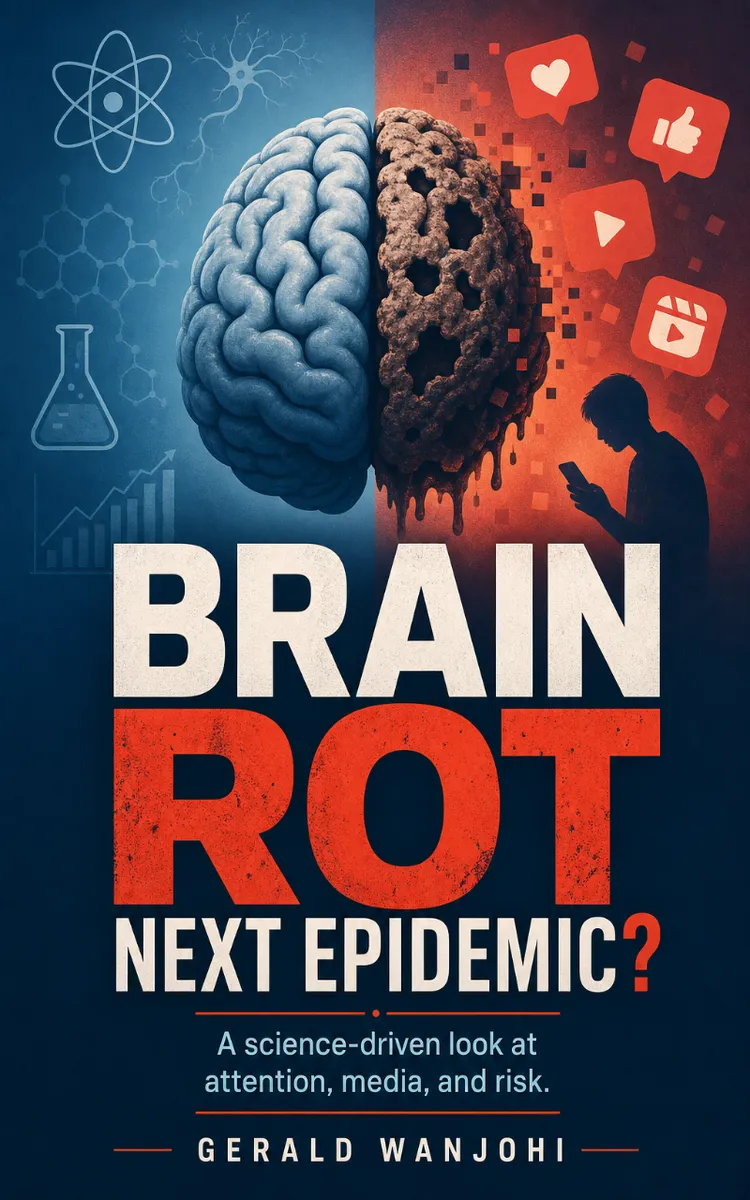
"Brain Rot Next Epidemic?" is a curiosity book by Gerald Wanjohi with 8 chapters and approximately 14,118 words. Exploring whether “brain rot” is an emerging public health risk.
This book was created using Inkfluence AI, an AI-powered book generation platform that helps authors write, design, and publish complete books.
Frequently Asked Questions
What is "Brain Rot Next Epidemic?" about?
Exploring whether “brain rot” is an emerging public health risk
How many chapters are in "Brain Rot Next Epidemic?"?
The book contains 8 chapters and approximately 14,118 words. Topics covered include The Viral Slang That Sticks, Attention Markets and the Dopamine Loop, When “Screen Time” Becomes a Diagnosis, The Attention Detox Reality Check, and more.
Who wrote "Brain Rot Next Epidemic?"?
This book was written by Gerald Wanjohi and created using Inkfluence AI, an AI book generation platform that helps authors write, design, and publish books.
Write your own curiosity book with AI
Describe your idea and Inkfluence writes the whole thing. Free to start.
Start writingCreated with Inkfluence AI


