
Read the first chapter
The whole of chapter one, free. About 6 min. Turn the pages with the arrows, your keyboard, or a swipe.
Chapter 1
Choosing a Weight-Loss Identity
The Moment You Decide Who You Are
What do you call yourself when you reach for takeout after a long day? A person who is “bad at dieting”? Someone who “always quits”? Or simply someone who hasn’t yet learned how to make a different choice feel normal?
It’s 8:17 p.m. You’ve eaten reasonably well all day, but work ran late, your feet hurt, and the kitchen feels like one more task waiting to judge you. You open a delivery app. The old thought arrives almost automatically: “I’ve already blown today, so it doesn’t matter.” One meal becomes a weekend. Monday becomes another fresh start.
The real struggle isn’t only what’s on the plate. It’s the story underneath the choice.
If your identity keeps saying “this is just who I am,” how can your habits become something new?
From “I’m Trying” to “This Is What I Do”
Old Belief: I need to lose weight first, then I’ll become the kind of person who eats well and stays consistent.
New Reality: I become that person by practicing small choices that prove my new identity before the result appears.
Weight loss often feels like a test you’re waiting to pass. Until the scale changes, you may not believe you’re disciplined, healthy, or capable. That puts your confidence at the mercy of a number. When the number moves slowly, your identity slips back into its old shape.
A stronger approach is to reverse the order. Instead of asking, “What would help me lose weight today?” ask, “What would a person who takes care of their body do next?” The answer doesn’t need to be dramatic. It might be filling a water bottle before leaving for work, ordering grilled food with a side of vegetables, or stopping after one serving because you’re satisfied.
This is the Identity-to-Action Loop. Your identity influences your action, and your action gives your identity evidence. One healthy lunch doesn’t transform your body, but it does send a message: “I’m someone who can make a thoughtful choice at lunch.” Repeated messages become believable.
Notice the difference between saying, “I’m trying to eat less sugar,” and saying, “I’m learning to be someone who doesn’t use sweets to handle every stressful afternoon.” The second statement leaves room for imperfect days while still pointing you toward a clear kind of person.
How Your Old Identity Keeps Taking the Wheel
Your habits aren’t random. Many of them are attached to labels you’ve repeated for years. “I’m a night eater.” “I have no willpower.” “I need a huge dinner.” “I can’t say no when people offer food.” These phrases may sound harmless, but the brain treats repeated descriptions as instructions.
When you call yourself a person who always quits, quitting feels like confirmation rather than failure. When you call yourself a person who protects their energy, turning down a second commitment - and the fast food that comes with it - can feel like self-respect. The action changes because the meaning changes.
Look for the pattern in these signs:
1. You make choices according to your past instead of your intention. You say, “I always eat this way,” before you’ve even looked at the menu or checked your hunger.
2. One imperfect choice turns into a full surrender. A slice of cake becomes proof that the whole day is ruined, because your identity still depends on being perfect.
3. You wait to feel motivated before acting like your future self. If motivation doesn’t show up, the healthier choice gets postponed until Monday, next month, or some imaginary calmer season.
4. You hide healthy choices because they don’t feel like “you” yet. You may feel awkward ordering differently around friends, as if your usual meal is part of your social identity.
The shift is not about pretending you’re already a completely different person. It’s about giving yourself a believable identity to practice.
Your identity becomes believable when your actions give it evidence.
Start with language that is both honest and forward-moving. “I’m becoming someone who plans breakfast.” “I’m learning to stop eating when I’m comfortably full.” “I’m a person who can recover at the next meal.” These statements don’t demand perfection. They create a direction your choices can follow.
Questions That Make the New Identity Real
1. What label do you use when you explain your eating habits to yourself? Write the exact phrase, even if it’s uncomfortable. Then soften it into a statement that leaves room for change, such as, “I’ve relied on food when stressed, and I’m learning other ways to respond.”
2. What would your healthier identity do during your most predictable difficult moment? Be specific. If your hardest moment is arriving home hungry at 6:30 p.m., your answer might be, “She eats the prepared meal before opening the delivery app,” or, “He has a planned snack so dinner doesn’t become frantic.”
3. Which choice would feel like a small vote for the person you want to become? Choose something visible and manageable. Drinking water before your afternoon coffee, putting vegetables on your plate first, or taking a ten-minute walk all count because they create evidence.
4. Where are you demanding proof before you allow yourself to claim progress? If you’re waiting for a certain weight, clothing size, or compliment, notice the cost. You can acknowledge, “I’m becoming more consistent,” while your body is still changing.
5. What identity are you afraid to adopt because people might notice? Perhaps ordering a different meal feels like announcing that you’re trying to lose weight. You don’t owe anyone a speech. A simple “I’m choosing what will help me feel good tonight” is enough.
Answer these in writing, not only in your head. A phone note titled “The Person I’m Practicing Becoming” works well. Written words are easier to revisit when the old identity gets loud.
The Seven-Day Identity-to-Action Challenge
Challenge: Collect Seven Days of Evidence
For the next seven days, practice one identity statement and connect it to one daily action. Keep the action small enough that you can do it on a busy day.
• Choose one statement: “I’m someone who plans ahead,” “I’m someone who eats until satisfied,” or “I’m someone who returns to healthy choices quickly.” - Write it at the top of a note on your phone. - Each morning, choose one action that supports it. For “I plan ahead,” pack a snack or decide dinner before work. - When the difficult moment arrives, pause for ten seconds and ask, “What would support the identity I’m practicing?” - Record the action with a simple check mark and one sentence about how it felt. - If you miss a day, restart at the next decision. Do not wait for Monday.
Expected difficulty: Medium
You’ll know it’s working when:
• You catch yourself using identity-based language instead of harsh labels. - A healthy action feels less like punishment and more like a normal choice. - You recover from an off-plan meal without declaring the day lost. - You notice at least one moment when you choose before acting on autopilot. - Your identity statement feels slightly more believable than it did on day one.
The goal isn’t to perform a perfect week. The goal is to gather evidence. Seven small actions may not create a visible physical transformation yet, but they can weaken the old story that you never follow through.
Let Your Choices Prove Who You Are
You don’t have to feel like a healthy person before you act like one; the feeling grows from the evidence your actions create.
• Your identity shapes the choices that feel natural. - Small actions can become proof of a new, believable self-image. - Honest language is more useful than harsh labels or fake certainty. - The Identity-to-Action Loop turns daily decisions into steady confidence. - A missed choice is information, not a permanent verdict about who you are.
The next time you stand in the kitchen tired and hungry, you won’t need to become perfect. You’ll only need to make one choice that supports the person you’re practicing becoming. That choice gives you evidence. The evidence strengthens your identity. And from there, healthier actions begin to feel less like a performance - and more like your life.
End of chapter one. 19 more chapters in the full book.
Swipe or use the arrows to turn the page


What's inside: 20 chapters
- 1. Choosing a Weight-Loss Identity
- 2. Breaking the All-or-Nothing Mindset
- 3. Defeating Emotional Eating Triggers
- 4. Designing Your Non-Negotiable Routine
- 5. Using the Hunger Scale Correctly
- 6. Building a Calorie Budget You Can Keep
- 7. Mastering Protein for Satiety
- 8. Carb Timing That Helps Your Goals
- 9. Fats Without Fear: The Smart Portions
- 10. The 80/20 Plate for Real Life
- 11. Meal Prep That Doesn’t Kill Motivation
- 12. Tracking Without Obsessing
- 13. Walking for Fat Loss Consistency
- 14. Strength Training to Protect Your Body
- 15. Sleep and Cravings: The Missing Lever
- 16. Stress-Proofing Your Eating Decisions
- 17. Social Eating Without Losing Control
- 18. Handling Plateaus With Smart Adjustments
- 19. Building Boundaries Without Guilt
- 20. Designing Your Forever Weight-Loss Plan
About this book
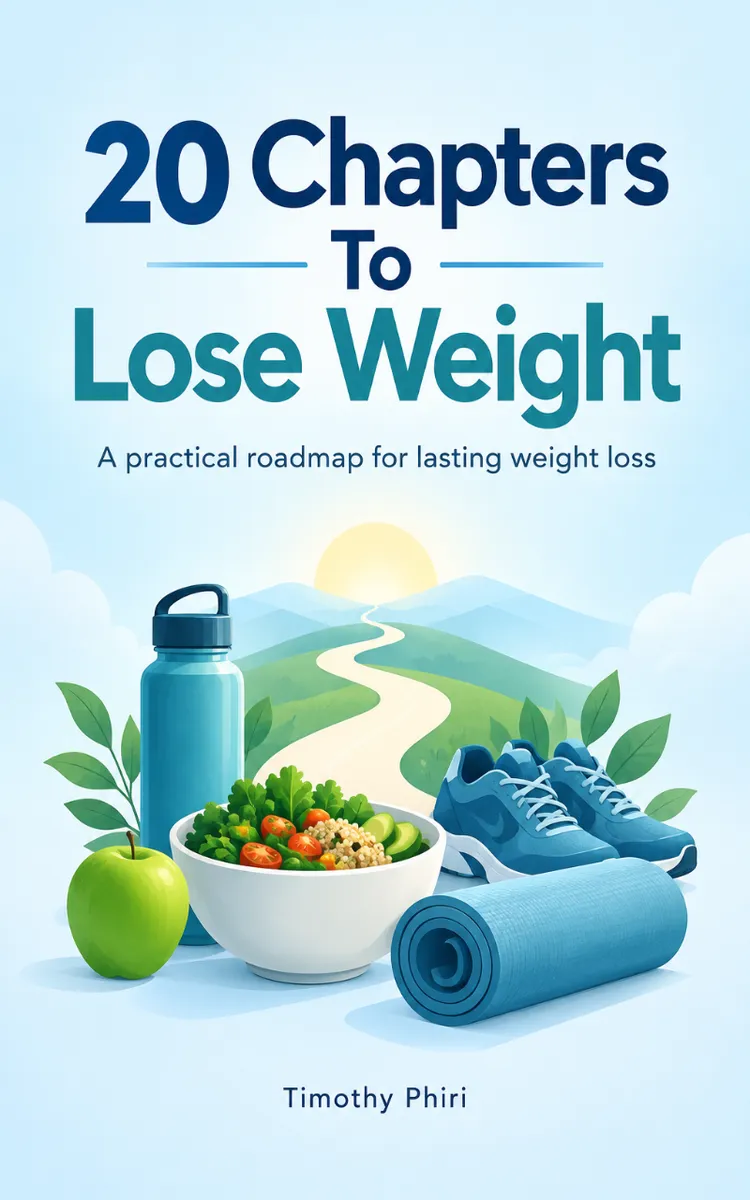
"20 Chapters To Lose Weight" is a self-help book by Timothy Phiri with 20 chapters and approximately 28,961 words. Weight loss guidance structured across 20 chapters.
This book was created using Inkfluence AI, an AI-powered book generation platform that helps authors write, design, and publish complete books. It was made with the AI Self-Help Book Writer.
Frequently Asked Questions
What is "20 Chapters To Lose Weight" about?
Weight loss guidance structured across 20 chapters
How many chapters are in "20 Chapters To Lose Weight"?
The book contains 20 chapters and approximately 28,961 words. Topics covered include Choosing a Weight-Loss Identity, Breaking the All-or-Nothing Mindset, Defeating Emotional Eating Triggers, Designing Your Non-Negotiable Routine, and more.
Who wrote "20 Chapters To Lose Weight"?
This book was written by Timothy Phiri and created using Inkfluence AI, an AI book generation platform that helps authors write, design, and publish books.
How can I create a similar self-help book?
You can create your own self-help book using Inkfluence AI. Describe your idea, choose your style, and the AI writes the full book for you. It's free to start.
Write your own self-help book with AI
Describe your idea and Inkfluence writes the whole thing. Free to start.
Start writingCreated with Inkfluence AI


