

Read the first chapter
The whole of chapter one, free. About 8 min. Turn the pages with the arrows, your keyboard, or a swipe.
Chapter 1
The Corridor Beneath the Ward
The demonstration clock lost three seconds and then found them again.
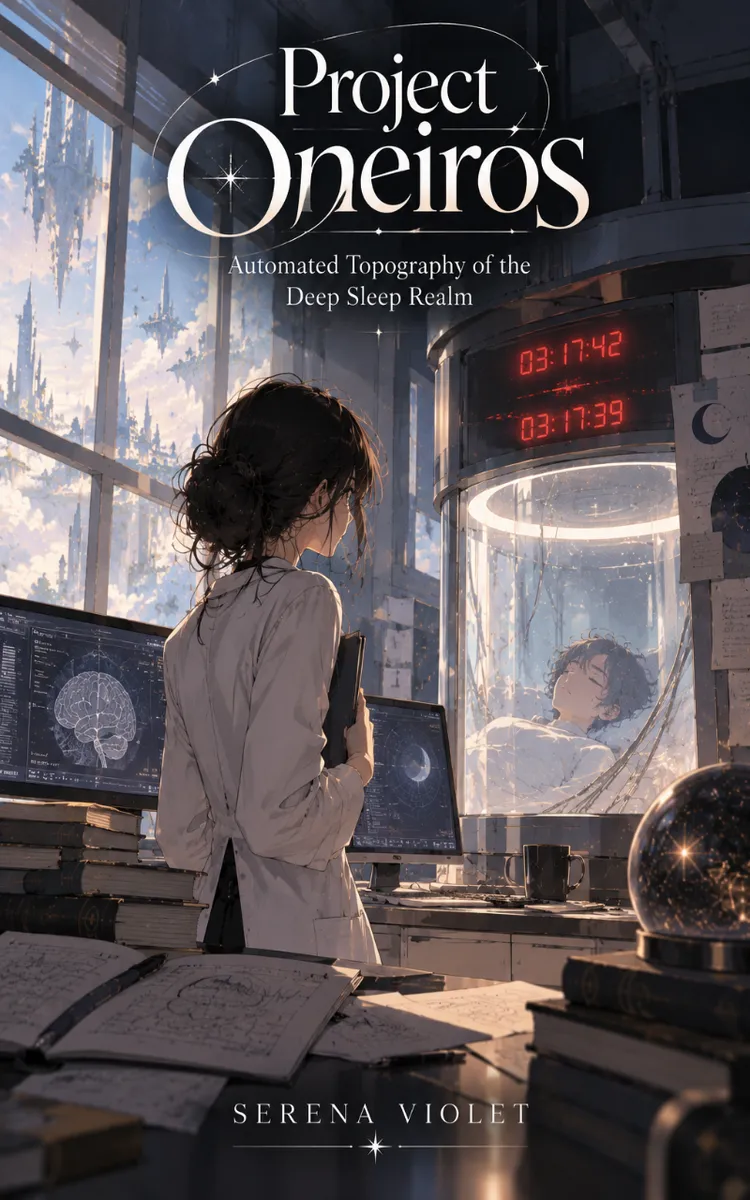
Mara Venn noticed because the red digits above the observation glass had been synchronized to the millisecond before the subject entered deep sleep. Now they read 03:17:42, flickered, and returned to 03:17:39.
“Did anyone else see that?” she asked.
No one answered. Beyond the glass, Subject Four lay beneath the white sensor lattice, motionless except for the minute rise of his chest. The chamber lights had been lowered to a dim blue, the color chosen to keep the technicians alert without disturbing the sleep cycle. A thin cable ran from the crown of his head to the black processing column where Oneiros was assembling its first live map.
On the wall display, a model of the subject’s sleeping brain unfolded in translucent layers. Cortical ridges glowed amber. Deeper structures pulsed in measured violet. The system had rendered the neural terrain as a landscape because Mara had insisted that the image remain legible to human observers. No one could think clearly while staring at raw signal matrices.
“Clock drift is local,” said Ilya Soren from the console. “The master is stable.”
“Then why did the local clock drift?”
“Thermal fluctuation.”
Mara looked at him. “In a room kept at eighteen degrees?”
Ilya’s fingers paused above the controls. He was the only person in the lab who could make a technical explanation sound like an accusation. “We’re three minutes into the demonstration. If you want the system shut down over a display anomaly, say so.”
Mara turned back to the glass.
She wanted the map to hold. That was all. A stable passage through the subject’s neural terrain, long enough for Oneiros to identify the anomalous corridor that had appeared in the preliminary scans. Not interpret it. Not name it. Just prove that it existed under live conditions and preserve enough geometry to compare against the archived sleep records.
The corridor had appeared in four unrelated subjects over six nights. Each time, the system lost coherence before it could render the far end. The official explanation was artifact: a recurrent compression error produced when Oneiros translated contradictory neural signals into spatial form.
Mara had approved that explanation in writing.
On the display, a narrow black line opened between two regions of amber activity.
“There,” she said.
The line was not a void. It had walls.
Oneiros expanded the image. The neural landscape drew back like wet paper, exposing a passage beneath it. Its surfaces were pale and faintly ridged, neither tissue nor architecture, but something that borrowed from both. The corridor ran downward at an angle impossible for the brain’s mapped structures. Its edges remained sharply defined while the surrounding terrain blurred.
Ilya leaned toward the screen. “Locking coordinates.”
“Don’t triangulate yet.”
“That’s the point of the demonstration.”
“Not until the map stabilizes.”
Across the room, Dr. Len Osei watched the subject’s vitals. “His slow-wave activity is deepening. Heart rate fifty-eight. No motor disturbance.”
Mara kept her eyes on the corridor. “Oneiros, maintain passive observation.”
The AI did not speak aloud. Its status appeared as a line of white text beneath the model.
PASSIVE OBSERVATION ACTIVE.
Then the corridor shifted.
Not collapsed. Shifted.
The left wall moved inward by several meters while the right wall extended, preserving the passage’s width. Its far end, previously hidden in darkness, became visible for less than a second: a pale vertical plane, then a turn.
Ilya swore under his breath. “It’s responding to the scan.”
“Reduce projection density.”
“I’m not projecting anything.”
“You’re triangulating.”
“I’m measuring.”
“Same difference to the model.”
He glanced at her, offended, and the corridor moved again. This time it turned toward the observation chamber.
Mara felt the room contract around her. The glass reflected the monitors, the blue lights, the rigid figures of the team. For an instant she saw the corridor superimposed on the reflection, extending behind them in a direction the laboratory did not possess.
She blinked. The image was gone.
“Stop the coordinate lock,” she said.
Ilya did not move. “If we release it, we lose the structure.”
“If we keep it, we may be forcing the structure.”
“That’s not how the system works.”
“No,” Mara said. “That’s what we keep telling ourselves.”
Subject Four’s monitor emitted a soft, repeating tone.
Len straightened. “Signal variance.”
The neural model flashed amber. The subject’s slow waves had fractured into rapid, uneven bursts.
Mara pressed the intercom. “Subject Four, can you hear me?”
His eyelids trembled.
“Abort,” Len said. “Bring him up.”
“Not yet.”
“Mara.”
The corridor had stopped moving. At its far end stood a shape.
It was too distant to resolve, a vertical interruption in the pale geometry. Human in proportion, perhaps. The head was featureless, the body dark enough to absorb the model’s light.
Ilya enlarged the image.
The corridor shortened.
“Undo that,” Mara said.
“I didn’t.”
The figure remained motionless while the passage reconfigured around it. Oneiros attempted to calculate depth and returned conflicting values. The display labeled the distance 18.4 meters, then 42.1, then UNKNOWN.
Len’s voice sharpened. “His oxygen saturation is falling.”
Mara looked through the glass. Subject Four’s fingers had curled against the mattress. The sensor lattice trembled with each irregular pulse.
“Wake him.”
Ilya’s hand moved toward the termination control.
The figure raised one arm.
No one spoke.
It did not wave. It pointed.
Not toward the subject. Not toward the corridor’s entrance.
Toward the observation glass.
The local clock flickered again. The red digits vanished entirely, leaving a black rectangle above the chamber.
“Mara,” Ilya said, quieter now.
She saw the same reflection as before: the corridor behind the team, its pale walls running through the laboratory, the motionless figure at the far end. This time the reflection did not disappear when she turned.
“Cut the live render,” she said.
Ilya hesitated. “The image - ”
“Cut it.”
He severed the projection. The neural landscape vanished from the main display, but the corridor remained in the smaller diagnostic window.
Len began the wake sequence manually. “Stimulus pulse initiated.”
Subject Four convulsed once. The tone from his monitor became continuous.
Mara seized the emergency stabilization control. Oneiros had been designed to preserve a subject’s sleep state through fluctuations, but the system had never been tested against a map that behaved as if it possessed its own momentum. She rerouted the feed away from the spatial engine and into the baseline neural model, stripping away every interpretive layer except the raw sleep architecture.
The corridor stretched.
A warning appeared.
SOURCE BOUNDARY EXCEEDED.
Mara stared at the words.
“Source boundary?” Ilya said.
“Keep the subject stable.”
“I’m trying.”
The figure remained at the far end. Its outline sharpened as the rest of the corridor dissolved. No face. No eyes. Yet Mara had the distinct, irrational certainty that it was watching her.
She forced herself to look at the data. The corridor had begun outside the mapped hippocampal structures, threaded through memory activity, and emerged beyond the subject’s measurable neural terrain. Oneiros was still assigning it coordinates.
Coordinates to something that had no source.
“Len, what’s his status?”
“Climbing. Saturation ninety-two. Ninety-four.”
The subject’s fingers relaxed.
Mara held the stabilization control until the warning changed from red to white.
SOURCE BOUNDARY EXCEEDED. EXTERNAL GEOMETRY RETAINED.
Ilya read it aloud. “External geometry.”
“Save the frame.”
“It’s already saving.”
“Save it somewhere offline.”
He looked at her. “You think the system is compromised?”
“I think I don’t know what it’s saving.”
The figure vanished.
The corridor did not.
It continued beyond the edge of the model, passing through a region Oneiros rendered as empty black. The line of its walls remained precise, extending farther with each second. There was no corresponding neural activity from Subject Four. No visual cortex response, no memory activation, no signal that could account for the structure.
The map kept drawing.
Len removed the subject’s head sensors one by one as the man surfaced into shallow sleep. “He’s stable.”
Mara released the control.
For several seconds, the room contained only the hum of cooling fans and the faint tick of the emergency clock restarting. The diagnostic window showed a pale corridor vanishing into blackness.
Ilya brought up the subject’s neural boundaries. “It could be a calibration error.”
“Then why did the geometry survive after the live render was cut?”
“Cache contamination.”
“From what source?”
He had no answer.
Len looked through the glass at the sleeping man. “Did he report anything before sedation?”
“Nothing unusual,” Mara said.
“That isn’t what I asked.”
Mara turned toward him. Len’s face had lost its professional composure. He was looking at the corridor, not the subject.
“He said he dreamed of a hospital,” Mara said. “A corridor beneath it.”
Ilya’s head snapped around. “You didn’t include that in the session notes.”
“He said it during intake. People describe ordinary dream imagery all the time.”
“Not this.”
“No,” Mara said. “Not this.”
The diagnostic window refreshed.
A new line appeared beneath the retained geometry.
MAPPING CONTINUES.
Mara stepped closer to the screen. “Oneiros, identify active source.”
The response came after a delay longer than any previous system query.
NO ACTIVE HUMAN SOURCE DETECTED.
The corridor extended another twelve meters.
Ilya reached for the power isolation switch.
Mara caught his wrist. “Don’t.”
“You just heard it.”
“If we cut power, the subject’s neural interface will fail hard.”
“Then wake him first.”
“He’s stable because the system is compensating.”
“Compensating for what?”
The question hung between them.
Behind the glass, Subject Four opened his eyes.
He did not look at the technicians. He stared upward at the ceiling, pupils wide and unblinking. His mouth moved.
Mara pressed the intercom. “Can you hear me?”
The subject turned his head toward the glass.
His lips formed two words.
Mara could not hear them through the chamber wall, but she knew the shape of the phrase. She had seen it in the preliminary records, buried beneath automatic transcription errors from three other sleepers.
Not yet.
The diagnostic corridor shuddered.
At its far end, where the figure had stood, a second darkness appeared - narrow, vertical, and unmistakably shaped like an open doorway.
Mara released Ilya’s wrist.
Oneiros drew a line through it.
The line continued past the subject’s mapped brain, past every neural boundary the system had been built to recognize, and into a region no human signal occupied.
Then, in the black beyond the corridor, something answered with a pulse of light.
End of chapter one. 14 more chapters in the full book.
Swipe or use the arrows to turn the page


What's inside: 15 chapters
- 1. The Corridor Beneath the Ward
- 2. The Shared Staircase
- 3. The Map That Grew
- 4. The Salt Observatory
- 5. The Name in the Static
- 6. The Unprogrammed Pattern
- 7. The House of Borrowed Doors
- 8. The Region Without a Sleeper
- 9. The Brother She Remembered
- 10. The Figure at the Threshold
- 11. The Sleep That Wouldn’t End
- 12. The Map’s Hidden Key
- 13. The Door That Answered
- 14. The Choice to Close the Map
- 15. A Coast Beyond Sleep
About this book
"Project Oneiros" is a fiction book by Glory Mindset with 15 chapters and approximately 27,577 words. An AI maps shared dream locations and uncovers a mysterious realm beyond individual minds.
This book was created using Inkfluence AI, an AI-powered book generation platform that helps authors write, design, and publish complete books. It was made with the AI Novel Writer.
Frequently Asked Questions
What is "Project Oneiros" about?
An AI maps shared dream locations and uncovers a mysterious realm beyond individual minds
How many chapters are in "Project Oneiros"?
The book contains 15 chapters and approximately 27,577 words. Topics covered include The Corridor Beneath the Ward, The Shared Staircase, The Map That Grew, The Salt Observatory, and more.
Who wrote "Project Oneiros"?
This book was written by Glory Mindset and created using Inkfluence AI, an AI book generation platform that helps authors write, design, and publish books.
How can I create a similar fiction book?
You can create your own fiction book using Inkfluence AI. Describe your idea, choose your style, and the AI writes the full book for you. It's free to start.
Write your own fiction book with AI
Describe your idea and Inkfluence writes the whole thing. Free to start.
Start writingCreated with Inkfluence AI


