
Read the first chapter
The whole of chapter one, free. About 7 min. Turn the pages with the arrows, your keyboard, or a swipe.
Chapter 1
Time Heals Isn’t Your Job
When the Clock Refuses to Do the Healing
“Time heals all wounds.”
I heard that sentence after my nineteen-year-old son died. People meant well. They were trying to give me something to hold on to. But the words landed wrong. Time didn’t heal the wound. It only kept moving while I stayed behind, trying to understand how the world could continue without him in it.
There are mornings when I can get dressed, answer a message, and make coffee. Then a song, a date, or the sight of someone his age can split the day open. I can be doing better at ten o’clock and unable to get out of bed by noon. That isn’t failure. That’s grief refusing to follow a calendar.
The lie is not that time changes us; the lie is that time finishes the job for us.
What Grief Looks Like When the Calendar Keeps Moving
The Birthday Chair. His mother set an extra chair at the table on what would have been his twentieth birthday. She knew he wasn’t coming home. Her hands still reached for another plate before she remembered. A year had passed, but the loss had not become smaller. The birthday had simply brought a new shape to it.
The Graduation Program. A father kept the graduation program from his daughter’s class. Her name wasn’t in it, but he looked for it anyway. He grieved the ceremony she should have attended, the clothes she might have worn, and the person she might have become. He wasn’t only missing her childhood. He was missing her future.
The Grocery Aisle. I once stood in a store and saw my son’s favorite snack. For one second, I reached toward it. Then I remembered. I left the aisle crying, embarrassed by how quickly an ordinary errand became a confrontation with the life I no longer had.
What all these have in common:
• Time passed, but love didn’t disappear. - The grief changed when a new milestone arrived. - The pain was connected to a life interrupted, not just a moment lost. - Looking “better” did not mean being healed.
That’s the part people often miss. When you lose a child, you grieve the life you shared. You also grieve the life your child could have had and should have had. The first day of school. The driver’s license. The wedding, the job, the ordinary Sunday phone call. Time cannot return those things.
The Wound-Not-Deadline Model gives me a different way to understand this. A deadline says, “By now, you should be finished.” A wound says, “This happened to you, and it needs care.” A wound may close and still ache. It may look quiet from the outside and hurt badly when touched. That doesn’t mean the body - or the heart - is doing healing wrong.
Why Repeating Grief Doesn’t Mean You’re Stuck
People often talk about the five stages of grief as if they’re five rooms with doors. You enter denial, then anger, then bargaining, then depression, and finally acceptance. Neat. Orderly. Easy to explain at a dinner table.
Real grief isn’t like that. You can move through all five stages in one afternoon. You can feel acceptance in the morning and anger by lunch. You can bargain years later, thinking, If only I had called. If only I had noticed. If only one thing had changed. Then depression can pull you under again. These stages aren’t steps you complete. They’re waves you may meet again and again, often without warning.
The repetition can feel like proof that you’re failing. It isn’t. Your mind keeps discovering new parts of what happened. At first, you may grieve the death itself. Later, you grieve the empty bedroom, the missed birthday, or the future you had pictured. Each discovery can reopen the wound. You aren’t going backward. You’re meeting another truth.
You may need this chapter if:
1. You judge yourself because you’re still crying after months or years. 2. You feel guilty when you laugh, as if a good moment betrays your child. 3. You wake up thinking, “I was doing better,” then feel crushed by a random reminder. 4. You’re tired of people asking whether you’re “moving on.”
Your grief is not a deadline you keep missing; it is love learning how to exist after loss.
That doesn’t mean you have to enjoy the pain or pretend it has a purpose. Some days, surviving the morning is enough. The goal isn’t to erase your child from your life so you can become acceptable to other people. The goal is to learn how to carry what happened without demanding that it stop mattering.
Questions for the Days That Don’t Make Sense
1. What did someone say about time that made you feel misunderstood? Write the exact words if you remember them. Then write what you wished they had said instead. Maybe it was, “I know this still hurts, and I’m not going to rush you.”
2. Which part of your child’s life are you grieving today - the past, the present, or the future? Be specific. You might write, “Today I’m grieving the future where my son turned twenty and chose his own apartment.”
3. Which stage of grief feels closest right now: denial, anger, bargaining, depression, or acceptance? You don’t need to choose only one. Write about the mix. “I accept that he died, but I’m still angry, and part of me keeps bargaining.”
4. What does a “better day” mean to you without calling it a healed day? Maybe you showered, ate toast, or answered one text. Maybe you laughed and then cried. Record the action, not a judgment.
5. What new reminder has appeared recently, and what did it bring with it? It could be a birthday, a school event, or a song in a store. Name the grief underneath the reminder. Naming it can keep you from mistaking a wave for a collapse.
Write for five minutes. Stop if you need to. This isn’t an assignment you can fail. It’s a way to tell the truth before someone else’s timeline gets into your head.
The Seven-Day No-Deadline Challenge
Challenge name: The Wound-Not-Deadline Week
Difficulty level: Gentle, but emotionally honest
For seven days, you’ll notice grief without measuring it against the calendar. You won’t try to force healing. You’ll practice responding to the wound as something that needs care today.
• Day 1: Write the date your child died at the top of a page. Under it, write: “My grief does not have an expiration date.” Add three feelings you have right now. - Day 2: Notice one trigger - a song, place, object, or date. Write what it brought up without calling the reaction “too much.” - Day 3: Give each stage a sentence. Write one sentence about denial, anger, bargaining, depression, and acceptance as they have appeared in your grief. - Day 4: Do one basic act of care before noon: drink water, eat something, shower, or step outside for five minutes. Say, “Care is not the same as moving on.” - Day 5: Tell one trusted person, “I’m having a grief wave today. I don’t need fixing. I need company.” Be clear about whether you want them to listen, sit with you, or check in later. - Day 6: Write about one future moment your child should have had. Let yourself grieve the age, event, or ordinary life that was taken. - Day 7: Review the week. Circle every place where you noticed grief without punishing yourself for it. Write one sentence about what you learned.
Celebrate when...
• You name a grief wave before it carries you away. - You care for your body without treating that care as proof you’re “over it.” - You allow a good moment without apologizing for it. - You recognize that a hard day is a hard day - not evidence that you have gone backward.
This challenge won’t make the loss disappear. That isn’t its promise. It gives you seven days of refusing to turn pain into a performance for other people.
The Truth We Carry Forward
Time does not heal the loss of a child; it gives you more moments to learn how to live with the wound, the love, and the life that should have been.
• “Time heals all wounds” fails because your child was not a temporary problem. - The five stages of grief can return in any order, at any time. - A bad day after a good day does not mean you are stuck. - The Wound-Not-Deadline Model replaces pressure with honest care.
You do not have to prove that you’re healing by smiling at the right time, returning to work, or making other people comfortable. You can laugh and still grieve. You can function and still be shattered. You can have a peaceful afternoon and wake up hurting tomorrow.
That is not a contradiction. That is what carrying love after loss can look like. And as we keep going, we’ll look more closely at the waves themselves - what brings them, how they move through your body, and how you can meet them without believing they have erased all your progress.
End of chapter one. 7 more chapters in the full book.
Swipe or use the arrows to turn the page
What's inside: 8 chapters
- 1. Time Heals Isn’t Your Job
- 2. Mapping the Five Stages Loop
- 3. Letting Love Be the Grief Engine
- 4. Breaking the Bed-All-Day Trap
- 5. Communicating Needs Without Apologies
- 6. Letting the Mind Stop Bargaining
- 7. Turning Triggers Into Gentle Signals
- 8. Living With the Pain, Not Past It
About this book
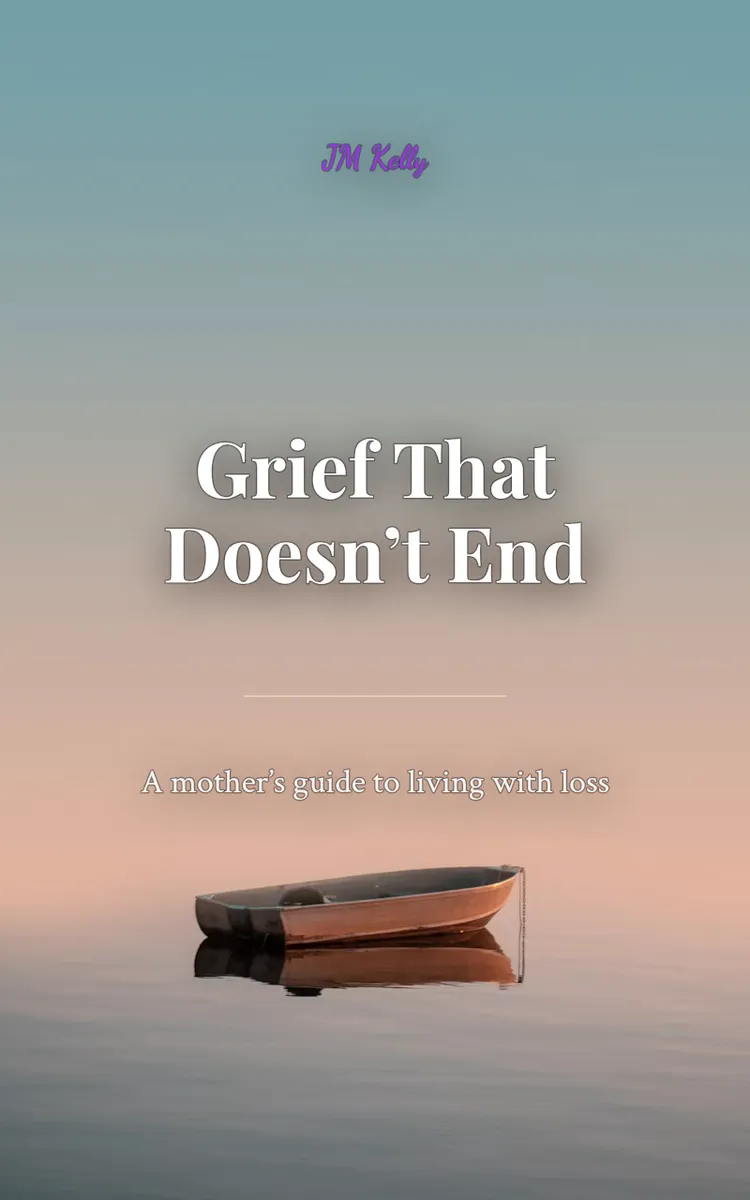
"Grief That Doesn’t End" is a self-help book by JM Kelly with 8 chapters and approximately 12,761 words. Understanding grief, stages, and recurring waves after losing a child.
This book was created using Inkfluence AI, an AI-powered book generation platform that helps authors write, design, and publish complete books. It was made with the AI Self-Help Book Writer.
Frequently Asked Questions
What is "Grief That Doesn’t End" about?
Understanding grief, stages, and recurring waves after losing a child
How many chapters are in "Grief That Doesn’t End"?
The book contains 8 chapters and approximately 12,761 words. Topics covered include Time Heals Isn’t Your Job, Mapping the Five Stages Loop, Letting Love Be the Grief Engine, Breaking the Bed-All-Day Trap, and more.
Who wrote "Grief That Doesn’t End"?
This book was written by JM Kelly and created using Inkfluence AI, an AI book generation platform that helps authors write, design, and publish books.
How can I create a similar self-help book?
You can create your own self-help book using Inkfluence AI. Describe your idea, choose your style, and the AI writes the full book for you. It's free to start.
Write your own self-help book with AI
Describe your idea and Inkfluence writes the whole thing. Free to start.
Start writingCreated with Inkfluence AI


