
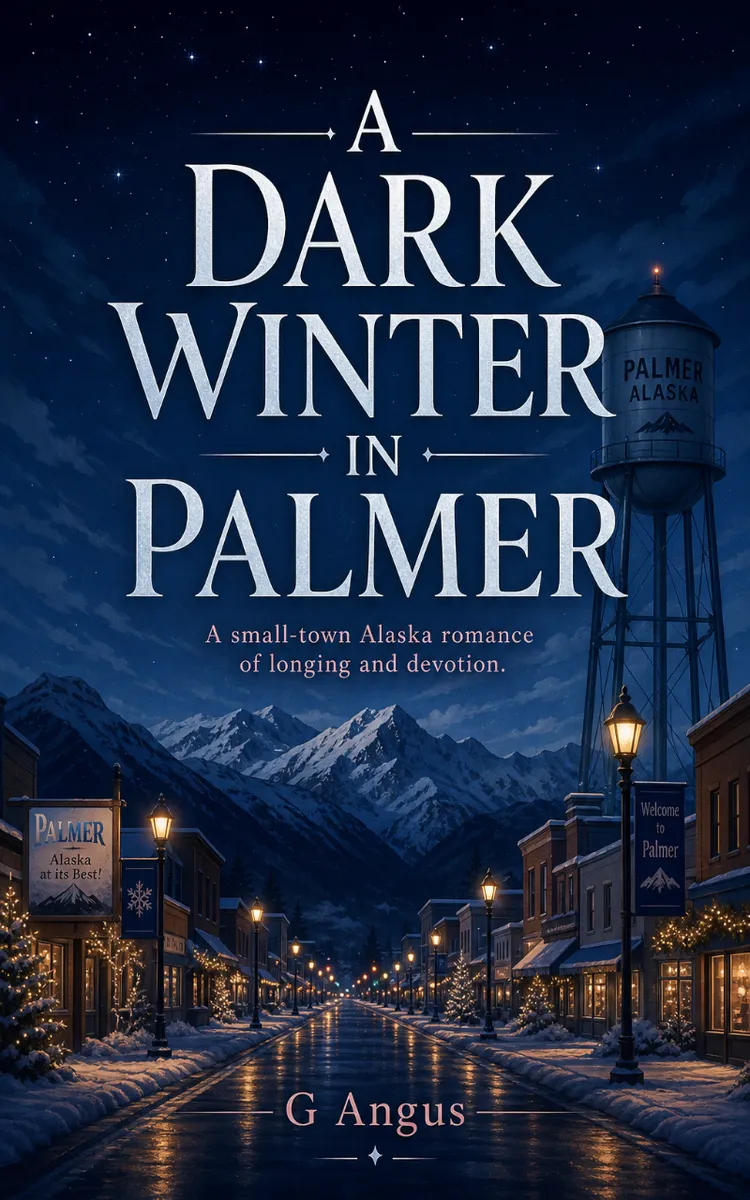
Read the first chapter
The whole of chapter one, free. About 10 min. Turn the pages with the arrows, your keyboard, or a swipe.
Chapter 1
A Snowbound Arrival at Palmer
Snow swallowed the road behind Mara Ellison before she could decide whether to turn back.
Her car coughed once, shuddered beneath her hands, and died beneath a veil of blowing white. The dashboard lights went dark. For a moment, there was only the ticking of cooling metal and the hard, dry hiss of wind against the windows.
“Come on,” she whispered.
She turned the key again. Nothing.
Palmer lay somewhere ahead, less than ten miles according to the sign she had passed before the storm thickened. Downtown. A room at the Palmer Inn. A shower, a phone charger, coffee strong enough to steady her. She had told herself she could make it before dark, that arriving alone in a town she had never seen was a choice rather than a test.
Now the road had vanished.
Mara grabbed her phone from the passenger seat. One bar flickered, then disappeared. She tried calling roadside assistance. The call failed before it rang.
Outside, snow struck the windshield in slanted sheets. The world beyond the glass had become a blank, shifting wall. She could not see the ditch, the road markers, or the mountains she had been watching all afternoon. Her breath clouded the inside of the car.
She reached for the emergency flashers. The lights blinked weakly, their rhythm swallowed almost at once by the storm.
A vehicle might not see her.
A vehicle might not come.
Mara pressed both hands against the steering wheel until the leather cut into her palms. She had spent six hours driving north with a carefully rehearsed calm, refusing to think about why she had chosen Palmer, why she had packed her life into two suitcases and left before anyone could ask her to explain. She had been certain of one thing: she would arrive under her own power.
The certainty had lasted until the engine stopped.
She searched the back seat for a coat, found the heavy wool one she had thrown in at the last minute, and pulled it over her sweater. The car’s warmth thinned quickly. Cold slipped through the door seals and gathered around her ankles.
Then headlights appeared.
They came out of the white at an angle, too high and too close. A dark pickup slowed beside her, tires grinding over packed snow. The driver’s window lowered only a few inches.
“You stranded?”
The voice was male, roughened by cold or disuse.
Mara kept her hand near the door lock. “No. I’m enjoying the view.”
His gaze moved over her car, then returned to her face. He had a narrow, weathered face, dark hair dusted with snow, and eyes that seemed almost black in the storm.
“View’s better in town.”
“I have a phone.”
“Does it work?”
She hated that he asked. Hated more that she had no answer.
The man looked past her toward the road. “You need to get out of the car.”
“I’m not getting into a stranger’s truck.”
“Then stay here and freeze beside a dead engine.”
His tone was not cruel. It was worse than cruel - practical, certain, as though her fear were another mechanical problem he had already assessed.
Mara lowered her window another inch. “Can you tow me?”
“Not with what I’ve got in the bed. I can get you somewhere warm and call a local rig.”
“My luggage - ”
“Leave it locked.”
“And my car?”
“If the plow comes through, it’ll be buried by morning.”
The answer settled between them. He did not soften it. He did not offer reassurance he could not guarantee.
Mara looked at the storm, then at the stranger. Her pulse beat hard beneath her scarf.
“What’s your name?”
“Evan Kessler.”
“Do you live in Palmer?”
“Just outside it.”
“That isn’t an answer.”
“It’s the one I’ve got.”
She should have refused. She should have waited until another car came, though the road had been empty for twenty minutes and the snow was now filling the shallow tracks behind her. Instead, she opened the door.
Wind tore at her immediately. Evan was out of his truck before she could step down, crossing the space between them with a steady, unhurried stride. He took her suitcase from the rear seat, then the second one, carrying both as if they weighed nothing.
“I can manage those,” she said.
“I know.”
He placed them in the truck bed beneath a canvas cover. His gloves were black and worn at the fingertips. When he shut the tailgate, he looked at her.
“Anything else?”
“My pride.”
“That won’t keep you warm.”
She almost laughed, but the sound caught somewhere behind her ribs.
The passenger door opened. Heat rolled over her, carrying the scents of pine, coffee, and something metallic from the truck’s vents. Evan waited beside it without touching her.
Mara climbed in.
The seat was cold beneath her, but the heater blew hard against her knees. Evan circled to the driver’s side and settled behind the wheel. He did not ask where she was going until the truck was moving again.
“Downtown,” she said. “The Palmer Inn.”
His hands tightened slightly around the wheel. “You have a reservation?”
“Yes.”
“Good.”
“Why?”
“Places fill up during the Colony Christmas parade.”
Mara turned toward him. “That’s tonight?”
“Tomorrow night.”
She had seen the signs along the road, painted snowflakes and red lettering, but had not stopped to read them. “I didn’t know there was a parade.”
“Most people know before they get here.”
“I’m not most people.”
“No,” he said. “You’re not.”
The words were simple. The way he said them was not.
The truck pushed through the storm, headlights carving a narrow tunnel through the snow. Mara watched his profile as he drove: the straight line of his nose, the faint scar near his jaw, the concentration that made him seem sealed away from her. He drove with both hands, slowing before every rise and curve. No radio played. No music softened the silence.
“You always pick up stranded women?” she asked.
“Only the ones blocking the road.”
“My car is on the shoulder.”
“Your back tire is in the lane.”
She looked behind them, but the storm had already erased the vehicle.
“Do you always correct people?”
“Only when they’re wrong.”
Mara faced the windshield. “You must be popular.”
“Not especially.”
The answer should have ended it. Instead, she found herself listening for whatever he might say next.
At the edge of Palmer, the snow thinned enough for buildings to emerge: dark roofs, glowing windows, strings of lights trembling in the wind. A wooden sign welcomed them to the town. Beyond it, the streets narrowed and brightened, lined with storefronts and wreaths. Palmer looked smaller than she had imagined, but not fragile. It had the guarded, weathered beauty of a place that expected winter to test everyone who entered.
Evan pulled up outside the V-Ho diner in downtown Palmer.
“I thought you were taking me to the inn.”
“I am. You need food first.”
“I’m not hungry.”
He turned off the engine. “You’re shaking.”
“I’m cold.”
“Same problem.”
Mara looked at the diner’s windows. Warm yellow light spilled across the snow. Inside, people sat close together in booths, their coats hanging from hooks, their faces softened by steam and coffee. She could see a handwritten sign about the Colony Christmas parade taped beside the door.
“I can wait at the inn,” she said.
“You can,” Evan agreed. “Or you can come inside for ten minutes and stop pretending you’re fine.”
The bluntness struck too near the truth.
She opened the door.
The diner smelled of frying onions, cinnamon, and wet wool. Conversation dipped when they entered, then resumed in low currents. A woman behind the counter glanced at Evan, then at Mara, and smiled as though she had already formed an opinion.
“Booth’s free,” Evan said.
“I can sit alone.”
“I didn’t say you couldn’t.”
He slid into one side of the booth. Mara took the other, leaving the table between them like a border. Her fingers still trembled as she wrapped them around the mug the waitress placed before her.
Evan ordered coffee and stew. Mara ordered tea, though the waitress insisted on bringing pie with it.
“You’re not from here,” Evan said.
“Is it that obvious?”
“You look at the windows every thirty seconds.”
“I’m checking the weather.”
“You’re checking the exits.”
Mara lowered her cup. “You read strangers quickly.”
“I notice what keeps people alive.”
The seriousness in his voice changed the air between them. She saw then that his restraint was not indifference. It was discipline, perhaps the kind built from having learned that warmth could become dangerous if offered carelessly.
“What brought you to Palmer?” he asked.
She looked down at the tea. A thin skin of steam blurred the surface.
“Work.”
“That’s not why you packed two suitcases.”
Her gaze lifted sharply.
Evan did not look away. “You left in a hurry.”
“You don’t know anything about me.”
“I know your tires are new, your registration is from Oregon, and you drove into a snowstorm without checking the parade schedule.”
“That’s a strange amount of attention for someone who only notices what keeps people alive.”
His mouth moved, almost a smile, but it disappeared before it formed. “Maybe I’m still deciding.”
The waitress set down his stew. He thanked her by name. Mara noticed the small exchange, the ease of it, the way the woman touched his shoulder before moving away.
“You know everyone here,” Mara said.
“Small town.”
“That must be convenient.”
“It can be.”
“And inconvenient?”
His spoon paused above the bowl. “Depends what you’re trying to hide.”
The words landed with quiet force.
Mara set down her cup. “I’m not hiding.”
“No?”
“No.” She could hear the defensiveness in her own voice and hated him for hearing it too. “I came here because I needed somewhere no one had already decided who I was.”
Evan’s expression changed - not softened, exactly, but opened by a fraction.
“That what people did?”
“Decided?” She stared through the window at the snow drifting beneath the streetlights. “They decided I was fine because I kept showing up. They decided I wanted the life I had because I didn’t complain loudly enough. After a while, correcting them felt more exhausting than disappearing.”
Evan said nothing.
The silence did not feel empty. It felt like being allowed to finish.
Mara swallowed. “I’m not asking you to understand.”
“I didn’t say you were.”
“No. You just keep helping.”
His eyes held hers. “You needed help.”
“And now I owe you.”
“You owe me a cup of coffee.”
“That’s not what I mean.”
“I know.”
The diner seemed suddenly too warm. Her coat pressed against her shoulders. Evan’s hand rested near his bowl, knuckles reddened from the cold. She wondered what it would feel like to place her fingers over them. The thought was so immediate she pulled her hands into her lap.
He noticed. Of course he noticed.
The tow truck arrived twenty minutes later. Evan paid for her meal before she could stop him, then walked her through the snow to the curb. The driver, a broad woman named June, climbed down from the cab and waved toward Evan.
“You bringing her to the inn?”
“After the car’s secured,” he said.
June looked at Mara. “You’ll want to let him handle it. He knows that road.”
Mara glanced at Evan. “Why?”
“Because he’s pulled half the town out of it.”
Evan opened the passenger door of the tow truck for her. “You’re going to the inn.”
“And you?”
“I’ll see what I can do about your car.”
“That’s your job?”
“No.”
“Then what is it?”
He looked toward the dark road where her vehicle had disappeared into the storm.
“Tonight, apparently, it’s yours.”
The inn’s front lights appeared through the snow a few minutes later. Mara climbed down from the truck, carrying only her handbag. Evan followed with her suitcases. At the entrance, she turned to him.
“I’ll pay you back.”
“For the coffee?”
“For everything.”
“You can repay me by doing one thing.”
The snow gathered in his hair again. “What?”
“Come to the parade tomorrow.”
She stared at him. “That’s the favor?”
“You came to Palmer to disappear. You won’t see the town from a motel room.”
“You don’t know that’s what I came to do.”
“I know you’re already looking for a way to leave.”
The truth of it made her angry. The tenderness beneath it made her more so.
“And if I say no?”
“Then you say no.”
He stepped back, giving her space. The gesture should have eased her. Instead, it left her aware of every inch between them.
Mara looked at the lit windows of the inn, then at Evan’s waiting truck. She had wanted to reach Palmer before dark. She had wanted a room, a locked door, and no obligations.
She had gotten there.
But the cost was a stranger who had seen too much, a town already drawing her into its winter warmth, and a promise she had not yet made.
“Tomorrow,” she said carefully, “I’ll decide.”
Evan nodded. “That’s not the same as no.”
“No,” Mara said. “It isn’t.”
He walked away before she could ask whether he wanted her to come. She stood beneath the inn’s awning, watching his taillights fade into the snow, and understood with a sudden, unsettling clarity that surviving Palmer might require more from her than staying alive.
It might require being known.
End of chapter one. 32 more chapters in the full book.
Swipe or use the arrows to turn the page


What's inside: 33 chapters
- 1. A Snowbound Arrival at Palmer
- 2. The V-Ho Diner’s Late-Winter Light
- 3. Evan’s Rules for Winter Roads
- 4. Refusing Help, Then Needing It
- 5. The First Time Mara Says Yes
- 6. A Power Outage Changes the Night
- 7. Searching the Past in Town Records
- 8. Ice on the Footbridge Breaks Plans
- 9. Mara’s Confession Over Hot Cocoa
- 10. The Wrong Name in the Snow
- 11. Evan Finds the Missing Page
- 12. The Colony Parade Route Gets Blocked
- 13. Holding Evan’s Hand in Cold Air
- 14. A Letter Delivered Too Late
- 15. Asking the Question Evan Avoids
- 16. The Diner’s Doorbell Rings Twice
- 17. Midwinter Truth in the Cold Storage
- 18. Mara Chooses Distance to Protect
- 19. The Snowplow Breaks the Bridge of Trust
- 20. Following Tracks to a Hidden Garage
- 21. Evan’s Apology Under the Aurora
- 22. A Cold Word Ends Their Plans
- 23. The Town Meeting Turns Against Them
- 24. The File That Names the Threat
- 25. Mara Breaks the Promise to Stay
- 26. Winter Storm Forces One Last Move
- 27. Asking Evan to Trust Her Again
- 28. The Last Clue at the V-Ho
- 29. A Public Stand Under Palmer’s Lights
- 30. Choosing Love Without Guardrails
- 31. Spring Planning in the Snow’s Shadow
- 32. A Promise Made for Decades
- 33. Life-Long Love in Palmer Winter
About this book
"A Dark Winter In Palmer" is a romance book by G Angus with 33 chapters and approximately 77,318 words. 30-something lovers finding deep connection in winter Palmer, Alaska.
This book was created using Inkfluence AI, an AI-powered book generation platform that helps authors write, design, and publish complete books. It was made with the AI Romance Novel Writer.
Frequently Asked Questions
What is "A Dark Winter In Palmer" about?
30-something lovers finding deep connection in winter Palmer, Alaska
How many chapters are in "A Dark Winter In Palmer"?
The book contains 33 chapters and approximately 77,318 words. Topics covered include A Snowbound Arrival at Palmer, The V-Ho Diner’s Late-Winter Light, Evan’s Rules for Winter Roads, Refusing Help, Then Needing It, and more.
Who wrote "A Dark Winter In Palmer"?
This book was written by G Angus and created using Inkfluence AI, an AI book generation platform that helps authors write, design, and publish books.
How can I create a similar romance book?
You can create your own romance book using Inkfluence AI. Describe your idea, choose your style, and the AI writes the full book for you. It's free to start.
Write your own romance book with AI
Describe your idea and Inkfluence writes the whole thing. Free to start.
Start writingCreated with Inkfluence AI


