
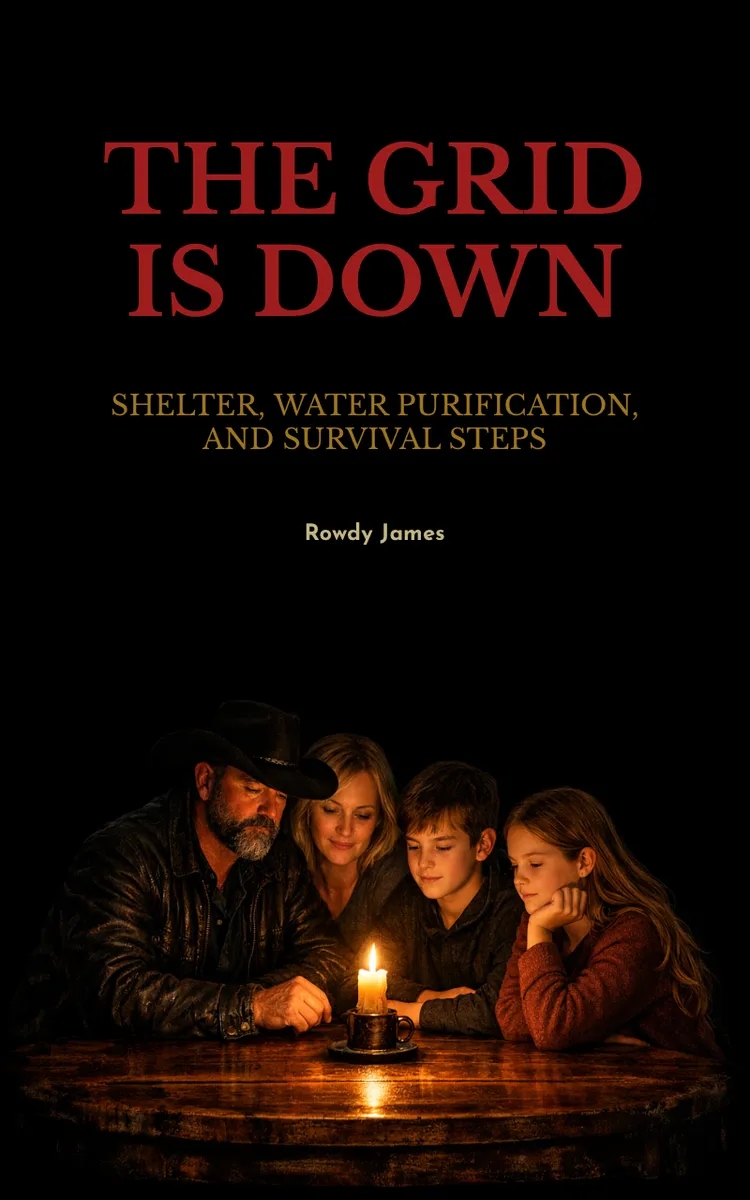

Read the first chapter
The whole of chapter one, free. About 10 min. Turn the pages with the arrows, your keyboard, or a swipe.
Chapter 1
Understanding the Basics of Grid-Down Survival Prep Guide
Fire up a flashlight and try to imagine the quiet right after the power quits-no fridge hum, no well pump, no hot water, no phone charging. That quiet is the whole point of grid-down survival prep: you stop guessing and you start running a simple plan that keeps you fed, watered, sheltered, and safe until electricity comes back or your neighborhood settles into a new normal.
This chapter lays the groundwork for the rest of the book. You’ll learn what a grid-down “prep guide” actually means in plain terms, how to organize your supplies and your actions, and how to follow a step-by-step routine for preparing before the grid fails and responding right after it does. When you finish, you’ll know what to do first, what to do next, and what not to waste your time on-because time and water don’t care about your intentions.
Why This Matters
A grid-down event doesn’t hit all at once like a storm that you can watch from your porch. It usually starts with little breaks: lights flicker, phones struggle to hold a signal, a store shelf stays empty longer than usual. Then it turns into a full stop. When that happens, your biggest problem won’t be “lack of bravery.” Your biggest problem will be confusion-people grab the wrong stuff, forget the basics, and burn their batteries before they know what’s going on.
This chapter solves that confusion. It gives you a clear framework for understanding how the guide works, so you can make decisions fast. You’ll learn how to organize your household into practical tasks, how to keep your water and heat plan from falling apart, and how to set up a “first 72 hours” response that matches what usually happens when the grid goes down. You’ll also learn how to track your progress with simple checks, so you don’t discover problems two days later.
After you read this, you’ll be able to look at your home-your doors, your water sources, your storage space, your kitchen setup-and turn it into a working survival plan. You won’t need to guess what “enough” looks like. You’ll know how to build a baseline kit, how to stage it where you can reach it without power, and how to start the post-grid-down routine without panicking.
Takeaway / reflection prompt: Grab a notepad and write one sentence: “If the lights go out tonight, I will check ____ first.” Then keep that sentence handy as you read the rest of the book.
How It Works
Think of a grid-down survival prep guide like a checklist system with priorities. It doesn’t ask you to be perfect-it asks you to be consistent. The guide works because it breaks the job into time blocks and “systems,” not vibes. You handle water first, then shelter and heat, then food, then communications and security, then maintenance. You don’t jump around. You move in order, and you fix issues while they’re still small.
Here are the core parts you’ll keep using throughout the book:
1. Make a “Now vs. Later” split. You separate what you must do before the grid goes down from what you do after it happens. The reason is simple: you can’t run to the store for essentials when roads are blocked, phones are dead, or crowds get ugly. You stage the “Now” items so you can act immediately.
2. Build your “Base Kit” around three needs: water, heat, and meds. Water keeps you alive. Heat keeps you safe from hypothermia and from frozen pipes. Meds keep small problems from becoming big emergencies. You set these up first so the rest of your plan doesn’t collapse.
3. Use a “first 72 hours” routine with checkpoints. The first three days decide your outcome more than people want to admit. You plan for short-term stability: drinking water, safe cooking, basic hygiene, and staying put. You check progress at set times so you catch mistakes early.
4. Turn your home into a system you can run without electricity. That means you plan for water delivery (like a manual pump or stored water), cooking (like a safe stove setup), lighting (like headlamps), and sanitation (like proper waste handling). You don’t rely on “maybe the power comes back soon.”
Now let’s make those parts concrete. When the grid goes down, your home stops being a “house” and becomes a “camp.” Camp survival runs on simple inputs: water, calories, warmth, and time. If you don’t have those inputs ready, you spend your first days hunting for them instead of building stability.
Here’s what your guide expects you to do with that idea:
• Before grid-down: stage supplies, practice routines, label storage, and check your water and heat systems. - Right after grid-down: confirm your situation, secure your home, start water and heat, and set your 72-hour plan into motion. - After 72 hours: shift from “survive the first hit” to “maintain and improve”-which includes water purification, shelter upgrades, and longer-term food planning.
Ask yourself a basic question while you read: “If my phone dies in two hours, do I still know what to do?” If the answer is no, you need to slow down and build a plan that doesn’t depend on screens.
Practical takeaway / reflection prompt: Write down your three priorities in order-water, heat, meds-and circle what you already have ready.
Putting It Into Practice
Let’s walk through a realistic setup you can do at home, using the kind of details that actually help when the lights go out. You’re not building a spaceship. You’re building a plan that works in a normal house with normal tools.
Step-by-step: Set up your “Prep Guide Basics”
1. Pick your “starting point” room and stage a grab zone. Choose one place you can reach quickly-usually the kitchen, living room, or hallway near the main door. Put your flashlights, headlamps, batteries, a first-aid kit, and emergency water containers there. Expected outcome: You stop hunting when things get chaotic. You can move as a group without losing people.
2. Inventory what you already have-then fill gaps. Walk through your home and list what you have in three piles: water, heat, and meds. Count what you can count: bottles, jugs, battery packs, propane cylinders (if you have them), blankets, and medicine. Expected outcome: You stop buying duplicates and you start buying what you actually need.
3. Mark “water access” and “water purification” routes. Find your stored water and label it with a big marker: “DRINK FIRST” and “WASH SECOND.” Then decide where you’ll set up purification if you have to. Expected outcome: You keep water clean and you don’t mix it up during stress.
4. Set a simple heat plan that doesn’t require electricity. If you use a generator, you follow generator rules later in the book. For now, focus on the basics: you create warmth with safe cooking and safe heating methods you already own. Gather extra blankets, sleeping bags, and thick clothing. Expected outcome: You reduce the “frozen pipes and cold night” problem.
5. Create your “first 72 hours” checklist and pin it up. Write it on paper and put it where you’ll see it without power. Keep it short and practical. Expected outcome: You reduce mistakes because you don’t rely on memory.
Here’s a realistic “after it happens” routine you can run tonight if you had to. Use it as your practice run.
Scenario walkthrough: Power goes out at 7:10 PM
1. Confirm the situation and start your lights plan. Put on headlamps or use flashlights immediately. Check if neighbors still have power. Expected outcome: You conserve batteries and you figure out whether this is a local outage or a wider grid problem.
2. Check water and start water use rules. Use your labeled drinking water first. Don’t open every container and don’t mix “wash water” into drinking. Expected outcome: You stretch your stored water longer and you keep it clean.
3. Start heat safely and keep everyone together. Choose one main warm area. Close doors and use blankets to hold warmth in. Expected outcome: You lower heat loss and you keep people from spreading out into cold rooms.
4. Feed the plan, not the impulse. Eat shelf-stable food that you already staged. Don’t cook everything at once. Expected outcome: You avoid wasting fuel and you keep calories steady.
5. Set a simple sanitation routine. Use your planned waste and hygiene setup. If you don’t have one yet, you follow the basics in this book’s later sanitation sections. Expected outcome: You prevent smell, contamination, and illness that can spread fast in close quarters.
6. Run your first checkpoint at midnight (or within 5 hours if you start later). Ask: How much drinking water did we use? Do we still have safe light? Do we feel warm enough? Expected outcome: You catch problems early and fix them before morning.
Quick checklist
• Stage a grab zone with flashlights/headlamps, batteries, first-aid kit, and emergency water - Label water: DRINK FIRST and WASH SECOND - Create a warm room plan and gather blankets - Post your first 72 hours checklist where you can find it in the dark - Run a midnight checkpoint: water use, light status, warmth level
Takeaway / reflection prompt: Write your “grab zone” list on paper and set it where you can reach it fast. If you can’t reach it without stepping into danger, change the location.
A note on tools you’ll use later This chapter doesn’t drown you in gear lists, but it does set you up for the book’s later builds. For example, you’ll learn a DIY water purification system later, and you’ll need to already know where you’ll put it. Same with shelter: you’ll build it later, but you’ll start planning now by choosing a safe spot on your property and clearing access.
If you want one differentiator to keep in mind for the rest of your prep: plan your water area like it’s a “workbench.” You want a stable surface, you want room to pour and filter, and you want a safe way to discard waste water away from where you drink.
What to Watch For
Most people don’t fail because they “didn’t try.” They fail because they skip steps, mislabel things, and depend on electricity when the whole event proves you can’t. Here are the most common mistakes that hit right at the basics.
Thinking you can “wing it” after the outage starts Do this: Stage a grab zone before anything happens. Include water containers, headlamps, batteries, first-aid, and a printed checklist. Practice finding it in the dark for 30 seconds. Not this: Wait until the lights go out to decide where your water is, then start running around your house in confusion.
If you rely on memory, you’ll forget the obvious when you’re stressed-like which jug is drinking water. Your labels keep you honest.
Mixing water sources and losing track of what’s safe Do this: Label every stored container. Use “DRINK FIRST” and “WASH SECOND.” Keep drinking water sealed. Set a separate spot for purification supplies if you have them. Not this: Pour rinse water into the same container you plan to drink from, or open everything “just to check it.”
Here’s a practical check: pick up one container and ask yourself, “If I opened this during a power outage, would I know what it’s for?” If you can’t answer in one second, label it now.
Overbuilding one part while ignoring the basics Do this: Focus your early prep on water, heat, and meds. Then add shelter planning and longer-term food storage. Not this: Spend all your time on gadgets-radios, fancy lights, and random survival tools-while you still don’t know how you’ll keep warm or how you’ll get clean water.
People get excited about cool gear. That’s fine. But your plan must still function if your radio dies, your battery runs out, or your fuel supply gets cut back.
Quick comprehension checks (use these like a drill) - Ask yourself: “If my stove fuel runs low, what’s my next cooking method?” - Ask yourself: “If my well pump fails, do I have stored water or a manual plan?” - Ask yourself: “Can I read my checklist without power?”
If you can’t answer those today, this is your job to fix-before you need the fix.
Practical takeaway / reflection prompt: Choose one mistake from this list and correct it today. Label one container. Stage one grab zone. Post one checklist. Do one concrete action now so your future self doesn’t have to improvise.
---
You’ve now got the “bones” of how this guide works: priorities, time blocks, and home systems you can run without electricity. Next, we’ll start turning that framework into a real plan you can build at home-starting with how to prepare your supplies and your space so the first hours don’t turn into a scramble.
End of chapter one. 19 more chapters in the full book.
Swipe or use the arrows to turn the page


What's inside: 20 chapters
- 1. Understanding the Basics of Grid-Down Survival Prep Guide
- 2. Essential Equipment and Setup for Grid-Down Survival Prep Guide
- 3. Your First Steps with Grid-Down Survival Prep Guide
- 4. Building Confidence with Grid-Down Survival Prep Guide
- 5. Solving Everyday Grid-Down Survival Prep Guide Problems
- 6. Taking Grid-Down Survival Prep Guide to the Next Level
- 7. Fine-Tuning Your Grid-Down Survival Prep Guide Approach
- 8. Making Grid-Down Survival Prep Guide Part of Your Routine
- 9. Understanding the Basics of Grid-Down Survival Prep Guide (Phase 2)
- 10. Essential Equipment and Setup for Grid-Down Survival Prep Guide (Phase 2)
- 11. Your First Steps with Grid-Down Survival Prep Guide (Phase 2)
- 12. Building Confidence with Grid-Down Survival Prep Guide (Phase 2)
- 13. Solving Everyday Grid-Down Survival Prep Guide Problems (Phase 2)
- 14. Taking Grid-Down Survival Prep Guide to the Next Level (Phase 2)
- 15. Fine-Tuning Your Grid-Down Survival Prep Guide Approach (Phase 2)
- 16. Making Grid-Down Survival Prep Guide Part of Your Routine (Phase 2)
- 17. Understanding the Basics of Grid-Down Survival Prep Guide (Phase 3)
- 18. Essential Equipment and Setup for Grid-Down Survival Prep Guide (Phase 3)
- 19. Your First Steps with Grid-Down Survival Prep Guide (Phase 3)
- 20. Building Confidence with Grid-Down Survival Prep Guide (Phase 3)
About this book
"Grid-Down Survival Prep Guide" is a how-to guide book by Rowdy James with 20 chapters and approximately 43,742 words. Survival preparation and post-grid-down instructions.
This book was created using Inkfluence AI, an AI-powered book generation platform that helps authors write, design, and publish complete books. It was made with the AI Ebook Generator.
Frequently Asked Questions
What is "Grid-Down Survival Prep Guide" about?
Survival preparation and post-grid-down instructions
How many chapters are in "Grid-Down Survival Prep Guide"?
The book contains 20 chapters and approximately 43,742 words. Topics covered include Understanding the Basics of Grid-Down Survival Prep Guide, Essential Equipment and Setup for Grid-Down Survival Prep Guide, Your First Steps with Grid-Down Survival Prep Guide, Building Confidence with Grid-Down Survival Prep Guide, and more.
Who wrote "Grid-Down Survival Prep Guide"?
This book was written by Rowdy James and created using Inkfluence AI, an AI book generation platform that helps authors write, design, and publish books.
How can I create a similar how-to guide book?
You can create your own how-to guide book using Inkfluence AI. Describe your idea, choose your style, and the AI writes the full book for you. It's free to start.
Write your own how-to guide book with AI
Describe your idea and Inkfluence writes the whole thing. Free to start.
Start writingCreated with Inkfluence AI


