
Read the first chapter
The whole of chapter one, free. About 3 min. Turn the pages with the arrows, your keyboard, or a swipe.
Chapter 1
Days 1-3: Mapping Your Habit Loops
Could you identify the exact moment your most automatic habit begins - or do you only notice it after the behavior is already complete? The Loop Cartography Method makes that hidden sequence visible by mapping the cue, context, action, and reward behind your three strongest automatic behaviors.
Over these three days, you’ll observe without judgment, test the pattern in real time, and convert your notes into a usable execution map.
Day 1: Catch the Loop in Motion
Tip of the Day:
Your first job isn’t to change a habit. It’s to catch one operating in the wild.
Choose a behavior you perform with almost no thought: checking your phone when work gets difficult, opening email before starting your priority task, grabbing a snack during a stressful afternoon, or scrolling in bed. Don’t label it good or bad. Treat it as a sequence your brain has learned to run efficiently.
Use the Loop Cartography Method to record four points: what happened immediately before the behavior, where and when it occurred, what you did, and what you received afterward. The reward may be relief, stimulation, certainty, social connection, or a temporary escape from discomfort. The behavior is only the middle of the loop. The reward is what keeps the circuit active.
Today's Action:
Record one complete habit loop in your notes immediately after it happens, using these prompts:
• Cue: What happened just before the urge? - Context: Where were you, and what was your physical or emotional state? - Action: What did you do? - Reward: What changed for you afterward?
---
Day 2: Track the Trigger Beneath the Trigger
Tip of the Day:
Yesterday gave you a visible loop. Today, look for the condition that makes the loop more likely to fire.
Automatic behavior rarely begins with the obvious cue. “I checked my phone” is the action. The deeper trigger may be an unclear task, a difficult conversation, low energy, a gap between meetings, or the first hint of boredom. Your brain is constantly scanning for the cheapest available way to regulate effort and discomfort. That doesn’t make the behavior weak or irrational. It makes the pattern practiced.
Track your second automatic behavior today. Pay attention to the thirty seconds before it starts. What were you avoiding, seeking, or trying to change? If you reach for email whenever a project feels ambiguous, the reward may not be information. It may be the feeling of being productive without facing uncertainty. That distinction matters because you can’t redesign a loop until you understand what it’s actually paying you.
Today's Action:
Ask one trusted person to observe and name a habit they see you repeat, then compare their observation with your own map of the cue, context, action, and reward.
---
Day 3: Build Your Three-Loop Map
Tip of the Day:
You now have enough evidence to stop guessing. Today, map your third automatic behavior and place all three loops side by side.
Look for repeated conditions. Do the loops appear when you’re tired, interrupted, rushed, or working without a clear next action? Do they all deliver the same reward - relief, novelty, control, or connection? Patterns often hide in the reward, not the behavior. Three different actions can serve one underlying demand.
Write each loop in a single line: “When _ happens, in the context of, I, and I get _.” Keep the language factual. No courtroom defense. No character judgment. You’re documenting a system so you can modify it later. The prefrontal cortex performs better when the problem is specific; vague self-criticism only creates more noise.
Today's Action:
Create a one-page map of your three loops, circle the repeated rewards, and mark the loop that currently costs you the most time, attention, or trust in yourself.
Your map is now the starting data for the reset. You’re not trying to overpower old wiring with heroic effort. You’re identifying the cues that activate it, the rewards that maintain it, and the exact point where a replacement routine can enter. That’s how an automatic pattern becomes an operating choice.
End of chapter one. 29 more chapters and about 18,051 words in the full book.
Swipe or use the arrows to turn the page
What's inside: 30 chapters
- 1. Days 1-3: Mapping Your Habit Loops
- 2. Days 4-6: Clearing Environmental Triggers
- 3. Days 7-9: Adding Friction to Distractions
- 4. Days 10-12: Resetting Your Morning State
- 5. Days 13-15: Aligning Sleep and Light
- 6. Days 16-18: Scripting Outcomes as Facts
- 7. Days 19-21: Rehearsing the First Work Block
- 8. Days 22-24: Building Deep-Work Tolerance
- 9. Days 25-27: Interrupting Reactive Patterns
- 10. Days 28-30: Reviewing Your Baseline
- 11. Days 31-33: Blocking Old Habit Pathways
- 12. Days 34-36: Practicing the 20-Second Rule
- 13. Days 37-39: Batching Communication Windows
- 14. Days 40-42: Separating Work Modes
- 15. Days 43-45: Replacing Distraction with Action
- 16. Days 46-48: Riding Out Urges
- 17. Days 49-51: Shortening Task Transitions
- 18. Days 52-54: Reinforcing Micro-Proof
- 19. Days 55-57: Executing Under Pressure
- 20. Days 58-60: Auditing the Scale-Up
- 21. Days 61-63: Chaining Daily Routines
- 22. Days 64-66: Automating the First Move
- 23. Days 67-69: Dropping Emotional Scorekeeping
- 24. Days 70-72: Using Operator Self-Talk
- 25. Days 73-75: Protecting Focus During Disruption
- 26. Days 76-78: Testing Routines Away from Home
- 27. Days 79-81: Recovering from Missed Days
- 28. Days 82-84: Measuring Automatic Execution
- 29. Days 85-87: Writing Your Operator SOP
- 30. Days 88-90: Locking In the Next Cycle
About this book
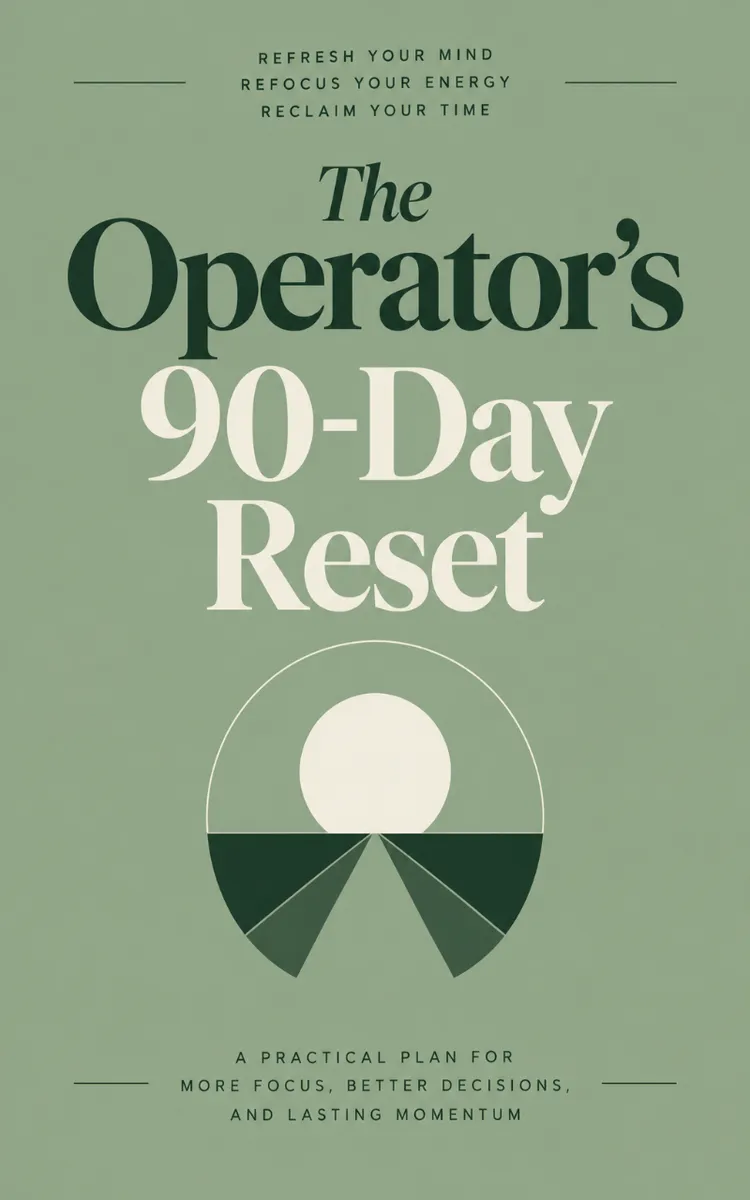
"The Operator’s 90-Day Reset" is a self-help book by Anonymous with 30 chapters and approximately 18,051 words. A 90-day neuroscience-informed program for identity change, habit formation, and high-performance execution.
This book was created using Inkfluence AI, an AI-powered book generation platform that helps authors write, design, and publish complete books. It was made with the AI Self-Help Book Writer.
Frequently Asked Questions
What is "The Operator’s 90-Day Reset" about?
A 90-day neuroscience-informed program for identity change, habit formation, and high-performance execution
How many chapters are in "The Operator’s 90-Day Reset"?
The book contains 30 chapters and approximately 18,051 words. Topics covered include Days 1-3: Mapping Your Habit Loops, Days 4-6: Clearing Environmental Triggers, Days 7-9: Adding Friction to Distractions, Days 10-12: Resetting Your Morning State, and more.
Who wrote "The Operator’s 90-Day Reset"?
This book was written by Anonymous and created using Inkfluence AI, an AI book generation platform that helps authors write, design, and publish books.
How can I create a similar self-help book?
You can create your own self-help book using Inkfluence AI. Describe your idea, choose your style, and the AI writes the full book for you. It's free to start.
Write your own self-help book with AI
Describe your idea and Inkfluence writes the whole thing. Free to start.
Start writingCreated with Inkfluence AI


