
Read the first chapter
The whole of chapter one, free. About 30 min. Turn the pages with the arrows, your keyboard, or a swipe.
Chapter 1
Introduction
✨ 🌙 ⭐ 🌙 ✨
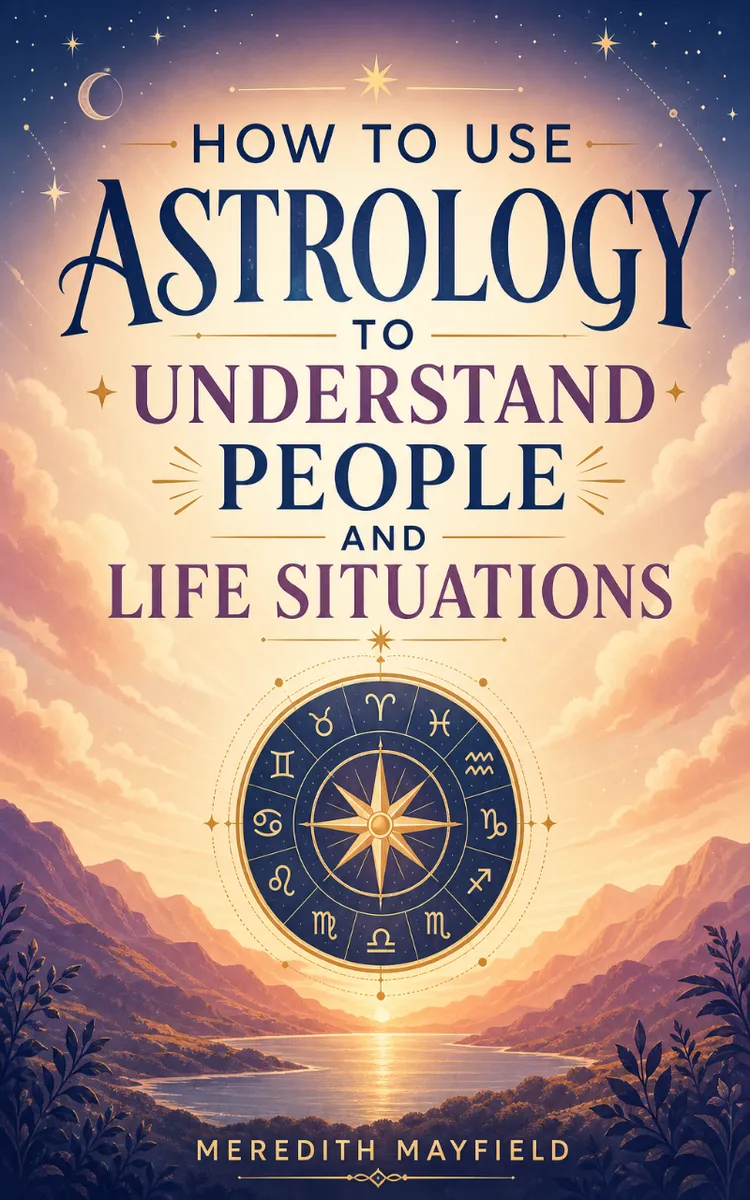
How to Use Astrology to Understand People & Life Situations
A Cosmic Guide to Reading the Stars, the Souls Around You, and the Seasons of Your Life
✦ ✦ ✦
by Meredith Mayfield
🌠 ✨ 🌠
"The stars are not our masters — they are our mirrors."
✨
For every woman who has ever looked up at the night sky and felt the universe whispering her name...
This book is for you.
May you find yourself written in the stars, and may you finally understand why you have always been exactly who you are.
With love, stardust, and infinite wonder,
— Meredith
✦ Author's Introduction ✦
A Note from Meredith
There was a night, many years ago, when everything in my life had fallen apart. My relationship was unraveling. My sense of self felt like a faded photograph — there, but barely. I sat outside under a sky thick with stars and I remember thinking: there has to be a map somewhere. There has to be something that can help me make sense of this.
That night, I picked up my first astrology book. I was skeptical — I want to be honest with you about that. I had spent enough time in logical, analytical circles to be suspicious of anything that smelled like "woo." But I was desperate enough to try. And what happened over the following weeks and months changed not just how I saw myself — it changed how I saw every single person in my life.
I began to understand why my mother, a Capricorn Sun with Saturn in the first house, expressed love through acts of service rather than words of affirmation — and why, for years, I had mistaken her practicality for coldness. I began to understand why I, with my Libra Moon, experienced emotions so intensely that other people seemed to live on a different emotional planet entirely. I began to understand the pattern in my romantic relationships — the same dynamic, cycling through different faces — and how my Venus placement was quietly orchestrating the whole drama.
Astrology gave me a language. Not a language of fate, or doom, or fixed destiny — but a language of pattern, of tendency, of potential. It helped me stop asking "What is wrong with me?" and start asking "What am I here to learn?" It helped me stop asking "What is wrong with them?" and start asking "What are they carrying that I cannot see?"
This book is the guide I wish I had held in my hands that night under the stars. It is written not for the academic astrologer, but for the woman who feels something stirring in her — a call toward the cosmos, a hunger for deeper self-understanding, a desire to move through her relationships and her life with more grace and wisdom and compassion.
This is not a book you will read once and set down. This is a book you will return to again and again as you grow, as your life changes, as new people enter your orbit and old patterns finally release their grip. Consider it your cosmic companion — worn at the edges, filled with your own notes, alive with your own discoveries.
The stars have been patient. They have been waiting for you. And I am so deeply honored to be the one to introduce you.
With love and starlight, Meredith Mesa, Arizona, 2026
✦ Before You Begin ✦
How to Use This Book
This book is a journey, not a destination. It has been designed with both the curious beginner and the enthusiastic intermediate student of astrology in mind — which means wherever you are right now, there is something here for you.
You may read this book straight through from beginning to end, and I encourage you to do so on your first pass. The chapters have been organized in a deliberate sequence: we build the foundations in Part One, move into reading people in Part Two, understand life situations in Part Three, apply everything practically in Part Four, and integrate it all in Part Five. Each chapter rests on the ones before it, so reading in order will give you the richest, most layered understanding.
That said — if you are pulled to a particular chapter, follow that pull. If someone just walked into your life and you need to understand them right now, go to Part Two. If you are in the middle of a major life transition and need cosmic context, go to Part Three. The stars respond to urgency. You have permission to meet this book where your life is.
Throughout every chapter, you will find three kinds of special elements designed to deepen your experience. Wisdom Boxes offer key insights and cosmic reframes — read them slowly and let them land. Journal Prompts appear at the end of every chapter and are the heart of this book — I encourage you to write in response to every single one, not just the ones that feel easy. Worksheets are practical tools you can fill in either digitally or by hand, helping you translate what you are learning into real insight about your own chart and the people in your life.
I also encourage you to keep a dedicated astrology journal for this journey. Something beautiful, if you can — a journal that feels special, that honors the sacred nature of this work. Your chart, your observations, your questions — all of it deserves a home.
Finally: please be patient and loving with yourself as you learn. Astrology is a vast, rich, layered symbolic language. You will not master it overnight, and you do not need to. Every new insight is a gift. Every moment of recognition — oh, THAT'S why I do that — is a portal. Trust the process. Trust the stars. And above all, trust yourself.
Welcome, dear one. Let us begin.
✦ Navigation ✦
Table of Contents
✨ 🌙 ✨
Front Matter
A Note from Meredith (Author's Introduction)
How to Use This Book
✦ PART ONE: THE FOUNDATIONS — Learning the Cosmic Language
Chapter 1: What Is Astrology, Really?
1.1 A Brief History of Astrology
1.2 The Three Branches: Natal, Mundane, and Predictive
1.3 How Astrology Actually Works
1.4 Western vs. Vedic vs. Chinese Astrology
Chapter 2: The Natal Chart — Your Cosmic Blueprint
2.1 What Is a Natal Chart?
2.2 The Three Pillars: Sun, Moon, Rising
2.3 The 10 Planets and What They Represent
2.4 The 12 Signs — Orientation
2.5 The 12 Houses — Overview
2.6 Aspects: The Conversations Between Planets
2.7 Worksheet: My Natal Chart Basics
Chapter 3: The 12 Signs — An Overview of the Cosmic Cast
3.1 The Four Elements: Fire, Earth, Air, Water
3.2 The Three Modalities: Cardinal, Fixed, Mutable
3.3 Polarity: Masculine/Feminine Signs
3.4 Sign Rulers
3.5 A Cosmic Cast Introduction: All 12 Signs
✦ PART TWO: UNDERSTANDING PEOPLE — Reading Souls Through the Stars
Chapter 4: The Sun Sign — The Core Identity
4.1 Why the Sun Sign Is Just the Beginning
4.2 Full Sun Sign Profiles (All 12 Signs)
4.3 Working with Sun Sign Incompatibilities
Chapter 5: The Moon Sign — Reading Emotional Needs
5.1 Why the Moon Is the Key to Emotional Understanding
5.2 Full Moon Sign Profiles (All 12 Signs)
5.3 Sun-Moon Combinations
5.4 Worksheet: Understanding Someone's Moon Sign
Chapter 6: The Rising Sign — The Mask and the Doorway
6.1 What the Rising Sign Really Is
6.2 The Rising Sign as Invitation
6.3 Rising Sign Profiles (All 12 Signs)
6.4 The Big Three in Action
Chapter 7: Venus and Mars — Love, Desire, and Attraction
7.1–7.6 Venus & Mars Through the Signs + Worksheet
Chapter 8: Mercury, Saturn, and the Outer Planets
8.1–8.5 Communication, Karma, Generations + Worksheet
✦ PART THREE: UNDERSTANDING LIFE SITUATIONS — Houses and Transits
Chapter 9: The 12 Houses — The Stages of Your Life
Chapter 10: Transits — The Weather of Your Life
Chapter 11: Progressions, Solar Returns, and Synastry
✦ PART FOUR: PRACTICAL APPLICATION — Astrology in Everyday Life
Chapter 12: Reading People You Just Met
Chapter 13: Understanding Difficult People and Challenging Relationships
Chapter 14: Timing Your Life with Astrology
Chapter 15: Astrology for Business, Creativity, and Purpose
✦ PART FIVE: INTEGRATION — Becoming the Astrologer of Your Own Life
Chapter 16: Building Your Astrological Practice
Chapter 17: Your Cosmic Signature — Putting It All Together
Chapter 18: Closing — A Love Letter to the Stars
✦ Back Matter
Appendix A: Glossary of Astrological Terms
Appendix B: Quick Reference Chart
Appendix C: Recommended Resources
Appendix D: Blank Natal Chart Worksheet
About the Author
A Final Blessing
✦ Part One ✦
The FoundationsLearning the Cosmic Language
"Before you can read the stars, you must learn their alphabet. Welcome to the language of the cosmos."
✦ Chapter One ✦
What Is Astrology, Really?
1.1 A Brief History of Astrology
Astrology is one of the oldest languages humanity has ever spoken. Long before we had psychology, neuroscience, or self-help books, our ancestors looked up at the night sky and understood, on some deep cellular level, that what moved above them was intimately connected to what moved within them. The story of astrology is the story of human consciousness itself — our endless, beautiful reaching toward meaning.
The earliest astrological records we have come from ancient Mesopotamia — from the Babylonians and Sumerians, who as far back as 3000 BCE were carefully tracking the movements of the planets and correlating them with events on Earth: floods, famines, the rise and fall of kings. These early astrologers were also astronomers, priests, and counselors — the original advisors to power. Their observations were not casual; they were meticulous, sacred, and passed down through generations with enormous care.
From Mesopotamia, astrological knowledge flowed into ancient Egypt, where the Egyptians added their own layer of cosmic mythology and created some of the earliest personal horoscopes. The Egyptians understood the stars as divine — the sky was the body of the goddess Nut, arching over the Earth, and the movements of the planets were expressions of divine will. Later, the Greeks inherited and transformed this tradition. Greek philosophers, including Plato, Aristotle, and later Ptolemy, integrated astrology into their frameworks for understanding the cosmos and the human soul. Ptolemy's second-century text, the Tetrabiblos, became one of the foundational documents of Western astrology and remained influential for over a thousand years.
Through the Renaissance, astrology flourished alongside medicine, philosophy, and art. It was not considered superstition — it was considered natural philosophy, the study of natural law as expressed through celestial cycles. The great astronomers we revere — Kepler, Copernicus, Galileo — all practiced astrology. The split between astronomy and astrology came later, as the scientific revolution demanded a different kind of proof than the symbolic, intuitive language of the stars could offer.
In the twentieth century, astrology experienced a profound renaissance of its own. Psychologists, particularly Carl Jung, recognized in astrology a sophisticated symbolic language for understanding the human psyche. Modern psychological astrology — the tradition this book is rooted in — moved away from prediction and fate and toward self-understanding, growth, and empathy. Today, astrology is experiencing another wave of revival, particularly among women and spiritual seekers who find in it a profound tool for navigating a complex world.
1.2 The Three Branches: Natal, Mundane, and Predictive Astrology
Astrology is not one single practice — it is a rich constellation of approaches, each with its own focus and methodology. Knowing these three major branches will help you understand the scope of what you are learning.
Natal Astrology is the branch we will spend the most time with in this book. It is the practice of reading the chart of an individual's birth — the snapshot of the sky at the exact moment and location of birth — to understand that person's character, gifts, challenges, soul purpose, and life patterns. Natal astrology says: you arrived in this world at a cosmically significant moment, and that moment contains a map. This book is primarily a guide to reading that map — for yourself and for others.
Mundane Astrology is the practice of reading the cosmic weather as it relates to world events — the rise and fall of nations, social movements, global crises, and collective shifts. When astrologers speak of Pluto entering Aquarius heralding a transformation in political and technological power structures, they are practicing mundane astrology. While this book touches on this branch, particularly in the transit chapters, it is not our primary focus.
Predictive Astrology is the practice of using astrological cycles and transits to forecast future trends and timing. It includes techniques like transits, progressions, solar returns, and solar arc directions. We will explore all of these in Part Three. Predictive astrology does not predict the future in a fixed, fated sense — rather, it illuminates the energetic weather you are likely to move through, helping you work with the cycles rather than against them.
1.3 How Astrology Actually Works
Here is the question that brave, honest students of astrology always ask: how does it work? And the honest answer is: we do not know, exactly — and that is perfectly fine. We do not know exactly how consciousness works either, yet we do not deny it.
What we can say is this: astrology operates as a symbolic language. The planets and signs and houses are not causing events — they are not sending rays of influence down from the sky to control your life. Rather, they are a symbolic map, a language of pattern and correspondence. The ancient philosophical principle that guides this is as above, so below — the idea that there is a correspondence between the macrocosm (the cosmos) and the microcosm (the individual soul). The same patterns and energies that play out in the great dance of the planets also play out in the lives of individual human beings.
Carl Jung, one of the twentieth century's greatest psychological thinkers, was deeply interested in astrology and helped develop the concept of synchronicity — the idea that events can be meaningfully connected without being causally connected. Two things can happen at the same time that mirror each other, not because one caused the other, but because they both arise from the same underlying pattern. Astrology, in this view, is a synchronistic system: the position of Mars at your birth does not cause you to be passionate and assertive — rather, you arrived in the world at a moment when the cosmic pattern was expressing that energy, and your life, your character, your tendencies, are an expression of that same pattern.
What this means, practically, is that astrology is a tool for self-awareness and empathy, not a machine for fate. It helps you see patterns you might not otherwise see. It offers you a framework for understanding why you are the way you are, and why the people in your life are the way they are. It invites compassion — for yourself and for others. And it opens a doorway to a more conscious, intentional way of living.
✨ Cosmic Wisdom ✨
"Astrology is not about fate — it is about understanding the energies at play so you can dance with them, not be dragged by them. You are not your chart. You are the consciousness looking at your chart, and that makes all the difference."
1.4 Western vs. Vedic vs. Chinese Astrology
The astrological tradition we explore in this book is Western astrology, also called Tropical astrology — the system derived from the Greco-Roman tradition that uses the Tropical zodiac, which is calibrated to the seasons and the Sun's relationship to Earth. This is the most widely practiced astrological system in the Western world, and it is the one that most people encounter when they look up their "star sign."
Vedic Astrology (also called Jyotish) is the ancient astrological tradition of India. It uses the Sidereal zodiac, which is calibrated to the actual position of the stars in the sky. Because of the phenomenon of axial precession — the slow wobble of Earth's axis — the Sidereal and Tropical zodiacs have drifted about 23-24 degrees apart over millennia. This means that if you are a Pisces in Western astrology, you might be an Aquarius in Vedic astrology. Vedic astrology is a profound, complete system in its own right, with a strong emphasis on karma, dharma, and life destiny. Many people find great insight in both systems.
Chinese Astrology is a completely different tradition — one based on a twelve-year cycle of animal signs (Rat, Ox, Tiger, Rabbit, Dragon, Snake, Horse, Goat, Monkey, Rooster, Dog, Pig) and a complex system of elemental cycles, heavenly stems, and earthly branches. It is rich, wise, and fascinating in its own right, but it operates on entirely different principles than the system we explore here.
For this book, we are anchored in Western Tropical astrology. This is where I work, where I find the greatest resonance, and where most of the contemporary tools and resources you will use are rooted. But I want you to know: if you are called to explore Vedic or Chinese astrology, those paths have profound wisdom to offer as well.
🌙 Journal Prompt — Chapter 1
What drew you to astrology? Was it a specific moment, a person, a feeling of recognition when you first read your sign description? What do you hope to understand about yourself or others through this journey? Write freely — let the page receive all of it.
✦ ✦ ✦
✦ Chapter Two ✦
The Natal Chart — Your Cosmic Blueprint
2.1 What Is a Natal Chart?
Imagine the sky as a great circular stage, and at the moment of your birth, every player — every planet, every luminary — was standing in a specific spot on that stage. Your natal chart is the photograph of that precise configuration: the heavens frozen at your moment of arrival. It is your cosmic blueprint, your soul's fingerprint, the map that says: this is the pattern this life is working with.
To generate your natal chart, you need three things: your date of birth, your time of birth (as accurate as possible — even a one-hour difference can shift your Rising sign and house placements significantly), and your place of birth. With these three pieces of information, you can calculate your chart at any of several excellent free websites: Astro.com (the gold standard for precision), Astro-Seek.com (wonderful for transit tracking and extra features), or Astro-Charts.com (beautifully visual). Many apps like TimePassages and Co-Star are also wonderful tools.
If you do not know your birth time — and many people do not — do not despair. You can still work with a great deal of your chart. Your Sun sign, Moon sign (though this one can shift if you were born on a day when the Moon changed signs), Mercury, Venus, Mars, Jupiter, Saturn, and the outer planets can all be determined from your date of birth alone. What you lose without a birth time is your Rising sign and your house placements — which are significant, but not the whole story. You can also explore what is called a "noon chart" — calculated for noon on your birth date — or a Solar chart, which places your Sun sign on the first house cusp.
Pull up your natal chart now, if you have not already. Take a moment to look at it. You do not need to understand everything you see — that is what this book is for. But begin to get acquainted with it. Notice the symbols (called glyphs) scattered around the circle. Notice the inner wheel, divided into twelve sections (the houses). Notice the planets gathered in clusters or spread around the wheel. This is your chart. This is you.
2.2 The Three Pillars: Sun, Moon, and Rising
If your natal chart is a symphony, then the Sun, Moon, and Rising sign are the three principal instruments — the ones whose melodies you will hear most clearly in your everyday experience. Together, they form what astrologers call "the Big Three," and knowing all three is essential to a nuanced, accurate self-understanding.
The Sun Sign is the one most people know — it is determined by which zodiac sign the Sun was moving through on your birthday. The Sun represents your core identity, your conscious self, the essence of who you are and who you are becoming. It is your hero's journey, your vital force, the way you shine in the world. The Sun is the story you are here to live.
The Moon Sign is determined by which zodiac sign the Moon was moving through at your birth — and because the Moon moves quickly (changing signs every two to two-and-a-half days), two people born on the same day can have completely different Moon signs. The Moon represents your emotional self, your inner world, your instinctive reactions, your needs, your relationship to nurturing and being nurtured. If the Sun is who you are consciously, the Moon is who you are unconsciously — the self you carry beneath the surface.
The Rising Sign (also called the Ascendant) is the zodiac sign that was rising over the Eastern horizon at the exact moment of your birth. It changes every two hours, which is why birth time matters so much. The Rising sign represents your outer personality, your appearance, the way you walk into a room, the mask or doorway you present to the world. It is often the first impression you give and the lens through which you experience the world around you.
Understanding all three creates a far richer portrait than the Sun sign alone. You might be a Gemini Sun who shines through communication and ideas — but if you have a Scorpio Moon and a Capricorn Rising, your inner world is intensely private and emotional, and the face you present to the world is serious and composed. Context is everything.
2.3 The 10 Planets and What They Represent
Planet ✦
Governs
Essence
☀ Sun
Identity, ego, vitality
The core self — your conscious identity, your creative life force, the story you are here to live. Where your Sun falls shows where you are meant to shine.
☽ Moon
Emotions, needs, instincts
Your inner world — emotional nature, childhood conditioning, what you need to feel safe and nurtured. The Moon is the soul's deepest home.
☿ Mercury
Communication, mind, learning
How you think, speak, write, process information, and communicate with others. Mercury is the messenger — the link between your inner world and the world of ideas.
♀ Venus
Love, beauty, values, pleasure
How you love and what you value — in relationships, in art, in aesthetics, in abundance. Venus shows what your heart truly desires and how you draw beauty into your life.
♂ Mars
Drive, desire, action, courage
How you pursue what you want — your energy, your passion, your assertiveness, your sexual energy. Mars is where you are willing to fight for what matters.
♃ Jupiter
Expansion, wisdom, abundance
Where life wants to grow and expand for you — your area of natural luck, philosophical wisdom, and generous abundance. Jupiter says: more is possible here.
♄ Saturn
Discipline, karma, structure
Where you are being invited to grow through challenge, restriction, and mastery. Saturn is the cosmic teacher — demanding, sometimes harsh, but ultimately the maker of real, lasting achievement.
♅ Uranus
Revolution, liberation, awakening
The planet of sudden change, innovation, and rebellion against the old order. Uranus says: break free. It brings disruption that ultimately leads to liberation.
♆ Neptune
Dreams, spirituality, dissolution
The planet of imagination, mysticism, spiritual longing, and the dissolution of boundaries. Neptune blurs edges — between self and other, between the real and the imagined.
♇ Pluto
Transformation, power, rebirth
The planet of death and rebirth — of going into the underworld and emerging transformed. Pluto strips away everything that is not true so that what is essential can survive and rise.
2.4 The 12 Signs — A Quick Orientation
Each of the ten planets lives in one of the twelve zodiac signs in your natal chart. The sign a planet occupies colors the energy of that planet — it tells you how that planet expresses itself. We will dive deeply into the twelve signs in Chapter 3 and explore how each planet functions through each sign in Part Two. For now, know that the signs are the great archetypes of the zodiac — twelve fundamental patterns of energy, twelve ways of being human.
2.5 The 12 Houses — Brief Overview
The natal chart is divided into twelve pie-slice sections called houses. While the signs describe how energy expresses, the houses describe where that energy plays out — what area of life it governs. The first house governs self and identity; the second governs money and values; the seventh governs relationships; the tenth governs career and public life. Each house is a stage, and the planets within it are the players performing on that stage. We will explore every house in detail in Chapter 9.
2.6 Aspects: The Conversations Between Planets
No planet in your chart stands alone. Each one is in relationship with the others, and the geometric angles between them — called aspects — describe the nature of those relationships. Aspects are the conversations happening between different parts of your psyche, and they add enormous richness to chart interpretation.
Conjunction (0°): Two planets sitting right next to each other, their energies blending and merging. This creates an intense focus — the energies amplify each other. It can be powerfully harmonious or intensely challenging, depending on which planets are involved.
Trine (120°): A flowing, harmonious connection. Planets in trine support and enhance each other naturally, with ease. These are your gifts — energies that flow together without friction.
Sextile (60°): A gentle, supportive connection, similar to the trine but requiring a bit more conscious activation. Sextiles represent opportunities and talents that bloom when you actively engage with them.
Square (90°): A dynamic tension between planets. Squares create friction, challenge, and pressure — they are the great motivators of the chart. They say: these two energies in you are pulling in different directions. Figure out how to integrate them. Squares often produce the most driven, accomplished people precisely because the tension demands resolution.
Opposition (180°): Two planets facing each other across the chart — a polarity, a see-saw. Oppositions ask you to integrate two seemingly contradictory energies, often playing out through relationships where you project one side onto others.
✦ Worksheet 2.7 ✦
My Natal Chart Basics
My Sun Sign (Core Identity):
My Moon Sign (Emotional Nature):
My Rising Sign / Ascendant (Outer Mask):
Mercury Sign (Communication):
Venus Sign (Love & Values):
Mars Sign (Drive & Desire):
Jupiter Sign (Expansion & Luck):
Saturn Sign (Lessons & Karma):
North Node Sign (Soul Direction):
Midheaven / MC (Career Calling):
One thing that surprises me about my chart:
One thing that deeply resonates:
🌙 Journal Prompt — Chapter 2
Pull up your natal chart. Look at it for a full three minutes before writing. What surprises you? What feels immediately, undeniably right? Which placements make you think "oh yes, that explains everything" — and which ones feel like a mystery you want to explore?
✦ ✦ ✦
✦ Chapter Three ✦
The 12 Signs — An Overview of the Cosmic Cast
3.1 The Four Elements: Fire, Earth, Air, Water
Before we meet each sign individually, we need to understand the four great elements that organize the zodiac — because these elements are not just poetic metaphors. They describe fundamentally different ways of experiencing and interacting with reality.
Fire Signs — Aries, Leo, Sagittarius: Fire is the element of spirit, inspiration, and vitality. Fire signs live in the realm of vision, enthusiasm, and possibility. They are energized by action, passion, and the future. At their best, they are inspiring, courageous, and magnetic. When unbalanced, they can burn through people and situations without stopping to feel the aftermath. Fire signs teach us the sacred courage of being fully alive.
Earth Signs — Taurus, Virgo, Capricorn: Earth is the element of matter, practicality, and embodiment. Earth signs live in the realm of the physical — the body, the senses, material reality, and tangible results. They are grounded, patient, and deeply reliable. At their best, they are the ones who make things real — who take the vision and build it. When unbalanced, they can become rigid, overly cautious, or stuck. Earth signs teach us the sacred art of being present in the body and building something that lasts.
Air Signs — Gemini, Libra, Aquarius: Air is the element of mind, communication, and connection. Air signs live in the realm of ideas, language, relationship, and social exchange. They are intellectual, curious, and gifted communicators. At their best, they are the bridges between worlds — the connectors, the thinkers, the visionaries of systems. When unbalanced, they can be scattered, detached, or disconnected from feeling. Air signs teach us the sacred power of thought and the necessity of genuine connection.
Water Signs — Cancer, Scorpio, Pisces: Water is the element of emotion, intuition, and soul. Water signs live in the realm of feeling, depth, psychic sensitivity, and the unseen. They are empathic, intuitive, and profoundly connected to the undercurrents of life. At their best, they are healers, visionaries, and deep lovers of the soul of the world. When unbalanced, they can drown in emotion or lose themselves in others. Water signs teach us the sacred language of feeling and the courage to dive into the deep.
3.2 The Three Modalities: Cardinal, Fixed, and Mutable
Within each element, the three signs are further differentiated by their modality — the quality of how they engage with the world and with change.
Cardinal Signs — Aries, Cancer, Libra, Capricorn: Cardinal signs are the initiators of the zodiac. They begin things, launch things, lead things. Each Cardinal sign opens a new season (Aries opens spring, Cancer opens summer, Libra opens autumn, Capricorn opens winter), and they carry that initiating, pioneering energy in everything they do. Cardinals say: let's go.
Fixed Signs — Taurus, Leo, Scorpio, Aquarius: Fixed signs are the sustainers of the zodiac. They deepen, commit, persevere, and endure. They land in the middle of each season and carry the energy of consolidation and determined focus. Fixed signs have extraordinary willpower and remarkable staying power — but they can also be resistant to change when change is most needed. Fixed signs say: I will hold.
Mutable Signs — Gemini, Virgo, Sagittarius, Pisces: Mutable signs are the adapters of the zodiac. They close each season, preparing for the next, and they carry the energy of flexibility, transition, and transformation. Mutable signs are wonderfully versatile, curious, and capable of seeing multiple perspectives — but they can struggle with completion and consistency. Mutable signs say: I can work with that.
3.3 Polarity: Masculine/Feminine (Yang/Yin) Signs
Each sign is also categorized as either Yang (traditionally called masculine) or Yin (traditionally called feminine). These terms describe modes of energy, not gender — all people carry both within them.
Yang Signs (Aries, Gemini, Leo, Libra, Sagittarius, Aquarius — the Fire and Air signs) are projective, outward-moving, and active. They tend to reach toward the world, express outward, and initiate contact.
Yin Signs (Taurus, Cancer, Virgo, Scorpio, Capricorn, Pisces — the Earth and Water signs) are receptive, inward-moving, and magnetic. They tend to draw the world toward them, process internally, and absorb deeply.
Neither is superior — both are essential. Understanding the Yin/Yang nature of the signs helps you recognize different styles of engagement without judgment.
3.4 Sign Rulers
Each zodiac sign has a planetary ruler — a planet whose nature is in deep resonance with the sign's energy. The ruler of your Sun sign, Moon sign, or Rising sign becomes extra important in your chart, because understanding its condition and placement adds another layer of meaning.
Sign
Ruler
Sign
Ruler
Aries ♈
Mars ♂
Libra ♎
Venus ♀
Taurus ♉
Venus ♀
Scorpio ♏
Pluto ♇ / Mars ♂
Gemini ♊
Mercury ☿
Sagittarius ♐
Jupiter ♃
Cancer ♋
Moon ☽
Capricorn ♑
Saturn ♄
Leo ♌
Sun ☀
Aquarius ♒
Uranus ♅ / Saturn ♄
Virgo ♍
Mercury ☿
Pisces ♓
Neptune ♆ / Jupiter ♃
3.5 A Cosmic Cast Introduction: All 12 Signs
♈ Aries (March 21 – April 19) — Fire, Cardinal, Yang
Aries is the first light of dawn — fierce, new, unapologetically alive. She arrives with the energy of the pioneer, the warrior, the one who goes first without knowing what lies ahead, trusting only the fire in her chest. Aries is pure creative impulse, raw courage made flesh, the soul that refuses to be diminished. She can be impatient, impulsive, even combustible — but her gift to the world is the sacred spark of beginning.
♉ Taurus (April 20 – May 20) — Earth, Fixed, Yin
Taurus is the sacred body — the lush garden, the perfumed earth after rain, the deep satisfaction of beauty fully received. She is ruled by Venus and carries within her a profound knowledge that pleasure is sacred, that the body is holy, that patience is a form of power. Taurus builds slowly and magnificently, rooted like an ancient oak. Her shadow is resistance to change; her gift is the ability to make life exquisitely real.
♊ Gemini (May 21 – June 20) — Air, Mutable, Yang
Gemini is the dancer of ideas — light, brilliant, endlessly curious, moving between worlds with the grace of a butterfly who is equally at home in every garden. She is the messenger, the connector, the one who weaves language into bridges between souls. Gemini's shadow is the restlessness that never quite lands; her gift is the magical ability to find something fascinating in everyone and everything.
♋ Cancer (June 21 – July 22) — Water, Cardinal, Yin
Cancer is the great mother of the zodiac — the keeper of memory, the guardian of the sacred hearth, the one who knows that love is the most powerful force in the universe. She feels everything, remembers everything, and loves with a devotion that can move mountains. Cancer's shadow is the tendency to retreat behind her shell when wounded; her gift is an emotional depth and nurturing wisdom that heals the world.
♌ Leo (July 23 – August 22) — Fire, Fixed, Yang
Leo is the great solar queen — the one who was born knowing that her life is a sacred performance, a brilliant work of art, a divine creative expression. She loves with her whole heart, leads with her whole presence, and lights up every room she enters simply by being fully herself. Leo's shadow is the hunger for validation that can become dependency; her gift is the courageous, generous heart that teaches everyone around her how to shine.
♍ Virgo (August 23 – September 22) — Earth, Mutable, Yin
Virgo is the sacred healer and the discerning priestess — the one who sees the gap between what is and what could be, and devotes herself to closing it through work, craft, and service. She is the most underestimated sign — mistakenly labeled "critical" when she is actually the one most deeply dedicated to excellence and wholeness. Virgo's shadow is the perfectionism that turns inward as harsh self-judgment; her gift is the profound capacity to make things better.
♎ Libra (September 23 – October 22) — Air, Cardinal, Yang
Libra is the goddess of beauty, balance, and sacred relationship — the one who understands, more deeply than any other sign, that we do not exist in isolation, that every soul is defined in part by its connections. She is the diplomat, the artist, the lover of harmony and fairness. Libra's shadow is the tendency to people-please at the cost of her own truth; her gift is the rare ability to see all sides and to weave connection where there was division.
♏ Scorpio (October 23 – November 21) — Water, Fixed, Yin
Scorpio is the mystic, the alchemist, the one who has walked through fire and come back carrying the secrets of the underworld in her eyes. She does not deal in surfaces — she goes straight to the bone, to the truth beneath the truth, to the thing everyone else is afraid to name. Scorpio's shadow is the tendency toward control, jealousy, and holding grudges; her gift is the incomparable capacity for transformation, for loving at depths most will never know.
♐ Sagittarius (November 22 – December 21) — Fire, Mutable, Yang
Sagittarius is the eternal seeker — the philosopher, the traveler, the one who is always reaching toward the next horizon of meaning, the next great adventure of the mind and spirit. She is ruled by Jupiter and carries within her an irrepressible optimism and a fierce love of truth and freedom. Sagittarius's shadow is the restlessness that commitments feel like cages; her gift is the visionary fire that expands everyone's sense of what is possible.
♑ Capricorn (December 22 – January 19) — Earth, Cardinal, Yin
Capricorn is the mountain — steady, ancient, patient, and impossibly sure of her path to the summit. She is the builder of legacies, the keeper of standards, the one who takes the long view when everyone else is lost in the immediate. Capricorn is ruled by Saturn and carries within her a profound sense of responsibility and purpose. Her shadow is the emotional armor that keeps vulnerability at bay; her gift is the capacity to build something genuinely great through sustained, devoted effort.
♒ Aquarius (January 20 – February 18) — Air, Fixed, Yang
Aquarius is the revolutionary — the visionary who sees ten years ahead, who carries the blueprint of a future the world is not yet ready for, who cannot make herself conform to structures that she knows are broken. She is the humanitarian, the innovator, the sacred rebel. Aquarius's shadow is the emotional detachment that can make intimacy feel threatening; her gift is the brilliant, luminous mind and generous heart that genuinely wants to liberate everyone she loves.
♓ Pisces (February 19 – March 20) — Water, Mutable, Yin
Pisces is the mystic ocean — boundless, compassionate, dreaming at the edge of the visible and invisible worlds. She feels what others cannot even name, loves without condition, and carries within her an ancient spiritual knowing that the separate self is an illusion. Pisces is ruled by Neptune and lives in a world where the veil between this reality and the next is translucent. Her shadow is the tendency to dissolve into others or escape into fantasy; her gift is the most profound spiritual compassion available in human form.
🌙 Journal Prompt — Chapter 3
Which sign do you feel most misunderstood by — the one whose energy has always seemed strange, difficult, or baffling to you? And which sign do you feel most drawn to — the one that magnetizes you, that you find yourself repeatedly in relationship with? What might those two things reveal about your own chart's story?
✦ Part Two ✦
Understanding PeopleReading Souls Through the Stars
"Every person who enters your life arrives with a cosmic signature. Learning to read it is one of the most profound gifts you can give yourself."
✦ Chapter Four ✦
The Sun Sign — The Core Identity
4.1 Why the Sun Sign Is Just the Beginning (And Why It Still Matters)
Let us be honest about something that popular astrology has both gotten right and gotten wrong: the Sun sign is simultaneously the most important and the most incomplete part of your chart. It is the most important because it represents your core identity — the soul's fundamental orientation toward life, the story you are here to live, the vital force that animates your entire existence. And it is incomplete because it is only one of the many voices in the symphony of your birth chart.
End of chapter one.
Swipe or use the arrows to turn the page


What's inside: 1 chapter
- 1. Introduction
About this book
"How to Use Astrology to Understand People and Life Situations" is a self-help book by Meredith Mayfield with 1 chapters and approximately 35,693 words. It covers key insights and practical takeaways on the topic.
This book was created using Inkfluence AI, an AI-powered book generation platform that helps authors write, design, and publish complete books. It was made with the AI Self-Help Book Writer.
Frequently Asked Questions
What is "How to Use Astrology to Understand People and Life Situations" about?
"How to Use Astrology to Understand People and Life Situations" is a self-help book by Meredith Mayfield covering key insights and practical takeaways on the topic.
How many chapters are in "How to Use Astrology to Understand People and Life Situations"?
The book contains 1 chapters and approximately 35,693 words. Topics covered include Introduction.
Who wrote "How to Use Astrology to Understand People and Life Situations"?
This book was written by Meredith Mayfield and created using Inkfluence AI, an AI book generation platform that helps authors write, design, and publish books.
How can I create a similar self-help book?
You can create your own self-help book using Inkfluence AI. Describe your idea, choose your style, and the AI writes the full book for you. It's free to start.
Write your own self-help book with AI
Describe your idea and Inkfluence writes the whole thing. Free to start.
Start writingCreated with Inkfluence AI


