
Read the first chapter
The whole of chapter one, free. About 11 min. Turn the pages with the arrows, your keyboard, or a swipe.
Chapter 1
Chapter 1
THE RELATIONSHIP THAT NEVER HAD A NAME
There are relationships we can describe with certainty. We know when they began, what they meant, and sometimes even the moment they ended. They have recognizable milestones, shared decisions, and a place in the story of our lives.
And then there are the connections that resist every familiar definition.
Someone enters your life and gradually becomes important. Perhaps the connection begins as a friendship, a professional acquaintance, or an unexpected meeting. There may be attraction, emotional closeness, private conversations, or an understanding that seems difficult to explain to anyone outside it. Over time, the person begins to occupy a meaningful place in your emotional world.
Yet no clear relationship develops.
There may be no agreement about what you are to each other, no shared understanding of where things are going, and no moment when both people openly acknowledge what the connection has become.
Still, something has happened.
You have developed feelings. You have invested attention, emotional energy, and perhaps a part of your imagined future. You may have discovered qualities in yourself that emerged specifically through knowing this person. You may have felt understood, desired, appreciated, or unusually connected.
The absence of an official relationship does not make these experiences imaginary.
But it does create a psychological complication: how do you understand an attachment when the relationship itself was never clearly defined?
This question sits at the center of a surprisingly complex emotional experience.
The Difference Between a Relationship and an Emotional Connection
In everyday conversation, people often use the word relationship to describe a recognized romantic partnership. Two people are together, they acknowledge their commitment, and their connection carries certain expectations.
Psychologically, however, human connection is not limited to formally established partnerships.
People develop emotional bonds through familiarity, meaningful interaction, vulnerability, shared experiences, and the perception that another person matters to them.
These processes do not necessarily require a romantic agreement.
A friendship can become emotionally intimate. Two people can experience mutual attraction without pursuing a relationship. A connection can grow through years of shared circumstances while remaining difficult to categorize.
Emotional significance and relationship status are therefore two different dimensions of human experience.
One describes the importance someone has acquired in your inner world. The other describes the nature of the relationship that two people have actually established.
They may develop together, but they do not always do so.
This distinction is essential because people often confuse the intensity of their emotional experience with the existence of a mutual romantic commitment.
Feeling deeply connected to someone tells you something meaningful about your experience. It does not, by itself, establish what the other person feels, intends, or is prepared to build.
Similarly, the absence of a formal commitment does not prove that the connection was meaningless to either person.
Both realities can exist simultaneously.
A person may have mattered profoundly to you without ever becoming your partner.
Understanding that possibility allows us to examine the experience without either exaggerating or dismissing it.
Why We Need Names for Our Relationships
Human beings organize their social lives through categories.
Friend. Partner. Spouse. Colleague. Former partner.
These labels are more than convenient descriptions. They help communicate expectations, responsibilities, boundaries, and the degree of involvement people can reasonably anticipate from one another.
When someone is your partner, you may expect certain forms of communication, consideration, exclusivity, or shared decision-making, depending on the agreements you have made.
When someone is a friend, the expectations may be different.
The label does not guarantee healthy behavior, but it provides a starting point for understanding the relationship.
An undefined connection lacks that shared reference point.
One person may experience increasing romantic attachment while the other understands the connection primarily as friendship. Both may recognize attraction but hold different assumptions about its significance. Sometimes neither person knows exactly what they want.
Without a shared definition, the same interaction can carry different meanings.
Consider two people who have known each other for several years. They enjoy one another’s company, remember personal details, and share conversations they rarely have with anyone else.
One begins to experience this closeness as the foundation of a possible romantic relationship.
The other values the connection deeply but has never considered changing its nature.
Neither person’s emotional experience is necessarily dishonest.
The difficulty arises when their interpretations remain unspoken.
A relationship label cannot manufacture commitment, but a lack of clarity can leave important expectations unexamined.
This is one reason undefined relationships can become emotionally complicated even when neither person intends to hurt the other.
When Emotional Reality and Social Reality Do Not Match
One of the most unsettling aspects of an undefined connection is the difference between what someone experiences privately and what they can acknowledge publicly.
Imagine spending years knowing a person who has influenced your emotional life.
You may remember meaningful conversations, shared experiences, moments of tenderness, or occasions when their presence changed how you felt about yourself.
Yet if someone asks, “Were you together?” the answer may be no.
That answer can feel strangely inadequate.
It describes the formal status of the relationship, but not necessarily its emotional importance.
Social recognition influences how people understand their experiences. Established relationships have familiar rituals, anniversaries, introductions, and endings. Other people can usually identify the connection and recognize its significance.
Undefined relationships may have none of these markers.
The emotional experience exists, but there may be no socially recognized category in which to place it.
This discrepancy can produce confusion.
You may question whether you have the right to feel attached, disappointed, or hurt. You may compare your experience with conventional relationships and conclude that yours somehow counts for less.
But emotions are not awarded according to relationship status.
They emerge from psychological processes involving perception, memory, expectation, attachment, and personal meaning.
A relationship does not need public recognition to influence someone’s emotional life.
At the same time, private emotional significance does not create mutual obligations that were never discussed or accepted.
Holding both truths is important.
Your feelings deserve to be understood, while the actual nature of the connection must also be examined.
The Quiet Development of Emotional Importance
Not every meaningful attachment begins with dramatic attraction.
Sometimes a person becomes important almost imperceptibly.
At first, they may be one individual among many in your everyday environment. You enjoy their company, appreciate their perspective, or feel comfortable around them.
Gradually, you begin to notice their absence.
You remember something they said because it changed how you understood a situation. You look forward to seeing them because your interactions feel different from ordinary social encounters. Their opinion begins to matter more than you expected.
This development is not inherently romantic.
Human beings naturally become emotionally invested in people who offer connection, understanding, familiarity, or a sense of belonging.
The experience becomes more complicated when romantic possibility enters the picture.
A gesture that once seemed friendly may acquire additional significance. A shared experience may become a treasured memory. An ordinary conversation may feel unusually intimate because of the emotional meaning you attach to the person.
The change is not always obvious.
There may be no identifiable moment when affection becomes romantic attachment.
Instead, the person gradually moves from being part of your environment to becoming part of your emotional expectations.
You begin to imagine their presence in situations that have not happened.
You may wonder how they would respond to an important decision, what spending more time together might feel like, or whether the connection could become something different.
These thoughts do not necessarily indicate an unhealthy attachment. Imagining possible futures is a normal part of human emotional life.
The important distinction is between recognizing a possibility and treating that possibility as an established reality.
One is an expression of interest.
The other can begin to shape expectations that the relationship has not yet supported.
The Problem With Measuring a Connection by Its Intensity
People often assume that powerful emotions must indicate an equally powerful relationship.
If a connection feels unusually meaningful, it can seem reasonable to conclude that something extraordinary exists between the two people.
But emotional intensity is not a reliable measure of mutual compatibility or commitment.
A powerful connection may arise because someone shares your values, understands your experiences, or brings out qualities you appreciate in yourself.
It may also become especially significant during a period of loneliness, transition, personal uncertainty, or emotional vulnerability.
Sometimes the attraction is strengthened by the fact that the relationship remains undefined.
When the future is unclear, the mind has more room to imagine what the connection could become.
This does not mean the feelings are false.
It means their intensity may reflect several psychological influences rather than one simple truth about the relationship.
Two people can experience genuine attraction and still want different lives.
They can understand one another deeply without being compatible romantic partners.
They can share meaningful experiences without developing the willingness or circumstances necessary to build a committed relationship.
Emotional intensity tells us that something matters.
It does not automatically tell us what that something can become.
This distinction becomes especially important when someone begins using the strength of their feelings as evidence that a relationship must eventually happen.
The emotional experience deserves respect, but the possibility of a relationship must also be evaluated through communication, shared intentions, and observable choices.
When Both People Feel Something but Nothing Develops
It is tempting to divide undefined relationships into two simple categories: one person cares, and the other does not.
Human relationships are rarely so convenient.
Sometimes both people experience attraction, affection, or emotional closeness, yet the connection never develops into a partnership.
There may be practical obstacles.
Two people might live in different countries, have incompatible family responsibilities, or be moving through life stages that make a shared future difficult.
There may also be emotional obstacles.
One person may want a committed relationship while the other feels uncertain about taking that step. Both may value the connection but struggle to communicate openly. They may disagree about what commitment would require.
In other cases, neither person takes the initiative necessary to transform the relationship.
This creates an important distinction between feeling something and building something.
Affection is an emotional experience.
A relationship is also a process involving decisions, communication, availability, and reciprocal participation.
The presence of feelings does not eliminate the need for these other elements.
Nor does the absence of commitment prove that every expression of affection was insincere.
Someone may genuinely care about another person while being unwilling, unable, or unprepared to pursue a romantic relationship.
Understanding this possibility can prevent two opposite mistakes.
The first is assuming that the connection meant nothing simply because it never became official.
The second is assuming that meaningful feelings must eventually produce commitment.
Neither conclusion is necessarily justified.
The reality may be more complicated, and accepting complexity is often the beginning of understanding.
Why Undefined Connections Can Be Difficult to Explain
People usually tell the stories of their romantic lives through recognizable events.
They met someone. They began dating. They became partners. They separated.
These events create a narrative with a beginning, development, and outcome.
Undefined connections frequently lack that structure.
You may struggle to identify when the emotional relationship began because there was never a formal beginning.
You may find it difficult to explain what changed because the connection developed through subtle interactions rather than explicit decisions.
And if the relationship fades, you may be unable to identify a clear ending.
This can make the experience difficult to communicate, even to people who care about you.
Someone listening from the outside may focus on the absence of commitment and overlook the emotional history.
They may wonder why a person who was never officially your partner could matter so much.
The question may be understandable, but it overlooks how emotional significance develops.
Human beings do not attach themselves only to clearly defined relationships.
They attach meaning to experiences, people, memories, expectations, and the ways they feel in another person’s presence.
A connection can influence your sense of identity even if it never becomes a conventional romance.
Perhaps knowing this person made you recognize a desire for emotional intimacy that you had previously ignored.
Perhaps the connection challenged your understanding of what you wanted from love.
Perhaps it revealed how strongly you value being understood, or how difficult you find uncertainty.
These discoveries may remain significant regardless of what happened between the two people.
That does not mean every undefined relationship contains a profound life lesson.
Sometimes a connection is simply disappointing, confusing, or incompatible with what someone needs.
But understanding its emotional significance requires more than asking whether it had an official title.
Giving the Experience Its Proper Place
There is a difference between acknowledging an experience and allowing it to define your emotional future.
Recognizing that a connection mattered does not require treating it as the most important relationship you will ever have.
It does not require preserving every hope associated with it.
And it does not require convincing yourself that the other person experienced the connection in exactly the same way.
Acknowledgment is simpler and more grounded.
It means accepting that something emotionally meaningful occurred, even if the relationship never developed as you hoped.
It means recognizing your own feelings without turning them into proof of another person’s intentions.
It means allowing the experience to be real without assuming that it was destined to become something more.
For some people, this distinction brings immediate clarity.
They no longer need to minimize the connection simply because it lacked a familiar label.
For others, it raises more difficult questions.
If the connection was meaningful, why did it remain undefined?
If two people cared about one another, why did they never establish a relationship?
And why can emotional closeness become so powerful when the practical foundations of a partnership remain uncertain?
These questions cannot be answered through labels alone.
They require a closer examination of how emotional intimacy develops, how attachment forms, and why the mind can begin to experience another person as important long before a relationship has been established.
That is where our understanding must go next.
Because before we can understand why someone becomes difficult to let go of, we need to understand how they became emotionally important in the first place.
End of chapter one. 15 more chapters in the full book.
Swipe or use the arrows to turn the page
What's inside: 16 chapters
- 1. Chapter 1
- 2. Chapter 2
- 3. Chapter 3
- 4. Chapter 4
- 5. Chapter 5
- 6. Chapter 6
- 7. Chapter 7
- 8. Chapter 8
- 9. Chapter 9
- 10. Chapter 10
- 11. Chapter 11
- 12. Chapter 12
- 13. Chapter 13
- 14. Chapter 14
- 15. Chapter 15
- 16. Chapter 16
About this book
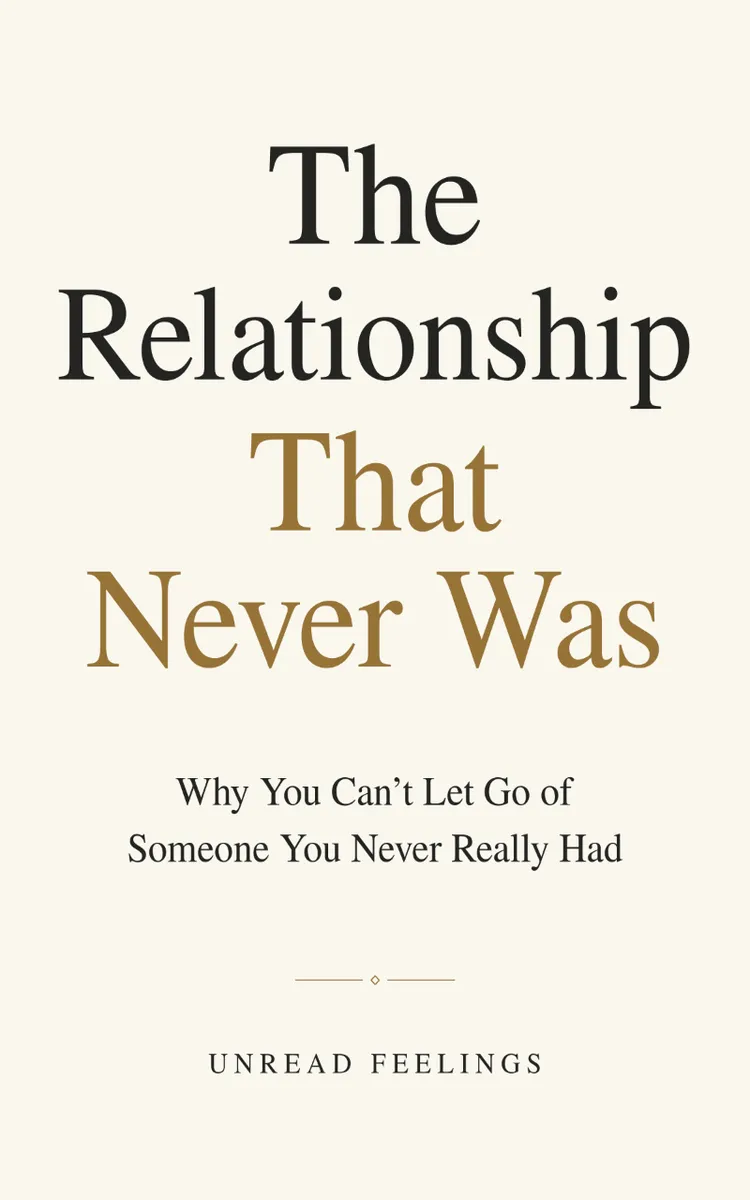
"The Relationship That Never Was" is a general book by Anonymous with 16 chapters and approximately 62,449 words. It covers key insights and practical takeaways on the topic.
This book was created using Inkfluence AI, an AI-powered book generation platform that helps authors write, design, and publish complete books.
Frequently Asked Questions
What is "The Relationship That Never Was" about?
"The Relationship That Never Was" is a general book by Anonymous covering key insights and practical takeaways on the topic.
How many chapters are in "The Relationship That Never Was"?
The book contains 16 chapters and approximately 62,449 words. Topics covered include Chapter 1, Chapter 2, Chapter 3, Chapter 4, and more.
Who wrote "The Relationship That Never Was"?
This book was written by Anonymous and created using Inkfluence AI, an AI book generation platform that helps authors write, design, and publish books.
Write your own book with AI
Describe your idea and Inkfluence writes the whole thing. Free to start.
Start writingCreated with Inkfluence AI


