
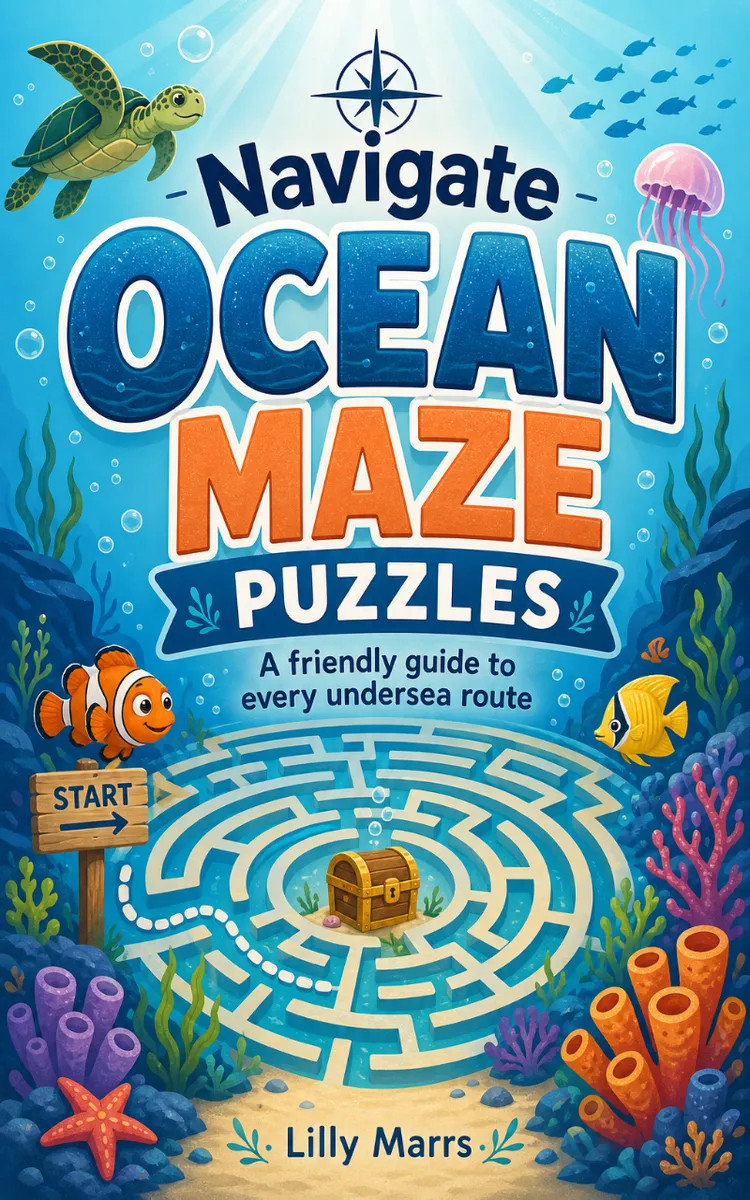
Navigate Ocean Maze Puzzles
Created with Inkfluence AI
🔀 Remixed from Ocean Maze Adventures
Learn a simple, repeatable way to solve 12 undersea mazes—from shallow reefs to the abyss gate—using the book’s start-to-finish structure and included solutions.
Table of Contents
- 1. Start-to-Finish Maze Basics
- 2. Choose Your Path in Shallow Water
- 3. From Cove to Deep Blue: Escalate
- 4. Living Fortresses and Ancient Ruins
- 5. Edge of the Trench: Solve the Hard Ones
- 6. Use the Solutions Without Spoiling It
Preview: Start-to-Finish Maze Basics
A short excerpt from “Start-to-Finish Maze Basics”. The full book contains 6 chapters and 9,268 words.
See the Maze as a Route
What do you check first when a maze looks crowded with twists, dead ends, and blue ocean spaces? If you start tracing random turns, the puzzle can quickly feel like a tangle. If you identify the route from S to E first, each line becomes a choice instead of a guess.
The 12 undersea mazes in this book move from the shallow reef toward the abyss gate, with difficulty increasing along the way. The basic task never changes: begin at S, follow connected paths, and finish at E without crossing a wall. That steady layout gives you a useful habit you can carry from the easiest printable puzzle to the most demanding one.
The Start - End Route Method helps you solve from the whole route rather than from isolated turns. You’ll learn how to read the maze, mark safe progress, test a doubtful branch, and return to the last reliable point when a path fails. After that, an 8 × 8 maze such as Shallow Reef becomes a short sequence of decisions, not a picture you must somehow memorize.
The Start - End Route Method
Begin by locating both endpoints before you draw anything. Find S and E, then look at the openings beside each one. An endpoint may sit along an outer edge or inside a wider section of the design. Knowing the entrance and destination gives your eyes a direction. You’re not searching for any path; you’re searching for one path that connects two fixed points.
Use the method in this order:
1. Spot S and E.
Put your finger or pencil beside the start and finish. This prevents a common mistake: following an attractive opening that leads away from the actual goal.
2. Read the nearby choices.
From S, inspect each connected passage. Count the available turns and note whether a passage ends quickly, bends around a wall, or continues toward the center. This first scan helps you choose a promising route without committing too early.
3. Trace one passage at a time.
Move your pencil through the open corridor, stopping at every junction. Don’t leap across a bend or assume two close lines connect. A maze rewards careful movement, not fast eye jumps.
4. Mark decisions lightly.
Use a small dot at a junction where you choose a branch. A dot records your decision without covering the printed walls. If the branch fails, you can return to that mark and try the next opening.
5. Test dead ends and turn back cleanly.
When a corridor stops, return to the last junction with an unused opening. This matters because a dead end gives useful information: it removes one possible route.
6. Confirm the finish.
When your line reaches E, follow it backward with your eyes. Check that every section stays inside the open path and that you didn’t cross a wall at a tight turn.
The method works because it separates movement from memory. You don’t need to remember every passage in an undersea maze. You only need to remember your latest decision and the last junction that still offers a choice.
Take the Shallow Reef example, an 8 × 8 grid. You might see S near the lower-left area and E near the upper-right area. The direct-looking path could turn into a dead end after four squares. Instead of erasing the whole attempt, place a small mark at the last junction, backtrack, and take the other opening. The maze now has a clear shape: one rejected branch and one route still under test.
Keep your marks light, especially in a printable puzzle book. A pencil works better than a thick pen because you can erase a wrong branch without hiding the walls. If you solve on a screen, use a thin drawing tool or a finger-friendly line that doesn’t cover nearby openings. Clear markings matter because a maze often places two paths close together.
A Route from Shallow Reef to E
Here’s a practical run through a small maze using the same habit. The exact artwork can vary, but the decisions show how to handle a real puzzle page.
1. Find the endpoints.
On an 8 × 8 Shallow Reef grid, locate S at the lower-left edge and E at the upper-right edge. Turn the page if needed so you can view the route comfortably. Expected outcome: you know the required direction without confusing an interior opening with the finish.
2. Inspect the first three openings from S.
Suppose one passage moves upward, one moves right, and one curves into a short pocket. Circle nothing yet. Choose the rightward passage because it remains open for several squares, while the pocket ends after two. Expected outcome: you make a reasoned first choice instead of picking the widest-looking gap.
3. Trace to the first junction.
Follow the rightward route until it reaches a split after five squares. Place a small pencil dot there. One branch turns upward; the other turns downward. Expected outcome: you create a clear return point before testing either branch.
4. Test the upward branch.
Follow it for three squares. It bends left, then stops against a wall....
About this book
"Navigate Ocean Maze Puzzles" is a how-to guide book by Lilly Marrs with 6 chapters and approximately 9,268 words. Learn a simple, repeatable way to solve 12 undersea mazes—from shallow reefs to the abyss gate—using the book’s start-to-finish structure and included solutions..
This book was created using Inkfluence AI, an AI-powered book generation platform that helps authors write, design, and publish complete books. It was made with the AI Ebook Generator.
Frequently Asked Questions
What is "Navigate Ocean Maze Puzzles" about?
Learn a simple, repeatable way to solve 12 undersea mazes—from shallow reefs to the abyss gate—using the book’s start-to-finish structure and included solutions.
How many chapters are in "Navigate Ocean Maze Puzzles"?
The book contains 6 chapters and approximately 9,268 words. Topics covered include Start-to-Finish Maze Basics, Choose Your Path in Shallow Water, From Cove to Deep Blue: Escalate, Living Fortresses and Ancient Ruins, and more.
Who wrote "Navigate Ocean Maze Puzzles"?
This book was written by Lilly Marrs and created using Inkfluence AI, an AI book generation platform that helps authors write, design, and publish books.
How can I create a similar how-to guide book?
You can create your own how-to guide book using Inkfluence AI. Describe your idea, choose your style, and the AI writes the full book for you. It's free to start.
Write your own how-to guide book with AI
Describe your idea and Inkfluence writes the whole thing. Free to start.
Start writingCreated with Inkfluence AI


