
Read the first chapter
The whole of chapter one, free. About 6 min. Turn the pages with the arrows, your keyboard, or a swipe.
Chapter 1
God’s Purpose for Your Money
Your next money decision can reflect your faith, even if it’s a small one. Before you spend, save, give, or borrow, pause and ask: “What purpose do I want this money to serve?” That question can turn a rushed transaction into a faithful choice.
You don’t need a perfect budget to begin. You need a clear direction. Today, you’ll connect your money to three things: what you believe, what you’re responsible for, and how you want to serve others.
Connect Your Money to Faith and Purpose
Money is a tool, not your identity. Scripture reminds us that everything we have ultimately belongs to God. That doesn’t mean money is bad or that you must ignore your needs. It means you’re a steward - a person trusted to manage resources wisely.
Faith-shaped money decisions usually include three questions:
1. What honors God? Does this choice reflect honesty, self-control, gratitude, and trust?
2. What fulfills my responsibilities? Does it help provide for my household, pay what I owe, prepare for the future, or care for what God has placed in my hands?
3. What serves a meaningful purpose? Does it support generosity, family, healthy work, ministry, community, or another calling?
Purpose gives your money a job. Without purpose, money often follows pressure. A sale, a social media post, or a stressful day can make the decision for you. With purpose, you can pause and choose.
Key takeaway: Your money decisions become clearer when you connect each dollar to faith, responsibility, and purpose.
Start with one decision you’ll make today. Maybe it’s a $60 grocery trip, a $35 meal out, a $200 tool purchase, or a $500 payment toward debt. The amount matters less than the direction. A faithful choice is not always the cheapest choice. It’s the choice that fits your values and responsibilities.
Your Purpose-to-Purchase Map
Materials needed: A notebook or printed workbook page, a pen, and your bank app or a recent account statement. Time required: 15 minutes. Expected outcome: You will name three money purposes and use them to evaluate one real spending decision.
Your Turn
1. Write three money purposes that matter to you right now. Choose purposes you can act on, not broad wishes. Examples include “provide stable housing,” “give $25 each month,” “save for reliable transportation,” or “reduce credit card debt by $100 monthly.”
• My first money purpose: ________________________________________ - My second money purpose: _____________________________________ - My third money purpose: ________________________________________
2. Beside each purpose, write the faith value connected to it. For example, providing stable housing may connect with responsibility. Giving may connect with generosity. Paying debt may connect with honesty and freedom.
• Purpose 1 faith value: __________________________________________ - Purpose 2 faith value: ________________________________________ - Purpose 3 faith value: __________________________________________
3. Choose one upcoming money decision within the next seven days. Write the exact decision and amount. Avoid writing “spend less.” Write “decide whether to buy the $48 kitchen appliance” or “choose how to use Friday’s $150 leftover.”
• Decision: ______________________________________________________ - Amount: $____________________________________________________ - Date I expect to make it: _______________________________________
4. Test the decision with these three questions. Answer each one in a complete sentence.
Does this choice honor God and reflect my faith? _________________________________________________________________
Does this choice meet a real responsibility or support a named purpose? _________________________________________________________________
What will this money make possible after I spend it? _________________________________________________________________
5. Choose one action. Mark the statement that fits:
• [ ] I will make the purchase as planned. - [ ] I will wait 24 hours before deciding. - [ ] I will choose a lower-cost option. - [ ] I will redirect the money to a higher-priority purpose. - [ ] I will ask for wise counsel before deciding.
6. Put a reminder where you’ll see it before making the decision. Set a phone reminder, write a note in your wallet, or add a label in your banking app. Use this sentence: “This money has a purpose.”
Completed example:
> Money purposes: > 1. Keep our household current on bills. > 2. Give $25 each month. > 3. Save $100 monthly for a dependable work vehicle. > > Upcoming decision: Buy a $180 upgraded pressure washer this Saturday. > > Does it honor God and reflect my faith? > It could support honest work, but I need to check whether the purchase is wise right now. > > Does it meet a responsibility or support a purpose? > It may help my business, but my electric bill is due first, and I’m short $75. > > What will this money make possible? > Buying it now may improve my work, but paying the bill protects my household from a late fee. > > Action: Wait 24 hours, pay the electric bill, and compare a used model before buying.
You’re finished when you have written three purposes, connected each to a faith value, evaluated one real decision, and chosen one specific action. Don’t leave the final action floating around in your head. Schedule it or write it where you’ll see it.
Practice Purpose in Everyday Money Decisions
Purpose becomes useful when it shows up in ordinary moments. At the grocery store, faith and responsibility may lead you to buy the food your household needs before adding convenience items. That doesn’t mean every treat is wrong. It means your choices serve the plan instead of quietly replacing it.
At work, purpose can guide a purchase. A plumber may need a replacement tool to complete jobs safely. A gym owner may need equipment that improves service. A parent may need dependable transportation to get to work and care for children. Ask whether the purchase supports a real need, earns its place, and fits the money already available. The expected outcome is a decision based on purpose rather than urgency or image.
Purpose also helps when money comes in unexpectedly. If you receive a $300 bonus, you might divide it before spending: $150 toward an overdue bill, $75 toward giving or helping someone, and $75 toward a needed repair. The exact amounts will differ, but the practice is the same. Give every dollar a job before the money disappears.
Use a short pause whenever a decision feels emotionally charged. Say a brief prayer, name the purpose, and check the numbers. If a $90 online purchase appears after a difficult day, waiting until tomorrow may protect both your budget and your peace. If a friend asks to borrow $200, purpose can help you respond honestly. You may choose to give $25 instead, or say no because your current responsibility comes first.
For the next seven days, use this three-part sentence before three money decisions: “God, help me use this money wisely. My responsibility is __. My purpose is __.” Record whether you followed through. You’ll know the practice is working when you can name the purpose before spending and make at least two decisions that match it.
Reflect and Choose Your Next Faithful Step
1. Which of your current money decisions is most influenced by pressure, habit, or emotion instead of a clear purpose? What specific change will you make before your next payday?
____________________________________________________________
____________________________________________________________
____________________________________________________________
2. Which responsibility must receive attention first this week, and what dollar amount will you assign to it?
____________________________________________________________
____________________________________________________________
____________________________________________________________
3. What is one way you will use money to express generosity or service during the next 30 days? Include the amount, person or cause, and date.
____________________________________________________________
____________________________________________________________
____________________________________________________________
Your money doesn’t have to be large to be meaningful. A grocery choice, a paid bill, a saved dollar, or a thoughtful gift can all reflect faithful stewardship. When you give your money a clear purpose, you make room for wiser decisions - and for peace that isn’t controlled by the next purchase.
End of chapter one. 6 more chapters in the full book.
Swipe or use the arrows to turn the page


What's inside: 7 chapters
- 1. God’s Purpose for Your Money
- 2. Building Your Money Baseline
- 3. Creating a Faith-Filled Budget
- 4. Paying Off Debt with a Plan
- 5. Practicing Generosity with Boundaries
- 6. Saving for Peace and Purpose
- 7. Building Wealth Habits That Last
About this book
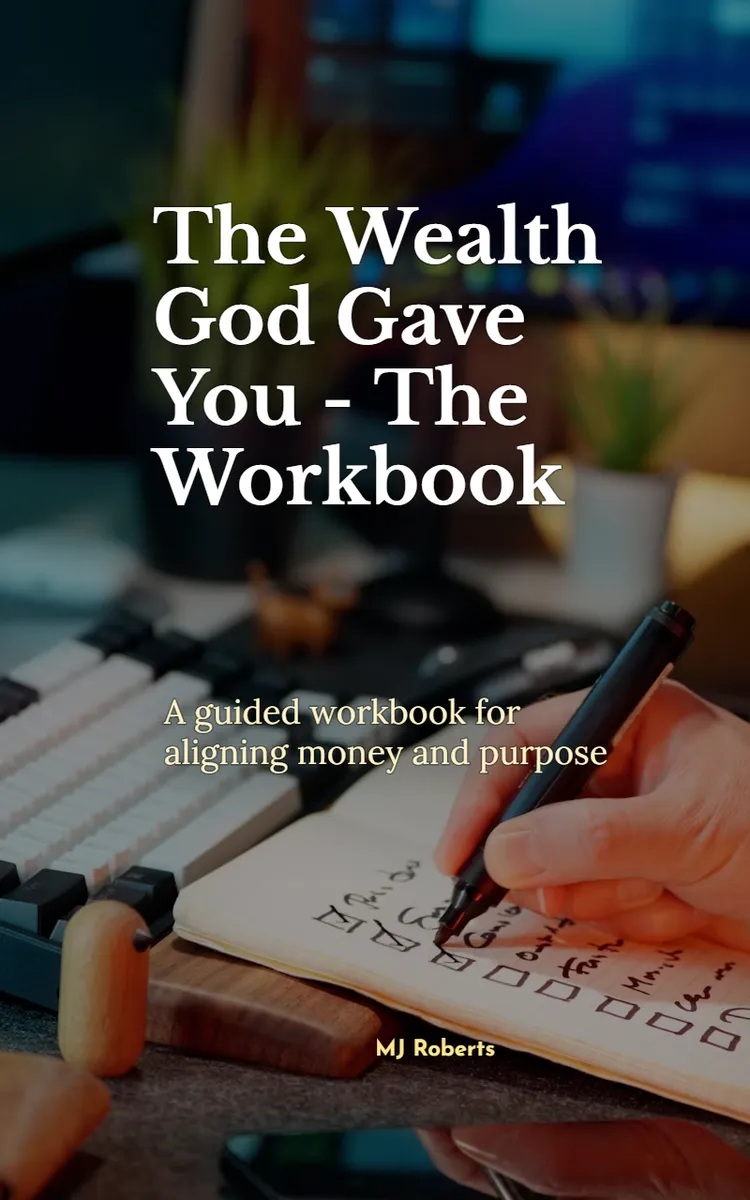
"The Wealth God Gave You Workbook" is a workbook by MJ Roberts with 7 chapters and approximately 10,268 words. Money mindset and purpose-focused financial reflection exercises.
This book was created using Inkfluence AI, an AI-powered book generation platform that helps authors write, design, and publish complete books. It was made with the Workbook Generator.
Frequently Asked Questions
What is "The Wealth God Gave You Workbook" about?
Money mindset and purpose-focused financial reflection exercises
How many chapters are in "The Wealth God Gave You Workbook"?
The book contains 7 chapters and approximately 10,268 words. Topics covered include God’s Purpose for Your Money, Building Your Money Baseline, Creating a Faith-Filled Budget, Paying Off Debt with a Plan, and more.
Who wrote "The Wealth God Gave You Workbook"?
This book was written by MJ Roberts and created using Inkfluence AI, an AI book generation platform that helps authors write, design, and publish books.
How can I create a similar workbook?
You can create your own workbook using Inkfluence AI. Describe your idea, choose your style, and the AI writes the full book for you. It's free to start.
Write your own workbook with AI
Describe your idea and Inkfluence writes the whole thing. Free to start.
Start writingCreated with Inkfluence AI


