
Read the first chapter
The whole of chapter one, free. About 13 min. Turn the pages with the arrows, your keyboard, or a swipe.
Chapter 1
Chapter 1 The Last Candle
The bus jerked to a stop on Elm Street and coughed out one last breath, spitting black smoke into the cold air.
For a moment, I stayed in my seat.
The engine ticked below my boots. What was left of the rain crawled down the windows in crooked lines, catching the last scraps of gray light. The driver had the door open, but neither of us budged. He kept both hands on the wheel, staring out at Havenwood like he’d pulled into the wrong place and was waiting for someone to tell him so.
I understood the feeling.
Four months of dust, blood, and that steady, gnawing fear of what waited over the next ridge. This was the homecoming I’d played out in my head a thousand times.
Pine needles. Mrs. Gable’s cinnamon rolls. Dad’s booming voice from the front porch. Sarah’s laugh coming through the screen door before I had even reached the steps.
Instead, I got a silence you could chew on.
The driver cleared his throat.
“You getting off?”
That voice made me jump. It sounded too normal for a street like this.
I looked through the window again.
Havenwood looked the same.
That was the first thing that didn’t sit right.
The storefronts stood in their familiar rows along Elm Street, their painted signs faded but intact. The oaks still lined the pavement, their branches arching over the road in the same patient canopy they had formed when I was a boy. The lawns were clipped. The sidewalks were cracked where I remembered. The white steeple of St. Jude’s rose above the rooftops on the hill, pale against the deepening sky.
Everything had the shape of home.
But none of it sounded right.
Every car sat parked with unnatural precision, as if the drivers had pulled to the curb, placed the transmissions in neutral, and stepped away at the same instant. A green sedan stood crooked across the lane with its driver’s door hanging open. A delivery truck idled beside the pharmacy, though no one sat behind the wheel. A station wagon had stopped half on the sidewalk, one rear door ajar.
On Mr. Henderson’s lawn, a bright red bicycle lay on its side.
Its front wheel was still turning.
Slowly.
Lazily.
No wind in the grass. No birds in the oaks. Not even a dog barking behind a fence.
The wheel continued turning.
I took my duffel from the luggage rack and stepped down onto the pavement.
The driver watched me through the open door.
“Expecting someone?” he asked.
I looked toward the town.
“My family.”
He seemed about to say something else. Then he looked at Havenwood again and changed his mind.
The doors folded shut behind me.
The bus pulled away with another wet cough, tires whispering over the road. It passed the pharmacy, the empty cars, the red bicycle. At the end of Elm Street, it turned the corner and vanished.
I waited for the engine to fade.
It did not.
The sound disappeared too quickly, swallowed by the town before the bus could have traveled more than a block.
I stood on the cracked sidewalk with my duffel at my feet and waited for the world to start making sense again.
It didn’t.
The air was off. Too still, too heavy, like the whole town was holding its breath and didn’t know how to let it out. Even the light was weird. Evening should’ve been rolling in, gray to blue, blue to black. Instead, the sky just hung there, flat and washed out. The sun was gone, but the dark hadn’t shown up yet.
“Just an evacuation,” I told myself.
The words came out dry and useless.
No sirens. No emergency vehicles. No lights flashing behind the houses. No voices calling from windows or porches.
A half-finished checkers game sat on a porch swing across the street. Red and black pieces were frozen mid-move on the board. One black piece had been lifted from its square and left standing between moves, as if the player had been interrupted by something too pressing to explain.
Yesterday’s Havenwood Herald lay open on a park bench.
The front page carried a photograph of the high-school baseball team beneath the headline:
TOWN PREPARES FOR ANNUAL SUMMER FAIR
The paper was open to an article about Mrs. Gable’s cinnamon-roll booth.
I could see her name.
For a moment, relief moved through me.
Mrs. Gable had to be somewhere. She had to know what had happened. She had lived in Havenwood longer than anyone I knew, longer than the pharmacy, longer than the oldest oak near the courthouse. She was the woman who put food in my hands when my father was too proud to admit we were short on groceries.
If anyone got this town, it was her.
I picked up the newspaper.
The paper was damp, even though the bench was dry. In the photo, Mrs. Gable stood behind a table stacked with pastries, one hand up like she was telling the photographer to get lost.
The face in the photograph was blurred.
Not damaged. Not scratched. Blurred, as though the image had been exposed to water while the ink remained wet.
I lowered the paper.
Across the street, the bicycle wheel finally stopped turning.
The silence deepened.
I called out once.
“Hello?”
The word traveled no farther than the curb.
There was no echo.
My training kicked in, fast and hard.
Assess. Identify threat. Establish a perimeter.
I scanned the street, rooftops, windows, and the dark gaps between buildings. No movement. No muzzle flash. No smoke. No smell of cordite. No distant engine noise. The town offered none of the signs I had learned to look for overseas.
This wasn’t any enemy I knew.
There was no direction of fire. No hostile position. No visible cause.
It felt like the world had forgotten its own name.
I left the duffel where it was and walked toward home.
My boots were too loud on the pavement. Every step echoed back at me, thin and off, like yelling into a pillow. I kept looking over my shoulder, half-expecting the bus to still be there, or the driver to lean out and yell for me.
The street remained empty.
The houses appeared intact, but the details had begun to drift.
A porch swing moved without wind.
A curtain hung in one window, then another, though I could not tell whether it was moving or just shifting when I looked away.
At the corner, a mailbox stood open. Inside were letters, advertisements, and a postcard showing a beach I did not recognize. The name on the mailbox had been painted over so thoroughly that the metal beneath it was scratched white.
I kept walking.
Our house stood three blocks from the bus stop, on a narrow rise above the street. The porch light glowed a weak yellow into the gathering dusk.
Sarah’s bicycle wasn’t leaning against the railing where it always was.
That empty spot hit me harder than I wanted to admit.
She had owned the bicycle since she was 9, though she had outgrown it years earlier and refused to replace it. The frame had been painted blue when she first got it. She had covered the paint with strips of red tape and silver stars, then forgotten about the project halfway through. The bicycle had become part of the porch. I had seen it through every season of my childhood.
Now there was only an empty space beside the railing.
The loneliness soaked into my bones, cold as ice water.
I climbed the steps.
The porch boards did not creak.
That was the second wrong thing.
Our porch had always complained. The third board near the door groaned beneath even Sarah’s weight. My father had promised to repair it for twelve years. He never did because, according to him, the house needed to keep some evidence of age.
I stepped on the board.
Nothing.
I put my hand on the doorknob.
The front door opened under my touch.
No fight at all.
No lock.
The streetlights had come on.
One by one, they flickered along the road in a sickly yellow sequence. The light did not spread evenly. It gathered in small circles beneath each lamp, leaving long stretches of darkness between them.
I stepped out onto the porch, legs shaky.
Behind me, the house was quiet.
I looked back.
The living room appeared normal through the front window. Dad’s chair. The coffee table. The open book.
Then the curtain moved.
Someone stood behind it.
I did not wait to see who.
I descended the steps and crossed the lawn.
The red bicycle was gone.
The porch light gave one last flicker.
Then died.
I returned to the sidewalk and looked toward the hill.
St. Jude’s showed a single weak candle flame behind a stained-glass window.
The light was small.
Thin.
Trembling.
But deliberate.
It was the only thing in Havenwood that still looked deliberate.
I stood in the middle of Elm Street with my duffel at my feet, and the photograph of Sarah clenched in my hand. Behind me, the house waited in darkness. Ahead, the church held its candle against the night.
I should have gone to the police station.
I should have found a telephone.
I should have walked to the edge of town and followed the road until I reached somewhere with people.
Instead, I walked toward the church.
The road rose gently through Havenwood's center. The storefronts remained closed, their windows reflecting no light. A barber pole turned without electricity. The pharmacy sign flickered between two letters, never completing the word.
Halfway up the street, I caught movement out of the corner of my eye.
A figure stood in the mouth of an alley.
Too still.
I turned my head.
The alley was empty.
Only the feeling remained that I had been observed and then deliberately ignored.
I kept my eyes straight ahead.
My hands stayed visible at my sides, the way I had been taught when moving through uncertain ground. The habit steadied me. It gave my body something familiar to do.
Behind me, a door opened.
I did not turn.
A footstep followed.
Then another.
The footsteps stopped when I did.
I continued walking.
The footsteps did not resume.
At the bottom of the church hill, the pressure behind my eyes eased slightly. The candle in the stained-glass window burned brighter.
The road to St. Jude’s was lined with memorial stones. Names had been carved into them over the years—town founders, soldiers, teachers, children who had died too young. I had played among them as a boy. Sarah used to bring flowers to the smallest stone, even though no one knew who it belonged to.
Tonight, several of the stones were blank.
The names had not been scraped away.
The surfaces were smooth.
Untouched.
As if no letters had ever been carved into them.
I stopped beside the smallest stone.
The name at the top remained visible.
HENDERSON
The first name beneath it had faded to a series of shallow curves.
I knew it.
I had known it all my life.
The name rose in my mind, then softened before I could speak it.
I tried again.
“Thomas.”
The letters in the stone seemed to darken.
“Thomas Henderson.”
Pressure built up behind my eyes, sharp and mean.
The name held.
For the moment.
I looked toward the church.
The candle continued burning.
I climbed the steps.
The heavy oak doors opened under my push.
Inside, the air smelled like old wood, candle wax, and something sweet I couldn’t name. The church was darker than it should’ve been. The stained glass looked black from outside, but the candle on the altar threw a skinny circle of gold on the floor.
An older man emerged from the deepest shadow near the confessional.
He was frail, almost bones, clutching a rosary so tight his knuckles were white. His clothes hung off him. His hair was wet, even though it hadn’t rained.
His eyes were wide and glassy.
He looked through me toward something worse.
“You shouldn’t be here,” he rasped.
I closed the doors behind me.
“What’s going on?”
He flinched at the sound of my voice.
“Where is everyone?”
He glanced back at the church, then toward the empty street beyond the doors.
“They’re gone.”
“Gone where?”
“All gone.”
“Evacuated?”
“No.”
“Then what happened?”
His mouth worked before he answered.
“Not taken.”
He swallowed.
“Erased.”
That word made the church feel colder.
“Erased by what?”
The older man’s eyes locked onto mine.
“It’s the Silence.”
I had heard the word before. In childhood stories. In church sermons. In the strange half-jokes people made when a room went quiet after someone said something cruel.
I had never heard it spoken like that.
“The Silence?”
“It comes,” he whispered. “It just stops.”
“What comes?”
He turned toward the altar.
The candle flame leaned slightly to one side.
“It isn’t empty,” he said. “That’s what people think. They think silence means nothing is there.”
His fingers tightened around the rosary.
“It’s watching.”
The church seemed to contract around the word.
“Waiting.”
The older man swayed.
“You can’t hear it, but it’s there. Everywhere. It unwrites things.”
“What does that mean?”
He looked at me.
For a second, I saw the man beneath the fear. A priest, perhaps. Or a caretaker. Someone who had spent years believing that names written in books and spoken over graves could keep the dead from disappearing.
His face looked like a guy who’d lost everything but still had to stick around and watch.
“The light,” he said.
“What light?”
His gaze moved to the candle.
“It’s all that’s left.”
He stumbled.
I reached for him.
“Hold on.”
His hand caught my sleeve.
The rosary beads dug into my skin.
“Don’t let it go out,” he whispered.
Then his grip loosened.
His knees folded.
I caught him badly, but the fall was almost silent. His shoulder struck the floor. His head rolled to one side.
I lowered him as carefully as I could.
“Sir?”
No response.
I checked for a pulse.
Nothing.
His face was locked in pure terror.
The rosary lay beside his still hand, the beads catching the thin altar light.
I stayed over him longer than I needed to.
A part of me expected the body to change.
To soften.
To vanish.
It did not.
That frightened me more than if it had.
I felt watched. Like something was wrapping wire around my ribs. The wood wasn’t abandoned.
It was getting erased, bit by bit, and I was standing on the last line.
I stepped over the older man and moved toward the altar.
The single candle burned in a shallow brass holder. Its flame was thin and trembling. Around it, the air felt different—lighter, perhaps, or less occupied. The darkness stopped several feet from the altar, forming an uneven circle around the candlelight.
I could feel something pressing against the edge of that circle.
Patient.
Hungry.
Attentive.
The flame bent toward me.
I reached out.
Heat bit into my palm.
My hand trembled.
The pressure behind my eyes cranked up.
I thought of the photograph in my pocket.
Sarah’s blank face.
I thought of the faces on the memorial stones.
I thought of my own name slipping when I tried to hold it.
The candle was not merely burning.
It was resisting.
I cupped my hands around the flame, shielding it from a draft that wasn’t there.
“I’m still here,” I whispered.
The words left my mouth and felt smaller the moment they entered the darkness.
The flame shuddered.
Then steadied.
Behind me, something shifted near the confessional.
I did not turn.
The altar held a few objects: a brass cross, a chipped ceramic bowl, a stack of hymnals, and a small black notebook lying beside the candle base.
The notebook looked ordinary.
That made me distrust it.
I picked it up.
The cover was worn smooth at the corners. A name had been written on the front, but the ink had faded beyond recognition. The first pages contained ordinary church notes—baptisms, funerals, wedding anniversaries, bake-sale reminders, and lists of families who had donated money for repairs.
The handwriting was neat and careful.
It belonged to someone who had tracked a town for decades.
I turned the pages.
The handwriting changed.
The letters became narrower.
The pressure of the pen increased.
The notes no longer described church business.
They described Havenwood.
The first entry was dated five days earlier.
Day 1 Mrs. Gable stopped mid-sentence on the porch. One second she was talking about cinnamon rolls. The next, the air where she stood was just… empty. I still remember her face. For now.
I read the entry twice.
The next was dated two days later.
Day 3 The children in the park. I watched three of them vanish while the fourth kept swinging, laughing at nothing. By evening I couldn’t remember the names of the three. Only the empty swings.
I gripped the notebook tighter.
I turned the page.
Day 5 The Silence doesn’t take bodies. It takes the fact that they ever existed. Photographs blur. Names on the memorial plaques smooth out like the stone was never carved. I checked the guest book this morning. Half the signatures are gone. Not crossed out. Gone.
The final entry was only hours old.
The handwriting had become nearly illegible.
Tonight It is inside the light now. Testing the edges. If the candle dies, I die with it. If anyone finds this—protect the flame. It is the only thing still writing us down.
I lowered the notebook.
End of chapter one. 20 more chapters and about 78,974 words in the full book.
Swipe or use the arrows to turn the page


What's inside: 21 chapters
- 1. Chapter 1 The Last Candle
- 2. Chapter 2 Do Not Trust the House
- 3. Chapter 3 The Silence
- 4. Chapter 4 Keep the Light
- 5. Chapter 5 Follow the Arrow
- 6. Chapter 6 The First Disk
- 7. Chapter 7 The Face That Was Mine
- 8. Chapter 8 The Hall Under the Water
- 9. Chapter 9 The Bowl
- 10. Chapter 10 You Cannot Escape by Yourself
- 11. Chapter 11 Wrong Side of the Light
- 12. Chapter 12 Wrong Side of the Light
- 13. Chapter 13 The Building That Shouldn’t Be There
- 14. Chapter 14 The Book of the Being
- 15. Chapter 15 No Clean Ground
- 16. Chapter 16 Seventh Movement
- 17. Chapter 17 Unmaking
- 18. Chapter 18 Begin
- 19. Chapter 19 Watching Towns Fall
- 20. Chapter 20 The Seam
- 21. Chapter 21 The Ones Who Waited
About this book
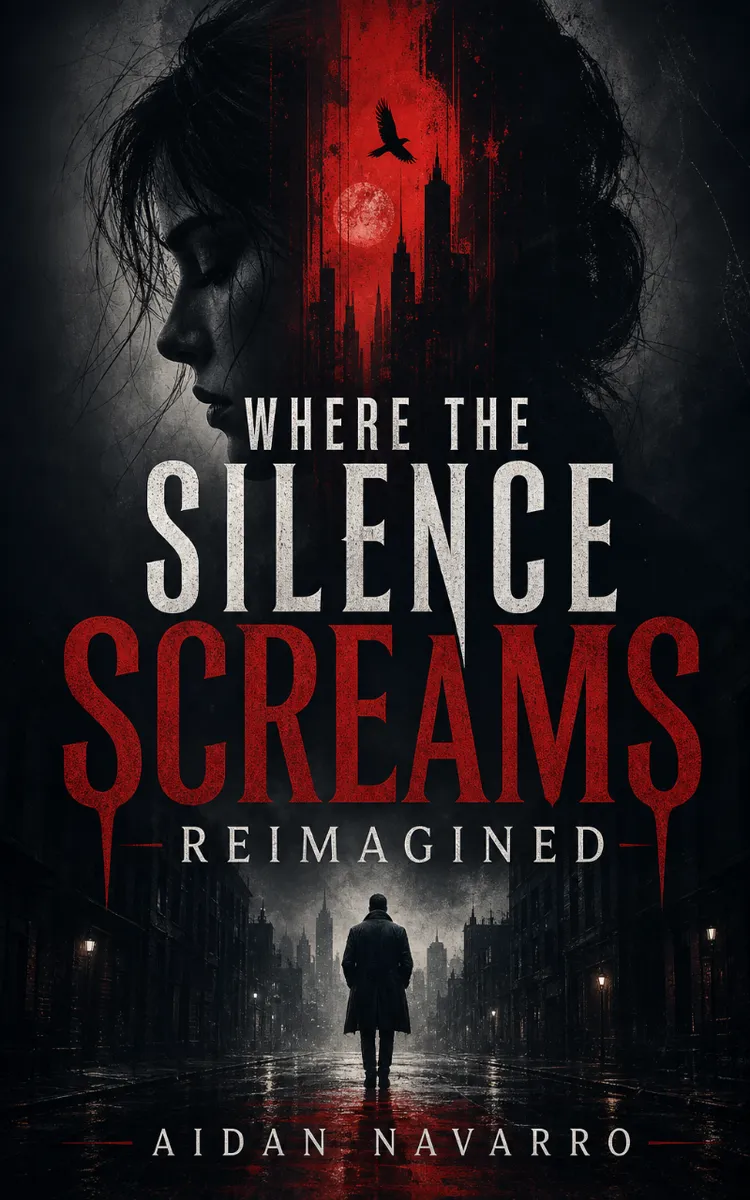
"Where the Silence Screams Reimagined" is a fiction book by Aidan Navarro with 21 chapters and approximately 78,974 words. It covers key insights and practical takeaways on the topic.
This book was created using Inkfluence AI, an AI-powered book generation platform that helps authors write, design, and publish complete books. It was made with the AI Novel Writer.
Frequently Asked Questions
What is "Where the Silence Screams Reimagined" about?
"Where the Silence Screams Reimagined" is a fiction book by Aidan Navarro covering key insights and practical takeaways on the topic.
How many chapters are in "Where the Silence Screams Reimagined"?
The book contains 21 chapters and approximately 78,974 words. Topics covered include Chapter 1 The Last Candle, Chapter 2 Do Not Trust the House, Chapter 3 The Silence, Chapter 4 Keep the Light, and more.
Who wrote "Where the Silence Screams Reimagined"?
This book was written by Aidan Navarro and created using Inkfluence AI, an AI book generation platform that helps authors write, design, and publish books.
How can I create a similar fiction book?
You can create your own fiction book using Inkfluence AI. Describe your idea, choose your style, and the AI writes the full book for you. It's free to start.
Write your own fiction book with AI
Describe your idea and Inkfluence writes the whole thing. Free to start.
Start writingCreated with Inkfluence AI


