
Read the first chapter
The whole of chapter one, free. About 11 min. Turn the pages with the arrows, your keyboard, or a swipe.
Chapter 1
The Paperback With Two Claims
Mara had been standing in the poetry aisle for eleven minutes, pretending to read a book she had no intention of buying, when the paperback slipped from the shelf.
She caught it against her chest.
The cover was faded pink beneath a film of dust, the title stamped in gold that had worn thin at the corners: The Geography of Small Things. A bicycle leaned against a brick wall beneath the lettering, its front wheel turned toward a road that disappeared beyond the page.
For one quiet second, Mara let herself imagine that was all she wanted - to hold something that had already survived being passed from hand to hand.
Then someone reached for it.
His fingers closed over the bottom edge.
Mara looked up.
The man standing on the other side of the narrow shelf was tall enough that the brass reading lamp above him cast a warm stripe across his dark hair. He wore a green overshirt with the sleeves rolled neatly to his forearms, and there was a smear of black grease near one knuckle. He looked less like someone who came to browse books than someone who had been dragged into the shop by weather and forgotten to leave.
“I had it first,” Mara said.
His gaze dropped to the paperback wedged between them. “You caught it first.”
“That is generally how having something works.”
A small smile touched his mouth, but it didn’t soften his grip. “I’ve been looking for it for three months.”
“I’ve been looking for something to do for three days.”
The smile disappeared.
Mara wished she could take the words back. Not because they were untrue, but because she had offered them too easily. The breakup had made her careless with the edges of herself. She kept saying things aloud that should have stayed locked behind her ribs.
The man’s eyes returned to her face. Brown, she noticed. Not the bright, uncomplicated brown of polished wood, but a darker shade, flecked with amber where the lamp caught it.
“Bad three days?” he asked.
“Long three days.”
“That sounds worse.”
“It is.”
The shop pressed close around them. Juniper & Quill had once been a tailor’s storefront, and the old shape remained: narrow aisles, slanted floorboards, shelves rising nearly to the ceiling. Rain ticked against the front windows. Somewhere near the register, a radiator clanked with the persistence of a trapped spoon. The air smelled of paper, cedar, and the cinnamon tea the owner brewed in a chipped blue mug.
Mara tightened her hold on the book. “You said you’ve been looking for it. Why?”
The question came out sharper than she meant it to.
He glanced toward the front counter, where a handwritten sign announced that all sales were final. “Because I need it.”
“That’s not an answer.”
“It’s the answer you gave me.”
“I didn’t say I needed it.”
“You said you’d been looking for something to do.”
“I said I needed something to do.”
“Which is different?”
“Completely.”
His mouth tilted again. “You’re right. Very different.”
There was something infuriating about the way he let her win small points without giving up any ground. Mara pulled the paperback toward her. He did the same. The cover bent faintly between them.
“Please don’t crease it,” she said.
“I’m trying not to.”
“Then let go.”
“I can’t.”
The honesty of it stopped her.
He seemed to realize what he had said and looked away first. A strand of hair had fallen over his forehead. He pushed it back with the hand marked by grease, leaving a faint gray streak near his temple.
Mara stared at it before she could stop herself.
His eyes flicked back to hers. “What?”
“You have something on your face.”
“Occupational hazard.”
“Your occupation is?”
“Repairing bicycles. Mostly the ones people insist are beyond saving.”
“That sounds optimistic.”
“It’s usually stubbornness.”
“Yours or theirs?”
“Depends who’s paying.”
A laugh escaped her, brief and unwilling. It felt strange in her throat, like a door opening in a room she had kept dark.
The man noticed. His expression changed, not triumphantly, but with care. That was worse. Care from a stranger could be more dangerous than charm.
Mara looked down at the book. A square of cream paper protruded from its pages, folded once and tucked beneath the front cover. Someone had written on it in blue ink.
She tugged it free.
The handwriting was narrow and deliberate.
For the person who thinks leaving is the same as being free: begin here.
Mara’s breath caught.
The words landed too close to the bruise she had been carrying since Monday night, when Daniel had stood in her kitchen with his keys in his hand and said, gently, that loving her had begun to feel like asking permission to stay.
She had told him to go.
He had.
Since then, every room in her apartment seemed to contain the shape of his absence.
The stranger’s hand loosened on the paperback. “You read it.”
“It’s a note.”
“I can see that.”
“Did you write it?”
“No.”
“Then why do you need the book?”
His expression closed a little. “That’s private.”
“You’re the one who started asking questions.”
“I asked about your three days.”
“You asked because you wanted the book.”
“I wanted the book before I knew about the three days.”
Mara studied him. He had the kind of stillness that suggested effort. His shoulders were relaxed, but his fingers remained on the cover, careful not to damage it. He was holding himself back from something - not anger, exactly. More like an admission.
At the end of the aisle, a cart of unsorted books blocked half the passage. There was no room to step around him without brushing shoulders. Mara became abruptly aware of the rain-darkened wool of his jacket, the clean scent of soap beneath the sharper smell of bicycle oil, the warmth gathered between them in the cramped aisle.
She shifted back.
The cart caught her hip.
The man reached out and steadied it before it rolled into her. His hand stopped an inch from her waist.
“Sorry,” he said.
“You didn’t touch me.”
“I know.”
The words settled between them with an odd weight.
Mara looked at his hand, then at his face. He lowered it slowly.
“What is your name?” he asked.
She should have said none of your business. Instead, she heard herself answer, “Mara.”
“Theo.”
“Just Theo?”
“For now.”
“That sounds suspicious.”
“It’s meant to.”
Despite herself, she smiled again. It was smaller this time.
Theo nodded toward the note. “That’s why I need the book.”
Mara folded the paper along its existing crease. “Because someone wrote you a dramatic message?”
“Because I wrote it.”
The radiator clanged. Rain whispered against the glass.
Mara looked at the note once more. “You wrote this?”
“Yes.”
“For someone?”
His gaze dropped to the book. “For whoever found it.”
“That’s not what you mean.”
“No,” he said. “It isn’t.”
Something in his voice made her stop teasing.
Theo leaned one shoulder against the shelf. “My sister gave me the book last year. She was moving across the country and wanted me to read it before she left. I didn’t. I kept saying I’d get to it. Then she stopped calling.”
Mara’s fingers tightened around the note.
“She’s gone?” she asked.
“She’s alive.” He swallowed. “Just not in my life, apparently. I found the book in a box when I was cleaning out the back room of my shop. I wrote the note because I thought maybe putting the words somewhere would make them less true.”
“Less true?”
“That leaving and being free aren’t the same thing.”
The shop seemed to grow quieter around them.
Mara knew something about words that refused to become less true. She thought of Daniel’s face, tired and hopeful at once, as he asked whether she wanted a life with him or merely wanted him to keep waiting outside the life she had already built.
She had hated him for asking.
She had hated herself more for not knowing.
Theo’s thumb brushed the torn edge of the paperback. “I put it in the donation box by mistake. Then I spent three months trying to find it.”
“You could buy another copy.”
“I did.”
“And?”
“It didn’t have the note.”
Mara looked at him.
He met her gaze, and the humor was gone now. “I need this one.”
The confession changed the shape of the argument. Not enough to make giving it up easy. It only made the book heavier in her hands.
“I need it too,” she said.
Theo waited.
She could have explained about Daniel. She could have said that she had come into Juniper & Quill because her apartment was full of evidence that she had made the wrong choice, and because the idea of reading about someone else’s small departures felt safer than thinking about her own.
Instead she said, “I need something that doesn’t know me.”
His expression softened. “Books usually know more than people think.”
“That’s exactly what I’m trying to avoid.”
A bell chimed near the entrance. The owner called that the shop would close in twenty minutes.
Mara glanced toward the register. “We need a solution.”
“You buy it.”
“That’s your solution?”
“It’s a good one.”
“You wrote the note. You found the book. You need it more.”
“I’m not sure that’s how need works.”
“Then you admit I might need it more.”
“I admit you’re making a compelling case.”
She held the book against her chest. “I’m not starting a scene.”
“I haven’t seen you start one.”
“Give me time.”
Theo’s laugh was quiet, and this time it reached his eyes. “All right. What do you propose?”
Mara looked at the worn spine, at the single copy that had somehow gathered both their unfinished business inside it.
“You can read it first,” she said. “Then give it to me.”
“No.”
“Why not?”
“Because you’ll disappear.”
The words were so direct that they seemed to strike the air.
Mara stared at him. “You don’t know me.”
“I know you came in here alone and picked up a book with a note about leaving. I know you’re trying very hard not to tell me why. I know you’ve looked at the door four times since we started arguing.”
Her face warmed. “You’ve been counting?”
“I notice things.”
“That’s not the same as knowing me.”
“No.” He glanced down, suddenly less certain. “It isn’t.”
For the first time, Mara saw the cost of his insistence. It wasn’t only the book he was afraid of losing. It was the possibility that she would take something from him without understanding what it had cost him to keep searching.
She exhaled slowly. “Fine. I’ll buy it.”
Theo’s eyebrows rose.
“But we split it.”
“That’s not how books work.”
“It is now. I take it home tonight. I read until I reach the end of the first section. Then I leave it somewhere we both agree on.”
“You mean a public place?”
“A café. The park. Here.”
“And if you don’t bring it back?”
“Then you can tell everyone at Juniper & Quill that Mara Ellison is a thief.”
“You’re giving me your full name as collateral?”
“You already have the book.”
His gaze lingered on her mouth for half a second before returning to her eyes. “You’re difficult.”
“I’ve been told.”
“Recently?”
“Recently, it became a reason to leave.”
The truth slipped out before she could catch it.
Theo didn’t reach for the easy answer. He didn’t say that whoever left was an idiot or that she deserved better. He only nodded once, as if accepting an object she had placed in his hands.
“Then I’ll trust the difficult version,” he said.
Mara’s throat tightened.
At the register, she paid for the book. The owner wrapped it in brown paper despite Mara saying she didn’t need wrapping. Theo stood beside the display of old maps, hands in his pockets, watching the rain stripe the windows.
When Mara tucked the parcel into her canvas bag, he held out a second piece of paper.
“For the exchange,” he said.
She took it but didn’t unfold it. “You wrote another note?”
“This one is only practical.”
“Your practical notes are suspiciously personal.”
“That’s fair.”
She turned toward the door. “Where do we meet?”
“Tomorrow. Six o’clock. The bench outside the closed cinema on Alder.”
“Why there?”
“It has a roof. You won’t get rained on.”
“And you?”
“I repair bicycles. I’m used to bad weather.”
She almost asked whether he would be bringing one. Instead, she said, “If you’re late, I keep the book.”
“If you’re late?”
“You keep the book.”
“That seems uneven.”
“You’re the one who said I might disappear.”
Theo stepped closer - not enough to crowd her, just enough for her to feel the warmth of him through the damp air. “I hope you don’t.”
The words were quiet. They made the shop’s narrowness feel suddenly intimate.
Mara looked down at the folded paper in her hand. “Good night, Theo.”
“Good night, Mara.”
She pushed through the door. The bell gave a thin, cheerful ring that did not suit the weather.
Outside, the rain had softened to mist. Mara stood beneath the awning and opened his note.
The book is yours tonight.
Beneath that, in the same narrow blue handwriting, he had added:
But the first time I saw you, you were sitting outside my bicycle shop, crying into a paper cup. You left before I could ask if you were all right.
Mara stopped breathing for a moment.
At the bottom of the page was an address.
Theo’s shop.
She looked back through the window.
He was still inside Juniper & Quill, one hand resting on the shelf where they had fought over the paperback. He wasn’t watching her now. He was looking at the place she had stood, as if trying to understand what he had missed.
Mara folded the note and slipped it into the book’s brown-paper wrapping.
She had come for a distraction, something nameless and temporary.
Instead, she had agreed to return to a stranger who remembered her from a day she had hoped no one had seen.
End of chapter one. 10 more chapters in the full book.
Swipe or use the arrows to turn the page


What's inside: 11 chapters
- 1. The Paperback With Two Claims
- 2. A Shared Ride, Unshared Feelings
- 3. Mail That Changes What They Knew
- 4. The Park Track and the Missing Page
- 5. A Second Address Leads to Truth
- 6. When the Hoodie Won’t Explain
- 7. The Wedding Plus-One Pact Breaks
- 8. After the Toast, Nothing Feels Safe
- 9. A Bike Chain Snap Forces a Choice
- 10. Hands on the Same Handlebar
- 11. They would tell each other when things were wrong
About this book
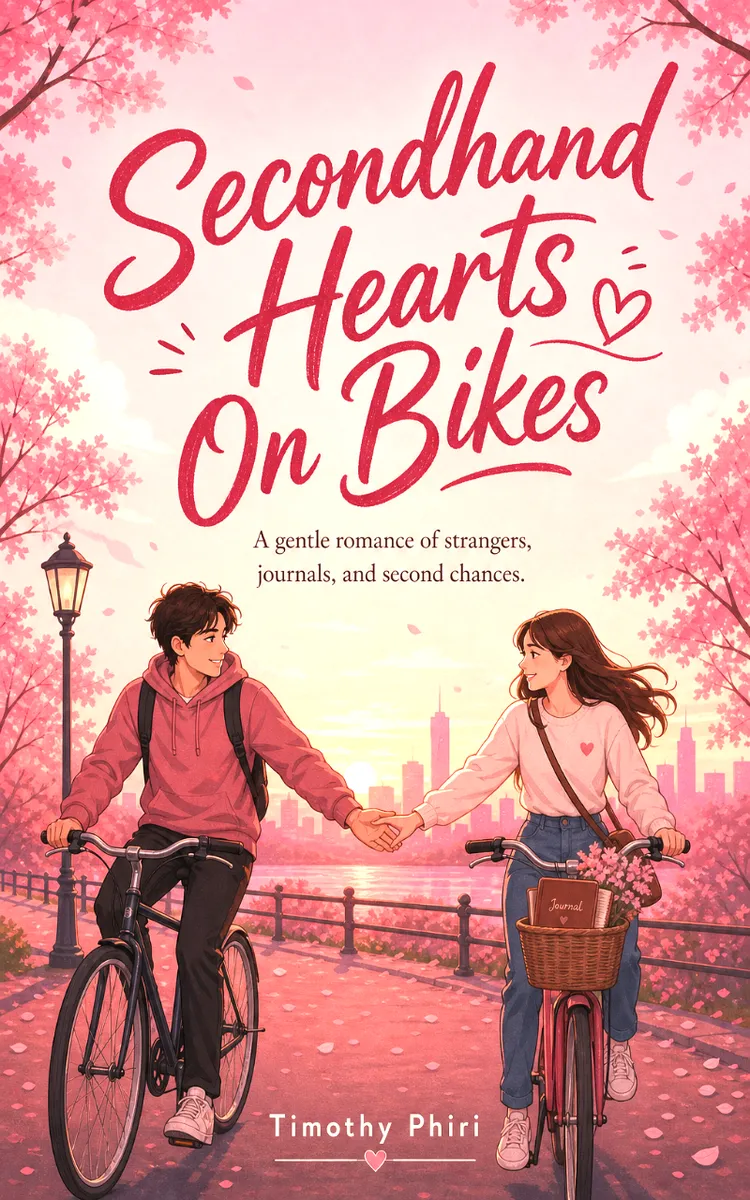
"Secondhand Hearts On Bikes" is a romance book by Timothy Phiri with 11 chapters and approximately 24,249 words. Intertwined romance stories about love, distance, and reconnection.
This book was created using Inkfluence AI, an AI-powered book generation platform that helps authors write, design, and publish complete books. It was made with the AI Romance Novel Writer.
Frequently Asked Questions
What is "Secondhand Hearts On Bikes" about?
Intertwined romance stories about love, distance, and reconnection
How many chapters are in "Secondhand Hearts On Bikes"?
The book contains 11 chapters and approximately 24,249 words. Topics covered include The Paperback With Two Claims, A Shared Ride, Unshared Feelings, Mail That Changes What They Knew, The Park Track and the Missing Page, and more.
Who wrote "Secondhand Hearts On Bikes"?
This book was written by Timothy Phiri and created using Inkfluence AI, an AI book generation platform that helps authors write, design, and publish books.
How can I create a similar romance book?
You can create your own romance book using Inkfluence AI. Describe your idea, choose your style, and the AI writes the full book for you. It's free to start.
Write your own romance book with AI
Describe your idea and Inkfluence writes the whole thing. Free to start.
Start writingCreated with Inkfluence AI


