
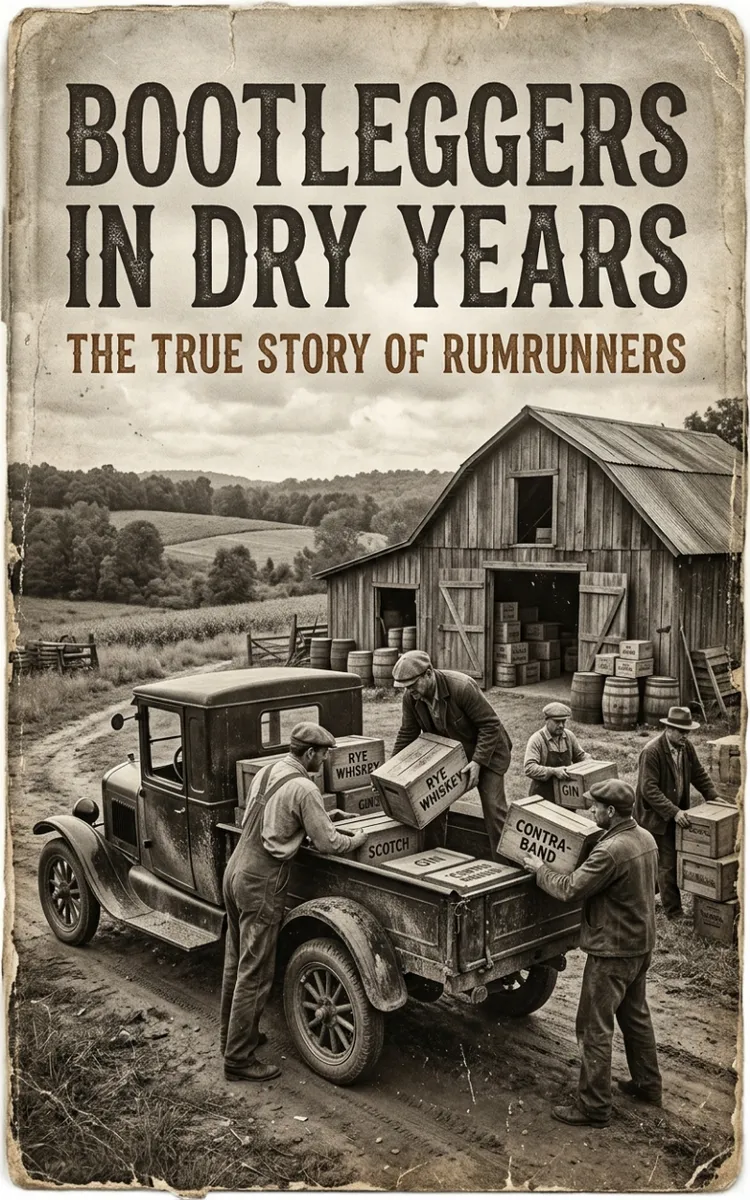

Read the first chapter
The whole of chapter one, free. About 8 min. Turn the pages with the arrows, your keyboard, or a swipe.
Chapter 1
A Dry Law, Wet Roads
A Road Appears Where the Map Shows None
A driver leaving Wichita Falls after dark in the 1920s could follow a public highway, turn onto a county road, or slip onto a ranch track worn into the prairie by wagons and oil workers. All three routes might lead to the same destination: a hidden cache of whiskey moving north toward Oklahoma, or south toward a Texas town where the law was dry but the demand was not.
Prohibition did not merely create secret bars. It altered the meaning of distance. Roads that had carried cotton, cattle, mail, and drilling equipment became links in a family trade that crossed county lines and, often, the Texas - Oklahoma border. The people using them were not all professional gangsters. Many were farmers, ranch hands, mechanics, shopkeepers, and relatives who understood that a car, a dark road, and a trusted connection could turn isolation into protection.
The Backroad Liquor Map helps reveal that hidden geography. It follows the practical features that made a route useful: water crossings, county boundaries, oil camps, small towns, weakly watched stretches of highway, and homes or barns where liquor could be stored. If the law made liquor illegal, why did the roads make it easier to move?
When Dry Law Met a Growing Road System
Texas adopted statewide prohibition in 1919, and Oklahoma had already entered the dry era through state law and local enforcement. National Prohibition followed with the Eighteenth Amendment and the Volstead Act, effective in January 1920. The laws restricted the manufacture, sale, and transportation of intoxicating liquor, but they did not erase the habits, family customs, and commercial networks that had grown around drinking.
They also arrived at a moment when transportation was changing quickly. Automobiles were becoming more common, roads were improving unevenly, and gasoline stations appeared along routes that had once been marked mainly by wagon ruts and courthouse distances. A horse and wagon limited both speed and carrying capacity. A car could cross a county line before a local officer had time to organize a search.
That difference mattered in a region where jurisdiction was divided. A sheriff might know every road in his county yet have little authority beyond its border. A town marshal could watch the main street while a load passed along a ranch road a few miles away. County lines, rivers, bridges, and oil-field roads were not just features of the landscape. They were breaks in enforcement.
The road itself often carried an innocent explanation. A vehicle might be hauling feed, tools, laundry, or supplies for a drilling crew. Containers could be hidden beneath ordinary cargo, but concealment did not always require elaborate machinery. The strongest protection was frequently familiarity: a driver known to local residents, a family name recognized at a filling station, or a delivery timed to fit the movement of legitimate traffic.
In this setting, bootlegging became less like a single criminal act and more like a chain of ordinary tasks. Someone obtained liquor. Someone stored it. Someone found a vehicle. Someone knew which bridge flooded, which deputy asked questions, and which relative could provide a bed or a barn. The road connected these separate forms of knowledge.
The Backroad Liquor Map
The Backroad Liquor Map is not a map of only the fastest routes. It is a map of confidence. A road was valuable when its users understood what could happen along it and how quickly trouble might travel.
North Texas offered several advantages. Towns such as Wichita Falls, Fort Worth, and Amarillo sat within broader networks of rail, livestock, oil, and commercial travel. Oklahoma communities, including Lawton, Oklahoma City, and towns along the Red River, were connected by roads that served legitimate trade. Liquor could move through these same channels without requiring a separate transportation system. Bootleggers borrowed the region’s existing circulation.
The Red River was especially important as both a physical boundary and a legal one. Crossing it could place a driver under a different sheriff, court, and set of local relationships. Bridges concentrated traffic, but crossings also included ferries, shallow stretches, and roads known best by residents. A family with land near the river possessed more than property. It possessed knowledge of movement.
Oil development added another layer. Boomtowns brought workers, money, boardinghouses, cafés, dance halls, and constant turnover. A place built quickly around a field could have more demand than supervision. Roads leading to drilling sites were busy enough to disguise deliveries and rough enough to discourage close inspection. Liquor followed the same routes as spare parts and food.
A surprising fact is that the most useful route was often not the most hidden one. A completely isolated road attracted attention when a vehicle appeared on it. A busy road offered cover because vehicles belonged there. The bootlegger’s advantage was not invisibility; it was being one ordinary movement among many.
That changes the familiar picture of Prohibition crime. The key resource was not always a secret tunnel or a heavily armed gang. It could be a working knowledge of local traffic: when ranchers went to town, when oil trucks returned, when deputies changed shifts, and which roads became impassable after rain. Geography became a form of family property, passed along through conversation and experience.
Families, Trust, and the Work of Moving Liquor
Bootlegging required trust because every link in the chain created risk. A driver knew the location of a load. A storekeeper might know who had purchased unusual supplies. A relative might provide storage without asking where the goods came from. In Black and white communities alike, family ties could make this work possible, though the opportunities and dangers were shaped by segregation, poverty, and unequal treatment by law enforcement.
Black families often faced a narrower range of legal and economic options. Segregated towns limited access to banks, jobs, public accommodations, and political protection. Yet Black communities also maintained strong networks of churches, lodges, boardinghouses, cafés, and extended households. Those networks could support ordinary survival and, when liquor moved through them, could provide warning, storage, or transportation. The same closeness that helped a community withstand discrimination could make its members visible to authorities.
White families were not automatically safe, though social standing and access to land could offer advantages. A ranch, garage, farm, or commercial business could provide a plausible reason for vehicles and deliveries. Relatives could divide tasks among households, reducing the amount any one person appeared to handle. In some places, race and class influenced whose activities were dismissed as local business and whose were treated as evidence of organized crime.
The road also changed family labor. A person who transported liquor might not be the person who sold it. Women could keep accounts, receive messages, provide lodging, or manage a household where liquor was stored. Older children might understand which visitors were expected and which questions not to answer. These roles did not always appear in arrest records, which tended to preserve the name of the person caught with the vehicle or container rather than the wider network behind the trip.
One documented pattern across Prohibition was the use of ordinary commercial fronts: garages, cafés, filling stations, and soft-drink establishments. Such businesses occupied the exact places where travelers naturally stopped. A roadside business could offer gasoline, conversation, food, and information. It could also tell a driver whether a particular road was watched.
The science of transportation was simple but decisive. A motor vehicle reduced travel time, carried more weight than a person or horse, and allowed a driver to change direction quickly. Tires, headlights, engine noise, and road conditions still imposed limits, but the car widened the distance between the act of sale and the place of arrest. Enforcement had to follow a moving object through a landscape that was difficult to patrol continuously.
The Border Road and the Human Story
Consider the border country around the Red River, where Texas and Oklahoma met through water, bridges, ferries, and roads that shifted with weather. A family living near such a crossing did not need to control the entire liquor trade to become useful to it. A barn, a truck, a cousin in a nearby town, or knowledge of a washed-out road could connect a supplier with a buyer several counties away.
The Red River made the arrangement visible in a way that a city street could not. On one side stood Texas law; on the other, Oklahoma law. Between them was water that changed depth, banks that changed shape, and communities whose daily lives crossed the boundary for work, trade, worship, and family visits. The border was official. The relationships were not.
That tension helps explain why local history often contains contradictory memories. One family may remember a relative as a respected farmer or mechanic. Another may remember the same person as a source of whiskey. A sheriff’s report may describe a dangerous bootlegger, while descendants recall someone who delivered medicine, lent money, or kept a household afloat during hard years. These accounts do not necessarily cancel one another. They describe different parts of a local economy.
The most counterintuitive feature of the road system was its dependence on normality. Bootlegging survived not because every participant lived outside respectable society, but because many participants remained inside it. The person who knew the road might also know the church schedule, the crop prices, and the condition of a neighbor’s roof. Illicit commerce fitted itself into ordinary life rather than replacing it.
What the Roads Carried
Prohibition exposed a gap between a national law and the local world through which that law had to travel. Washington could define illegal liquor, but a county sheriff still had to find a vehicle on a road that crossed fields, rivers, towns, and private property. Enforcement was strongest where people, roads, and authority converged. It weakened where those elements separated.
The Backroad Liquor Map therefore reveals more than routes used by bootleggers. It shows how infrastructure can redirect crime, how family enterprise can grow from practical knowledge, and how racial inequality shapes who receives protection and who receives suspicion. The road was never neutral. It carried the law, the goods that violated the law, and the memories left behind by both.
A dry nation did not produce a silent landscape. It produced engines after dark, coded visits, hurried crossings, and families whose histories could not be divided neatly into respectable and criminal. Somewhere beyond the courthouse map, the old roads kept their own record - one measured not in legal boundaries, but in who knew where they led.
End of chapter one. 39 more chapters and about 68,188 words in the full book.
Swipe or use the arrows to turn the page


What's inside: 40 chapters
- 1. A Dry Law, Wet Roads
- 2. The Family Still in the Woods
- 3. Black Bootleggers, Unequal Risks
- 4. White Clans Behind Respectability
- 5. Oklahoma’s Indian Territory Legacy
- 6. Texas Counties, Different Dry Rules
- 7. Who Owned the Still?
- 8. Corn, Sugar, and Cheap Whiskey
- 9. The Women Who Kept Accounts
- 10. Children as Lookouts
- 11. The Roadhouse After Midnight
- 12. Black Juke Joints, Hidden Trade
- 13. Bootleggers’ Routes by Rail
- 14. Cars, Hidden Compartments, and Chases
- 15. The County Line Escape
- 16. Sheriffs Who Looked Away
- 17. Federal Agents on Rural Roads
- 18. Raids That Made Headlines
- 19. Informants Inside the Family
- 20. Courtrooms, Juries, and Local Loyalties
- 21. Prison, Fines, and Family Debt
- 22. When Whiskey Turned Poisonous
- 23. Churches Divided Over Prohibition
- 24. Temperance Women and Dry Politics
- 25. Black Communities Under Double Policing
- 26. White Rural Networks of Protection
- 27. Customers Who Kept the Business Alive
- 28. Bootlegging at the Oil Boom’s Edge
- 29. The Great Depression’s New Pressures
- 30. Rumors, Songs, and Family Legend
- 31. Reading Arrest Records Carefully
- 32. Photographs That Hide as Much
- 33. The Geography of a Still Site
- 34. Liquor Across the Red River
- 35. Repeal Changed the Family Business
- 36. From Moonshine to Legal Distilling
- 37. The Women Left to Rebuild
- 38. What the Law Remembered Unequally
- 39. Family Names After the Still
- 40. The Dry Years Were Never Simple
About this book
"Bootleggers Of The Dry Years" is a curiosity book by Adrian Lorain with 40 chapters and approximately 68,188 words. Bootlegging by Black and white families during Prohibition in Texas and Oklahoma.
This book was created using Inkfluence AI, an AI-powered book generation platform that helps authors write, design, and publish complete books.
Frequently Asked Questions
What is "Bootleggers Of The Dry Years" about?
Bootlegging by Black and white families during Prohibition in Texas and Oklahoma
How many chapters are in "Bootleggers Of The Dry Years"?
The book contains 40 chapters and approximately 68,188 words. Topics covered include A Dry Law, Wet Roads, The Family Still in the Woods, Black Bootleggers, Unequal Risks, White Clans Behind Respectability, and more.
Who wrote "Bootleggers Of The Dry Years"?
This book was written by Adrian Lorain and created using Inkfluence AI, an AI book generation platform that helps authors write, design, and publish books.
Write your own curiosity book with AI
Describe your idea and Inkfluence writes the whole thing. Free to start.
Start writingCreated with Inkfluence AI


