
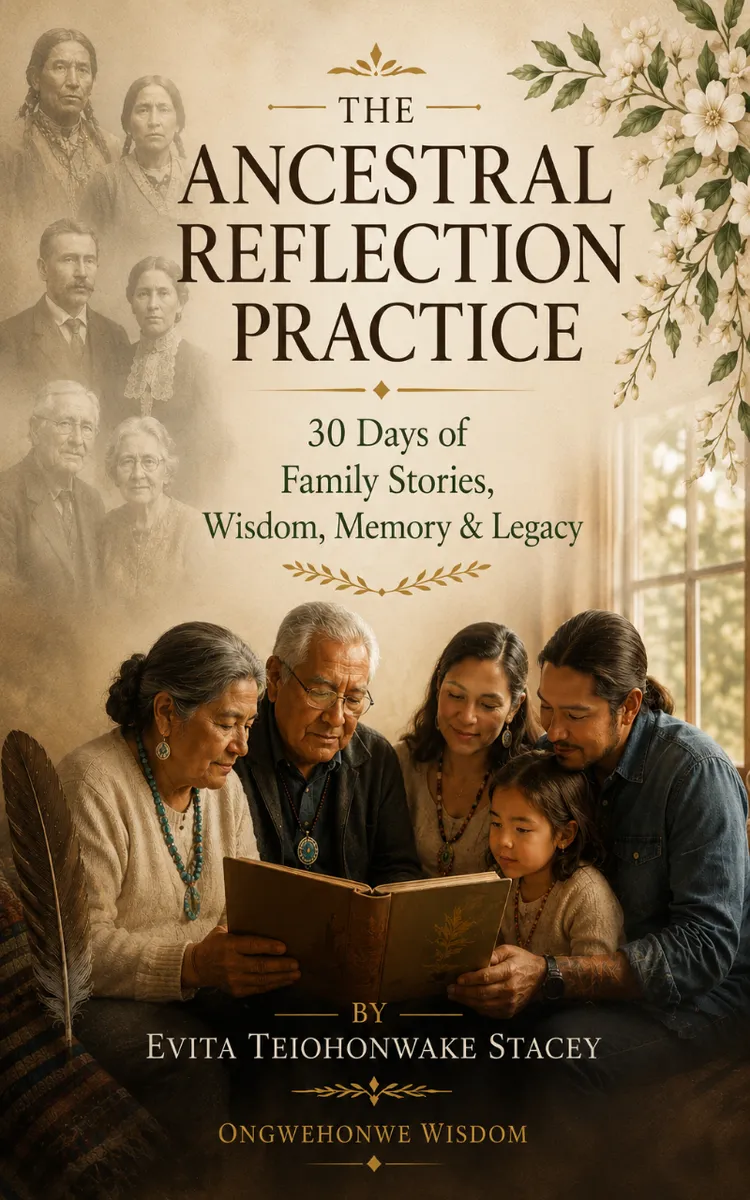
Read the first chapter
The whole of chapter one, free. About 3 min. Turn the pages with the arrows, your keyboard, or a swipe.
Chapter 1
Days 1-3: Who Came Before Me
What names rise first when you ask yourself, Who came before me? Perhaps you see a grandmother’s hands, a great-uncle’s work boots, or a family name written in an old Bible. The Ancestral Compass Map begins there - not with a perfect family tree, but with the people, places, and stories that give your life its starting point.
Over these three days, you’ll gather what you know, make room for what you don’t, and choose one ancestor to meet more closely. You won’t need a box of records or a polished family history. A notebook, a quiet corner, and your honest memory are enough.
Day 1: Draw Your Starting Point
Tip of the Day:
Begin with what you can name today. Family history often feels like a puzzle with missing pieces, but you don’t have to solve the whole picture before you begin. The Ancestral Compass Map starts with four directions: the people you remember, the places they belonged to, the work they did, and the values they carried.
Write down names, even if all you know is “Grandpa’s sister” or “the uncle who lived near the river.” Add maiden names, nicknames, occupations, towns, churches, military service, favorite sayings, or details about a home. Small facts matter. A person’s habit of saving string may tell you something about scarcity. A Sunday meal may point to a tradition that crossed generations.
Don’t correct yourself as you write. Mark uncertain details with a question mark. Your first map is allowed to be incomplete.
Today's Action:
Draw four circles in your journal, label them People, Places, Work, and Values, and fill each circle with at least five details you already know.
---
Day 2: Follow the Family Thread
Tip of the Day:
Yesterday, you gathered names and fragments. Today, look for the thread connecting them. Choose one person from your map and trace what you know about their life through the people and places around them.
Where did this person begin? Who stood beside them? What kind of work filled their days? What did they have to leave behind, and what did they carry forward? You might notice that several relatives worked with their hands, moved often, cared for younger siblings, or held tightly to a certain holiday meal. These patterns aren’t proof of everything your family believed, but they’re worthy of attention.
If your information is thin, use a gentle conversation to widen the map. Call an older relative, send a message, or ask someone who keeps the family photographs. Ask for one story, not the entire family archive. A focused question is easier to answer: “What do you remember about your mother’s childhood?” or “Who in the family was known for being stubborn, generous, or funny?”
Today's Action:
Contact one relative or family friend and ask, “What is one thing you remember about someone who came before me?”
---
Day 3: Choose the Ancestor You’re Ready to Meet
Tip of the Day:
Now choose one ancestor whose life has begun to pull at your attention. It may be someone you knew well, someone whose name appears in several stories, or someone almost entirely hidden from you. Don’t worry about choosing the most important person in the family. Choose the person whose unanswered questions feel alive.
Write their name at the top of a fresh page. Under it, record what you know, what you suspect, and what you want to learn. Keep those three groups separate. “Worked in a factory” belongs under what you know if you have a reliable source. “Must have been lonely” belongs under what you suspect. “Why did she leave home?” belongs under what you want to learn.
This simple separation protects the truth while leaving room for curiosity. Family stories sometimes arrive polished by repetition. Your task isn’t to turn guesses into facts. It’s to listen closely enough to recognize where the story is clear, where it has blurred, and where your questions begin.
Today's Action:
Create a three-column page for one ancestor - What I Know, What I Suspect, and What I Want to Learn - and write at least three entries in each column.
---
The Ancestral Compass Map is now taking shape. You have a starting point, a living thread, and one person waiting at the edge of your questions. Keep that page close. It may lead you toward records, conversations, photographs, and stories - but first, it has given you something just as valuable: a place to begin meeting the people whose choices helped make your life possible.
End of chapter one. 10 more chapters and about 7,394 words in the full book.
Swipe or use the arrows to turn the page
What's inside: 11 chapters
- 1. Days 1-3: Who Came Before Me
- 2. Days 4-6: The Story Not Forgotten
- 3. Days 7-9: Wisdom Received from an Elder
- 4. Days 10-12: Family Tradition Worth Preserving
- 5. Days 13-15: The Strength I Inherited
- 6. Days 16-18: A Life That Influenced Mine
- 7. Days 19-21: What I Wish I Had Asked
- 8. Days 22-24: What My Descendants Need to Know
- 9. Days 25-27: Build Your Family Memory Archive
- 10. Days 28-29: Practice Ethical Storytelling
- 11. Days 30-30: What Ancestor Will I Become
About this book
"The Ancestral Reflection Practice" is a day challenge book by Anonymous with 11 chapters and approximately 7,394 words. A 30-day journaling practice to capture family legacy.
This book was created using Inkfluence AI, an AI-powered book generation platform that helps authors write, design, and publish complete books.
Frequently Asked Questions
What is "The Ancestral Reflection Practice" about?
A 30-day journaling practice to capture family legacy
How many chapters are in "The Ancestral Reflection Practice"?
The book contains 11 chapters and approximately 7,394 words. Topics covered include Days 1-3: Who Came Before Me, Days 4-6: The Story Not Forgotten, Days 7-9: Wisdom Received from an Elder, Days 10-12: Family Tradition Worth Preserving, and more.
Who wrote "The Ancestral Reflection Practice"?
This book was written by Anonymous and created using Inkfluence AI, an AI book generation platform that helps authors write, design, and publish books.
Write your own day challenge book with AI
Describe your idea and Inkfluence writes the whole thing. Free to start.
Start writingCreated with Inkfluence AI


