

Read the first chapter
The whole of chapter one, free. About 6 min. Turn the pages with the arrows, your keyboard, or a swipe.
Chapter 1
Stop Confusing Indifference With Strength
When “I Don’t Care” Is Really Just Exhaustion
You’re standing in the kitchen, staring at a message from your boss: Can we talk tomorrow? Your stomach drops. You tell yourself it’s fine. You don’t care. Then you reread the message eleven times, invent three possible disasters, and spend the evening pretending to watch television while mentally attending your own workplace funeral.
Or maybe it’s a friend who keeps canceling. A date who talks over you. A family member who knows exactly which button to press and treats it like a game-show buzzer. You say, “Whatever. I’m done caring.” But you’re not done caring. You’re hurt, angry, and exhausted from caring so loudly inside your own head.
That isn’t strength. That’s emotional smoke pouring out of the vents.
The goal isn’t to care about nothing; it’s to stop donating your best energy to things that haven’t earned it.
The Care-Not-Indifference Split
Old Belief: Strong people don’t care what anyone thinks.
New Reality: Strong people care deliberately. They choose what gets their attention, effort, and emotional rent.
Indifference says, “Nothing matters.” Choice says, “Some things matter more than this.” Those statements may look similar from the outside, but they come from completely different places. Indifference is often armor. Choice is direction.
Take the coworker who criticizes your work in front of the team. Indifference says, “I don’t give a fuck,” while you replay the meeting during your shower. Choice says, “I care about doing good work and being treated with basic respect. I don’t need to win this person’s approval.” One response abandons your values. The other protects them.
This is the Care-Not-Indifference Split: caring less about random judgment while caring more about the life you’re actually building. You still notice the insult. You still feel the sting. You simply refuse to make the insult your new full-time employer.
That distinction matters because numbness can look brave for a while. You stop asking for what you need. You stop risking rejection. You stop being disappointed because you stop participating. Congratulations: you’ve achieved emotional safety by turning your life into a waiting room.
Real courage is different. It lets you care about your marriage, your craft, your health, your friends, or your golf swing without requiring every stranger, customer, relative, and internet goblin to approve.
The Difference Between Armor and Direction
Your attention is not an endless public resource. Every complaint, awkward interaction, delayed reply, and imaginary argument charges a small fee. One fee won’t ruin you. Hundreds of them can leave you too depleted to handle what actually matters.
The brain loves unfinished social problems. A rude comment has no clean ending, so it keeps reopening the file. You may think you’re “processing,” but sometimes you’re just letting a two-minute interaction squat in your head rent-free. The person who snapped at you has gone home, eaten dinner, and forgotten your name. You’re still preparing a courtroom speech while brushing your teeth.
The Care-Not-Indifference Split gives you a better question: Is this worth my care, or is it merely demanding my reaction? Those are not the same thing.
Signs this pattern is running your life:
1. You spend more time explaining yourself to people who already decided to misunderstand you than doing the work you claim matters. 2. A stranger’s criticism can ruin an entire afternoon, while a friend’s genuine encouragement barely registers. 3. You call yourself “chill,” but you’re quietly avoiding conversations, opportunities, and decisions that might expose you to judgment. 4. You keep saying you don’t care, yet you check, reread, rehearse, and monitor the situation like a private investigator with terrible boundaries.
Strength isn’t a blank heart; it’s a heart with a better hiring process.
Try that hiring process on a real situation. Suppose a customer leaves a nasty review after you made one honest mistake. You can care about fixing the mistake, improving the process, and serving the next customer well. You do not have to care about proving that this particular person is an idiot. Those are separate jobs. Handle the useful one. Fire the other.
Questions That Expose What Matters
1. What am I calling “not caring” because I’m afraid to admit I’m hurt? Maybe you say you don’t care that your friend excluded you, but the truth is you wanted to be included. Naming the hurt doesn’t make you weak. It stops the hurt from secretly driving the car.
2. If nobody could praise or criticize this decision, would I still choose it? Think about the job, relationship, purchase, or public goal currently eating your attention. If applause disappeared, would the choice still fit your values?
3. What outcome am I trying to control that belongs to another person? You can speak honestly. You can set a boundary. You can do excellent work. You cannot force someone to understand, apologize, reply, mature, or stop being a spectacular pain in the ass.
4. What deserves more of my care because I’ve been wasting it elsewhere? Be specific. “My health” is a fog bank. “Walk for twenty minutes after lunch instead of rereading that angry email” is a decision.
5. Where am I using indifference to avoid a brave action? Perhaps you claim not to care about the promotion because applying would expose you to rejection. Perhaps you “don’t need anyone” because asking for support feels dangerous. Indifference can be a very stylish disguise for fear.
Don’t answer these with the person you wish you were. Answer as the person who spent forty minutes arguing with a stranger in the comments section. Honest answers are more useful than impressive ones.
The Seven-Day Care Audit
Challenge: The Care-Not-Indifference Split
For the next seven days, track one moment each day when something hooks your attention. It can be a text, criticism, delay, awkward conversation, or sudden urge to prove yourself.
• Write down what happened in one sentence. - Name what you genuinely care about underneath it: respect, security, belonging, competence, trust, freedom. - Separate the useful action from the emotional theater. - Take one useful action within twenty-four hours, if one exists. - Deliberately release the part that depends on someone else’s reaction. - At the end of the week, review which triggers received too much care and which values received too little.
Expected difficulty: Medium.
You’ll know it’s working when:
• You pause before reacting instead of immediately sending the paragraph. - You can feel disappointed without making the disappointment your identity. - You repair a mistake without groveling for universal approval. - You set one clear boundary without adding a twelve-minute explanation. - You notice that “I don’t care” has become a more honest sentence: “I care, but not enough to abandon myself.”
This isn’t a challenge to become calm, detached, and spiritually polished. You may still mutter in the car. You may still compose a devastating reply and wisely delete it. Progress is not the absence of emotion. Progress is refusing to let every emotion issue orders.
Care Deeply, Spend Carefully
You do not become brave by caring less about everything; you become brave by caring enough about the right things to tolerate being misunderstood.
• Indifference says nothing matters; deliberate care says this matters more than that. - The Care-Not-Indifference Split separates useful action from the desperate need to control reactions. - Feeling hurt doesn’t mean you’ve failed; letting the hurt run your entire day is the part worth questioning. - Your attention should serve your values, not whoever happens to poke your nervous system first.
The next time you feel tempted to announce that you don’t give a fuck, stop and ask what you’re protecting. Maybe you need distance. Maybe you need a boundary. Maybe you need to admit that you care and act with courage anyway.
That’s where sharper priorities begin: not with a colder heart, but with fewer places for your heart to be wasted.
End of chapter one. 7 more chapters in the full book.
Swipe or use the arrows to turn the page


What's inside: 8 chapters
- 1. Stop Confusing Indifference With Strength
- 2. Pick Your Fuckworthy Cause First
- 3. Spend Fucks Like a Limited Budget
- 4. Choose Maturity: Give Fewer, Better Fucks
- 5. Stop Giving Fucks to People Who Don’t Earn Them
- 6. End the Approval Addiction With Tim-Mode
- 7. Turn Rejection Into Fuel, Not Proof
- 8. Spend Your Last Fuck on What Matters
About this book
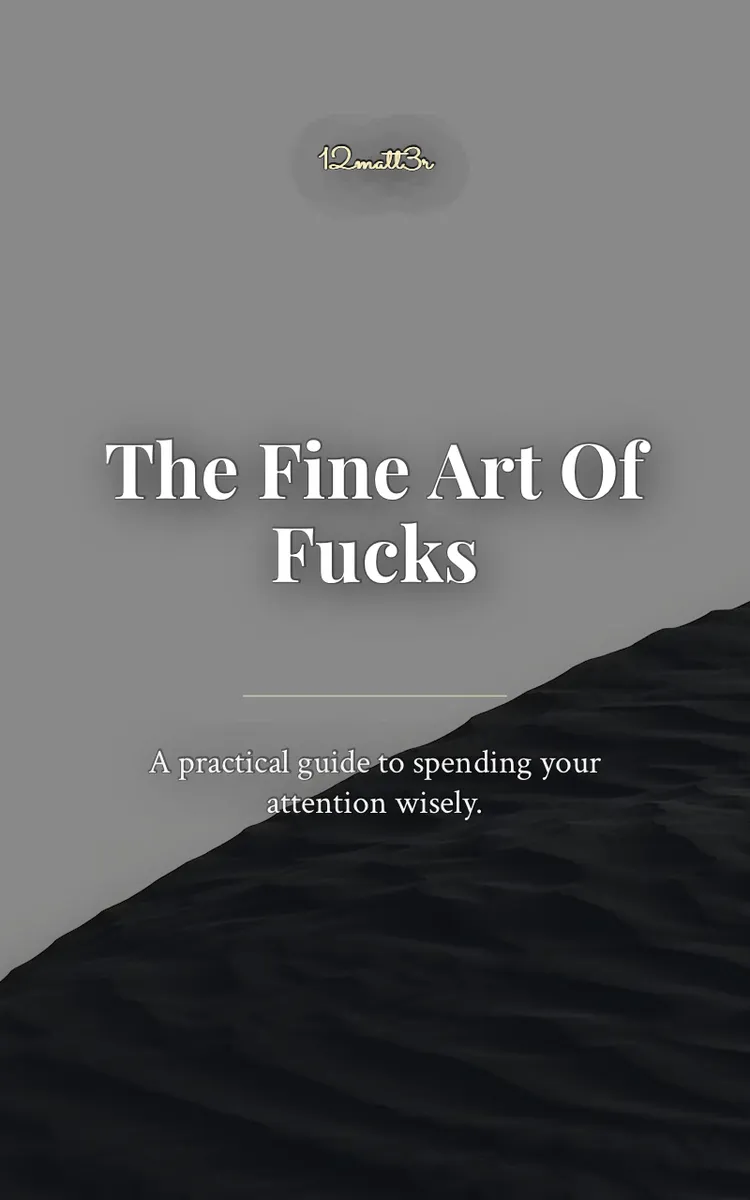
"The Fine Art Of Fucks" is a self-help book by 12matt3r with 8 chapters and approximately 12,137 words. Managing attention and priorities by choosing what matters..
This book was created using Inkfluence AI, an AI-powered book generation platform that helps authors write, design, and publish complete books. It was made with the AI Self-Help Book Writer.
Frequently Asked Questions
What is "The Fine Art Of Fucks" about?
Managing attention and priorities by choosing what matters.
How many chapters are in "The Fine Art Of Fucks"?
The book contains 8 chapters and approximately 12,137 words. Topics covered include Stop Confusing Indifference With Strength, Pick Your Fuckworthy Cause First, Spend Fucks Like a Limited Budget, Choose Maturity: Give Fewer, Better Fucks, and more.
Who wrote "The Fine Art Of Fucks"?
This book was written by 12matt3r and created using Inkfluence AI, an AI book generation platform that helps authors write, design, and publish books.
How can I create a similar self-help book?
You can create your own self-help book using Inkfluence AI. Describe your idea, choose your style, and the AI writes the full book for you. It's free to start.
Write your own self-help book with AI
Describe your idea and Inkfluence writes the whole thing. Free to start.
Start writingCreated with Inkfluence AI


