
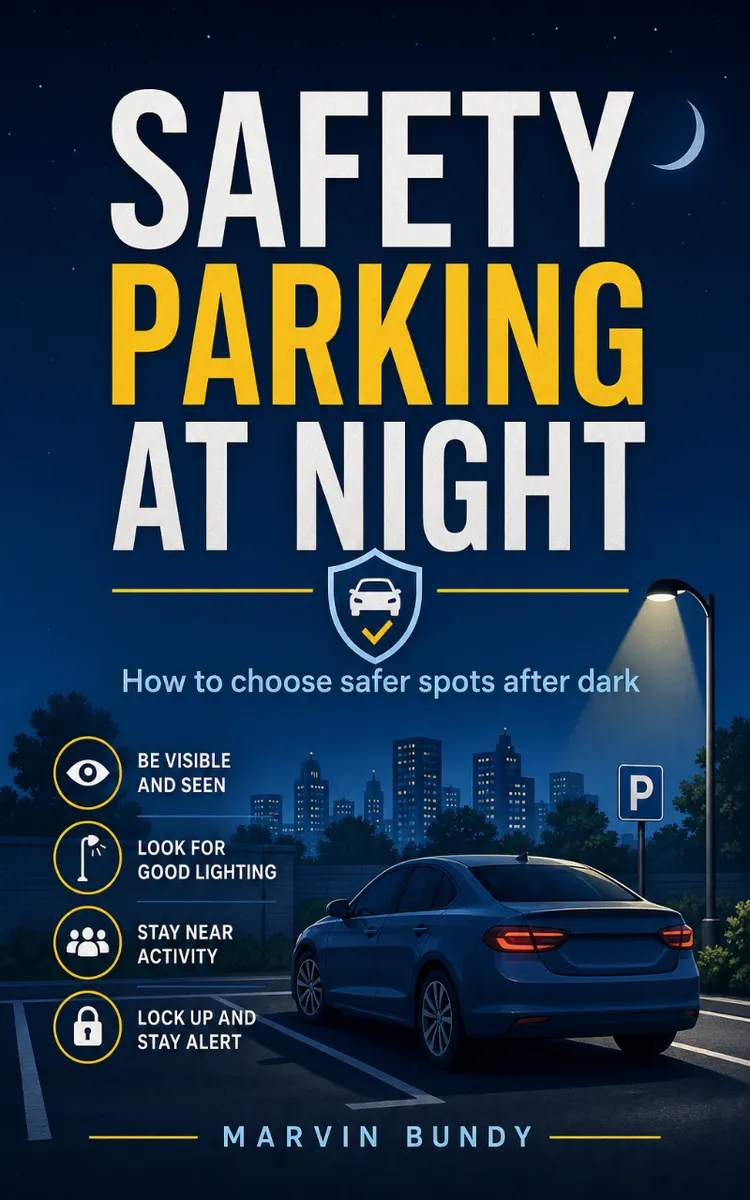
Choosing safer parking locations and routines at night
Table of Contents
- 1. Reading Light, Activity, Visibility
- 2. Matching Spots to Your Stop
- 3. Using Foot Traffic Without Loitering
- 4. Choosing Lighting That Eliminates Shadows
- 5. Technology Prep With Offline Backups
- 6. Avoiding Hidden, Isolated Parking Traps
- 7. Parking Where Rules Are Clear
- 8. Late-Night Parking Routine and Return
Preview: Reading Light, Activity, Visibility
A short excerpt from “Reading Light, Activity, Visibility”. The full book contains 8 chapters and 13,120 words.
sightline: Why Light, Activity, and Visibility MatterCould you see a person standing beside your car before you pulled into the space? Could someone across the street see you if you needed help? Those two questions quickly separate a safer parking area from a merely convenient one.
At night, darkness hides details that daylight gives you for free. A space may look open on a map but sit behind a closed building, under a broken lamp, or beside a wall that blocks your view. Brightness, nearby movement, and clear sight lines give you more information before you step out. They also make your car and your actions easier for ordinary people to notice.
The goal is not to find a perfect space. The goal is to compare nearby choices and select the one that gives you the clearest view and the best chance of being seen. After using the L.A.V. Scan-
Light Activity Visibility-you should be able to inspect a street, lot, or garage entrance in seconds, reject poor choices early, and choose a parking area that supports a safer walk to your destination.
When you arrive in an unfamiliar town, slow down before you commit. Keep the engine running while you inspect the surroundings. Look beyond the empty space itself. Check what the headlights reveal, what nearby businesses are doing, and whether walls, parked vans, trees, or corners block your view. A space farther from the entrance may work better if it sits under steady lighting and faces an active business.
Ask yourself one practical question: “If something unusual happened here, who would notice?” A bright restaurant frontage, a hotel entrance, or a gas station may provide more useful visibility than a dark lot with several empty spaces. Normal activity does not guarantee safety, but it gives you more eyes, more light, and more chances to get assistance.
Use the L.A.V. scan before you park.The L.A.V. Scan gives you three checks in a fixed order. Use it while driving slowly past a possible space, not after you have already switched off the engine.
Light: Check whether steady lighting reaches the parking space, the path to the entrance, and the area around your vehicle. Light helps you see people, doors, glass, curbs, and obstacles before you open the car. Prefer working streetlights, open storefront lighting, hotel entrances, and well-lit fuel stations. Do not count a single bright sign if the space itself remains dark.
Activity: Look for normal nearby movement, such as customers entering a restaurant, hotel staff working at a desk, people using a transit stop, or vehicles arriving and leaving in an orderly way. Activity matters because people nearby can notice unusual behavior and provide help. Choose normal movement over a crowd that appears angry, intoxicated, or out of control.
Visibility: Check your sight lines, meaning the areas you can see clearly from the driver’s seat and while walking to the entrance. Look for open views across the lot, visible doors, clear corners, and an exit route that does not force you between tall vehicles or behind buildings. Visibility works both ways: you want to see around you, and you want others to see you.
Run the three checks together. A brightly lit space beside a closed warehouse may still leave you isolated. A busy street with poor lighting may hide a person in a doorway. A clear lot with no nearby activity may leave you without help. The strongest choice usually combines all three conditions.
Use your headlights as a temporary inspection tool, but do not treat them as the area’s lighting. Stop where you can see the pavement, nearby vehicles, the walking route, and the entrance. If your view changes after you turn the wheel or pull beside a large van, inspect again. A space can lose visibility within a few feet.
Renee, 34, works a night shift at a hospital and arrives in unfamiliar towns when many businesses have closed. She compares a dark side-street space near her destination with a brighter space beside a hotel lobby two minutes away. The hotel space has steady entrance lighting, a visible front desk, and a clear sidewalk. Even if Renee walks a little farther, the L.A.V. Scan favors the hotel area because it gives her light, normal activity, and an unobstructed view.
As a quick check, point out the exact light source, the nearest normal activity, and the longest clear sight line. If you cannot name all three, keep looking.
Apply the scan at the curb and in the lot.Renee reaches a town at 10:40 p.m. and needs to stop for a short rest before continuing to the hospital. Her destination sits near restaurants, a small hotel, and a public garage. She uses the L.A.V. Scan rather than taking the first empty space.
Pass the first side street at low speed. Renee sees one working lamp at the entrance, but the rest of the street falls dark behind parked delivery vans. She cannot see the building doors or the sidewalk beyond the vans. She keeps driving.
...
About this book
"Safety Parking At Night" is a how-to guide book by Marvin Bundy with 8 chapters and approximately 13,120 words. Choosing safer parking locations and routines at night.
This book was created using Inkfluence AI, an AI-powered book generation platform that helps authors write, design, and publish complete books. It was made with the AI Ebook Generator.
Frequently Asked Questions
What is "Safety Parking At Night" about?
Choosing safer parking locations and routines at night
How many chapters are in "Safety Parking At Night"?
The book contains 8 chapters and approximately 13,120 words. Topics covered include Reading Light, Activity, Visibility, Matching Spots to Your Stop, Using Foot Traffic Without Loitering, Choosing Lighting That Eliminates Shadows, and more.
Who wrote "Safety Parking At Night"?
This book was written by Marvin Bundy and created using Inkfluence AI, an AI book generation platform that helps authors write, design, and publish books.
How can I create a similar how-to guide book?
You can create your own how-to guide book using Inkfluence AI. Describe your idea, choose your style, and the AI writes the full book for you. It's free to start.
Write your own how-to guide book with AI
Describe your idea and Inkfluence writes the whole thing. Free to start.
Start writingCreated with Inkfluence AI


